Problems
Filters
42 problems found
1996 Paper 2 Q2
Consider the system of equations \begin{alignat*}{1} 2yz+zx-5xy & =2\\ yz-zx+2xy & =1\\ yz-2zx+6xy & =3 \end{alignat*} Show that \[xyz=\pm 6\] and find the possible values of \(x\), \(y\) and \(z\).
Solution: Consider the linear \(3\times 3\) system in \(yz, zx, xy\), then \begin{align*} \left(\begin{array}{ccc|c} 2 & 1 & -5 & 2 \\ 1 & -1 & 2 & 1 \\ 1 & -2 & 6 & 3 \\ \end{array}\right) \\ \left(\begin{array}{ccc|c} 1 & -1 & 2 & 1 \\ 1 & -2 & 6 & 3 \\ 2 & 1 & -5 & 2 \\ \end{array}\right) \\ \left(\begin{array}{ccc|c} 1 & -1 & 2 & 1 \\ 0 & -1 & 4 & 2 \\ 0 & 3 & -9 & 0 \\ \end{array}\right) \\ \left(\begin{array}{ccc|c} 1 & -1 & 2 & 1 \\ 0 & -1 & 4 & 2 \\ 0 & 0 & 3 & 6 \\ \end{array}\right) \\ \end{align*} Therefore \(yz = 2, zx = 6, xy = 3 \Rightarrow (xyz)^2 = 36 \Rightarrow xyz = \pm 6\). If \(xyz = 6, x = 3, y = 1, z = 2\), if \(xyz = -6, x = -3, y = -1, z = -2\)
1996 Paper 2 Q3
The Fibonacci numbers \(F_{n}\) are defined by the conditions \(F_{0}=0\), \(F_{1}=1\) and \[F_{n+1}=F_{n}+F_{n-1}\] for all \(n\geqslant 1\). Show that \(F_{2}=1\), \(F_{3}=2\), \(F_{4}=3\) and compute \(F_{5}\), \(F_{6}\) and~\(F_{7}\). Compute \(F_{n+1}F_{n-1}-F_{n}^{2}\) for a few values of \(n\); guess a general formula and prove it by induction, or otherwise. By induction on \(k\), or otherwise, show that \[F_{n+k}=F_{k}F_{n+1}+F_{k-1}F_{n}\] for all positive integers \(n\) and \(k\).
1996 Paper 2 Q4
Show that \(\cos 4u=8\cos^{4}u-8\cos^{2}u+1\). If \[ I=\int_{-1}^{1} \frac{1}{\vphantom{{\big(}^2}\; \surd(1+x)+\surd(1-x)+2\; }\;{\rm d}x ,\] show, by using the change of variable \(x=\cos t\), that \[ I= \int_0^\pi \frac{\sin t}{4\cos^{2}\left(\frac{t}{4}-\frac{\pi}{8}\right)}\,{\rm d}t.\] By using the further change of variable \(u=\frac{t}{4}-\frac{\pi}{8}\), or otherwise, show that \[I=4\surd{2}-\pi-2.\] \noindent[You may assume that \(\tan\frac{\pi}{8}=\surd{2}-1\).]
Solution: \begin{align*} && \cos 4u &= 2\cos^2 2u - 1 \\ &&&= 2 (2\cos^2 u - 1)^2 - 1 \\ &&&= 2(4\cos^4u - 4\cos^2 u + 1) - 1\\ &&&= 8\cos^4u - 8\cos^2 u + 1 \end{align*} \begin{align*} && I &= \int_{-1}^1 \frac{1}{\sqrt{1+x}+\sqrt{1-x}+2} \d x \\ x = \cos t, \d x = - \sin t \d t: &&&= \int_{t = \pi}^{t=0} \frac{1}{\sqrt{1+\cos t} + \sqrt{1-\cos t} + 2} (- \sin t ) \d t \\ &&&= \int_0^\pi \frac{\sin t}{\sqrt{2 \cos^2 \frac{t}{2}}+\sqrt{2 \sin^2 \frac{t}{2}}+2} \d t \\ &&&= \int_0^\pi \frac{\sin t}{\sqrt{2}(\cos \frac{t}{2} + \sin \frac{t}{2}) + 2} \d t \\ &&&= \int_0^\pi \frac{\sin t}{\sqrt{2}(\sqrt{2} \cos (\frac{t}{2}-\frac{\pi}{4})) + 2} \d t \\ &&&= \int_0^\pi \frac{\sin t}{2(1+\cos (\frac{t}{2}-\frac{\pi}{4}))} \d t \\ &&&= \int_0^\pi \frac{\sin t}{4\cos^2(\frac{t}{4}-\frac{\pi}{8})} \d t \\ \\ u = \tfrac{t}{4} -\tfrac{\pi}{8}, \d u = \tfrac14 \d t:&&&=\int_{-\frac{\pi}{8}}^{\frac{\pi}{8}} \frac{\sin (4u+\frac{\pi}{2})}{4 \cos^2 u} 4 \d u \\ &&&= \int_{-\frac{\pi}{8}}^{\frac{\pi}{8}} \frac{\cos4u}{\cos^2 u} \d u \\ &&&= \int_{-\frac{\pi}{8}}^{\frac{\pi}{8}} 4 (2 \cos^2 u-1)-4 + \sec^2 u \d u \\ &&&= \int_{-\frac{\pi}{8}}^{\frac{\pi}{8}} 4 \cos 2u-4 + \sec^2 u \d u \\ &&&= \left [2\sin 2u - 4u + \tan u \right]_{-\pi/8}^{\pi/8} \\ &&&= 4 \sin \frac{\pi}{4} - \pi+ 2\tan \frac{\pi}{8} \\ &&&= \frac{4}{\sqrt{2}} - \pi + 2\sqrt{2}-2 \\ &&&= 4\sqrt{2} - \pi - 2 \end{align*}
1996 Paper 2 Q5
If $$ z^{4}+z^{3}+z^{2}+z+1=0\tag{*} $$ and \(u=z+z^{-1}\), find the possible values of \(u\). Hence find the possible values of \(z\). [Do not try to simplify your answers.] Show that, if \(z\) satisfies \((*)\), then \[z^{5}-1=0.\] Hence write the solutions of \((*)\) in the form \(z=r(\cos\theta+i\sin\theta)\) for suitable real \(r\) and \(\theta\). Deduce that \[\sin\frac{2\pi}{5}=\frac{\surd(10+2\surd 5)}{4} \ \ \hbox{and}\ \ \cos\frac{2\pi}{5}=\frac{-1+\surd 5}{4}.\]
Solution: \begin{align*} && 0 &= z^4+z^3+z^2+z+1 \\ \Rightarrow && 0 &= z^2+z+1+z^{-1}+z^{-2} \tag{\(z \neq 0\)} \\ &&&= \left ( z+z^{-1} \right)^2-2 + z+z^{-1} + 1 \\ &&&= u^2+u-1 \\ \Rightarrow && u &= \frac{-1 \pm \sqrt{5}}{2} \\ \Rightarrow && z+z^{-1} &= \frac{-1 \pm \sqrt{5}}{2} \\ \Rightarrow && 0 &= z^2-\left ( \frac{-1 \pm \sqrt{5}}{2}\right)z+1 \\ \Rightarrow && z &= \frac{\left ( \frac{-1 \pm \sqrt{5}}{2}\right) \pm \sqrt{\left ( \frac{-1 \pm \sqrt{5}}{2}\right)^2-4}}{2} \\ &&&= \frac{\left ( \frac{-1 \pm \sqrt{5}}{2}\right) \pm \sqrt{\frac{1+5\mp2\sqrt{5}-16}{4}}}{2} \\ &&&= \frac{\left ( \frac{-1 \pm \sqrt{5}}{2}\right) \pm \sqrt{\frac{-10\mp2\sqrt{5}-16}{4}}}{2} \\ &&&= \frac{-1\pm\sqrt{5}}{4} \pm i\frac{\sqrt{10\pm 2\sqrt{5}}}{4} \end{align*} Since \(z^4+z^3+z^2+z+1 = 0\) we can multiply both sides by \(z-1\) to obtain \(z^5-1 = 0\). Therefore if \(z = r(\cos \theta + i \sin \theta)\) we see that \(z^5 = 1 \Rightarrow r^5 (\cos 5 \theta + i \sin 5 \theta) = 1 \Rightarrow r = 1, 5 \theta = 2n \pi\) ie \(z = \cos \frac{2n\pi}{5} + i\sin \frac{2n \pi}{5}\). We are looking for a solution in the first quadrant, therefore \(\cos \frac{2\pi}{5} = \frac{-1 + \sqrt{5}}4\) and \(\sin \frac{2\pi}{5} = \frac{\sqrt{10+2\sqrt{5}}}{4}\)
1996 Paper 2 Q6
A proper factor of a positive integer \(N\) is an integer \(M\), with \(M\ne 1\) and \(M\ne N\), which divides \(N\) without remainder. Show that \(12\) has \(4\) proper factors and \(16\) has \(3\). Suppose that \(N\) has the prime factorisation \[N=p_{1}^{m_{1}}p_{2}^{m_{2}}\dots p_{r}^{m_{r}},\] where \(p_{1}, p_{2}, \dots, p_{r}\) are distinct primes and \(m_{1}, m_{2}, \dots, m_{r}\) are positive integers. How many proper factors does \(N\) have and why? Find:
- the smallest positive integer which has precisely 12 proper factors;
- the smallest positive integer which has at least 12 proper factors.
Solution: \(12\) has factors \(1,2,3,4,6,12\) of which \(4\) are neither \(1\) nor \(12\). \(16\) has factors \(1,2,4,8,16\) of which \(3\) are neither \(1\) nor \(16\). If \(N = p_1^{m_1} \cdots p_r^{m_r}\) then \(N\) has \((m_1+1)\cdots(m_r+1)\) factors since we can have between \(0 \leq k \leq m_i\) of the \(i\)th prime factor, whcih is \(m_i+1\) possibilities. We then need to subtract two for the proper factors, ie \((m_1+1)\cdots(m_r+1) - 2\).
- We need \((m_1 + 1) \cdots (m_r + 1) - 2 = 12\) ie \((m_1+1) \cdots (m_r +1) = 14\). Since \(14 = 2 \times 7\) we should have two prime factors, ie of the form \(p_1^6p_2^1\). The smallest number of this form is \(2^6 \cdot 3 = 192\)
- We wish to make \((m_1+1)\cdots(m_r+1) \geq 14\) with \(2^{m_1} \cdot 3^{m_2} \cdots p_r^{m_r}\) as small as possible and \(m_1 \geq m_2 \geq \cdots \geq m_r\). With \(1\) prime, the best we can do is \(2^{13}\). With \(2\) primes the best we can do is \(2^p \cdot 3^q\) with \((p+1)(q+1) \geq 14\). \begin{array}{c|c} q & p & N \\ \hline 0 & 13 & 2^{13} \\ 1 & 6 & 2^6 \cdot 3^1 \\ 2 & 5 & 2^5 \cdot 3^2 \\ 3 & 3.& 2^3 \cdot 3^3 \end{array} So the best here is \(2^6 \cdot 3\) With \(3\) primes, the best we can do is \(2^p 3^q 5^r\) with \(p \geq q \geq r\) and \((p+1)(q+1)(r+1) \geq 14\) \begin{array}{c|c|c|c} r & q & p & N \\ \hline 1 & 1 & 3 & 2^3 \cdot 3 \cdot 5 \\ 1 & 2 & 2& 2^2 \cdot 3^2 \cdot 5 \\ 2 & 2& 2 & 2^2 \cdot 3^2 \cdot 5^2 \end{array} With four primes we can achieve it immediately with \(2\cdot3\cdot5\cdot 7\) and more primes clearly wont help, so our best options is \(120\)
1996 Paper 2 Q7
Consider a fixed square \(ABCD\) and a variable point \(P\) in the plane of the square. We write the perpendicular distance from \(P\) to \(AB\) as \(p\), from \(P\) to \(BC\) as \(q\), from \(P\) to \(CD\) as \(r\) and from \(P\) to \(DA\) as \(s\). (Remember that distance is never negative, so \(p,q,r,s\geqslant 0\).) If \(pr=qs\), show that the only possible positions of \(P\) lie on two straight lines and a circle and that every point on these two lines and a circle is indeed a possible position of \(P\).
1996 Paper 2 Q8
Suppose that \[{\rm f}''(x)+{\rm f}(-x)=x+3\cos 2x\] and \({\rm f}(0)=1\), \({\rm f}'(0)=-1\). If \({\rm g}(x)={\rm f}(x)+{\rm f}(-x)\), find \({\rm g}(0)\) and show that \({\rm g}'(0)=0\). Show that \[{\rm g}''(x)+{\rm g}(x)=6\cos 2x,\] and hence find \({\rm g}(x)\). Similarly, if \({\rm h}(x)={\rm f}(x)-{\rm f}(-x)\), find \({\rm h}(x)\) and show that \[{\rm f}(x)=2\cos x -\cos2x-x.\]
Solution: \begin{align*} && g(0) &= f(0)+f(-0) = 2f(0) = 2 \\ && g'(x) &= f'(x) - f'(-x) \\ && g'(0) &= f'(0) - f'(-0) = 0 \\ && g''(x) &= f''(x) +f''(-x) \\ \Rightarrow && g''(x) + g(x) &= f''(x) +f''(-x) + f(x) + f(-x) \\ &&&= f''(x)+ f(-x) +f''(-x) + f(x) \\ &&&= x + 3 \cos 2x + (-x + 3 \cos (-2x) ) \\ &&&= 6 \cos 2x \\ \end{align*} Considering the homogeneous part, we should expected a solution of the form \(g(x) = A \sin x + B \cos x\). Seeking an integrating factor of the form \(g(x) = C \cos 2x\) we see that \(-4C \cos 2x + C \cos 2x = 6 \cos 2x \Rightarrow -3C = 6 \Rightarrow C = -2\). Therefore the general solution is \begin{align*} && g(x) &= A\sin x + B \cos x - 2\cos 2x \\ && g(0) &= B - 2 = 2\\ && g'(0) &= A = 0 \\ \Rightarrow && g(x) &= 4\cos x - 2\cos 2x \\ \end{align*} \begin{align*} && h(0) &= f(0) - f(-0) = 0 \\ && h'(x) &= f'(x) + f'(-x) \\ && h'(0) &= f'(0) + f'(-0) = -2 \\ && h''(x) &= f''(x) - f''(-x) \\ \Rightarrow && h''(x) - h(x) &= f''(x) - f''(-x) -( f(x) - f(-x)) \\ &&&= f''(x) +f(-x)- (f''(-x) + f(x)) \\ &&&= x + 3\cos 2x - (-x + 3 \cos(-2x)) \\ &&&= 2x \end{align*} Considering the homogeneous part, we should expect a solution of the form \(Ae^x + Be^{-x}\). For a specific integral, we can take \(-2x\), ie \begin{align*} && h(x) &= Ae^x + Be^{-x} - 2x \\ && h(0) &= A+B =0 \\ && h'(0) &= A-B-2 =-2 \\ \Rightarrow && A &=B = 0 \\ \Rightarrow && h(x) &= -2x \end{align*} Therefore \(f(x) = \frac12(f(x) + f(-x)) + \frac12(f(x) -f(-x)) = 2\cos x - \cos 2x -x\)
1996 Paper 2 Q9
A child's toy consists of a solid cone of height \(\lambda a\) and a solid hemisphere of radius \(a\), made out of the same uniform material and fastened together so that their plane faces coincide. (Thus the diameter of the hemisphere is equal to that of the base of the cone.) Show that if \(\lambda < \sqrt{3}\) the toy will always move to an upright position if placed with the surface of the hemisphere on a horizontal table, but that if \(\lambda > \sqrt{3}\) the toy may overbalance. Show, however, that if the toy is placed with the surface of the cone touching the table it will remain there whatever the value of \(\lambda\). [The centre of gravity of a uniform solid cone of height \(h\) is a height \(h/4\) above its base. The centre of gravity of a uniform solid hemisphere of radius \(a\) is at distance \(3a/8\) from the centre of its base.]
Solution:


1996 Paper 2 Q10
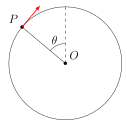
The plot of `Rhode Island Red and the Henhouse of Doom' calls for the heroine to cling on to the circumference of a fairground wheel of radius \(a\) rotating with constant angular velocity \(\omega\) about its horizontal axis and then let go. Let \(\omega_{0}\) be the largest value of \(\omega\) for which it is not possible for her subsequent path to carry her higher than the top of the wheel. Find \(\omega_{0}\) in terms of \(a\) and \(g\). If \(\omega>\omega_{0}\) show that the greatest height above the top of the wheel to which she can rise is \[\frac{a}{2}\left(\frac{\omega}{\omega_{0}} -\frac{\omega_{0}}{\omega}\right)^{\!\!2}.\]
Solution:
1996 Paper 2 Q11
A particle hangs in equilibrium from the ceiling of a stationary lift, to which it is attached by an elastic string of natural length \(l\) extended to a length \(l+a\). The lift now descends with constant acceleration \(f\) such that \(0 < f < g/2\). Show that the extension \(y\) of the string from its equilibrium length satisfies the differential equation $$ {{\rm d}^2 y \over {\rm d} t^2} +{g \over a}\, y = g-f. $$ Hence show that the string never becomes slack and the amplitude of the oscillation of the particle is \(af/g\). After a time \(T\) the lift stops accelerating and moves with constant velocity. Show that the string never becomes slack and the amplitude of the oscillation is now \[\frac{2af}{g}|\sin {\textstyle \frac{1}{2}}\omega T|,\] where \(\omega^{2}=g/a\).
1996 Paper 2 Q12
- Let \(X_{1}, X_{2}, \dots, X_{n}\) be independent random variables each of which is uniformly distributed on \([0,1]\). Let \(Y\) be the largest of \(X_{1}, X_{2}, \dots, X_{n}\). By using the fact that \(Y<\lambda\) if and only if \(X_{j}<\lambda\) for \(1\leqslant j\leqslant n\), find the probability density function of \(Y\). Show that the variance of \(Y\) is \[\frac{n}{(n+2)(n+1)^{2}}.\]
- The probability that a neon light switched on at time \(0\) will have failed by a time \(t>0\) is \(1-\mathrm{e}^{-t/\lambda}\) where \(\lambda>0\). I switch on \(n\) independent neon lights at time zero. Show that the expected time until the first failure is \(\lambda/n\).
Solution:
- \(\,\) \begin{align*} && F_Y(\lambda) &= \mathbb{P}(Y < \lambda) \\ &&&= \prod_i \mathbb{P}(X_i < \lambda) \\ &&&= \lambda^n \\ \Rightarrow && f_Y(\lambda) &= \begin{cases} n \lambda^{n-1} & \text{if } 0 \leq \lambda \leq 1 \\ 0 & \text{otherwise} \end{cases} \\ \\ && \E[Y] &= \int_0^1 \lambda f_Y(\lambda) \d \lambda \\ &&&= \int_0^1 n \lambda^n \d \lambda \\ &&&= \frac{n}{n+1} \\ && \E[Y^2] &= \int_0^1 \lambda^2 f_Y(\lambda) \d \lambda \\ &&&= \int_0^1 n \lambda^{n+1} \d \lambda \\ &&&= \frac{n}{n+2} \\ \Rightarrow && \var[Y] &= \E[Y^2]-(\E[Y])^2 \\ &&&= \frac{n}{n+2} - \frac{n^2}{(n+1)^2} \\ &&&= \frac{(n+1)^2n-n^2(n+2)}{(n+2)(n+1)^2} \\ &&&= \frac{n[(n^2+2n+1)-(n^2+2n)]}{(n+2)(n+1)^2} \\ &&&= \frac{n}{(n+2)(n+1)^2} \end{align*}
- Using the same reasoning, we can see that \begin{align*} && 1-F_Z(t) &= \mathbb{P}(\text{all lights still on after t}) \\ &&&= \prod_i e^{-t/\lambda} \\ &&&= e^{-nt/\lambda} \\ \\ \Rightarrow && F_Z(t) &= 1-e^{-nt/\lambda} \end{align*} Therefore \(Z \sim Exp(\frac{n}{\lambda})\) and the time to first failure is \(\lambda/n\)
1996 Paper 2 Q13
By considering the coefficients of \(t^{n}\) in the equation \[(1+t)^{n}(1+t)^{n}=(1+t)^{2n},\] or otherwise, show that \[\binom{n}{0}\binom{n}{n}+\binom{n}{1}\binom{n}{n-1}+\cdots +\binom{n}{r}\binom{n}{n-r}+\cdots+\binom{n}{n}\binom{n}{0} =\binom{2n}{n}.\] The large American city of Triposville is laid out in a square grid with equally spaced streets running east-west and avenues running north-south. My friend is staying at a hotel \(n\) avenues west and \(n\) streets north of my hotel. Both hotels are at intersections. We set out from our own hotels at the same time. We walk at the same speed, taking 1 minute to go from one intersection to the next. Every time I reach an intersection I go north with probability \(1/2\) or west with probability \(1/2\). Every time my friend reaches an intersection she goes south with probability \(1/2\) or east with probability \(1/2\). Our choices are independent of each other and of our previous decisions. Indicate by a sketch or by a brief description the set of points where we could meet. Find the probability that we meet. Suppose that I oversleep and leave my hotel \(2k\) minutes later than my friend leaves hers, where \(k\) is an integer and \(0\leqslant 2k\leqslant n\). Find the probability that we meet. Have you any comment? If \(n=1\) and I leave my hotel \(1\) minute later than my friend leaves hers, what is the probability that we meet and why?
Solution: \begin{align*} && (1+t)^{n}(1+t)^{n}&=(1+t)^{2n} \\ [t^n]: &&\sum_{k=0}^n \underbrace{\binom{n}{k}}_{t^k\text{ from left bracket}} \underbrace{\binom{n}{n-k}}_{t^{n-k}\text{ from right bracket}} &= \binom{2n}{n} \end{align*}

1996 Paper 2 Q14
The random variable \(X\) is uniformly distributed on \([0,1]\). A new random variable \(Y\) is defined by the rule \[ Y=\begin{cases} 1/4 & \mbox{ if }X\leqslant1/4,\\ X & \mbox{ if }1/4\leqslant X\leqslant3/4\\ 3/4 & \mbox{ if }X\geqslant3/4. \end{cases} \] Find \({\mathrm E}(Y^{n})\) for all integers \(n\geqslant 1\). Show that \({\mathrm E}(Y)={\mathrm E}(X)\) and that \[{\mathrm E}(X^{2})-{\mathrm E}(Y^{2})=\frac{1}{24}.\] By using the fact that \(4^{n}=(3+1)^{n}\), or otherwise, show that \({\mathrm E}(X^{n}) > {\mathrm E}(Y^{n})\) for \(n\geqslant 2\). Suppose that \(Y_{1}\), \(Y_{2}\), \dots are independent random variables each having the same distribution as \(Y\). Find, to a good approximation, \(K\) such that \[{\rm P}(Y_{1}+Y_{2}+\cdots+Y_{240000} < K)=3/4.\]
Solution: \begin{align*} && \E[Y^n] &= \frac14 \cdot \frac1{4^n} + \frac14 \cdot \frac{3^n}{4^n} + \frac12 \int_{1/4}^{3/4}2 y^n \d y \\ &&&= \frac{3^n+1}{4^{n+1}} + \left [ \frac{y^{n+1}}{n+1} \right]_{1/4}^{3/4} \\ &&&= \frac{3^n+1}{4^{n+1}} + \frac{3^{n+1}-1}{(n+1)4^{n+1}} \end{align*} \begin{align*} && \E[Y] &= \frac{3+1}{16} + \frac{9-1}{2 \cdot 16} \\ &&&= \frac{1}{4} + \frac{1}{4} = \frac12 = \E[X] \end{align*} \begin{align*} && \E[X^2] &= \int_0^1 x^2 \d x = \frac13 \\ && \E[Y^2] &= \frac{9+1}{64} + \frac{27-1}{3 \cdot 64} = \frac{56}{3 \cdot 64} = \frac{7}{24} \\ \Rightarrow && \E[X^2] - \E[Y^2] &= \frac13 - \frac{7}{24} = \frac{1}{24} \end{align*} \begin{align*} && \E[X^n] &= \frac{1}{n+1} \\ && \E[Y^n] &= \frac{1}{n+1} \frac{1}{4^{n+1}}\left ( (n+1)(3^n+1)+3^{n+1}-1 \right) \\ &&&= \frac{1}{n+1} \frac{1}{4^{n+1}}\left ( 3^{n+1} + (n+1)3^n +n \right) \\ \\ && (3+1)^{n+1} &= 3^{n+1} + (n+1)3^n + \cdots + (n+1) \cdot 3 + 1 \\ &&&> 3^{n+1} + (n+1)3^n + n + 1 \end{align*} if \(n \geq 2\) Notice that by the central limit theorem: \begin{align*} &&\frac{1}{240\,000} \sum_{i=1}^{240\,000} Y_i &\sim N \left ( \frac12, \frac{1}{24 \cdot 240\,000}\right) \\ \Rightarrow && \mathbb{P}\left (\frac{\frac{1}{240\,000} \sum_{i=1}^{240\,000} Y_i - \frac12}{\frac1{24} \frac{1}{100}} \leq \frac23 \right) &\approx 0.75 \\ \Rightarrow && \mathbb{P} \left ( \sum_i Y_i \leq 240\,000 \cdot \left ( \frac2{3} \frac1{2400}+\frac12 \right) \right ) & \approx 0.75 \\ \Rightarrow && K &= 120\,000 + 66 \\ &&&\approx 120\,066 \end{align*}
1996 Paper 3 Q1
Define \(\cosh x\) and \(\sinh x\) in terms of exponentials and prove, from your definitions, that \[ \cosh^{4}x-\sinh^{4}x=\cosh2x \] and \[ \cosh^{4}x+\sinh^{4}x=\tfrac{1}{4}\cosh4x+\tfrac{3}{4}. \] Find \(a_{0},a_{1},\ldots,a_{n}\) in terms of \(n\) such that \[ \cosh^{n}x=a_{0}+a_{1}\cosh x+a_{2}\cosh2x+\cdots+a_{n}\cosh nx. \] Hence, or otherwise, find expressions for \(\cosh^{2m}x-\sinh^{2m}x\) and \(\cosh^{2m}x+\sinh^{2m}x,\) in terms of \(\cosh kx,\) where \(k=0,\ldots,2m.\)
Solution: \begin{align*} \cosh x &= \frac12 (e^x + e^{-x}) \\ \sinh x &= \frac12 (e^x - e^{-x}) \\ \end{align*} \begin{align*} \cosh^4x -\sinh^4 x &= (\cosh^2x -\sinh^2 x)(\cosh^2x +\sinh^2 x) \\ &= \left ( \frac14 \left (e^{2x}+2+e^{-2x} \right)- \frac14 \left (e^{2x}-2+e^{-2x} \right) \right)(\cosh^2x +\sinh^2 x) \\ &= (\cosh^2x +\sinh^2 x) \\ &= \left ( \frac14 \left (e^{2x}+2+e^{-2x} \right)+ \frac14 \left (e^{2x}-2+e^{-2x} \right) \right) \\ &= \frac{1}{4} \left (2e^{2x}+2e^{-2x} \right) \\ &= \frac12 \left ( e^{2x}+e^{-2x} \right) \\ &= \cosh 2x \\ \\ \cosh^4x +\sinh^4 x &= \frac1{2^4}\left (e^{4x}+4e^{2x}+6+4e^{-2x}+e^{-4x} \right)+\frac1{2^4}\left (e^{4x}-4e^{2x}+6-4e^{-2x}+e^{-4x} \right) \\ &= \frac18 (e^{4x}+e^{-4x}) + \frac{3}{4} \\ &= \frac14 \cosh 4x + \frac34 \end{align*} \begin{align*} \cosh^n x &=\frac{1}{2^n} \left ( e^{x}+e^{-x} \right)^n \\ &= \frac{1}{2^n} \sum_{k=0}^n \binom{n}{k} e^{kx}e^{-(n-k)x} \\ &= \frac{1}{2^n} \sum_{k=0}^n \binom{n}{k} e^{2kx-nx} \\ &= \frac{1}{2^n} \left ( \binom{n}{n} \left(e^{nx}+e^{-nx} \right) + \binom{n}{n-1}\left(e^{(n-2)x}+e^{-(n-2)x} \right) + \cdots + \binom{n}{n-k} \left( e^{(n-2k)x}+e^{-(n-2k)x} \right) + \cdots \right) \\ &= \frac{1}{2^{n-1}} \cosh nx + \frac{1}{2^{n-1}} \binom{n}{n-1} \cosh (n-2)x + \cdots + \frac{1}{2^{n-1}} \binom{n}{n-k} \cosh (n-2k)x + \cdots \end{align*} ie \begin{align*} \cosh^{2m} x &= \frac{1}{2^{2m-1}} \cosh 2m x + \frac{2m}{2^{2m-1}} \cosh(2(m-1)x) + \cdots + \frac{1}{2^{2m-1}}\binom{2m}{k} \cosh (2(m-k)x) +\cdots+ \frac{1}{2^{2m-1}} \binom{2m}{m} \\ \sinh^{2m} x &= \frac{1}{2^{2m-1}} \cosh 2m x - \frac{2m}{2^{2m-1}} \cosh(2(m-1)x) + \cdots + (-1)^{k}\frac{1}{2^{2m-1}}\binom{2m}{k} \cosh (2(m-k)x) +\cdots+ (-1)^m\frac{1}{2^{2m-1}} \binom{2m}{m} \\ \cosh^{2m} x -\sinh^{2m} x &= \frac{m}{2^{2m-3}} \cosh (2(m-1)x) + \cdots + \frac{1}{2^{2m-2}} \binom{2m}{2k+1}\cosh(2(m-2k-1)x) + \cdots\\ \cosh^{2m} x +\sinh^{2m} x &= \frac{1}{2^{2m-2}} \cosh (2mx) + \cdots + \frac{1}{2^{2m-2}} \binom{2m}{2k}\cosh(2(m-2k)x) + \cdots \end{align*}
1996 Paper 3 Q2
For all values of \(a\) and \(b,\) either solve the simultaneous equations \begin{alignat*}{1} x+y+az & =2\\ x+ay+z & =2\\ 2x+y+z & =2b \end{alignat*} or prove that they have no solution.
Solution: Consider the matrix system: \begin{align*} \left(\begin{array}{ccc|c} 1 & 1 & a & 2 \\ 1 & a & 1 & 2 \\ 2 & 1 & 1 & 2b \\ \end{array}\right) \\ \left(\begin{array}{ccc|c} 1 & 1 & a & 2 \\ 0 & a-1 & 1-a & 0 \\ 0 & -1 & 1-2a & 2b-4 \\ \end{array}\right)\\ \left(\begin{array}{ccc|c} 1 & 1 & a & 2 \\ 0 & a-1 & 1-a & 0 \\ 0 & 0 & -2a & 2b-4 \\ \end{array}\right) \\ \end{align*} Assuming that \(a \neq 1, 0\) all steps are fine and: \(z = \frac{2-b}{a}, y = \frac{2-b}{a}, x +(1+a)y = 2, x = 2 - \frac{(2-b)(1+a)}{a} = \frac{ab+b-2}{a}\) If \(a = 0\), \(y = z\) and \(\begin{cases} x + y &= 2 \\ 2x + 2y &= 2b \end{cases} \Rightarrow b= 2, x = t, y = 2-t, z = 2-t\) If \(a = 1\), \(x = 2b-2, y = t, z = 4-t-2b\), where \(t \in \mathbb{R}\)