Problems
Filters
22 problems found
1993 Paper 1 Q13
A train starts from a station. The tractive force exerted by the engine is at first constant and equal to \(F\). However, after the speed attains the value \(u\), the engine works at constant rate \(P,\) where \(P=Fu.\) The mass of the engine and the train together is \(M.\) Forces opposing motion may be neglected. Show that the engine will attain a speed \(v\), with \(v\geqslant u,\) after a time \[ t=\frac{M}{2P}\left(u^{2}+v^{2}\right). \] Show also that it will have travelled a distance \[ \frac{M}{6P}(2v^{3}+u^{3}) \] in this time.
Solution: While the force is constant, the train is accelerating at \(\frac{F}{M}\), and since \(u = \frac{F}{M} t_1 \Rightarrow t_1 = \frac{Mu^2}{Fu} = \frac{Mu^2}{P}\). Once the train is being driven at a constant rate, we can observe that change in energy will be power times time, ie \(Pt_2 = \frac{1}{2}M(v^2 - u^2) \Rightarrow t_2 = \frac{M}{2P} ( v^2 - u^2)\). Therefore the total time will be \(t_1 + t_2 = \frac{M}{2P} ( u^2 + v^2)\). During the first period, the distance will be: \(s_1 = \frac12 \frac{F}{M} t_1^2 = \frac12 \frac{F}{M} \frac{M^2u^2}{F^2} = \frac{Mu^3}{2P}\) In the second period, \(P = Fu\) and so \(\text{Force} = \frac{P}{v} \Rightarrow M v \frac{\d v}{\d x} = \frac{P}{v} \Rightarrow M \l \frac{v^3}{3} - \frac{u^3}{3}\r = Ps_2\) and therefore total distance will be: \(\frac{M}{6P}(2v^{3}+u^{3})\)
1993 Paper 2 Q11
In this question, take the value of \(g\) to be \(10\ \mathrm{ms^{-2}.\)} A body of mass \(m\) kg is dropped vertically into a deep pool of liquid. Once in the liquid, it is subject to gravity, an upward buoyancy force of \(\frac{6}{5}\) times its weight, and a resistive force of \(2mv^{2}\mathrm{N}\) opposite to its direction of travel when it is travelling at speed \(v\) \(\mathrm{ms}^{-1}.\) Show that the body stops sinking less than \(\frac{1}{4}\pi\) seconds after it enters the pool. Suppose now that the body enters the liquid with speed \(1\ \mathrm{ms}^{-1}.\) Show that the body descends to a depth of \(\frac{1}{4}\ln2\) metres and that it returns to the surface with speed \(\frac{1}{\sqrt{2}}\ \mathrm{ms}^{-1},\) at a time \[ \frac{\pi}{8}+\frac{1}{4}\ln\left(\frac{\sqrt{2}+1}{\sqrt{2}-1}\right) \] seconds after entering the pool.
Solution: While descending, the body experiences the force \(-\frac15mg - 2mv^2\). \begin{align*} \text{N2:} && m \dot{v} &= -\frac15 mg - 2mv^2 \\ \Rightarrow && \frac{\dot{v}}{\frac15g + 2v^2} &= -1 \\ \Rightarrow && \frac{1}{2}\tan^{-1} v_1 - \frac{1}{2}\tan^{-1} {v_0} &= -T \end{align*} We care about when \(v_1 = 0\), ie \(\displaystyle T = \frac{1}{2}\tan^{-1} {v_0} < \frac12 \frac{\pi}2 = \frac{\pi}4\) seconds. If the body enters at speed \(1\ \mathrm{ms}^{-1}.\) then for the first part of it's journey it will experience forces \(-\frac15mg - 2mv^2\) and so: \begin{align*} \text{N2:} && m v \frac{\d v}{\d x} &= -\frac15 mg - 2mv^2 \\ \Rightarrow && \int \frac{v}{2(1 + v^2)} \d v &= \int -1 \d x \\ \Rightarrow && \frac14 \ln (1 + v^2) &= -x \end{align*} Therefore the depth is \(\frac14 \ln 2\) metres. When the body is rising, it experiences forces of: \(\frac15mg - 2mv^2\) and so: \begin{align*} \text{N2:} && m v \frac{\d v}{\d x} &= \frac15mg - 2mv^2 \\ \Rightarrow && \int \frac{v}{2(1 - v^2)} \d v &= \int -1 \d x \\ \Rightarrow && -\frac14 \ln (1 - v^2) &= \frac14 \ln 2 \\ \Rightarrow && 1-v^2 &= \frac12 \\ \Rightarrow && v &= \frac{1}{\sqrt{2}} \ \mathrm{ms}^{-1} \end{align*} This will take \begin{align*} \text{N2:} && m \dot{v} &= \frac15mg - 2mv^2 \\ \Rightarrow && \frac{\dot{v}}{2(1-v^2)} &= -1 \\ \Rightarrow && \dot{v} \frac{1}{4}\l \frac{1}{1 - v} + \frac{1}{1+v} \r &= -1 \\ \Rightarrow && \frac{1}{4} \l -\ln(1 - v) + \ln(1 + v)\r &= -T \end{align*} Since \(v = \frac{1}{\sqrt{2}}\) \begin{align*} T &= \frac{1}{4} \ln \l \frac{1+ \frac1{\sqrt{2}}}{1 - \frac1{\sqrt{2}}}\r \\ &= \frac14 \ln \l \frac{\sqrt{2} + 1}{\sqrt{2}-1} \r \end{align*} and therefore the total time will be: \begin{align*} & \frac12 \tan^{-1} 1 + \frac14 \ln \l \frac{\sqrt{2} + 1}{\sqrt{2}-1} \r \\ =& \frac{\pi}{8} + \frac14 \ln \l \frac{\sqrt{2} + 1}{\sqrt{2}-1} \r \end{align*}
1992 Paper 1 Q13
A comet, which may be regarded as a particle of mass \(m\), moving in the sun's gravitational field, at a distance \(x\) from the sun, experiences a force \(Gm/x^{2}\) (where \(G\) is a constant) directly towards the sun. Show that if, at some time, \(x=h\) and the comet is travelling directly away from the sun with speed \(V\), then \(x\) cannot become arbitrarily large unless \(V^{2}\geqslant2G/h\). A comet is initially motionless at a great distance from the sun. If, at some later time, it is at a distance \(h\) from the sun, how long after that will it take to fall into the sun?
Solution: Consider \(E = \frac12 m \dot{x}^2 - \frac{Gm}{x}\), notice that \begin{align*} && \dot{E} &= m \dot{x} \ddot{x} + \frac{Gm}{x^2} \dot{x} \\ &&&= \dot{x} \underbrace{\left (m\ddot{x} + \frac{Gm}{x^2} \right)}_{=0 \text{ by N2}} \end{align*} Therefore \(E\) is conserved. Therefore if \(x \to \infty\) \(\frac12 m V^2 - \frac{Gm}{h} = \frac12 m u^2 - 0 \geq 0\) so \(V^2 \geqslant 2G/h\) Since \(E \approx 0\) we want to solve \begin{align*} && \dot{x} &= -\sqrt{\frac{2G}{x}} \\ \Rightarrow && -\int_h^0 \sqrt{x} \d x &= \int_0^T \sqrt{2G} \d t \\ \Rightarrow && \frac{2h^{3/2}}{3} &= \sqrt{2G}T \\ \Rightarrow && T &= \frac{\sqrt{2}h^{3/2}}{3\sqrt{G}} = \frac13 \sqrt{\frac{2h^3}{G}} \end{align*}
1991 Paper 2 Q14
The current in a straight river of constant width \(h\) flows at uniform speed \(\alpha v\) parallel to the river banks, where \(0<\alpha<1\). A boat has to cross from a point \(A\) on one bank to a point \(B\) on the other bank directly opposite to \(A\). The boat moves at constant speed \(v\) relative to the water. When the position of the boat is \((x,y)\), where \(x\) is the perpendicular distance from the opposite bank and \(y\) is the distance downstream from \(AB\), the boat is pointing in a direction which makes an angle \(\theta\) with \(AB\). Determine the velocity vector of the boat in terms of \(v,\theta\) and \(\alpha.\) The pilot of the boat steers in such a way that the boat always points exactly towards \(B\). Show that the velocity vector of the boat is \[ \begin{pmatrix}\dfrac{\mathrm{d}x}{\mathrm{d}t}\\ \tan\theta\dfrac{\mathrm{d}x}{\mathrm{d}t}+x\sec^{2}\theta\dfrac{\mathrm{d}\theta}{\mathrm{d}t} \end{pmatrix}. \] By comparing this with your previous expression deduce that \[ \alpha\frac{\mathrm{d}x}{\mathrm{d}\theta}=-x\sec\theta \] and hence show that \[ (x/h)^{\alpha}=(\sec\theta+\tan\theta)^{-1}. \] Let \(s(t)\) be a new variable defined by \(\tan\theta=\sinh(\alpha s).\) Show that \(x=h\mathrm{e}^{-s},\) and that \[ h\mathrm{e}^{-s}\cosh(\alpha s)\frac{\mathrm{d}s}{\mathrm{d}t}=v. \] Hence show that the time of crossing is \(hv^{-1}(1-\alpha^{2})^{-1}.\)
1989 Paper 1 Q10
A spaceship of mass \(M\) is travelling at constant speed \(V\) in a straight line when it enters a force field which applies a resistive force acting directly backwards and of magnitude \(M\omega(v^{2}+V^{2})/v\), where \(v\) is the instantaneous speed of the spaceship, and \(\omega\) is a positive constant. No other forces act on the spaceship. Find the distance travelled from the edge of the force field until the speed is reduced to \(\frac{1}{2}V\). As soon as the spaceship has travelled this distance within the force field, the field is altered to a constant resistive force, acting directly backwards, whose magnitude is within 10% of that of the force acting on the spaceship immediately before the change. If \(z\) is the extra distance travelled by the spaceship before coming instantaneously to rest, determine limits between which \(z\) must lie.
Solution: Using Newton's second law, we have: \begin{align*} && -M\omega(v^2+V^2)/v &= M v \frac{\d v}{\d x} \\ \Rightarrow && \frac{v^2}{v^2+V^2} \frac{\d v}{\d x} &= -\omega \\ \Rightarrow && \omega X &= \int_{V/2}^V \frac{v^2}{v^2+V^2} \d v \\ &&&= \int_{V/2}^V \l 1 - \frac{V^2}{v^2+V^2} \r \d v \\ &&&= \left [v - V\tan^{-1} \frac{v}{V} \right]_{V/2}^V \\ &&&= V \l \frac12 - \tan^{-1} 1 + \tan^{-1} \frac12 \r \\ \Rightarrow X &= \frac{V}{\omega} \l \tan^{-1} \frac12 + \frac12 - \frac{\pi}{4} \r \end{align*}. The resistive force just before the field changes is \(M \omega (\frac{V^2}{4} + V^2)/\frac{V}{2} = \frac52MV\omega\). Therefor the constant resistive force is between \(\frac{11}4MV\omega\) and \(\frac{9}{4}MV \omega\) and acceleration is \(\frac{11}{4}V\omega, \frac{9}{4}V\omega\). Since \(v^2 = u^2 + 2as \Rightarrow s = \frac{v^2-u^2}{2a} = \frac{\frac{V^2}{4}}{2kV\omega} = \frac{V}{8k\omega}\) therefore \(z \in \left [ \frac{V}{22\omega},\frac{V}{18 \omega} \right]\)
1988 Paper 3 Q13
A goalkeeper stands on the goal-line and kicks the football directly into the wind, at an angle \(\alpha\) to the horizontal. The ball has mass \(m\) and is kicked with velocity \(\mathbf{v}_{0}.\) The wind blows horizontally with constant velocity \(\mathbf{w}\) and the air resistance on the ball is \(mk\) times its velocity relative to the wind velocity, where \(k\) is a positive constant. Show that the equation of motion of the ball can be written in the form \[ \frac{\mathrm{d}\mathbf{v}}{\mathrm{d}t}+k\mathbf{v}=\mathbf{g}+k\mathbf{w}, \] where \(\mathbf{v}\) is the ball's velocity relative to the ground, and \(\mathbf{g}\) is the acceleration due to gravity. By writing down horizontal and vertical equations of motion for the ball, or otherwise, find its position at time \(t\) after it was kicked. On the assumption that the goalkeeper moves out of the way, show that if \(\tan\alpha=\left|\mathbf{g}\right|/(k\left|\mathbf{w}\right|),\) then the goalkeeper scores an own goal.
Solution: Applying \(\mathbf{F} = m\mathbf{a} = m \frac{\d \mathbf{v}}{dt}\) we have: \begin{align*} && m \frac{\d \mathbf{v}}{d t} &= m\mathbf{g} - mk(\mathbf{v} - \mathbf{w}) \\ \Rightarrow && \frac{\d \mathbf{v}}{d t} +k \mathbf{v} &= \mathbf{g} + k \mathbf{w} \\ \\ \Rightarrow && e^{k t} \l \frac{\d \mathbf{v}}{d t} +k \mathbf{v} \r &= e^{kt} ( \mathbf{g} + k \mathbf{w}) \\ \Rightarrow && \frac{\d}{\d t} \l e^{kt} \mathbf{v} \r &= e^{kt}( \mathbf{g} + k \mathbf{w}) \\ \Rightarrow && e^{kt} \mathbf{v} &= \frac{1}ke^{kt}( \mathbf{g} + k \mathbf{w}) + c \\ \Rightarrow && \mathbf{v}_0 &= \frac{1}{k} ( \mathbf{g} + k \mathbf{w})+c \\ \Rightarrow && \mathbf{v} &= e^{-kt} \l \mathbf{v_0} - \frac{1}{k}\mathbf{g} - \mathbf{w} \r + \frac{1}{k} \mathbf{g} + \mathbf{w} \\ \Rightarrow && \mathbf{x} &= -\frac{1}{k}e^{-kt} \l \mathbf{v_0} - \frac{1}{k}\mathbf{g} - \mathbf{w} \r + \frac{1}{k} \mathbf{g}t + \mathbf{w}t+C \\ \Rightarrow && \mathbf{0} &= -\frac{1}{k} \l \mathbf{v_0} - \frac{1}{k}\mathbf{g} - \mathbf{w} \r + C \\ \Rightarrow && \mathbf{x} &= \frac1{k}\l 1- e^{-kt} \r\l \mathbf{v_0} - \frac{1}{k}\mathbf{g} - \mathbf{w} \r + \frac{1}{k} \mathbf{g}t + \mathbf{w}t \end{align*} Position at time \(t\) is: \begin{align*} && x_x &= \frac1{k} ( 1-e^{-kt})(u_x - w)+wt \\ && x_y &= \frac1{k} ( 1-e^{-kt})(u_x \frac{g}{kw} - \frac{g}{k})+\frac{1}{k}gt \\ &&&= \frac{g}{kw} \left ( ( 1-e^{-kt})(u_x - w)+wt \right) \\ &&&= \frac{g}{kw} x_x \end{align*} Therefore if \(x_x\) is ever \(0\) then \(x_y\) will also be zero. But the ball must eventually hit the ground, and when it does, it will be in the process of scoring an own goal.
1987 Paper 1 Q13
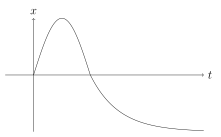
A particle of mass \(m\) moves along the \(x\)-axis. At time \(t=0\) it passes through \(x=0\) with velocity \(v_{0} > 0\). The particle is acted on by a force \(\mathrm{F}(x)\), directed along the \(x\)-axis and measured in the direction of positive \(x\), which is given by \[ \mathrm{F}(x)=\begin{cases} -m\mu^{2}x & \qquad(x\geqslant0),\\ -m\kappa\dfrac{\mathrm{d}x}{\mathrm{d}t} & \qquad(x < 0), \end{cases} \] where \(\mu\) and \(\kappa\) are positive constants. Obtain the particle's subsequent position as a function of time, and give a rough sketch of the \(x\)-\(t\) graph.
Solution: Using Newton's second law in the form, \(\F(x) = m \ddot{x}\). Our two different differential equations can be solved as follows: When \(x \geq 0\) \(-\mu^2x = \ddot{x} \Rightarrow x = A\sin \mu t + B \cos \mu t\) when \(x \geq 0\). And when \(x < 0\) \(-\kappa \dot{x} = \ddot{x} \Rightarrow \dot{x} = Ce^{-\kappa t} \Rightarrow x = De^{-\kappa t} + E\) when \(x < 0\) Following the trajectory of the particle: At \(t = 0, x = 0, \dot{x} = v_0 > 0\), so \(x = \frac{v_0}{\mu} \sin \mu t\) until \(t = \frac{\pi}{\mu}\). When \(t = \frac{\pi}{\mu}\) the particle will head into the negative \(x\)-axis with velocity \(-v_0\). At which point our initial conditions for our differential equations give us that \(De^{-\frac{\pi\kappa}{\mu}} + E = 0, -\kappa De^{-\frac{\pi\kappa}{\mu}} = -v_0 \Rightarrow De^{-\frac{\pi\kappa}{\mu}} = \frac{v_0}{\kappa}, E = -\frac{v_0}{\kappa}\). To summarise: \[ x(t) = \begin{cases} \frac{v_0}{\mu} \sin \mu t & 0 \leq t \leq \frac{\pi}{\mu} \\ -\frac{v_0}{\kappa} \l 1-e^{-\kappa(t-\frac{\pi}{\mu})}\r & t > \frac{\pi}{\mu}\end{cases}\]