Problems
Filters
39 problems found
2015 Paper 3 Q5
- In the following argument to show that \(\sqrt2\) is irrational, give proofs appropriate for steps 3, 5 and 6.
- Assume that \(\sqrt2\) is rational.
- Define the set \(S\) to be the set of positive integers with the following property:
\(n\) is in \(S\) if and only if \(n \sqrt2\) is an integer.
- Show that the set \(S\) contains at least one positive integer.
- Define the integer \(k\) to be the smallest positive integer in \(S\).
- Show that \((\sqrt2-1)k\) is in \(S\).
- Show that steps 4 and 5 are contradictory and hence that \(\sqrt2\) is irrational.
- Prove that \(2^{\frac13} \) is rational if and only if \(2^{\frac23}\) is rational. Use an argument similar to that of part (i) to prove that \(2^{\frac13}\) and \(2^{\frac23}\) are irrational.
Solution:
- For step 3, since we have assumed \(\sqrt{2}\) is rational we can write it in the form \(p/q\) with \(p, q\) coprime with \(q \geq 1\). Then \(q \in S\) since \(q\sqrt{2} = p\) which is an integer. For step 5, notice that \((\sqrt{2}-1)k\) is an integer (since \(\sqrt{2}k\) is an integer and so is \(-k\). It is also positive since \(\sqrt{2} > 1\). We must check that \((\sqrt{2}-1)k \cdot \sqrt{2} = 2k - \sqrt{2}k\) is also an integer, but clearly it is as both \(2k\) and \(-\sqrt{2}k\) are integers. Therefore \((\sqrt{2}-1)k \in S\). For step 6, notice that \((\sqrt{2}-1) < 1\) and therefore \((\sqrt{2}-1)k < k\), contradicting that \(k\) is the smallest element in our set. (And all non-empty sets of positive integers have a smallest element)
- Claim: \(2^{\frac13}\) is irrational \(\Leftrightarrow 2^{\frac23}\) is irrational.
Proof: Since \(2^{\frac13} \cdot 2^{\frac23} = 2\) if one of them is rational, then the other one must also be rational. Which is the same as them both being irrational at the same time.
- Assume that \(\sqrt[3]{2}\) is rational, ie \(\sqrt[3]{2} = p/q\) for some integers.
- \(S := \{ n \in \mathbb{Z}_{>0} : n \sqrt[3]{2} \text{ and } n \sqrt[3]{4}\in \mathbb{Z}\}\)
- Suppose \(k\) is the smallest element in \(S\) (which must exist, consider \(q^2\)
- Consider \((\sqrt[3]{2}-1)k\) then clearly this is an integer, and \((\sqrt[3]{2}-1)\sqrt[3]{2}k = \sqrt[3]{4}k - \sqrt[3]{2}k \in \mathbb{Z}\) and \((\sqrt[3]{2}-1)\sqrt[3]{4}k = 2 k -\sqrt[3]{4}k \in \mathbb{Z}\).
- But this is a smaller element of \(S\), contradicting that \(k\) is the smallest element. Therefore, we have a contradiction.
2013 Paper 3 Q5
In this question, you may assume that, if \(a\), \(b\) and \(c\) are positive integers such that \(a\) and \(b\) are coprime and \(a\) divides \(bc\), then \(a\) divides \(c\). (Two positive integers are said to be coprime if their highest common factor is 1.)
- Suppose that there are positive integers \(p\), \(q\), \(n\) and \(N\) such that \(p\) and \(q\) are coprime and \(q^nN=p^n\). Show that \(N=kp^n\) for some positive integer \(k\) and deduce the value of \(q\). Hence prove that, for any positive integers \(n\) and \(N\), \(\sqrt[n]N\) is either a positive integer or irrational.
- Suppose that there are positive integers \(a\), \(b\), \(c\) and \(d\) such that \(a\) and \(b\) are coprime and \(c\) and \(d\) are coprime, and \(a^ad^b = b^a c^b \,\). Prove that \(d^b = b^a\) and deduce that, if \(p\) is a prime factor of \(d\), then \(p\) is also a prime factor of \(b\). If \(p^m\) and \(p^n\) are the highest powers of the prime number \(p\) that divide \(d\) and \(b\), respectively, express \(b\) in terms of \(a\), \(m\) and \(n\) and hence show that \(p^n\le n\). Deduce the value of \(b\). (You may assume that if \(x > 0\) and \(y\ge2\) then \(y^x > x\).) Hence prove that, if \(r\) is a positive rational number such that \(r^r\) is rational, then \(r\) is a positive integer.
Solution:
- Suppose \(q^nN = p^n\) then since \((p,q) =1\) we must have \(p \mid N\), and then by dividing both \(p^n\) and \(N\) by \(p\) we can repeat this process \(n\) times to find that \(N = kp^n\) and in particular \(q = 1\). Suppose \(\sqrt[n]{N} = \frac{p}q\) for \(p,q\) coprime positive integers (ie it is not irrational), then \(q^nN = p^n\) and so \(q = 1\) and in fact \(\sqrt[n]{N}\) is an integer so \(N\).
- Suppose \((a,b) = 1, (c,d) = 1\) and \(a^ad^b = b^ac^b\), then since \((a,b) = 1\) we must have \((b^a, a) = 1\) so \(b^a \mid d^b\). Similarly since \((c,d) = 1\) we must have \((d^b, c) = 1\) so \(d^b \mid b^a\). Therefore \(d^b = b^a\). Suppose \(p \mid d\) then \(p \mid d^b = b^a \Rightarrow p \mid b\). Suppose \(\nu_p(d) = m, \nu_p(b) = n\) we must have \(bm = \nu_p(d^b) = \nu_p(b^a) = an\), ie \(b = \frac{an}{m}\). Note that \(p^n \mid b \Rightarrow p^n \mid n \frac{a}{m} \Rightarrow p^n \mid n \Rightarrow p^n \leq n\). Since \((p,a) = 1\).. But since \(p^n > n\) if \(p \geq 2\) we must have that \(b = 1\). Therefore suppose \(r = \frac{a}{b}\) with \((a,b) = 1\) an \(r^r = \frac{c}{d}\) we must ahve \(a^ac^b = b^ad^b\) and so \(b = 1\) implying \(r\) is an integer.
2012 Paper 2 Q2
If \(\p(x)\) and \(\q(x)\) are polynomials of degree \(m\) and \(n\), respectively, what is the degree of \(\p(\q(x))\)?
- The polynomial \(\p(x)\) satisfies \[ \p(\p(\p(x)))- 3 \p(x)= -2x\, \] for all \(x\). Explain carefully why \(\p(x)\) must be of degree 1, and find all polynomials that satisfy this equation.
- Find all polynomials that satisfy \[ 2\p(\p(x)) +3 [\p(x)]^2 -4\p(x) =x^4 \] for all \(x\).
Solution: If \(\p(x)\) and \(\q(x)\) are polynomials of degree \(m\) and \(n\), \(\p(\q(x))\) has degree \(mn\).
- Suppose \(\p(\p(\p(x)))- 3 \p(x)= -2x\), and suppose \(p(x)\) has degree \(n = \geq 2\), then \(\p(\p(\p(x)))\) has degree \(n^3\) and so the left hand side has degree higher than \(1\) and the right hand side is degree \(1\). Therefore \(\p(x)\) is degree \(1\) or \(0\). If \(p(x) = c\) then \(c^3-3c = -2x\) but the LHS doesn't depend on \(x\) which is also a contradiction. Therefore \(\p(x)\) is degree \(1\). Suppose \(\p(x) = ax+b\) then: \begin{align*} && -2x &= \p(\p(\p(x))) - 3\p(x) \\ &&&= \p(\p(ax+b)) - 3(ax+b) \\ &&&= \p(a(ax+b)+b) - 3ax -3b \\ &&&= a(a^2x+ab+b) + b - 3ax - 3b \\ &&&= (a^3-3a)x + b(a^2+a-2) \\ \Rightarrow &&& \begin{cases} a^3-3a&=-2 \\ b(a^2+a-2) &= 0\end{cases} \\ \Rightarrow &&& \begin{cases} a^3-3a+2 = 0 \\ b = 0, a = 1, a = -2\end{cases} \\ \Rightarrow &&& \begin{cases} (a-1)(a^2+a-2) = 0 \\ b = 0, a = 1, a = -2\end{cases} \\ \Rightarrow && (a,b) &= (1, b), (-2,b) \end{align*}
- Suppose \(2\p(\p(x)) +3 [\p(x)]^2 -4\p(x) =x^4\) and let \(\deg \p(x) = n\), then LHS has degree \(\max(n^2,2n,n)\) and the right hand side has degree \(4\). Therefore \(\p(x)\) must have degree \(2\). Let \(\p(x) = ax^2 + bx + c\), then, considering the coefficient of \(x^4\) in \(2\p(\p(x)) + 3[\p(x)]^2 -4\p(x)\) we will have \(2a^3+3a^2=1 \Rightarrow 2a^3+3a^2-1 = (a+1)^2(2a-1) \Rightarrow a = -1, a=\frac12\). Consider the coefficient of \(x^3\) in \(2\p(\p(x)) + 3[\p(x)]^2 -4\p(x)\) we have \(4a^2b+6ab = 0 \Rightarrow 2ab(2a+3) = 0\) Since \(a = -1, \frac12\) this means \(b = 0\). Consider the constant coefficient in \(2\p(\p(x)) + 3[\p(x)]^2 -4\p(x)\) (using \(b = 0\)). \(2ac^2+c+3c^2-4c = 0 \Rightarrow c(2ac+3c-3) = 0\). Therefore \(c = 0\) or \(a = -1, c = 3, a = \frac12, c = \frac34\), so our possible polynomials are: \(\p(x) = -x^2, \frac12x^2, -x^2+3, \frac12x^2+\frac34\)
2011 Paper 3 Q2
The polynomial \(\f(x)\) is defined by \[ \f(x) = x^n + a_{{n-1}}x^{n-1} + \cdots + a_{2} x^2+ a_{1} x + a_{0}\,, \] where \(n\ge2\) and the coefficients \(a_{0}\), \(\ldots,\) \(a_{{n-1}}\) are integers, with \(a_0\ne0\). Suppose that the equation \(\f(x)=0\) has a rational root \(p/q\), where \(p\) and \(q\) are integers with no common factor greater than \(1\), and \(q>0\). By considering \(q^{n-1}\f(p/q)\), find the value of \(q\) and deduce that any rational root of the equation \(\f(x)=0\) must be an integer.
- Show that the \(n\)th root of \(2\) is irrational for \(n\ge2\).
- Show that the cubic equation \[ x^3- x +1 =0 \] has no rational roots.
- Show that the polynomial equation \[ x^n- 5x +7 =0 \] has no rational roots for \(n\ge2\).
Solution: Let \(\f(x) = x^n + a_{{n-1}}x^{n-1}+ \cdots + a_{2} x^2+ a_{1} x + a_{0}\), and suppose \(f(p/q) = 0\) with \((p,q) = 1\), the consider \begin{align*} && 0 &= q^{n-1}f(p/q) \\ &&&= \frac{p^n}{q} + \underbrace{a_{n-1}p^{n-1} + a_{n-2}p^{n-2}q + \cdots + a_0q^{n-1}}_{\in \mathbb{Z}} \\ \end{align*} But \(p^n/q \not \in \mathbb{Z}\) unless \(q = 1\) therefore \(p/q\) must be an integer, ie all rational roots are integers.
- Note that \(\sqrt[n]2\) is a root of \(x^n - 2 =0\), but this has no integer solutions. (We can try all factors of \(2\)). Therefore all its roots must be irrational, ie \(\sqrt[n]2\) is irrational for \(n \geq 2\)
- If \(n\) is a root of \(x^3 - x+1\) then it must be \(1\) or \(-1\) by the rational root theorem, ie \(1-1+1 \neq 0\) and \(-1 + 1 +1 \neq 0\), therefore no integer roots, therefore no rational roots.
- Suppose \(m\) is an integer root of \(x^n - 5x + 7 = 0\) then by considering parity we must have \(m^n - 5m + 7 \equiv 1 \pmod{2}\) therefore we cannot have any rational roots.
2010 Paper 1 Q8
- Suppose that \(a\), \(b\) and \(c\) are integers that satisfy the equation \[ a^{3}+3b^{3}=9c^{3}. \] Explain why \(a\) must be divisible by 3, and show further that both \(b\) and \(c\) must also be divisible by 3. Hence show that the only integer solution is \(a=b=c=0\,\).
- Suppose that \(p\), \(q\) and \(r\) are integers that satisfy the equation \[ p^4 +2q^4 = 5r^4 \,.\] By considering the possible final digit of each term, or otherwise, show that \(p\) and \(q\) are divisible by 5. Hence show that the only integer solution is \(p=q=r=0\,\).
Solution:
- Since \(a^3 = 9c^3 - 3b^3 = 3(3c^3-b^3)\) we must have \(3 \mid a^3\). But since \(3\) is prime, \(3 \mid a\). Since \(3 \mid a\) we can write \(a = 3a'\) for some \(a' \in \mathbb{Z}\). Therefore our equation is \(27(a')^3 + 3b^3 = 9c^3 \Rightarrow 9(a')^3 + b^3 = 3c^3\) which means that \(3 \mid b\) by the same argument from earlier. So \(b = 3b'\) so the equation is \(9(a')^3 + 27(b')^3 = 3c^3 \Rightarrow 3(a')^3 + 9(b')^3 = c^3\) which means that \(3 \mid c\). Suppose \((a,b,c)\) is the smallest measured by \(a^2+b^2+c^2\) with \(a, b, c\neq 0\). Then \((\frac{a}{3}, \frac{b}{3}, \frac{c}{3})\) is also a solution. But this contradicts that we had found the smallest solution. Therefore the only possible solution is \((0,0,0)\) which clearly works.
- Consider \(p, q \pmod{5}\). By \(FLT\) \(p^4, q^4 = 0, 1 \pmod{5}\) so \(p^4+2q^4 \in \{0, 1, 2, 3\}\) and in particular the only way they are divisible by \(5\) is if \(p \equiv q \equiv 0 \pmod{5}\). Therefore \(p = 5p', q = 5q'\) and so \(5^4(p')^4 + 5^4(q')^4 = 5r^4 \Rightarrow r^4 = 5(25(p')^4 + 25(q')^4) \Rightarrow 5\mid r^4 \Rightarrow 5 \mid r\). Therefore we can use the same argument about the smallest solution to show that \(p = q= r = 0\)
2010 Paper 3 Q3
For any given positive integer \(n\), a number \(a\) (which may be complex) is said to be a primitive \(n\)th root of unity if \(a^n=1\) and there is no integer \(m\) such that \(0 < m < n\) and \(a^m = 1\). Write down the two primitive 4th roots of unity. Let \({\rm C}_n(x)\) be the polynomial such that the roots of the equation \({\rm C}_n(x)=0\) are the primitive \(n\)th roots of unity, the coefficient of the highest power of \(x\) is one and the equation has no repeated roots. Show that \({\rm C}_4(x) = x^2+1\,\).
- Find \({\rm C}_1(x)\), \({\rm C}_2(x)\), \({\rm C}_3(x)\), \({\rm C}_5(x)\) and \({\rm C}_6(x)\), giving your answers as unfactorised polynomials.
- Find the value of \(n\) for which \({\rm C}_n(x) = x^4 + 1\).
- Given that \(p\) is prime, find an expression for \({\rm C}_p(x)\), giving your answer as an unfactorised polynomial.
- Prove that there are no positive integers \(q\), \(r\) and \(s\) such that \({\rm C}_q(x) \equiv {\rm C}_r(x) {\rm C}_s(x)\,\).
Solution: The primitive 4th roots of unity are \(i\) and \(-i\). (Since the other two roots of \(x^4-1\) are also roots of \(x^2-1\) \({\rm C}_4(x) = (x-i)(x+i) = x^2+1\) as required.
- \(\,\) \begin{align*} && {\rm C}_1 (x) &= x-1 \\ && {\rm C}_2 (x) &= x+1 \\ && {\rm C}_3 (x) &= x^2+x+1 \\ && {\rm C}_5 (x) &= x^4+x^3+x^2+x+1 \\ && {\rm C}_6 (x) &= x^2-x+1 \\ \end{align*}
- Since \((x^4+1)(x^4-1) = x^8-1\) we must have \(n \mid 8\). But \(n \neq 1,2,4\) so \(n = 8\).
- \({\rm C}_p(x) = x^{p-1} +x^{p-2}+\cdots+x+1\)
- Suppose \({\rm C_q}(x) \equiv {\rm C}_r(x){\rm C}_s(x)\), then if \(\omega\) is a primitive \(q\)th root of unity we must \({\rm C}_q(\omega) = 0\), but that means that one of \({\rm C}_r(\omega)\), \({\rm C}_s(\omega)\) is \(0\). But that's only possible if \(r\) or \(s\) \(=q\). If this were the case, then what would the other value be? There are no possible values, hence it's not possible.
2008 Paper 1 Q1
What does it mean to say that a number \(x\) is irrational? Prove by contradiction statements A and B below, where \(p\) and \(q\) are real numbers.
- A: If \(pq\) is irrational, then at least one of \(p\) and \(q\) is irrational.
- B: If \(p+q\) is irrational, then at least one of \(p\) and \(q\) is irrational.
- C: If \(p\) and \(q\) are irrational, then \(p+q\) is irrational.
Solution:
- A: Suppose for sake of contradiction that neither \(p\) nor \(q\) is irrational, then \(pq\) is the product of two rational numbers, ie is also rational. Therefore \(pq\) is rational. Contradiction.
- B: Suppose for the sake of contradiction both \(p\) and \(q\) are rational, but then \(p+q\) is also rational, contradicting \(p+q\) is irrational.
- C: Note that \(\sqrt{2}\) and \(-\sqrt{2}\) are both irrational, but \(\sqrt{2}+(-\sqrt{2}) = 0\) which is rational.
2008 Paper 2 Q3
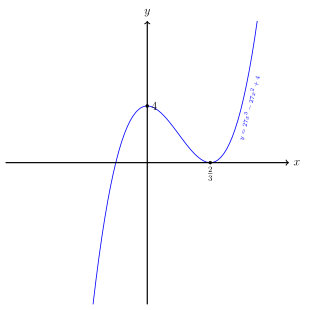
- Find the coordinates of the turning points of the curve \(y=27x^3-27x^2+4\). Sketch the curve and deduce that \(x^2(1-x)\le 4/27\) for all \(x\ge0\,\). Given that each of the numbers \(a\), \(b\) and \(c\) lies between \(0\) and \(1\), prove by contradiction that at least one of the numbers \(bc(1-a)\), \(ca(1-b)\) and \(ab(1-c)\) is less than or equal to \(4/27\).
- Given that each of the numbers \(p\) and \(q\) lies between \(0\) and \(1\), prove that at least one of the numbers \(p(1-q)\) and \(q(1-p)\) is less than or equal to \(1/4\).
Solution:
- \(\,\)
\begin{align*}
&& y & = 27x^3 - 27x^2 + 4 \\
\Rightarrow && \frac{\d y}{\d x} &= 81x^2 - 54x \\
\Rightarrow && x &= 0, \frac23 \\
\Rightarrow && (x,y) &= (0, 4), \left (\frac23, 0 \right)
\end{align*}
Since \(f(x) \geq 0\) for \(x \geq 0\) we must have \(27x^2(1-x) \leq 4 \Rightarrow x^2(1-x) \leq \frac{4}{27}\) Suppose for contradiction that \(bc(1-a) > \frac{4}{27}, ca(1-b) > \frac{4}{27}, ab(1-c) > \frac{4}{27}\) then taking the product we see \begin{align*} && \left ( \frac{4}{27} \right)^3 &< bc(1-a) \cdot ca(1-b) \cdot ab(1-c) \\ &&&= a^2(1-c) \cdot b^2(1-b) \cdot c^2(1-c) \leq \left ( \frac{4}{27}\right)^3 \end{align*} which is a contradiction.
- Notice that \(f(x) = x(1-x)\) has a turning point at \((\frac12, \frac14)\), and so \(f(x) \leq \frac14\). Suppose for contradiction that both \(p(1-q)\) and \(q(1-p)\) are larger than \(1/4\) \begin{align*} && \left ( \frac14 \right)^2 &< p(1-q) \cdot q(1-p) \\ &&&= p(1-p) \cdot q(1-q) \\ &&&\leq \left ( \frac14 \right)^2 \end{align*} which is a contradiction.
2006 Paper 1 Q11
Particles \(A_1\), \(A_2\), \(A_3\), \(\ldots\), \(A_n\) (where \(n\ge 2\)) lie at rest in that order in a smooth straight horizontal trough. The mass of \(A_{n-1}\) is \(m\) and the mass of \(A_n\) is \(\lambda m\), where \(\lambda>1\). Another particle, \(A_0\), of mass \(m\), slides along the trough with speed \(u\) towards the particles and collides with \(A_1\). Momentum and energy are conserved in all collisions.
- Show that it is not possible for there to be exactly one particle moving after all collisions have taken place.
- Show that it is not possible for \(A_{n-1}\) and \(A_n\) to be the only particles moving after all collisions have taken place.
- Show that it is not possible for \(A_{n-2}\), \(A_{n-1}\) and \(A_n\) to be the only particles moving after all collisions have taken place.
- Given that there are exactly two particles moving after all collisions have taken place, find the speeds of these particles in terms of \(u\) and \(\lambda\).
2005 Paper 3 Q1
Show that \(\sin A = \cos B\) if and only if \(A = (4n+1)\frac{\pi}{2}\pm B\) for some integer \(n\). Show also that \(\big\vert\sin x \pm \cos x \big\vert \le \sqrt{2}\) for all values of \(x\) and deduce that there are no solutions to the equation \(\sin\left( \sin x \right) = \cos \left( \cos x \right)\). Sketch, on the same axes, the graphs of \(y= \sin \left( \sin x \right)\) and \(y = \cos \left( \cos x \right)\). Sketch, not on the previous axes, the graph of \(y= \sin \left(2 \sin x \right)\).
Solution: \begin{align*} && \sin A &= \cos B \\ \Leftrightarrow && 0 &= \sin A - \cos B \\ &&&= \sin A - \sin ( \frac{\pi}{2} - B) \\ &&&= 2 \sin \left ( \frac{A + B - \frac{\pi}{2}}{2} \right) \cos \left (\frac{A - B + \frac\pi2}{2} \right) \\ \Leftrightarrow && n \pi &= \frac{A+B - \frac{\pi}{2}}{2}, n\pi + \frac{\pi}{2} = \frac{A-B+\frac{\pi}{2}}{2} \\ \Leftrightarrow && A \pm B &= 2n\pi + \frac{\pi}{2} \\ &&&= (4n+1) \frac{\pi}{2} \end{align*} \begin{align*} |\sin x \pm \cos x| &= | \sqrt{2} \sin(x \pm \frac{\pi}{4} )| \\ & \leq \sqrt{2} \end{align*} Therefore if \(\sin(\sin x) = \cos (\cos x)\) we must have that \(|\sin x \pm \cos x| = |(4n+1) \frac{\pi}{2}| \geq \frac{\pi}{2} > 1.5 > \sqrt{2}\) contradiction.


2004 Paper 1 Q5
The positive integers can be split into five distinct arithmetic progressions, as shown: \begin{align*} A&: \ \ 1, \ 6, \ 11, \ 16, \ ... \\ B&: \ \ 2, \ 7, \ 12, \ 17, \ ...\\ C&: \ \ 3, \ 8, \ 13, \ 18, \ ... \\ D&: \ \ 4, \ 9, \ 14, \ 19, \ ... \\ E&: \ \ 5, 10, \ 15, \ 20, \ ... \end{align*} Write down an expression for the value of the general term in each of the five progressions. Hence prove that the sum of any term in \(B\) and any term in \(C\) is a term in \(E\). Prove also that the square of every term in \(B\) is a term in \(D\). State and prove a similar claim about the square of every term in \(C\).
- Prove that there are no positive integers \(x\) and \(y\) such that \[ x^2+5y=243\,723 \,. \]
- Prove also that there are no positive integers \(x\) and \(y\) such that \[ x^4+2y^4=26\,081\,974 \,. \]
2003 Paper 1 Q2
The first question on an examination paper is: Solve for \(x\) the equation \(\displaystyle \frac 1x = \frac 1 a + \frac 1b \;.\) where (in the question) \(a\) and \(b\) are given non-zero real numbers. One candidate writes \(x=a+b\) as the solution. Show that there are no values of \(a\) and \(b\) for which this will give the correct answer. The next question on the examination paper is: Solve for \(x\) the equation \(\displaystyle \frac 1x = \frac 1 a + \frac 1b +\frac 1c \;.\) where (in the question) \(a\,\), \(b\) and \(c\) are given non-zero numbers. The candidate uses the same technique, giving the answer as \(\displaystyle x = a + b +c \;.\) Show that the candidate's answer will be correct if and only if \(a\,\), \(b\) and \(c\) satisfy at least one of the equations \(a+b=0\,\), \(b+c=0\) or \(c+a=0\,\).
Solution: Suppose \begin{align*} && \frac{1}{a+b} &= \frac{1}{a} + \frac{1}{b} \\ \Rightarrow && ab &= b(a+b)+a(a+b) \\ &&&= (a+b)^2 \\ \Rightarrow && 0 &= a^2+ab + b^2 \\ &&&= \tfrac12 (a^2+(a+b)^2+b^2) \end{align*} Which clearly has no solution for non-zero \(a,b\). Suppose \begin{align*} && \frac{1}{a+b+c} &= \frac1a + \frac1b+\frac1c \\ \Leftrightarrow && abc &= (a+b+c)(bc+ca+ab) \\ \Leftrightarrow && 0 &= (a+b+c)(bc+ca+ab) - abc \\ &&&= (a+b)(b+c)(c+a) \end{align*} Therefore it is true iff \(a+b = 0\) or \(b+c=0\) or \(c+a =0\) as required.
2003 Paper 2 Q3
Prove that the cube root of any irrational number is an irrational number. Let \(\displaystyle u_n = {5\vphantom{\dot A}}^{1/{(3^n)}}\,\). Given that \(\sqrt[3]5\) is an irrational number, prove by induction that \(u_n\) is an irrational number for every positive integer \(n\). Hence, or otherwise, give an example of an infinite sequence of irrational numbers which converges to a given integer \(m\,\). [An irrational number is a number that cannot be expressed as the ratio of two integers.]
Solution: Claim: \(x \in \mathbb{R}\setminus \mathbb{Q} \Rightarrow x^{1/3} \in \mathbb{R} \setminus\mathbb{Q}\) Proof: We will prove the contrapositive, since \(x^{1/3} = p/q\) but then \(x = p^3/q^3 \in \mathbb{Q}\), therefore we're done. Claim: \(u_n = 5^{1/(3^n)}\) is irrational for \(n \geq 1\) Proof: We are assuming the base case, but then \(u_{n+1} = \sqrt[3]{u_n}\) which is clearly irrational by our first lemma, so we're done. Note that \(u_n \to 1\) and so \((m-1)+u_n \to m\) for any integer \(m\).
2002 Paper 3 Q4
Show that if \(x\) and \(y\) are positive and \(x^3 + x^2 = y^3 - y^2\) then \(x < y\,\). Show further that if \(0 < x \le y - 1\), then \(x^3 + x^2 < y^3 - y^2\). Prove that there does not exist a pair of {\sl positive} integers such that the difference of their cubes is equal to the sum of their squares. Find all the pairs of integers such that the difference of their cubes is equal to the sum of their squares.
2000 Paper 1 Q11
A rod \(AB\) of length 0.81 m and mass 5 kg is in equilibrium with the end \(A\) on a rough floor and the end \(B\) against a very rough vertical wall. The rod is in a vertical plane perpendicular to the wall and is inclined at \(45^{\circ}\) to the horizontal. The centre of gravity of the rod is at \(G\), where \(AG = 0.21\) m. The coefficient of friction between the rod and the floor is 0.2, and the coefficient of friction between the rod and the wall is 1.0. Show that the friction cannot be limiting at both \(A\) and \(B\). A mass of 5 kg is attached to the rod at the point \(P\) such that now the friction is limiting at both \(A\) and \(B\). Determine the length of \(AP\).