Problems
Filters
74 problems found
2015 Paper 2 Q6
- Show that \[ \mathrm{sec}^2\left(\tfrac14\pi-\tfrac12 x\right)=\frac{2}{1+\sin x} \,. \] Hence integrate \(\dfrac{1}{1+\sin x}\) with respect to \(x\).
- By means of the substitution \(y=\pi -x\), show that \[ \int_0^\pi x \f (\sin x)\, \d x = \frac \pi 2 \int_0^\pi \f(\sin x) \, \d x ,\] where \(\mathrm{f}\) is any function for which these integrals exist. Hence evaluate \[ \int_0^\pi \frac x {1+\sin x} \, \d x \,. \]
- Evaluate \[ \int_0^\pi\frac{ 2x^3 -3\pi x^2}{(1+\sin x)^2}\, \d x .\]
Solution:
- \(\,\) \begin{align*} && \sec^2\left(\tfrac14\pi-\tfrac12 x\right) &= \frac{1}{\cos^2 \left(\tfrac14\pi-\tfrac12 x\right)} \\ &&&= \frac{1}{\frac{1+\cos 2\left(\tfrac14\pi-\tfrac12 x\right)}{2}} \\ &&&= \frac{2}{1 + \cos \left(\tfrac12\pi- x\right)} \\ &&&= \frac{2}{1+\sin x} \\ \\ && \int \frac{1}{1+\sin x} \d x &= \int \tfrac12\sec^2\left(\tfrac14\pi-\tfrac12 x\right) \d x\\ &&&= - \tan\left(\tfrac14\pi-\tfrac12 x\right) + C \end{align*}
- \(\,\) \begin{align*} && I &= \int_0^{\pi} x f(\sin x) \d x \\ y = \pi - x, \d y = - \d x: &&&= \int_{y=\pi}^{y = 0} (\pi - y) f(\sin(\pi - y))(-1) \d y \\ &&&= \int_0^\pi (\pi - y) f(\sin y) \d y \\ &&&= \pi \int_0^\pi f(\sin y) \d y - I \\ \Rightarrow && I &= \frac{\pi}{2} \int_0^\pi f(\sin x) \d x \\ \\ \Rightarrow && \int_0^{\pi} \frac{x}{1 + \sin x} \d x &= \frac{\pi}{2} \int_0^{\pi} \frac{1}{1 + \sin x} \d x\\ &&&=\frac{\pi}{2} \left [- \tan\left(\tfrac14\pi-\tfrac12 x\right) \right]_0^{\pi} \\ &&&= \frac{\pi}{2} \left (-\tan (-\tfrac{\pi}{4}) + \tan \tfrac{\pi}{4} \right) \\ &&&= \pi \end{align*}
- \(\,\) \begin{align*} && J &= \int_0^{\pi} \frac{2x^3-3\pi x^2}{(1+\sin x)^2} \d x \\ y = \pi - x: &&&= \int_0^{\pi} \frac{2(\pi-y)^3-3\pi (\pi - y)^2}{(1+\sin x)^2 } \d y \\ &&&= \int_0^{\pi} \frac{-2 y^3 + 3 \pi y^2 - \pi^3}{(1+ \sin x)^2}\\ &&&= -\pi^3 \int_0^{\pi} \frac{1}{(1 + \sin x)^2} \d x -J \\ \Rightarrow && J &= -\frac{\pi^3}{2} \int_0^{\pi} \frac{1}{(1 + \sin x)^2} \d x\\ &&&= -\frac{\pi^3}{2} \int_0^\pi \tfrac14 \sec^4\left(\tfrac14\pi-\tfrac12 x\right) \d x \\ &&&= -\frac{\pi^3}{8} \int_0^\pi \sec^2\left(\tfrac14\pi-\tfrac12 x\right)\left (1 + \tan^2\left(\tfrac14\pi-\tfrac12 x\right) \right) \d x \\ &&&= -\frac{\pi^3}{8} \left [-\frac23 \tan^3\left(\tfrac14\pi-\tfrac12 x\right) - 2 \tan\left(\tfrac14\pi-\tfrac12 x\right) \right]_0^{\pi} \\ &&&= -\frac{\pi^3}{8} \left (\frac43+4 \right) \\ &&&= -\frac{2\pi^3}{3} \end{align*}
2014 Paper 1 Q2
- Show that \(\int \ln (2-x) \d x = -(2-x)\ln (2-x) + (2-x) + c \,,\ \) where \(x<2\).
- Sketch the curve \(A\) given by \(y= \ln \vert x^2-4\vert\).
- Show that the area of the finite region enclosed by the positive \(x\)-axis, the \(y\)-axis and the curve \(A\) is \(4\ln(2+\sqrt3)-2\sqrt3\,\).
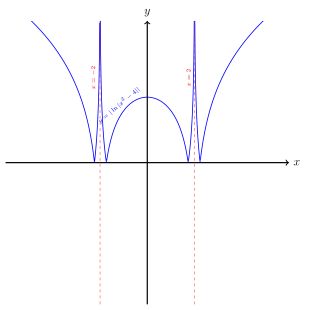
- The curve \(B\) is given by \(y= \vert \ln \vert x^2-4\vert \vert\,\). Find the area between the curve \(B\) and the \(x\)-axis with \(| x| <2\). Note: you may assume that \(t \ln t \to 0\) as \(t\to 0\).
Solution:
- \(\,\) \begin{align*} && \int \ln (2- x) \d x &= \left [ (x-2) \ln (2- x) \right] - \int -\frac{x-2}{2-x} \d x \\ && \int \ln (2- x) \d x &= \left [ (x-2) \ln (2- x) \right] + \int 1 \d x \\ &&&= -(2-x) \ln (2-x) +(2-x) + C \end{align*}
- \(\,\)
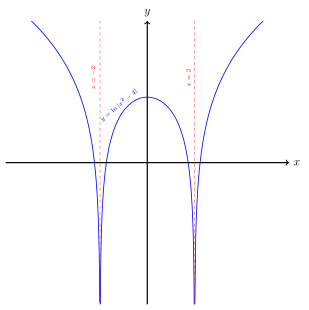
- \begin{align*} && \text{Area} &= \int_0^{\sqrt{3}} \ln | x^2 - 4 | \d x \\ &&&= \int_0^\sqrt{3} \ln(4-x^2) \d x \\ &&&= \int_0^\sqrt{3} \left ( \ln(2-x) + \ln (2+x) \right) \d x \\ &&&= \left [ -(2-x) \ln (2-x) +(2-x) +(2+x)\ln(2+x)-(2+x)\right]_0^{\sqrt{3}} \\ &&&= \left ( -(2-\sqrt{3}) \ln (2-\sqrt{3}) +(2-\sqrt{3}) +(2+\sqrt{3})\ln(2+\sqrt{3})-(2+\sqrt{3}) \right) - \\ &&&\quad \quad \left (- 2\ln (2)+2 +2\ln(2)-2 \right) \\ &&&=\left ( -(2-\sqrt{3}) \ln \left ( \frac{1}{2+\sqrt{3}} \right) -2\sqrt{3} +(2+\sqrt{3})\ln(2+\sqrt{3}) \right) \\ &&&= 4\ln(2 + \sqrt{3}) - 2 \sqrt{3} \end{align*}
- \begin{align*} && \text{Area} &= 2 \left ( \int_0^\sqrt{3} \ln (4-x^2) \d x - \lim_{t \to 2}\int_{\sqrt{3}}^t \ln(4-x^2) \d x \right) \\ &&&= 8\ln(2 + \sqrt{3})-4\sqrt{3} - 2 \lim_{t \to 2}\int_{\sqrt{3}}^t \left ( \ln (2-x) + \ln (2+x) \right) \d x \\ &&&= 8\ln(2 + \sqrt{3})-4\sqrt{3} - 2 \lim_{t \to 2} \left [ -(2-x) \ln (2-x) +(2-x) +(2+x)\ln(2+x)-(2+x)\right]_{\sqrt{3}}^{t} \\ &&&= 16 \ln(2+\sqrt{3})-8\sqrt{3} - 2 \lim_{t \to 2} \left(-(2-t) \ln (2-t) +(2-t) +(2+t)\ln(2+t)-(2+x) \right) \\ &&&= 16 \ln(2+\sqrt{3})-8\sqrt{3} -2(4 \ln4-4) \\ &&&= 16 \ln(2 + \sqrt{3}) - 16 \ln 2 +8(1-\sqrt{3}) \end{align*}
2014 Paper 2 Q4
- By using the substitution \(u=1/x\), show that for \(b>0\) \[ \int_{1/b}^b \frac{x \ln x}{(a^2+x^2)(a^2x^2+1)} \d x =0 \,. \]
- By using the substitution \(u=1/x\), show that for \(b>0\), \[ \int_{1/b}^b \frac{\arctan x}{x} \d x = \frac{\pi \ln b} 2\,. \]
- By using the result \( \displaystyle \int_0^\infty \frac 1 {a^2+x^2} \d x = \frac {\pi}{2 a} \) (where \(a > 0\)),and a substitution of the form \(u=k/x\), for suitable \(k\), show that \[ \int_0^\infty \frac 1 {(a^2+x^2)^2} \d x = \frac {\pi}{4a^3 } \, \ \ \ \ \ \ (a > 0). \]
Solution:
- \begin{align*} && I &= \int_{1/b}^b \frac{x \ln x}{(a^2+x^2)(a^2x^2+1} \d x \\ u = 1/x, \d u = -1/x^2 \d x: &&&= \int_{u=b}^{u=1/b} \frac{1/u \ln(1/u)}{(a^2+u^{-2})(a^2u^{-2}+1)} (- \frac{1}{u^2}) \d u \\ &&&= \int_{1/b}^b \frac{-u\ln u}{(a^2u^2+1)(a^2+u^2)} \d u \\ &&&= -I \\ \Rightarrow && I &= 0 \end{align*}
- \(\,\) \begin{align*} && I &= \int_{1/b}^b \frac{\arctan x}{x} \d x \\ u = 1/x, \d x = -1/u^2 \d u: &&&= \int_{u=b}^{u=1/b} \frac{\arctan \frac1u}{\frac1u} \frac{-1}{u^2} \d u \\ &&&= \int_{1/b}^b \frac{\arctan \frac1u}{u} \d u \\ \Rightarrow && 2I &= \int_{1/b}^b \frac{\arctan x + \arctan \frac1x}{x} \d x \\ &&&= \int_{1/b}^b \frac{\frac{\pi}2}{x} \d x \\ &&&= \pi \ln b \\ \Rightarrow && I &= \frac{\pi}{2} \ln b \end{align*}
- \(\,\) \begin{align*} && I_a &= \int_0^{\infty} \frac{1}{(a^2+x^2)^2} \d x \\ u = a/x, \d x = -a/u^2 \d u:&&&= \int_{u=0}^{u=\infty} \frac{1}{\left (a^2+\frac{a^2}{u^2} \right)^2} \frac{a}{u^2} \d u \\ &&&= \frac1{a^3}\int_0^{\infty} \frac{1}{(u+1/u)^2} \d u \\ &&&= \frac{1}{a^3} \int_0^{\infty} \frac{u^2}{(u^2+1)^2} \d u \\ &&&= \frac{1}{a^3} \int_0^{\infty} \frac{u^2+1-1}{(u^2+1)^2} \d u \\ &&&= \frac{1}{a^3} \int_0^{\infty} \frac{1}{(u^2+1)} - \frac{1}{(u^2+1)^2} \d u \\ &&&= \frac1{a^3} \frac{\pi}{2} - \frac{1}{a^3} I_1 \\ \Rightarrow && 2I_1 &= \frac{\pi}{2} \\ \Rightarrow && I_1 &= \frac{\pi}{4} \\ \Rightarrow && I_a &= \frac{\pi}{4a^3} \end{align*}
2014 Paper 3 Q2
- Show, by means of the substitution \(u=\cosh x\,\), that \[ \int \frac{\sinh x}{\cosh 2x} \d x = \frac 1{2\sqrt2} \ln \left\vert \frac{\sqrt2 \cosh x - 1}{\sqrt2 \cosh x + 1 } \right\vert + C \,.\]
- Use a similar substitution to find an expression for \[ \int \frac{\cosh x}{\cosh 2x} \d x \,.\]
- Using parts (i) and (ii) above, show that \[ \int_0^1 \frac 1{1+u^4} \d u = \frac{\pi + 2\ln(\sqrt2 +1)}{4\sqrt2}\,. \]
Solution:
- \begin{align*} && \int \frac{\sinh x}{\cosh 2x} \d x &= \int \frac{\sinh x}{2\cosh^2 x -1} \d x \\ u = \cosh x, \d u = \sinh x \d x &&&= \int \frac{1}{2u^2 -1} \d u \\ &&&= \int\frac12 \left ( \frac{1}{\sqrt{2}u-1}-\frac{1}{\sqrt{2}u+1} \right) \d u \\ &&&= \frac1{2\sqrt{2}} \left (\ln (\sqrt{2}u-1) - \ln(\sqrt{2}u+1) \right) + C \\ &&&= \frac{1}{2\sqrt{2}} \ln \left ( \frac{\sqrt{2}\cosh x -1}{\sqrt{2}\cosh x +1} \right) + C \end{align*}
- \begin{align*} && \int \frac{\cosh x}{\cosh 2x} \d x &= \int \frac{\cosh x}{1+2\sinh^2 x} \d x \\ u = \sinh x && &= \int \frac{1}{1+2u^2} \d u \\ &&&=\frac{1}{\sqrt{2}} \tan^{-1} (\sqrt{2}u) + C \\ &&&= \frac{1}{\sqrt{2}} \tan^{-1}(\sqrt{2}\sinh x) + C \end{align*}
- \begin{align*} u = e^x : && \int_0^1 \frac{1}{1+u^4} \d u &= \int_{x=-\infty}^{x=0} \frac{1}{1+e^{4x}}e^{x} \d x \\ &&&= \int_{-\infty}^{0} \frac{e^{-x}}{e^{2x}+e^{-2x}} \d x \\ &&&= \int_{-\infty}^{0} \frac{\cosh x - \sinh x}{2\cosh 2x } \d x \\ &&&= \frac12 \int_{-\infty}^{0} \frac{\cosh x}{\cosh 2x} \d x - \frac12 \int_{-\infty}^{0} \frac{\sinh x}{\cosh 2x} \\ &&&= \frac12 \left [\frac{1}{\sqrt{2}} \tan^{-1}(\sqrt{2}\sinh x) \right]_{-\infty}^{0}-\frac12 \left [ \frac{1}{2\sqrt{2}}\ln \left ( \frac{\sqrt{2}\cosh x -1}{\sqrt{2}\cosh x +1} \right) \right]_{-\infty}^{0} \\ &&&= 0 - \frac1{2\sqrt{2}} \frac{-\pi}{2}-\left (\frac1{4\sqrt{2}} \ln \left (\frac{\sqrt{2}-1}{\sqrt{2}+1} \right) - 0 \right) \\ &&&= \frac{\pi - \ln((\sqrt{2}-1)^2)}{4\sqrt{2}} \\ &&&= \frac{\pi + 2 \ln(1+\sqrt{2})}{4\sqrt{2}} \end{align*}
2013 Paper 1 Q4
- Show that, for \(n> 0\), \[ \int_0^{\frac14\pi} \tan^n x \,\sec^2 x \, \d x = \frac 1 {n+1} \; \text{ and } \int_0^{\frac14\pi} \!\! \sec ^n\! x \, \tan x \, \d x = \frac{(\sqrt 2)^n - 1}n \,. \]
- Evaluate the following integrals: \[ \displaystyle \int_0^{\frac14\pi} \!\! x\, \sec ^4 \! x\, \tan x \, \d x \, \text{ and } \int_0^{\frac14\pi} \!\! x^2 \sec ^2 \! x\, \tan x \, \d x \,. \]
Solution:
- \begin{align*} u = \tan x, \d u = \sec^2 x \d x: &&\int_0^{\pi/4} \tan^n x \sec^2 x \d x &= \int_0^1 u^n \d u \\ &&&= \frac{1}{n+1} \end{align*} \begin{align*} u = \sec x, \d u = \sec x \tan x \d x: &&\int_0^{\pi/4} \sec^n x \tan x \d x &= \int_{u=1}^{u=\sqrt{2}} u^{n-1} \d u \\ &&&= \left [ \frac{u^n}{n}\right] \\ &&&= \frac{(\sqrt{2})^n - 1}n \end{align*}
- \begin{align*} &&\int_0^{\frac14\pi} x \sec ^4 x \tan x \d x &= \left [x \frac{1}{4} \sec^4 x \right]_0^{\frac14\pi} - \frac14 \int_0^{\frac14\pi} \sec^4 x \d x \\ &&&= \frac{\pi}{4} - \frac14 \int_0^{\frac14\pi} \sec^2 x(1+ \tan^2 x) \d x \\ &&&= \frac{\pi}{4} - \frac14 \left [ \tan x+ \frac13 \tan^3 x \right] _0^{\frac14\pi} \\ &&&= \frac{\pi}{4} - \frac{1}{3} \end{align*} \begin{align*} \int_0^{\frac14\pi} \!\! x^2 \sec ^2 \! x\, \tan x \, \d x &= \left [x^2 \frac12 \tan^2 x \right]_0^{\frac14\pi} - \int_0^{\frac14\pi} x \tan^2 x \d x\\ &= \frac{\pi^2}{32} - \int_0^{\frac14\pi} x (\sec^2 x - 1) \d x\\ &= \frac{\pi^2}{32} - \left [x (-x + \tan x) \right]_0^{\frac14\pi} + \int_0^{\frac14\pi}-x + \tan x \d x \\ &= \frac{\pi^2}{32} - \frac{\pi}{4} (-\frac{\pi}{4} + 1) -\frac{\pi^2}{32} + \left [ -\ln \cos x \right]_0^{\pi/4} \\ &= \frac{\pi^2}{16}- \frac{\pi}{4} + \frac12 \ln 2 \end{align*}
2012 Paper 1 Q5
Show that \[ \int_0^{\frac14\pi} \sin (2x) \ln(\cos x)\, \d x = \frac14(\ln 2 -1)\,, \] and that \[ \int_0^{\frac14\pi} \cos (2x) \ln(\cos x)\, \d x = \frac18(\pi -\ln 4-2)\,. \] Hence evaluate \[ \int_{\frac14\pi}^{\frac12\pi} \big ( \cos(2x) + \sin (2x)\big) \, \ln \big( \cos x + \sin x\big)\, \d x\,. \]
Solution: \begin{align*} &&\int_0^{\frac14\pi} \sin (2x) \ln(\cos x)\, \d x &= \int_0^{\frac14 \pi} 2 \sin x \cos x \ln (\cos x) \d x \\ u = \cos \theta :&&&= \int_{u=1}^{u=\frac1{\sqrt2}} -2u \ln u \d u \\ &&&= \int_{\frac1{\sqrt{2}}}^1 2u \ln u \d u \\ &&&= \left [u^2 \ln u \right]_{\frac1{\sqrt{2}}}^1-\int_{\frac1{\sqrt{2}}}^1 u \d u \\ &&&= -\frac12 \ln \frac{1}{\sqrt{2}} - \l\frac12 - \frac14 \r \\ &&&= \frac14 (\ln 2 - 1) \end{align*} \begin{align*} && \int_0^{\frac14\pi} \cos (2x) \ln(\cos x)\, \d x &= \left [ \frac12 \sin 2x \ln (\cos x) \right]_0^{\frac14\pi}- \int_0^{\frac14\pi} \frac12 \sin 2x \frac{-\sin x}{\cos x} \d x \\ &&&=\frac12 \ln \frac{1}{\sqrt{2}}+\int_0^{\frac14\pi} \sin^2 x \d x \\ &&&= -\frac14 \ln 2 + \int_0^{\frac14\pi} \frac{1-\cos 2x }{2} \d x \\ &&&= -\frac14 \ln 2 +\frac{\pi}{8} -\frac{1}{4} \\ &&&= \frac18 (\pi - 2\ln 2 - 2) \\ &&&= \frac18 (\pi - \ln 4 - 2) \\ \end{align*} Notice that \(\cos x + \sin x = \sqrt{2} \cos (x -\frac{\pi}{4})\), so: \begin{align*} &&\int_{\frac14\pi}^{\frac12\pi} \big ( \cos(2x) + \sin (2x)\big) \ln \big( \cos x + \sin x\big)\d x &= \int_{\frac14\pi}^{\frac12\pi} \big ( \cos(2x) + \sin (2x)\big) \ln (\sqrt{2} \cos ( x - \frac{\pi}{4}) ) \d x \\ &&&= \int_{u=0}^{u=\frac{\pi}{4}} \l \cos(2u+\frac{\pi}{2})+\sin(2u+\frac{\pi}{2}) \r \cdot \l \frac12 \ln 2 +\ln (\cos u) \r \d x \\ &&&= \int_{0}^{\frac{\pi}{4}} \l -\sin 2u+\cos 2u \r \cdot \l \frac12 \ln 2 +\ln (\cos u) \r \d x \\ &&&= \frac14 \ln 2\left [ \cos 2u + \sin 2u \ \right]_{0}^{\frac{\pi}{4}} - \frac14(\ln2 - 1) + \frac18\pi - \frac14(\ln 2 +1) \\ &&&= \frac{\pi}{8}-\frac12 \ln 2 \end{align*}
2012 Paper 2 Q3
Show that, for any function f (for which the integrals exist), \[ \int_0^\infty \f\big(x+\sqrt{1+x^2}\big) \,\d x = \frac12 \int_1^\infty \left(1+\frac 1 {t^2}\right) \f(t)\, \d t \,. \] Hence evaluate \[ \int_0^\infty \frac1 {2x^2 +1 + 2 x\sqrt{x^2+1} \ } \, \, \d x \,, \] and, using the substitution \(x=\tan\theta\), \[ \int_0^{\frac12\pi} \frac{1}{(1+\sin\theta)^3}\,\d \theta \,. \]
Solution: \begin{align*} && t &= x + \sqrt{1+x^2} \\ &&\frac1t &= \frac{1}{x+\sqrt{1+x^2}} \\ &&&= \frac{\sqrt{1+x^2}-x}{1+x^2-1} \\ &&&= \sqrt{1+x^2}-x \\ \Rightarrow && x &=\frac12 \left ( t - \frac1t\right) \\ \Rightarrow && \d x &=\frac12 \left (1 + \frac1{t^2} \right)\d t \\ \\ \Rightarrow && \int_0^\infty \f\big(x+\sqrt{1+x^2}\big) \,\d x &= \int_{t=1}^{t = \infty}f(t) \frac12\left (1 + \frac1{t^2} \right)\d t \\ &&&= \frac12 \int_1^\infty \left (1 + \frac1{t^2} \right)f(t) \d t \end{align*} \begin{align*} && I &= \int_0^\infty \frac1 {2x^2 +1 + 2 x\sqrt{x^2+1} \ } \d x \\ &&&= \int_0^\infty \frac1 {(x+\sqrt{x^2+1})^2} \d x \\ &&&= \frac12 \int_1^\infty \left (1 + \frac1{t^2} \right) \frac{1}{t^2} \d t \\ &&&= \frac12 \left [-\frac1t-\frac13\frac1{t^3} \right]_1^{\infty} \\ &&&= \frac12 \cdot \frac43 = \frac23 \end{align*} \begin{align*} && J &= \int_0^{\frac12 \pi} \frac{1}{(1+\sin \theta)^3} \d \theta \\ &&x &= \tan \theta\\ && \d x &= \sec^2 \theta = (1+x^2) \d \theta\\ && \tan\theta &= \frac{s}{\sqrt{1-s^2}}\\ \Rightarrow && \tan^2 \theta &= \frac{s^2}{1-s^2} \\ \Rightarrow && \sin \theta &= \frac{\tan\theta}{\sqrt{1+\tan^2\theta}} \\ && J &= \int_0^{\frac12 \pi} \frac{1}{(1+\sin \theta)^3} \d \theta \\ &&&= \int_0^{\frac12 \pi} \frac{1}{\left (1+ \frac{\tan\theta}{\sqrt{1+\tan^2\theta}} \right )^3} \d \theta \\ &&&= \int_{x=0}^{x=\infty} \frac{1}{\left(1 + \frac{x}{\sqrt{1+x^2}} \right)^3} \frac{1}{1+x^2} \d x \\ &&&= \int_0^{\infty} \frac{\sqrt{1+x^2}}{(\sqrt{1+x^2}+x)^3} \d x \\ &&J_a &= \int_0^{\infty} \frac{\sqrt{1+x^2}+x}{(\sqrt{1+x^2}+x)^3} \d x \\ &&&= \frac23 \\ &&J_b &= \int_0^{\infty} \frac{\sqrt{1+x^2}-x}{(\sqrt{1+x^2}+x)^3} \d x \\ &&&= \int_0^{\infty} \frac{1}{(\sqrt{1+x^2}+x)^4} \d x\\ &&&= \frac12\int_1^{\infty} \left (1 +\frac1{t^2} \right)\frac{1}{t^4} \d t \\ &&&= \frac12 \left [-\frac13 t^{-3}-\frac15t^{-5} \right]_1^{\infty} \\ &&&= \frac12 \cdot \frac8{15} = \frac4{15} \\ \Rightarrow && J &= \frac12(J_a+J_b) = \frac7{15} \end{align*}
2011 Paper 1 Q2
The number \(E\) is defined by $\displaystyle E= \int_0^1 \frac{\e^x}{1+x} \, \d x\,.$ Show that \[ \int_0^1 \frac{x \e^x}{1+x} \, \d x = \e -1 -E\, ,\] and evaluate \(\ds \int_0^1 \frac{x^2\e^x}{1+x} \, \d x\) in terms of \(\e\) and \(E\). Evaluate also, in terms of \(E\) and \(\rm e\) as appropriate:
- \[ \int_0^1 \frac{\e^{\frac{1-x}{1+x}}}{1+x}\, \d x\,\]
- \[ \int_1^{\sqrt2} \frac {\e^{x^2}}x \, \d x \, \]
Solution: \begin{align*} \int_0^1 \frac{x \e^x}{1+x} \, \d x &= \int_0^1 \frac{(x+1-1) \e^x}{1+x} \, \d x \\ &= \int_0^1 \left ( e^x -\frac{\e^x}{1+x} \right )\, \d x \\ &= \e-1-E \end{align*} \begin{align*} \int_0^1 \frac{x^2 \e^x}{1+x} \, \d x &= \int_0^1 \frac{(x^2+x-x) \e^x}{1+x} \, \d x \\ &= \int_0^1 \left ( xe^x -\frac{x\e^x}{1+x} \right )\, \d x \\ &= \left [xe^{x} \right]_0^1 - \int_0^1 e^x \, \d x -(\e-1-E) \\ &= \e-(\e-1)-(\e -1 -E) \\ &= 2-\e + E \end{align*}
- Since \(\displaystyle u = \frac{1-x}{1+x},\frac{\d u}{\d x} = \frac{-(1+x)-(1-x)}{(1+x)^2}\), \begin{align*} && \int_0^1 \frac{\e^{\frac{1-x}{1+x}}}{1+x}\, \d x &= \int_{u=1}^{u=0} \frac{e^u}{1+x} \cdot \frac{(1+x)^2}{-2} \d u \\ &&&= \int_0^1 \frac{(1+x) e^u}{2} \d u \\ &&&= \int_0^1 \frac{\left ( 1 + \frac{1-u}{1+u} \right) e^u}{2}\, \d u \\ &&&= \frac12 \int_0^1 \left (e^u + \frac{e^{u}}{1+u} - \frac{ue^u}{1+u} \right) \, \d u \\ &&&= \frac12 \left( \e-1 + E - (\e - 1 - E) \right) \\ &&&= E \end{align*}
- Since \(\displaystyle u = x^2-1, \d u = 2x \d x\)\begin{align*} \int_1^{\sqrt2} \frac {\e^{x^2}}x \, \d x &= \int_{u=0}^{u=1} \frac{e^{u+1}}{x} \frac{1}{2x} \d u \\ &= \int_0^1 \frac{e^{u+1}}{2(u+1)} \d u \\ &= \frac{\e}{2} E \\ &= \frac{E\e}{2} \end{align*}
2010 Paper 2 Q2
Prove that \[ \cos 3x = 4 \cos^3 x - 3 \cos x \,. \] Find and prove a similar result for \(\sin 3x\) in terms of \(\sin x\).
- Let \[ {\rm I}(\alpha) = \int_0^\alpha \big(7\sin x - 8 \sin^3 x\big) \d x\,. \] Show that \[ {\rm I}(\alpha) = -\tfrac 8 3 c^3 + c +\tfrac5 3\,, \] where \(c = \cos \alpha\). Write down one value of \(c\) for which \({\rm I}(\alpha) =0\).
- Useless Eustace believes that \[ \int \sin^n x \, \d x =\dfrac {\sin^{n+1}x}{n+1}\, \] for \(n=1, \ 2, \ 3, \ldots\, \). Show that Eustace would obtain the correct value of \({\rm I}(\beta)\,\), where \(\cos \beta= -\frac16\). Find all values of \(\alpha\) for which he would obtain the correct value of \({\rm I}(\alpha)\).
Solution: \begin{align*} \cos 3x &\equiv \cos (2x + x) \\ &\equiv \cos 2x \cos x - \sin 2x \sin x \\ &\equiv (2\cos^2 x - 1) \cos x - 2 \sin x \cos x \sin x \\ &\equiv 2 \cos^3 x - \cos x - 2\cos x (\sin^2 x) \\ &\equiv 2 \cos^3 x - \cos x - 2\cos x (1- \cos^2 x) \\ &\equiv 4\cos^3 x - 3\cos x \end{align*} Similarly, \begin{align*} \sin 3x &\equiv \sin (2x + x) \\ &\equiv \sin 2x \cos x + \cos 2x \sin x \\ &\equiv 2 \sin x \cos x \cos x + (1-2\sin^2 x) \sin x \\ &\equiv 2 \sin x (1-\sin^2 x) + \sin x - 2 \sin^3 x \\ &\equiv 3 \sin x -4 \sin ^3 x \end{align*}
- \begin{align*} I(\alpha) &= \int_0^{\alpha} (7 \sin x - 8 \sin^3 x) \d x \\ &= \int_0^{\alpha} (7 \sin x - (6\sin x-2 \sin 3x) ) \d x \\ &= \int_0^{\alpha} (\sin x +2 \sin 3x ) \d x \\ &= -\cos \alpha - \frac23 \cos 3\alpha +1+\frac23 \\ &= -c - \frac23 (4c^3-3c) + \frac53 \\ &= -\frac83 c^3 +c + \frac53 \end{align*} as required. When \(c = -1\) this value is \(0\). Eustace will obtain the value \(\frac{7}{2} \sin^2 \beta - 2 \sin^4 \beta = \frac72 (1-\cos^2 \beta) - 2(1-\cos^2 \beta)^2 = \frac32 + \frac12\cos^2 \beta -2\cos^4 \beta\) So if \(\cos \beta = -\frac16\) he will obtain \(\frac32 + \frac{1}{2\cdot36} - \frac{2}{6^4}\) and he should obtain \(\frac{8}{3} \frac{1}{6^3} - \frac{1}{6} + \frac{5}{3}\) which are equal. We want to find all roots of: \begin{align*} && \frac32 + \frac12 c^2 - 2c^4 &= -\frac83 c^3+ c + \frac53 \\ \Rightarrow && 0 &=2c^4-\frac83c^3-\frac12 c^2+c +\frac{1}{6} \\ &&&= 12c^4-16c^3-3c^2+6c+1\\ &&&= (6c+1)(2c^3-3c^2+1) \\ &&&= (6c+1)(2c+1)(c-1)^2 \end{align*} Therefore \(\cos \alpha = - \frac16, -\frac12, 1\) will give the correct answers.
2010 Paper 2 Q4
- Let \[ I=\int_0^a \frac {\f(x)}{\f(x)+\f(a-x)} \, \d x\,. \] Use a substitution to show that \[ I = \int_0^a \frac {\f(a-x)}{\f(x)+\f(a-x)} \, \d x\, \] and hence evaluate \(I\) in terms of \(a\). Use this result to evaluate the integrals \[ \int_0^1 \frac{\ln (x+1)}{\ln (2+x-x^2)}\, \d x \ \ \ \ \ \ \text{ and }\ \ \ \ \ \int_0^{\frac\pi 2} \frac{\sin x } {\sin(x+\frac \pi 4 )} \, \d x \,. \]
- Evaluate \[ \int_{\frac12}^2 \frac {\sin x}{x \big(\sin x + \sin \frac 1 x\big)} \, \d x\,. \]
Solution:
- \(\,\) \begin{align*} && I &= \int_0^a \frac{f(x)}{f(x)+f(a-x)} \d x \\ u =a-x, \d u = - \d x: &&& \int_{u=a}^{u=0} \frac{f(a-u)}{f(a-u)+f(u)} (-1) \d u \\ &&&= \int_0^a \frac{f(a-u)}{f(u)+f(a-u)} \d u \\ &&&= \int_0^a \frac{f(a-x)}{f(x)+f(a-x)} \d x \\ \Rightarrow && 2 I &= \int_0^a \left ( \frac{f(x)}{f(x)+f(a-x)} + \frac{f(a-x)}{f(x)+f(a-x)} \right) \d x \\ &&&= \int_0^a 1 \d x \\ &&&= a \\ \Rightarrow && I &= \frac{a}{2} \end{align*} \begin{align*} && J &= \int_0^1 \frac{\ln (x+1)}{\ln (2+x-x^2)}\, \d x \\ &&&= \int_0^1 \frac{\ln (x+1)}{\ln((x+1)(2-x))} \d x \\ &&&= \int_0^1 \frac{\ln (x+1)}{\ln(x+1) + \ln ((1-x)+1)} \d x \\ &&&= \frac{1}{2} \tag{\(f(x) = \ln (x+1)\)} \\ \\ && K &= \int_0^{\frac\pi 2} \frac{\sin x } {\sin(x+\frac \pi 4 )} \, \d x \\ &&&= \int_0^{\frac{\pi}{2}} \frac{\sin x }{\sin x \cos \frac{\pi}{4} + \cos x \sin \frac{\pi}{4}} \\ &&&= \sqrt{2} \int_0^{\frac{\pi}{2}} \frac{\sin x }{\sin x + \sin (\frac{\pi}{2}-x)} \d x\\ &&&= \frac{\pi}{2\sqrt{2}} \end{align*}
- \(\,\) \begin{align*} &&I &= \int_{\frac12}^2 \frac{\sin x }{x(\sin x + \sin \frac1x)} \d x \\ u = 1/x, \d u = -1/x^2 \d x : &&&= \int_{u = 2}^{u=\frac12} \frac{\sin \frac1u}{\frac{1}{u}(\sin \frac1u + \sin u)} (-\frac{1}{u^2} ) \d u \\ &&&= \int_{\frac12}^2 \frac{\sin \frac1u}{u (\sin u + \sin \frac1u)} \d u \\ \Rightarrow && 2I &= \int_{\frac12}^2 \left ( \frac{\sin x }{x(\sin x + \sin \frac1x)} + \frac{\sin \frac1x }{x(\sin x + \sin \frac1x)}\right) \d x \\ &&&= \int_{\frac12}^2 \frac{1}{x} \d x\\ &&&= 2\ln2 \\ \Rightarrow && I &= \ln 2 \end{align*}
2010 Paper 3 Q2
In this question, \(a\) is a positive constant.
- Express \(\cosh a\) in terms of exponentials. By using partial fractions, prove that \[ \int_0^1 \frac 1{ x^2 +2x\cosh a +1} \, \d x = \frac a {2\sinh a}\,. \]
- Find, expressing your answers in terms of hyperbolic functions, \[ \int_1^\infty \frac 1 {x^2 +2x \sinh a -1} \,\d x \, \] and \[ \int_0^\infty \frac 1 {x^4 +2x^2\cosh a +1} \,\d x \,.\]
Solution:
- \(\cosh a = \frac12 (e^a + e^{-a})\) \begin{align*} \int_0^1 \frac 1{ x^2 +2x\cosh a +1} \, \d x &= \int_0^1 \frac{1}{x^2+(e^a+e^{-a})x+e^ae^{-a}} \d x \\ &= \int_0^1 \frac{1}{e^a-e^{-a}}\left (\frac{1}{x+e^{-a}}-\frac{1}{x+e^a} \right)\d x \\ &= \frac{1}{2 \sinh a} \int_0^1 \left (\frac{1}{x+e^{-a}}-\frac{1}{x+e^a} \right)\d x \\ &= \frac{1}{2 \sinh a}\left [\ln(x+e^{-a})-\ln(x+e^a) \right]_0^1 \\ &= \frac{1}{2 \sinh a} \left (\ln(1+e^a)-\ln(1+e^{-a}) - (\ln e^{-a}-\ln e^a) \right) \\ &= \frac{1}{2\sinh a}\left (2a + \ln \frac{1+e^a}{1+e^{-a}}\right) \\ &= \frac1{2\sinh a} \left ( 2a -a \right) \\ &= \frac{a}{2 \sinh a} \end{align*}
- \begin{align*} \int_1^\infty \frac 1 {x^2 +2x \sinh a -1} \,\d x &= \int_1^{\infty} \frac{1}{(x+e^a)(x-e^{-a})} \d x \\ &= \int_1^{\infty} \frac{1}{e^a+e^{-a}} \left ( \frac{1}{x-e^{-a}} - \frac{1}{x+e^{a}} \right)\d x \\ &= \frac{1}{2\cosh a} \int_1^{\infty} \left ( \frac{1}{x-e^{-a}} - \frac{1}{x+e^{a}} \right)\d x \\ &= \frac{1}{2\cosh a} \left [\ln(x-e^{-a}) - \ln (x + e^{a} ) \right]_1^{\infty} \\ &= \frac1{2\cosh a} \left [ \ln \frac{x-e^{-a}}{x+e^{a}} \right]_1^{\infty} \\ &= \frac{1}{2\cosh a} \left ( 0 - \ln \frac{1-e^{-a}}{1+e^a}{}\right) \\ &= \frac{1}{2\cosh a} \ln \frac{1+e^a}{1-e^{-a}}\\ &= \frac{1}{2\cosh a} \left ( a + \ln \coth \frac{a}{2} \right) \end{align*} and \begin{align*} \int_0^\infty \frac 1 {x^4 +2x^2\cosh a +1} \,\d x &= \int_0^\infty\frac{1}{(x^2+e^a)(x^2+e^{-a})} \d x \\ &= \int_0^\infty \frac{1}{e^a-e^{-a}} \left ( \frac{1}{x^2+e^{-a}} - \frac{1}{x^2+e^{a}} \right) \d x \\ &= \frac{1}{2\sinh a} \left [ \frac{1}{e^{-a/2}} \tan^{-1} \frac{x}{e^{-a/2}} - \frac{1}{e^{a/2}}\tan^{-1} \frac{x}{e^{a/2}} \right]_0^{\infty} \\ &= \frac{1}{2\sinh a} \left (e^{a/2}\frac{\pi}{2}-e^{-a/2}\frac{\pi}{2} - 0 \right) \\ &= \frac{1}{2\sinh a} \pi \sinh \frac{a}{2} \\ &= \frac{\pi \sinh \tfrac{a}{2}}{2\sinh a} \\ &= \frac{\pi \sinh \tfrac{a}{2}}{4\sinh \tfrac{a}{2} \cosh \tfrac{a}{2}} \\ &= \frac{\pi}{4\cosh \tfrac{a}{2}} \end{align*}
2009 Paper 1 Q6
- Show that, for \(m>0\,\), \[ \int_{1/m}^m \frac{x^2}{x+1} \, \d x = \frac{(m-1)^3(m+1)}{2m^2}+ \ln m\,. \]
- Show by means of a substitution that \[ \int_{1/m}^m \frac1 {x^n(x+1)}\,\d x = \int_{1/m}^m \frac {u^{n-1}}{u+1}\,\d u \,. \]
- Evaluate:
- \(\bf (a)\) \(\displaystyle \int_{1/2}^2 \frac {x^5+3}{x^3(x+1)}\,\d x \;;\)
- \(\bf (b)\) \(\displaystyle \int_1^2 \frac{x^5+x^3 +1}{x^3(x+1)}\, \d x\;. \)
Solution:
- \(\,\) \begin{align*} && \int_{1/m}^m \frac{x^2}{x+1} \d x &= \int_{1/m}^m \left ( x- 1 + \frac{1}{x+1} \right) \d x \\ &&&= \left [ \frac{x^2}{2} - x + \ln (x+1) \right]_{1/m}^m \\ &&&= \left ( m^2/2 - m + \ln(m+1) \right)- \left ( \frac{1}{2m^2} - \frac{1}{m} + \ln\left(\frac1m+1\right) \right) \\ &&&= \frac{m^4-2m^3-1+2m}{2m^2} + \ln (m+1) - \ln(m+1) + \ln m \\ &&&= \frac{(m-1)^3(m+1)}{2m^2} + \ln m \end{align*}
- \(\,\) \begin{align*} u = \frac{1}x, \d x = -\frac{1}{u^2} \d u:&& \int_{1/m}^m \frac1 {x^n(x+1)}\,\d x &= \int_{u=m}^{u=1/m} \frac{1}{u^{-n}(u^{-1}+1)} \frac{-1}{u^2} \d u \\ &&&= \int_{1/m}^m \frac{u^{n-1}}{u+1} \d u \end{align*}
- \(\bf (a)\) \(\,\) \begin{align*} && I &= \int_{1/2}^2 \frac {x^5+3}{x^3(x+1)}\,\d x \\ &&&= \int_{1/2}^2 \left ( \frac{x^2}{x+1} + \frac{3}{x^3(x+1)} \right) \d x \\ &&&= \int_{1/2}^2 \frac{x^2}{x+1} \d x + 3 \int_{1/2}^2 \frac{x^2}{x+1} \d x \\ &&&= 4 \left ( \frac{(2-1)^3(2+1)}{2 \cdot 2^2} + \ln 2 \right) \\ &&&= \frac32+4 \ln 2 \end{align*}
- \(\bf (b)\) \(\,\) \begin{align*} && J &= \int_1^2 \frac{x^5+x^3 +1}{x^3(x+1)}\, \d x \\ && K &= \int_1^2 \frac{x^5 +1}{x^3(x+1)}\, \d x\\ u = 1/x, \d x = -1/u^2 \d u: &&&= \int_{u=1}^{u=1/2} \frac{u^{-5}+1}{u^{-3}(u^{-1}+1)} \frac{-1}{u^2} \d u \\ &&&= \int_{1/2}^1 \frac{1 + u^5}{u^3(u+1)} \d u \\ \Rightarrow && K &= \frac12 \int_{1/2}^2 \frac{x^5+1}{x^3(x+1)} \d x \\ &&&= \frac{(2-1)^3(2+1)}{2 \cdot 2^2} + \ln 2 \\ &&&= \frac38 + \ln 2 \\ && L &= \int_1^2 \frac{x^3}{x^3(x+1)} \d x \\ &&&= \ln (3) - \ln 2 \\ \Rightarrow && J &= \frac38 + \ln 3 \end{align*}
2009 Paper 1 Q7
Show that, for any integer \(m\), \[ \int_0^{2\pi} \e^x \cos mx \, \d x = \frac {1}{m^2+1}\big(\e^{2\pi}-1\big)\,. \]
- Expand \(\cos(A+B) +\cos(A-B)\). Hence show that \[\displaystyle \int_0^{2\pi} \e^x \cos x \cos 6x \, \d x\, = \tfrac{19}{650}\big( \e^{2\pi}-1\big)\,. \]
- Evaluate $\displaystyle \int_0^{2\pi} \e^x \sin 2x \sin 4x \cos x \, \d x\,$.
Solution: \begin{align*} && I &= \int_0^{2 \pi} e^{x} \cos m x \d x \\ &&&= \left [e^x \cos m x \right]_0^{2 \pi}-\int_0^{2 \pi} e^x m (-\sin mx) \d x\\ &&&= e^{2\pi}-1 + m\int_0^{2\pi}e^x \sin m x \d x \\ &&&= e^{2\pi}-1 + m\left [e^x \sin m x \right]_0^{2\pi} - m \int_0^{2\pi} e^x m \cos x \d x \\ &&&= e^{2\pi}-1+0 - m^2 I\\ \Rightarrow && (m^2+1)I &= e^{2\pi}-1 \\ \Rightarrow && I &= \frac{1}{m^2+1} (e^{2\pi}-1) \end{align*}
- \(\,\) \begin{align*} && \cos(A+B) + \cos(A-B) &= \cos A\cos B - \sin A \sin B + \cos A \cos B + \sin A \sin B \\ &&&= 2 \cos A \cos B \end{align*} Therefore \begin{align*} && I &= \int_0^{2\pi} e^x \cos x \cos 6x \d x \\ &&&= \int_0^{2\pi} e^x \frac12\left (\cos 7x + \cos 5x \right) \d x\\ &&&= \left ( \frac{1}{2(1+7^2)} + \frac1{2(1+5^2)}\right)(e^{2\pi}-1) \\ &&&= \left (\frac{1}{100}+\frac{1}{52} \right) (e^{2\pi}-1) \\ &&&= \frac{19}{650}(e^{2\pi}-1) \end{align*}
- \(\,\) \begin{align*} && I &= \int_0^{2\pi} e^x \sin 2x \sin 4x \cos x \d x\\ &&&= \int_0^{2\pi} e^x \tfrac12(\cos2x-\cos 6x) \cos x \d x\\ &&&= \frac12 \int_0^{2\pi} e^x \left (\cos 2x \cos x -\cos 6x \cos x \right) \d x \\ &&&= \frac14 \int_0^{2\pi} e^x \left (\cos 3x + \cos x-\cos 7x-\cos 5x \right) \d x \\ &&&= \frac14 \left (\frac{1}{1+3^2}+\frac{1}{1+1^2}-\frac{1}{1+7^2} - \frac{1}{1+5^2} \right)(e^{2\pi}-1) \\ &&&= \frac14 \left (\frac{1}{10}+\frac{1}{2}-\frac{1}{50} - \frac{1}{26} \right)(e^{2\pi}-1) \\ &&&= \frac{44}{325}(e^{2\pi}-1) \end{align*}
2009 Paper 2 Q5
Expand and simplify \((\sqrt{x-1}+1)^2\,\).
- Evaluate \[ \int_{5}^{10} \frac{ \sqrt{x+2\sqrt{x-1} \;} + \sqrt{x-2\sqrt{x-1} \;} } {\sqrt{x-1}} \,\d x\;. \]
- Find the total area between the curve \[ y= \frac{\sqrt{x-2\sqrt{x-1}\;}}{\sqrt{x-1}\;} \] and the \(x\)-axis between the points \(x=\frac54\) and \(x=10\).
- Evaluate \[ \int_{\frac54}^{10} \frac{ \sqrt{x+2\sqrt{x-1}\;} + \sqrt{x-2\sqrt{x+1}+2 \;} } {\sqrt{x^2-1} } \;\d x\;. \]
2008 Paper 1 Q6
The function \(\f\) is defined by \[ \f(x) = \frac{\e^x-1}{\e-1}, \ \ \ \ \ x\ge0, \] and the function \(\g\) is the inverse function to \(\f\), so that \(\g(\f(x))=x\). Sketch \(\f(x)\) and \(\g(x)\) on the same axes. Verify, by evaluating each integral, that \[ \int_0^\frac12 \f(x) \,\d x + \int_0^k \g(x) \,\d x = \frac1 {2(\sqrt \e +1)}\,, \] where \(\displaystyle k= \frac 1{\sqrt\e+1}\), and explain this result by means of a diagram.