Problems
Filters
1988 Paper 1 Q6
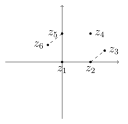
The complex numbers \(z_{1},z_{2},\ldots,z_{6}\) are represented by six distinct points \(P_{1},P_{2},\ldots,P_{6}\) in the Argand diagram. Express the following statements in terms of complex numbers:
- \(\overrightarrow{P_{1}P_{2}}=\overrightarrow{P_{5}P_{4}}\) and \(\overrightarrow{P_{2}P_{3}}=\overrightarrow{P_{6}P_{5}}\,\);
- \(\overrightarrow{P_{2}P_{4}}\) is perpendicular to \(\overrightarrow{P_{3}P_{6}}\,\).
Solution:
- \(\overrightarrow{P_{1}P_{2}}=\overrightarrow{P_{5}P_{4}}\) is equivalent to \(z_2 - z_1 = z_4 - z_5\). \(\overrightarrow{P_{2}P_{3}}=\overrightarrow{P_{6}P_{5}}\) is equivalent to \(z_3-z_2 = z_5 - z_6\).
- \(\overrightarrow{P_{2}P_{4}}\) is perpendicular to \(\overrightarrow{P_{3}P_{6}}\,\) is equivalent to \(\frac{z_4 - z_2}{z_6-z_3} \in i\mathbb{R}\)
1988 Paper 1 Q7
The function \(\mathrm{f}\) is defined by \[ \mathrm{f}(x)=ax^{2}+bx+c. \] Show that \[ \mathrm{f}'(x)=\mathrm{f}(1)\left(x+\tfrac{1}{2}\right)+\mathrm{f}(-1)\left(x-\tfrac{1}{2}\right)-2\mathrm{f}(0)x. \] If \(a,b\) and \(c\) are real and such that \(\left|\mathrm{f}(x)\right|\leqslant1\) for \(\left|x\right|\leqslant1\), show that \(\left|\mathrm{f}'(x)\right|\leqslant4\) for \(\left|x\right|\leqslant1\). Find particular values of \(a,b\) and \(c\) such that, for the corresponding function \(\mathrm{f}\) of the above form \(\left|\mathrm{f}(x)\right|\leqslant1\) for all \(x\) with \(\left|x\right|\leqslant1\) and \(\mathrm{f}'(x)=4\) for some \(x\) satisfying \(\left|x\right|\leqslant1\).
Solution: Let \(f(x) = ax^2 + bx + c\) then \begin{align*} f'(x) &= 2ax + b \\ f(0) &= c \\ f(1) &= a+b+c \\ f(-1) &= a-b+c \\ f(1)+f(-1) &= 2(a+c) \\ f(1)-f(-1) &= 2b \\ f'(x) &= x(f(1)+f(-1)) + \frac12 (f(1) - f(-1)) - 2f(0)x \end{align*} as required. Since \(f'(x)\) is a straight line, the maximum value is either at \(1, -1\) or it's constant and either end suffices. \begin{align*} |f'(1)| & \leq |f(1)|\frac{3}{2} + |f(-1)| \frac12 + 2 |f(0)| \\ &\leq \frac{3}{2} + \frac12 + 2 \\ &= 4 \\ \\ |f'(-1)| & \leq |f(1)|\frac{1}{2} + |f(-1)| \frac32 + 2 |f(0)| \\ &\leq \frac{3}{2} + \frac12 + 2 \\ &= 4 \\ \end{align*} Therefore \(|f'(x)| \leq 4\). Suppose \(|f'(x)| = 4\) for some value in \(x \in [-1,1]\), then it must be either \(-1\) or \(1\). If \(f'(1) = 4\) then \(f(1) = 1, f(-1) = 1, f(0) = -1\) so \(f(x) = 1+ k(x^2-1) \Rightarrow f(x) = 1+2(x^2-1) = 2x^2 -1\). If \(f'(-1) = 4\) then \(f(1) = -1, f(-1) = -1, f(0) = 1 \Rightarrow f(x) = -2x^2 + 1\)
1988 Paper 1 Q8
\(ABCD\) is a skew (non-planar) quadrilateral, and its pairs of opposite sides are equal, i.e. \(AB=CD\) and \(BC=AD\). Prove that the line joining the midpoints of the diagonals \(AC\) and \(BD\) is perpendicular to each diagonal.
Solution: Let \(\mathbf{a}\) denote the vector position of \(A\) and similarly for \(B, C, D\). Then we know that \((\mathbf{b}-\mathbf{a})\cdot(\mathbf{b}-\mathbf{a})=(\mathbf{c}-\mathbf{d})\cdot(\mathbf{c}-\mathbf{d})\) and \((\mathbf{b}-\mathbf{c})\cdot(\mathbf{b}-\mathbf{c})=(\mathbf{a}-\mathbf{d})\cdot(\mathbf{a}-\mathbf{d})\). Subtracting these two equations we see that \(|\mathbf{a}|^2 -2\mathbf{a}\cdot\mathbf{b}+2\mathbf{c}\cdot\mathbf{b} - |\mathbf{c}|^2 = |\mathbf{c}|^2-2\mathbf{c}\cdot\mathbf{d}+2\mathbf{a}\cdot\mathbf{d}-|\mathbf{a}|^2\) or \(2|\mathbf{a}|^2 -2\mathbf{a}\cdot\mathbf{b}+2\mathbf{c}\cdot\mathbf{b} - 2|\mathbf{c}|^2 +2\mathbf{c}\cdot\mathbf{d}-2\mathbf{a}\cdot\mathbf{d}=0\) The midpoints of the diagonals \(AC\) and \(BD\) are \(\frac{\mathbf{a}+\mathbf{c}}{2}\) and \(\frac{\mathbf{b}+\mathbf{d}}{2}\), so the line is parallel to: \(\mathbf{a}-\mathbf{b}+\mathbf{c}-\mathbf{d}\). The diagonals are parallel to \(\mathbf{a}-\mathbf{c}\) and \(\mathbf{b}-\mathbf{d}\). So it suffices to prove that \((\mathbf{a}-\mathbf{b}+\mathbf{c}-\mathbf{d}) \cdot (\mathbf{a}-\mathbf{c}) = 0\) (since the other will follow by symmetry, \begin{align*} (\mathbf{a}-\mathbf{b}+\mathbf{c}-\mathbf{d}) \cdot (\mathbf{a}-\mathbf{c}) &= |\mathbf{a}|^2-\mathbf{a}\cdot\mathbf{b}-\mathbf{a}\cdot \mathbf{d}+\mathbf{b}\cdot \mathbf{c}-|\mathbf{c}|^2+\mathbf{c}\cdot \mathbf{d} \\ \end{align*} But this is exactly half the equation we determined earlier, so we are done.
1988 Paper 1 Q9
Find the following integrals:
- \(\ {\displaystyle \int_{1}^{\mathrm{e}}\frac{\ln x}{x^{2}}\,\mathrm{d}x}\,,\)
- \(\ {\displaystyle \int\frac{\cos x}{\sin x\sqrt{1+\sin x}}\,\mathrm{d}x.}\)
Solution:
- \begin{align*} \int_{1}^{\mathrm{e}}\frac{\ln x}{x^{2}}\,\mathrm{d}x &= \left [-\frac{\ln x}{x} \right]_1^e + \int_1^e \frac{1}{x^2} \, \d x \\ &= -\frac{1}{e} + \left [ -\frac{1}{x} \right]_1^e \\ &= 1 - \frac{2}{e} \end{align*}
- \begin{align*} \int\frac{\cos x}{\sin x\sqrt{1+\sin x}}\,\mathrm{d}x &= \int \frac{2u}{(u^2-1)u} \d u \tag{\(u^2 = 1+\sin x\)} \\ &= \int \frac{1}{u-1} - \frac{1}{u+1} \d u \\ &= \ln(u-1) - \ln (u+1) + C \\ &= \ln \l \frac{u-1}{u+1} \r + C \\ &= \ln \l \frac{\sqrt{\sin x + 1} + 1}{\sqrt{\sin x + 1} -1} \r + C \end{align*}
1988 Paper 1 Q10
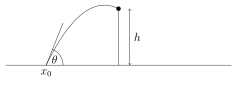
A sniper at the top of a tree of height \(h\) is hit by a bullet fired from the undergrowth covering the horizontal ground below. The position and elevation of the gun which fired the shot are unknown, but it is known that the bullet left the gun with speed \(v\). Show that it must have been fired from a point within a circle centred on the base of the tree and of radius \((v/g)\sqrt{v^{2}-2gh}\). {[}Neglect air resistance.{]}
Solution:
1988 Paper 1 Q11
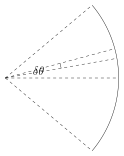
Derive a formula for the position of the centre of mass of a uniform circular arc of radius \(r\) which subtends an angle \(2\theta\) at the centre.

Solution:

1988 Paper 1 Q12
A skater of mass \(M\) is skating inattentively on a smooth frozen canal. She suddenly realises that she is heading perpendicularly towards the straight canal bank at speed \(V\). She is at a distance \(d\) from the bank and can choose one of two methods of trying to avoid it; either she can apply a force of constant magnitude \(F\), acting at right-angles to her velocity, so that she travels in a circle; or she can apply a force of magnitude \(\frac{1}{2}F(V^{2}+v^{2})/V^{2}\) directly backwards, where \(v\) is her instantaneous speed. Treating the skater as a particle, find the set of values of \(d\) for which she can avoid hitting the bank. Comment briefly on the assumption that the skater is a particle.
Solution: Suppose she applies a force of magnitude \(\frac{1}{2}F(V^{2}+v^{2})/V^{2}\) backwards, then \begin{align*} && M v \frac{dv}{dx} &= -\frac{1}{2}F(V^{2}+v^{2})/V^{2} \\ \Rightarrow && M\int_{V}^0 \frac{2v}{V^2+ v^2} \d v &= - \frac{F}{V^2} x \\ \Rightarrow && M \left [ -\log(V^2+v^2) \right]_0^V &= -\frac{Fx}{V^2} \\ \Rightarrow && -M \ln 2&= -\frac{Fx}{V^2} \end{align*} Therefore she will stop quickly enough if \(d > \frac{V^2M \ln 2}{F}\) If she attempts to use the right-angled method, then she will travel a distance at most \(r\) where \(r\) is the radius of her circle: \begin{align*} && F &= M \frac{V^2}{r} \\ \Rightarrow && r &= \frac{MV^2}{F} \end{align*} Therefore she can always avoid the wall if \(d > \frac{MV^2}{F}\). There are two potential issues with being a particle. Firstly we would need to account for any variation in the distance to the wall (which could be accounted for by changing \(d\)). Secondly when she enters circular motion she will rotate and therefore we might need to consider her inertia as well as just her velocity when modelling.
1988 Paper 1 Q13
A piece of circus apparatus consists of a rigid uniform plank of mass 1000\(\,\)kg, suspended in a horizontal position by two equal light vertical ropes attached to the ends. The ropes each have natural length 10\(\,\)m and modulus of elasticity 490\(\,\)000 N. Initially the plank is hanging in equilibrium. Nellie, an elephant of mass 4000\(\,\)kg, lands in the middle of the plank while travelling vertically downwards at speed 5\(\,\)ms\(^{-1}.\) While carrying Nellie, the plank comes instantaneously to rest at a negligible height above the floor, and at this instant Nellie steps nimbly and gently off the plank onto the floor. Assuming that the plank remains horizontal, and the rope remain vertical, throughout the motion, find to three significant figures its initial height above the floor. During the motion after Nellie alights, do the ropes ever become slack? {[}Take \(g\) to be \(9.8\mbox{\,\ ms}^{-1}.\){]}
Solution: In the initial position, since the system is in equilibrium the tension in the two ropes must be \(500g\). Therefore since \(T = \frac{\lambda x}{l} \Rightarrow x = \frac{10 \cdot 500 g}{490\, 000} = \frac1{10}\) so the initial extension is \(\frac1{10}\) By conservation of momentum, if the initial speed of the plank + Nellie is \(V\), we must have \(4000 \cdot 5 = 5000 V \Rightarrow V = 4\) \begin{array}{ccc} & \text{GPE} & \text{EPE} & \text{KE} \\ \hline \text{Initially} & 5000gh & 2 \cdot \frac12 \frac{\lambda}{l} \frac{1}{100} & \frac12 \cdot 5000 \cdot 4^2 \\ & 49\,000h & 490 & 40\,000 \\ \text{Finally} & 0 & 2 \cdot \frac12 \frac{\lambda}{l} (h + \frac1{10})^2 & 0 \\ & 0 & 49\,000 (h+\frac1{10})^2 & 0 \end{array} By conservation of energy, we can set up a quadratic: \begin{align*} && 49\,000 (h+\frac1{10})^2 &= 49\,000h + 40\,490 \\ \Rightarrow && 49\,000(h + \frac1{10})^2 &= 49\,000(h + \frac1{10})+35\, 590 \\ \Rightarrow&& h + \frac1{10} &= 1.488092\cdots \\ \Rightarrow && h &= 1.49 \,\, (3\text{ s.f.}) \end{align*} When she gets off the plank, it will move according to: \begin{align*} \text{N2}(\uparrow): && \frac{\lambda x}{l} -1000g &= -1000 \ddot{x} \\ && 49 x-g &= -\ddot{x} \\ \Rightarrow && x &= A \sin 7t + B \cos 7t + 0.2 \\ && x(0) = 1.49, &x'(0) = 0 \\ \Rightarrow && B = -1.69, & A=0 \end{align*} If we continued under this motion the string would definitely reach a point \(0.1\) above \(0\), and therefore the ropes would go slack.
1988 Paper 1 Q14
Let \(X\) be a standard normal random variable. If \(M\) is any real number, the random variable \(X_{M}\) is defined in terms of \(X\) by \[ X_{M}=\begin{cases} X & \mbox{if }X < M,\\ M & \mbox{if }X\geqslant M. \end{cases} \] Show that the expectation of \(X_{M}\) is given by \[ \mathrm{E}(X_{M})=-\phi(M)+M(1-\Phi(M)), \] where \(\phi\) is the probability density function, and \(\Phi\) is the cumulative distribution function of \(X\). Fifty times a year, 1024 tourists disembark from a cruise liner at the port of Slaka. From there they must travel to the capital either by taxi or by bus. Officials of HOGPo are equally likely to direct a tourist to the bus station or to the taxi rank. Each bus of the bus coorperative holds 31 passengers, and the coorperative currently runs 16 buses. The bus coorperative makes a profit of 1 vloska for each passenger carried. It carries all the passengers it can, with any excess being (eventually) transported by taxi. What is the largest annual bribe the bus coorperative should consider paying to HOGPo in order to be allowed to run an extra bus?
Solution: Let \(X \sim N(0,1)\), and $\displaystyle X_{M}=\begin{cases} X & \text{if }X < M,\\ M & \text{if }X\geqslant M. \end{cases} $. Then we can calculate: \begin{align*} \mathbb{E}[X_M] &= \int_{-\infty}^M xf_X(x)\,dx + M\mathbb{P}(X \geq M) \\ &= \int_{-\infty}^M x \frac1{\sqrt{2\pi}}e^{-\frac12x^2}\,dx + M\mathbb{P}(X \geq M) \\ &= \left [ -\frac{1}{\sqrt{2\pi}}e^{-\frac12x^2} \right ]_{-\infty}^M + M (1-\mathbb{P}(X < M)) \\ &= -\phi(M) + M(1-\Phi(M)) \end{align*} Let \(B \sim B\left (1024, \frac12 \right)\) be the number of potential bus passengers. Then \(B \approx N(512, 256) = N(512, 16^2)\) which is a good approximation since both \(np\) and \(nq\) are large. The question is asking us, how much additional profit would the bus company get if they ran an additional bus. Currently each week they is (on average) \(512\) passengers worth of demand, but they can only supply \(496\) seats, so we should expect that there is demand for another bus. The question is how much that demand is worth. Using the first part of the question, we can see that their profit is something like a `capped normal', \(X_M\), except we are scaled and with a different cap. So we are interested in $\displaystyle Y_{M}=\begin{cases} B & \mbox{if }B< M,\\ M & \mbox{if }B\geqslant M. \end{cases}\(, but since \)B \approx N\left (512,16^2\right)$ this is similar to \begin{align*} Y_{M}&=\begin{cases} 16X+512 & \mbox{if }16X+512< M,\\ M & \mbox{if }16X+512\geq M. \end{cases} \\ &= \begin{cases} 16X+512 & \mbox{if }X< \frac{M-512}{16},\\ M & \mbox{if }X \geq \frac{M-512}{16}. \end{cases} \\ &= 16X_{\frac{M-512}{16}} + 512\end{align*} We are interested in \(\mathbb{E}[Y_{16\times31}]\) and \(\mathbb{E}[Y_{17\times31}]\), which are \(16\mathbb{E}[X_{-1}]+512\) and \(16\mathbb{E}[Y_{\frac{15}{16}}]+512\) Since \(\frac{15}{16} \approx 1\), lets look at \(16(\mathbb{E}[X_1] - \mathbb{E}[X_{-1}])\) \begin{align*} \mathbb{E}[X_1] - \mathbb{E}[X_{-1}] &= \left ( -\phi(1) + 1-\Phi(1)\right) - \left ( - \phi(-1) -(1 - \Phi(-1)) \right ) \\ &= -\phi(1) + \phi(-1) + 1-\Phi(1) + 1 - \Phi(-1) \\ &= 1 - \Phi(1) + \Phi(1) \\ &= 1 \end{align*} Therefore the extra \(31\) will fill roughly \(16\) of them. (This is a slight overestimate, which is worth bearing in mind). A better approximation might be that \(\mathbb{E}[X_t] - \mathbb{E}[X_{-1}] = \frac{t +1}{2}\) for \(t \approx 1\), (since we want something increasing). This would give us an approximation of \(15.5\), which is very close to the `true' answer. Therefore, over \(50\) bus runs, we should earn roughly \(800\) vloska extra from an additional bus. (Again an overestimate, and with an uncertain pay-off, they should consider offering maybe \(600\)). Since this is the future, we can quite easily calculate the exact values using the binomial distribution on a computer. This gives the true value as \(15.833\), and so they should pay up to \(791\)
1988 Paper 1 Q15
In Fridge football, each team scores two points for a goal and one point for a foul committed by the opposing team. In each game, for each team, the probability that the team scores \(n\) goals is \(\left(3-\left|2-n\right|\right)/9\) for \(0\leqslant n\leqslant4\) and zero otherwise, while the number of fouls committed against it will with equal probability be one of the numbers from \(0\) to \(9\) inclusive. The numbers of goals and fouls of each team are mutually independent. What is the probability that in some game a particular team gains more than half its points from fouls? In response to criticisms that the game is boring and violent, the ruling body increases the number of penalty points awarded for a foul, in the hope that this will cause large numbers of fouls to be less probable. During the season following the rule change, 150 games are played and on 12 occasions (out of 300) a team committed 9 fouls. Is this good evidence of a change in the probability distribution of the number of fouls? Justify your answer.
Solution: \begin{array}{c|c|c|c} k & \P(k \text{ goals}) & \P(\geq 2k+1 \text{ fouls}) & \P(k \text{ goals and } \geq 2k+1 \text{ fouls}) \\ \hline 0 & \frac{3-|2|}{9} = \frac19 & \frac{9}{10} & \frac{9}{90}\\ 1 & \frac{3-|2-1|}{9} = \frac29 & \frac{7}{10} & \frac{14}{90} \\ 2 & \frac{3-|2-2|}{9} = \frac39 & \frac{5}{10} & \frac{15}{90} \\ 3 & \frac{3-|2-3|}{9} = \frac29 & \frac{3}{10} & \frac{6}{90} \\ 4 & \frac{3-|2-4|}{9} = \frac19 & \frac{1}{10} & \frac{1}{90} \\ \hline &&& \frac{9+14+15+6+1}{90} = \frac12 \end{array} The probability a team scores more than half its points from fouls is \(\frac12\). Letting \(X\) be the number of times a team committed \(9\) fouls, then \(X \sim B(300, p)\). Consider two hypotheses: \(H_0: p = \frac1{10}\) \(H_1: p < \frac1{10}\) Under \(H_0\), we are interested in \(\P(X \leq 9)\). Since \(300 \frac{1}{10} > 5\) it is appropriate to use a normal approximation, \(N(30, 27)\). Therefore, \begin{align*} && \P(X \leq 9) &\approx \P(3\sqrt{3}Z + 30 \leq 9.5) \\ &&&= \P( Z \leq \frac{9.5-30}{3\sqrt{3}}) \\ &&&= \P(Z \leq \frac{-20.5}{3\sqrt{3}}) \\ &&&< \P(Z \leq -\frac{7}{2}) \end{align*} Which is very small. Therefore there is good evidence to believe there has been a change in the number of fouls.