Problems

Filters
Clear Filters
1992 Paper 3 Q6
D: 1700.0 B: 1500.0

Given that \({\displaystyle I_{n}=\int_{0}^{\pi}\frac{x\sin^{2}(nx)}{\sin^{2}x}\,\mathrm{d}x,}\) where \(n\) is a positive integer, show that \(I_{n}-I_{n-1}=J_{n},\) where \[ J_{n}=\int_{0}^{\pi}\frac{x\sin(2n-1)x}{\sin x}\,\mathrm{d}x. \] Obtain also a reduction formula for \(J_{n}.\) The curve \(C\) is given by the cartesian equation \[ y=\dfrac{x\sin^{2}(nx)}{\sin^{2}x}, \] where \(n\) is a positive integer and \(0\leqslant x\leqslant\pi.\) Show that the area under the curve \(C\) is \(\frac{1}{2}n\pi^{2}.\)


Solution: \begin{align*} I_n - I_{n-1} &= \int_0^{\pi} \frac{x \sin^2(nx)}{\sin ^2 x} \d x-\int_0^{\pi} \frac{x \sin^2((n-1)x)}{\sin ^2 x} \d x \\ &= \int_0^{\pi} \frac{x}{\sin^2 x} \left ( \sin^2 (nx) - \sin^2((n-1)x) \right) \d x \\ &= \int_0^{\pi} \frac{x}{\sin^2 x}\frac12 \left ( \cos (2(n-1)x) - \cos(2nx) \right) \d x \\ &= \int_0^{\pi} \frac{x}{\sin^2 x}\frac12 2 \sin ((2n-1)x )\sin x \d x \\ &= \int_0^{\pi} \frac{x\sin ((2n-1)x )}{\sin x}d x \\ &= J_n \\ \\ J_{n+1} - J_{n} &= \int_0^{\pi} \frac{x \left (\sin ((2n+1)x )-\sin ((2n-1)x )\right)}{\sin x} \d x \\ &= \int_0^{\pi} \frac{x \left ( 2 \cos (\frac{4n x}{2}) \sin \frac{2x}{2} \right)}{\sin x} \d x \\ &= \int_0^{\pi}2x \cos (2n x) \d x \\ &= \left [ \frac{x}{2n} \sin (2n x) \right]_0^{\pi} - \int_0^{\pi} \frac{1}{2n} \sin (2n x) \d x \\ &= \left [ \frac{1}{4n^2} \cos (2n x)\right]_0^{\pi} \\ &= 0 \\ \\ J_1 &= \int_0^\pi x \d x \\ &= \frac{\pi^2}{2} \\ \Rightarrow J_n &= \frac{\pi^2}{2} \\ \end{align*} And so \(I_n = I_1 + (n-1) \frac{\pi^2}{2}\) and \(I_1 = \frac{\pi^2}{2}\) so \(I_n = \frac12 n \pi^2\). But \(I_n\) is exactly the area under the curve described.

1992 Paper 3 Q7
D: 1700.0 B: 1474.8

The points \(P\) and \(R\) lie on the sides \(AB\) and \(AD,\) respectively, of the parallelogram \(ABCD.\) The point \(Q\) is the fourth vertex of the parallelogram \(APQR.\) Prove that \(BR,CQ\) and \(DP\) meet in a point.


Solution: Let \(\overrightarrow{AX} = \mathbf{x}\) for all points, so: \begin{align*} \mathbf{p} &= p\mathbf{b}\\ \mathbf{r} &= r\mathbf{d}\\ \mathbf{q} &= \mathbf{p}+\mathbf{r} \\ &= p\mathbf{b} + r\mathbf{d} \end{align*} Therefore \begin{align*} BR: && \mathbf{b} + \lambda(\mathbf{r}-\mathbf{b}) \\ &&= (1-\lambda) \mathbf{b}+ \lambda r \mathbf{d} \\ CQ: && \mathbf{c} + \mu(\mathbf{q} - \mathbf{c}) \\ &&= \mathbf{b}+\mathbf{d} + \mu(p\mathbf{b}+r\mathbf{d} - (\mathbf{b}+\mathbf{d}) ) \\ &&= (1+\mu(p-1))\mathbf{b} + (1+\mu(r-1))\mathbf{d} \\ DP: && \mathbf{d} + \nu (\mathbf{p} - \mathbf{d}) \\ &&= \nu p\mathbf{b} +(1-\nu) \mathbf{d} \end{align*} So we need \(1-\nu = \lambda r, \nu p = 1-\lambda, \) so lets say \(1 = \nu + \lambda r, 1 = \lambda + \nu p \Rightarrow \lambda(pr-1) = p-1 \Rightarrow \lambda = \frac{p-1}{pr-1}\) so they intersect at \(\frac{rp-r}{pr-1} \mathbf{d} + \frac{pr-p}{pr-1}\mathbf{b}\). If we take \(\mu = -\frac{\lambda}{p-1} = 1-pr\) this is clearly also on \(CQ\) hence they all meet at a point

1992 Paper 3 Q8
D: 1700.0 B: 1515.1

Show that \[ \sin(2n+1)\theta=\sin^{2n+1}\theta\sum_{r=0}^{n}(-1)^{n-r}\binom{2n+1}{2r}\cot^{2r}\theta, \] where \(n\) is a positive integer. Deduce that the equation \[ \sum_{r=0}^{n}(-1)^{r}\binom{2n+1}{2r}x^{r}=0 \] has roots \(\cot^{2}(k\pi/(2n+1))\) for \(k=1,2,\ldots,n\). Show that

  • sep}{3mm}
  • [\bf (i)] \({\displaystyle \sum_{k=1}^{n}\cot^{2}\left(\frac{k\pi}{2n+1}\right)=\frac{n(2n-1)}{3}},\)
  • [\bf (ii)] \({\displaystyle \sum_{k=1}^{n}\tan^{2}\left(\frac{k\pi}{2n+1}\right)=n(2n+1)},\)
  • [\bf (iii)] \({\displaystyle \sum_{k=1}^{n}\mathrm{cosec}^{2}\left(\frac{k\pi}{2n+1}\right)=\frac{2n(n+1)}{3}}.\)

1992 Paper 3 Q9
D: 1700.0 B: 1515.1

The straight line \(OSA,\) where \(O\) is the origin, bisects the angle between the positive \(x\) and \(y\) axes. The ellipse \(E\) has \(S\) as focus. In polar coordinates with \(S\) as pole and \(SA\) as the initial line, \(E\) has equation \(\ell=r(1+e\cos\theta).\) Show that, at the point on \(E\) given by \(\theta=\alpha,\) the gradient of the tangent to the ellipse is given by \[ \frac{\mathrm{d}y}{\mathrm{d}x}=\frac{\sin\alpha-\cos\alpha-e}{\sin\alpha+\cos\alpha+e}. \] The points on \(E\) given by \(\theta=\alpha\) and \(\theta=\beta\) are the ends of a diameter of \(E\). Show that \[ \tan(\alpha/2)\tan(\beta/2)=-\frac{1+e}{1-e}. \] [Hint. A diameter of an ellipse is a chord through its centre.]


Solution:

TikZ diagram
\begin{align*} && \ell &= r(1 + e \cos \theta) \\ \Rightarrow && 0 &= \frac{\d r}{\d \theta}(1 + e \cos \theta) - re \sin \theta \\ \Rightarrow && \frac{\d r}{\d \theta} &= \frac{re \sin \theta}{1+e \cos \theta} \end{align*} Suppose we consider the \((x',y')\) plane, which is essentially the \(x-y\) plan rotated by \(45^\circ\), then we would have \begin{align*} && \frac{\d y'}{ \d x'} &= \frac{\frac{\d y'}{\d \theta}}{\frac{\d x'}{\d \theta}} \\ &&&= \frac{\frac{\d r}{\d \theta} \sin \theta + r\cos \theta}{\frac{\d r}{\d \theta} \cos \theta - r\sin \theta} \\ &&&= \frac{\frac{re \sin \theta}{1+e \cos \theta} \sin \theta + r\cos \theta}{\frac{re \sin \theta}{1+e \cos \theta} \cos\theta -r\sin \theta} \\ &&&= \frac{re\sin^2 \theta+r \cos \theta(1+e \cos \theta)}{re\sin \theta \cos \theta -r \sin \theta (1+e \cos \theta)} \\ &&&= \frac{\cos \theta + e \cos^2 \theta+e \sin^2 \theta}{-\sin \theta} \\ &&&= \frac{\cos \theta + e}{-\sin \theta} \end{align*} Since our frame is rotated by \(45^\circ\) we need to consider the appropriate gradient for this. We know that \(m = \tan \theta\) so \(m' = \tan (\theta+45^{\circ}) = \frac{1+m}{1-m}\) therefore we should have \begin{align*} && \frac{\d y}{ \d x} &= \frac{1+\frac{\cos \theta + e}{-\sin \theta}}{1-\frac{\cos \theta + e}{-\sin \theta}} \\ &&&= \frac{\cos \theta - \sin \theta + e}{-\sin \theta - \cos \theta-e} \\ &&&= \frac{\sin \theta - \cos \theta -e}{\sin \theta + \cos \theta +e} \end{align*} As required. The tangents at those points are parallel, therefore \begin{align*} && \frac{\cos \alpha+e}{\sin \alpha} &= \frac{\cos \beta+e}{\sin \beta} \\ \Rightarrow && \frac{\frac{1-\tan^2 \frac{\alpha}{2}}{1+\tan^2 \frac{\alpha}{2}}+e}{\frac{2\tan \frac{\alpha}{2}}{1+\tan^2 \frac{\alpha}{2}}} &= \frac{\frac{1-\tan^2 \frac{\beta}{2}}{1+\tan^2 \frac{\beta}{2}}+e}{\frac{2\tan \frac{\beta}{2}}{1+\tan^2 \frac{\beta}{2}}} \\ && \frac{1-\tan^2 \frac{\alpha}{2}+e(1+\tan^2\frac{\alpha}{2})}{2\tan\frac{\alpha}{2}} &= \frac{1-\tan^2 \frac{\beta}{2}+e(1+\tan^2\frac{\beta}{2})}{2\tan\frac{\beta}{2}} \\ && \frac{(1+e)+(e-1)\tan^2 \frac{\alpha}{2}}{2\tan \frac{\alpha}{2}} &= \frac{(1+e)+(e-1)\tan^2 \frac{\beta}{2}}{2\tan \frac{\beta}{2}} \\ && \frac{(1+e)}{\tan\frac{\alpha}2} - (1-e)\tan\frac{\alpha}2 &= \frac{(1+e)}{\tan\frac{\beta}2} - (1-e)\tan\frac{\beta}2 \end{align*} ie both \(\tan \frac{\alpha}{2}\) and \(\tan \frac{\beta}{2}\) are roots of a quadratic of the form \((1-e)x^2-cx-(1+e)\) but this means the product of the roots is \(-\frac{1+e}{1-e}\)

1992 Paper 3 Q10
D: 1700.0 B: 1484.8

Sketch the curve \(C\) whose polar equation is \[ r=4a\cos2\theta\qquad\mbox{ for }-\tfrac{1}{4}\pi<\theta<\tfrac{1}{4}\pi. \] The ellipse \(E\) has parametric equations \[ x=2a\cos\phi,\qquad y=a\sin\phi. \] Show, without evaluating the integrals, that the perimeters of \(C\) and \(E\) are equal. Show also that the areas of the regions enclosed by \(C\) and \(E\) are equal.


Solution:

TikZ diagram
\begin{align*} && \text{Perimeter}(C) &= \int_{-\pi/4}^{\pi/4} \sqrt{r^2 + \left ( \frac{\d r}{\d \theta} \right)^2} \d \theta \\ &&&= \int_{-\pi/4}^{\pi/4} \sqrt{16a^2 \cos^2 2 \theta + 64a^2 \sin^2 2 \theta } \d \theta \\ &&&= \int_{-\pi/4}^{\pi/4} 4a\sqrt{1 + 3 \sin^2 2 \theta } \d \theta \\ \\ \\ && \text{Perimeter}(D) &= \int_0^{2 \pi} \sqrt{\left ( \frac{\d x}{\d \phi}\right)^2+\left ( \frac{\d y}{\d \phi}\right)^2} \d \phi \\ &&&= \int_0^{2 \pi} \sqrt{ 4a^2 \sin^2 \phi+a^2 \cos^2 \phi} \d \phi \\ &&&= a^2\int_0^{2 \pi} \sqrt{ 1+3 \sin^2 \phi} \d \phi \\ \end{align*} But clearly these two integrals are equal. \begin{align*} && \text{A}(C) &= \frac12 \int_{-\pi/4}^{\pi/4} r^2 \d \theta \\ &&&= \frac12 \int_{-\pi/4}^{\pi/4} 16a^2 \cos^2 2 \theta \d \theta \\ &&&= 8a^2\int_{-\pi/4}^{\pi/4} \cos^2 2 \theta \d \theta \\ &&&= 8a^2 \frac{\pi}{4} = 2\pi a^2 \\ && \text{A}(D) &= 2\pi a^2 \end{align*}

1992 Paper 3 Q11
D: 1700.0 B: 1500.0

\(\,\)

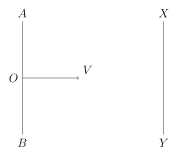
TikZ diagram
\(AOB\) represents a smooth vertical wall and \(XY\) represents a parallel smooth vertical barrier, both standing on a smooth horizontal table. A particle \(P\) is projected along the table from \(O\) with speed \(V\) in a direction perpendicular to the wall. At the time of projection, the distance between the wall and the barrier is \((75/32)VT\), where \(T\) is a constant. The barrier moves directly towards the wall, remaining parallel to the wall, with initial speed \(4V\) and with constant acceleration \(4V/T\) directly away from the wall. The particle strikes the barrier \(XY\) and rebounds. Show that this impact takes place at time \(5T/8\). The barrier is sufficiently massive for its motion to be unaffected by the impact. Given that the coefficient of restitution is \(1/2\), find the speed of \(P\) immediately after impact. \(P\) strikes \(AB\) and rebounds. Given that the coefficient of restitution for this collision is also \(1/2,\) show that the next collision of \(P\) with the barrier is at time \(9T/8\) from the start of the motion.

1992 Paper 3 Q12
D: 1700.0 B: 1500.0

\(\,\)

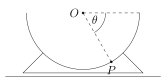
TikZ diagram
A smooth hemispherical bowl of mass \(2m\) is rigidly mounted on a light carriage which slides freely on a horizontal table as shown in the diagram. The rim of the bowl is horizontal and has centre \(O\). A particle \(P\) of mass \(m\) is free to slide on the inner surface of the bowl. Initially, \(P\) is in contact with the rim of the bowl and the system is at rest. The system is released and when \(OP\) makes an angle \(\theta\) with the horizontal the velocity of the bowl is \(v\)? Show that \[3v=a\dot{\theta}\sin\theta \] and that \[ v^{2}=\frac{2ga\sin^{3}\theta}{3(3-\sin^{2}\theta)}, \] where \(a\) is the interior radius of the bowl. Find, in terms of \(m,g\) and \(\theta,\) the reaction between the bowl and the particle.

1992 Paper 3 Q13
D: 1700.0 B: 1500.0

\(\,\)

\psset{xunit=1.0cm,yunit=1.0cm,algebraic=true,dimen=middle,dotstyle=o,dotsize=3pt 0,linewidth=0.3pt,arrowsize=3pt 2,arrowinset=0.25} \begin{pspicture*}(-2.8,-2.34)(3.26,4.36) \pspolygon[linewidth=0.4pt](0.22,-0.18)(0.4,0.04)(0.18,0.22)(0,0) \pscircle(0,0){2} \psline(2,0)(2,4) \rput[tl](2.24,2.64){\(\pi b\)} \rput[tl](2.22,0.02){\(C\)} \rput[tl](2.24,4.3){\(A\)} \rput[tl](1.32,2.1){\(Q\)} \rput[tl](-0.42,0.08){\(O\)} \rput[tl](1.6,-1.38){\(P\)} \psline[linestyle=dashed,dash=3pt 3pt](1.27,1.54)(0,0) \psline[linestyle=dashed,dash=3pt 3pt](0,0)(1.54,-1.27) \rput[tl](0.06,1.1){\(2b\)} \begin{scriptsize} \psdots[dotsize=2pt 0,dotstyle=*](2,4) \end{scriptsize} \end{pspicture*}
A uniform circular disc of radius \(2b,\) mass \(m\) and centre \(O\) is free to turn about a fixed horizontal axis through \(O\) perpendicular to the plane of the disc. A light elastic string of modulus \(kmg\), where \(k>4/\pi,\) has one end attached to a fixed point \(A\) and the other end to the rim of the disc at \(P\). The string is in contact with the rim of the disc along the arc \(PC,\) and \(OC\) is horizontal. The natural length of the string and the length of the line \(AC\) are each \(\pi b\) and \(AC\) is vertical. A particle \(Q\) of mass \(m\) is attached to the rim of the disc and \(\angle POQ=90^{\circ}\) as shown in the diagram. The system is released from rest with \(OP\) vertical and \(P\) below \(O\). Show that \(P\) reaches \(C\) and that then the upward vertical component of the reaction on the axis is \(mg(10-\pi k)/3\).

1992 Paper 3 Q14
D: 1700.0 B: 1500.0

\(\,\)

\psset{xunit=1.0cm,yunit=1.0cm,algebraic=true,dimen=middle,dotstyle=o,dotsize=3pt 0,linewidth=0.3pt,arrowsize=3pt 2,arrowinset=0.25} \begin{pspicture*}(-2.26,-2.36)(6,5.7) \pscircle(0,0){2} \psline(-1.52,1.3)(1.38,4.08) \psline{->}(0,0)(0,5) \psline{->}(0,0)(5,0) \psline(0,0)(-1.52,1.3) \psline(0,2)(4,2) \parametricplot{0.0}{2.4340509797353143}{0.6*cos(t)+0|0.6*sin(t)+0} \rput[tl](1.58,4.34){\(P\)} \rput[tl](4.22,2.14){\(B\)} \rput[tl](0.44,0.92){\(\theta\)} \rput[tl](-2,1.75){\(Q\)} \rput[tl](-0.26,-0.06){\(O\)} \rput[tl](5.14,0.12){\(x\)} \rput[tl](-0.08,5.4){\(y\)} \begin{scriptsize} \psdots[dotstyle=*](1.38,4.08) \psdots[dotstyle=*](4,2) \end{scriptsize} \end{pspicture*}
A horizontal circular disc of radius \(a\) and centre \(O\) lies on a horizontal table and is fixed to it so that it cannot rotate. A light inextensible string of negligible thickness is wrapped round the disc and attached at its free end to a particle \(P\) of mass \(m\). When the string is all in contact with the disc, \(P\) is at \(A\). The string is unwound so that the part not in contact with the disc is taut and parallel to \(OA\). \(P\) is then at \(B\). The particle is projected along the table from \(B\) with speed \(V\) perpendicular to and away from \(OA\). In the general position, the string is tangential to the disc at \(Q\) and \(\angle AOQ=\theta.\) Show that, in the general position, the \(x\)-coordinate of \(P\) with respect to the axes shown in the figure is \(a\cos\theta+a\theta\sin\theta,\) and find \(y\)-coordinate of \(P\). Hence, or otherwise, show that the acceleration of \(P\) has components \(a\theta\dot{\theta}^{2}\) and \(a\dot{\theta}^{2}+a\theta\ddot{\theta}\) along and perpendicular to \(PQ,\) respectively. The friction force between \(P\) and the table is \(2\lambda mv^{2}/a,\) where \(v\) is the speed of \(P\) and \(\lambda\) is a constant. Show that \[ \frac{\ddot{\theta}}{\dot{\theta}}=-\left(\frac{1}{\theta}+2\lambda\theta\right)\dot{\theta} \] and find \(\dot{\theta}\) in terms of \(\theta,\lambda\) and \(a\). Find also the tension in the string when \(\theta=\pi.\)

1992 Paper 3 Q15
D: 1700.0 B: 1500.0

A goat \(G\) lies in a square field \(OABC\) of side \(a\). It wanders randomly round its field, so that at any time the probability of its being in any given region is proportional to the area of this region. Write down the probability that its distance, \(R\), from \(O\) is less than \(r\) if \(0 < r\leqslant a,\) and show that if \(r\geqslant a\) the probability is \[ \left(\frac{r^{2}}{a^{2}}-1\right)^{\frac{1}{2}}+\frac{\pi r^{2}}{4a^{2}}-\frac{r^{2}}{a^{2}}\cos^{-1}\left(\frac{a}{r}\right). \] Find the median of \(R\) and probability density function of \(R\). The goat is then tethered to the corner \(O\) by a chain of length \(a\). Find the conditional probability that its distance from the fence \(OC\) is more than \(a/2\).