Problems

Filters
Clear Filters

2 problems found

2005 Paper 3 Q9
D: 1700.0 B: 1484.0

Two particles, A and B, move without friction along a horizontal line which is perpendicular to a vertical wall. The coefficient of restitution between the two particles is \(e\) and the coefficient of restitution between particle B and the wall is also \(e\), where \( 0< e < 1\). The mass of particle~A is \(4em\) (with \(m > 0\)), and the mass of particle B is \((1-e)^2m\)\,. Initially, A is moving towards the wall with speed \((1-e)v\) (where \(v > 0\)) and B is moving away from the wall and towards A with speed \(2ev\). The two particles collide at a distance \(d\) from the wall. Find the speeds of A and B after the collision. When B strikes the wall, it rebounds along the same line. Show that a second collision will take place, at a distance \(de\) from the wall. Deduce that further collisions will take place. Find the distance from the wall at which the \(n\)th collision takes place, and show that the times between successive collisions are equal.

2001 Paper 2 Q10
D: 1600.0 B: 1486.3

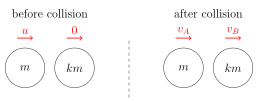
Two particles \(A\) and \(B\) of masses \(m\) and \(km\), respectively, are at rest on a smooth horizontal surface. The direction of the line passing through \(A\) and \(B\) is perpendicular to a vertical wall which is on the other side of \(B\) from \(A\). The particle \(A\) is now set in motion towards \(B\) with speed \(u\). The coefficient of restitution between \(A\) and \(B\) is \(e_1\) and between \(B\) and the wall is \(e_2\). Show that there will be a second collision between \(A\) and \(B\) provided $$ k< \frac {1+e_2(1+e_1)} {e_1}\;. $$ Show that, if \(e_1=\frac13\), \(e_2=\frac12\) and \(k<5\), then the kinetic energy of \(A\) and \(B\) immediately after \(B\) rebounds from the wall is greater than \(mu^2/27\).


Solution: First collision:
TikZ diagram
Since the \(e = e_1\), the speed of approach is \(u\) the speed of separation will be \(e_1u\) and so \(v_B = v_A + e_1u\). \begin{align*} \text{COM}: && mu &= mv_A + km(v_A + e_1u) \\ \Rightarrow && v_A(1+k) &= u(1-ke_1) \\ \Rightarrow && v_A &= \frac{1-ke_1}{1+k} u \\ && v_B &= \frac{1-ke_1}{1+k} u + e_1 u \\ &&&= \frac{1-ke_1 + e_1+ke_1}{1+k}u \\ &&&= \frac{1+e_1}{1+k}u \end{align*} Once the ball rebounds from the wall it will have velocity (still taking towards the wall as +ve) of \(-\frac{1+e_1}{1+k}e_2u\). There will be another collision if it is travelling faster than \(A\), ie if: \begin{align*} -\frac{1+e_1}{1+k}e_2u &< \frac{1-ke_1}{1+k} u \\ \Leftrightarrow && 0 &< (1-ke_1) + (1+e_1)e_2 \\ \Leftrightarrow && ke_1 &< 1 +e_2 (1+e_1) \\ \Leftrightarrow && k &< \frac{1 +e_2 (1+e_1)}{e_1} \\ \end{align*} If \(e_1 = \frac13, e_2 = \frac12\), then \(v_A = \frac{1-\frac13k}{1+k}u = \frac{3-k}{3(1+k)}u\) and \(v_B = \frac{4}{3(1+k)}u\). Therefore \begin{align*} && \text{total k.e.} &= \underbrace{\frac12 m v_A^2}_{\text{k.e. of }A} + \underbrace{\frac12 (km) (e_2 v_B)^2}_{\text{k.e. of }B} \\ &&&= \frac12 m \frac{(3-k)^2}{9(1+k)^2}u^2 + \frac12 km \frac14 \frac{16}{9(1+k)^2}u^2 \\ &&&= \frac12mu^2 \frac{1}{9(1+k)^2}\left ( (3-k)^2+4k \right) \\ &&&= \frac12mu^2 \frac{1}{9(1+k)^2}\left ( 9-2k+k^2 \right) \\ &&&= \frac{mu^2}{18} \frac{9-2k+k^2}{1+2k+k^2} \end{align*} We wish to minimize this as a function of \(k\). \begin{align*} \frac{\d}{\d k} \left ( \frac{9-2k+k^2}{1+2k+k^2}\right) &= \frac{(1+k)^2(2k-2)-2(1+k)(k^2-2k+9)}{(1+k)^4} \\ &= \frac{2(k^2-1) - 2(k^2-2k+9)}{(1+k)^3} \\ &= \frac{2(2k-10)}{(1+k)^3} \end{align*} Therefore the minimum will be when \(k = 5\) can't be a maximum by considering \(k \to 0\). This value is \(\frac{2}{3}\) and therefore \(\frac{mu^2}{18} \frac{2}{3} = \frac{mu^2}{27}\) is the smallest energy (which isn't quite achievable since \(k < 5\).