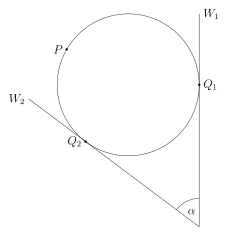
A uniform sphere of mass \(M\) and radius \(r\) rests between a vertical wall \(W_{1}\) and an inclined plane \(W_{2}\) that meets \(W_{1}\) at an angle \(\alpha.\) \(Q_{1}\) and \(Q_{2}\) are the points of contact of the sphere with \(W_{1}\) and \(W_{2}\) resectively, as shown in the diagram. A particle of mass \(m\) is attached to the sphere at \(P\), where \(PQ_{1}\) is a diameter, and the system is released. The sphere is on the point of slipping at \(Q_{1}\) and at \(Q_{2}.\) Show that if the coefficients of friction between the sphere and \(W_{1}\) and \(W_{2}\) are \(\mu_{1}\) and \(\mu_{2}\) respectively, then
\[
m=\frac{\mu_{2}+\mu_{1}\cos\alpha-\mu_{1}\mu_{2}\sin\alpha}{(2\mu_{1}\mu_{2}+1)\sin\alpha+(\mu_{2}-2\mu_{1})\cos\alpha-\mu_{2}}M.
\]
If the sphere is on the point of rolling about \(Q_{2}\) instead of slipping, show that
\[
m=\frac{M}{\sec\alpha-1}.
\]
Solution:
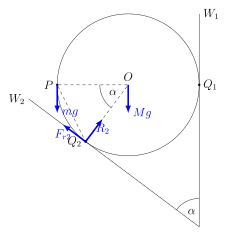
Since the sphere is on the point of slipping at both \(Q_1\) and \(Q_2\), \(F_{r1} = \mu_1 R_1\) and \(F_{r2} = \mu_2 R_2\)
\begin{align*}
\text{N2}(\uparrow): && -mg-Mg-\mu_1 R_1 + R_2 \sin \alpha + \mu_2 R_2 \cos \alpha &= 0 \\
\text{N2}(\rightarrow): && -R_1 + R_2 \cos \alpha - \mu_2 R_2 \sin \alpha &= 0 \\
\\
\Rightarrow && R_2 \cos \alpha - \mu_2 R_2 \sin \alpha &= R_1 \\
% && -mg-Mg+\mu_1 (R_2 \cos \alpha - \mu_2 R_2 \sin \alpha) + R_2 \sin \alpha + \mu_2 R_2 \cos \alpha &= 0 \\
% \\
\overset{\curvearrowleft}{O}: && mg - \mu_1 R_1 - \mu_2R_2 &= 0 \\
\Rightarrow && \mu_1 R_2 \l \cos \alpha - \mu_2 \sin \alpha \r - \mu_2 R_2 &= -mg \\
&& \mu_1 (R_2 \cos \alpha - \mu_2 R_2 \sin \alpha) + R_2 \sin \alpha + \\ && \quad \quad \mu_2 R_2 \cos \alpha - \mu_1 R_2 \l \cos \alpha - \mu_2 \sin \alpha \r - \mu_2 R_2 &= Mg \\
\Rightarrow && \frac{\mu_2+\mu_1 \l \cos \alpha - \mu_2 \sin \alpha \r }{\mu_1 ( \cos \alpha - \mu_2 \sin \alpha) + \sin \alpha + \mu_2 \cos \alpha - \mu_1 \l \cos \alpha - \mu_2 \sin \alpha \r - \mu_2 } &= \frac{m}{M} \\
&& \frac{\mu_2+\mu_1 \cos \alpha - \mu_1\mu_2 \sin \alpha }{\cos \alpha (-2\mu_1+\mu_2) + \sin \alpha (1 +2\mu_1\mu_2) -\mu_2} &= \frac{m}{M}
\end{align*}
If instead the sphere is about to roll about \(Q_2\), then the forces at \(Q_1\) will be \(0\), we can then take moments about \(Q_2\).
Looking at perpendicular distances from \(Q_2\) to \(O\) and \(P\) we have \(r \cos \alpha\) and \(r(1-\cos \alpha)\)
\begin{align*}
\overset{\curvearrowleft}{Q_2}: && mg (1 - \cos \alpha) - Mg \cos \alpha &= 0 \\
\Rightarrow && \frac{1}{\sec \alpha-1} &= \frac{m}{M}
\end{align*}