Problems

Filters
Clear Filters

4 problems found

2012 Paper 3 Q10
D: 1700.0 B: 1500.0

A small ring of mass \(m\) is free to slide without friction on a hoop of radius \(a\). The hoop is fixed in a vertical plane. The ring is connected by a light elastic string of natural length \(a\) to the highest point of the hoop. The ring is initially at rest at the lowest point of the hoop and is then slightly displaced. In the subsequent motion the angle of the string to the downward vertical is \(\phi\). Given that the ring first comes to rest just as the string becomes slack, find an expression for the modulus of elasticity of the string in terms of \(m\) and \(g\). Show that, throughout the motion, the magnitude \(R\) of the reaction between the ring and the hoop is given by \[ R = ( 12\cos^2\phi -15\cos\phi +5) mg \] and that \(R\) is non-zero throughout the motion.

2003 Paper 3 Q9
D: 1700.0 B: 1503.8

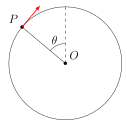
A particle \(P\) of mass \(m\) is constrained to move on a vertical circle of smooth wire with centre~\(O\) and of radius \(a\). \(L\) is the lowest point of the circle and \(H\) the highest and \(\angle LOP = \theta\,\). The particle is attached to \(H\) by an elastic string of natural length \(a\) and modulus of elasticity~\(\alpha mg\,\), where \(\alpha > 1\,\). Show that, if \(\alpha>2\,\), there is an equilibrium position with \(0<\theta<\pi\,\). Given that \(\alpha =2+\sqrt 2\,\), and that \(\displaystyle \theta = \tfrac{1}{2}\pi + \phi\,\), show that \[ \ddot{\phi} \approx -\frac{g (\sqrt2+1)}{2a }\, \phi \] when \(\phi\) is small. For this value of \(\alpha\), explain briefly what happens to the particle if it is given a small displacement when \( \theta = \frac{1}{2}\pi\).

1996 Paper 2 Q10
D: 1600.0 B: 1516.0

The plot of `Rhode Island Red and the Henhouse of Doom' calls for the heroine to cling on to the circumference of a fairground wheel of radius \(a\) rotating with constant angular velocity \(\omega\) about its horizontal axis and then let go. Let \(\omega_{0}\) be the largest value of \(\omega\) for which it is not possible for her subsequent path to carry her higher than the top of the wheel. Find \(\omega_{0}\) in terms of \(a\) and \(g\). If \(\omega>\omega_{0}\) show that the greatest height above the top of the wheel to which she can rise is \[\frac{a}{2}\left(\frac{\omega}{\omega_{0}} -\frac{\omega_{0}}{\omega}\right)^{\!\!2}.\]


Solution:
TikZ diagram
\begin{align*} \uparrow: && v &= u + at \\ \Rightarrow && T &= \frac{a \omega \sin \theta}{g} \\ && s &= ut + \frac12 gt^2 \\ \Rightarrow && s &= a\omega \sin \theta \cdot \frac{a \omega \sin \theta}{g} - \frac12 g \left ( \frac{a \omega \sin \theta}{g} \right) ^2 \\ &&&= \frac1{2g} a^2 \omega^2 \sin^2 \theta \\ s < \text{distance to top}: && \frac1{2g} a^2 \omega^2 \sin^2 \theta &< a(1- \cos \theta) \\ \Rightarrow && \omega^2 &< \frac{2g}{a} \frac{1-\cos \theta}{\sin^2 \theta} \\ &&&= \frac{2g}{a} \frac{2 \sin^2 \tfrac12 \theta}{4 \sin^2 \tfrac12 \theta \cos^2 \tfrac12 \theta} \\ &&&= \frac{g}{a} \sec^2 \tfrac12 \theta \\ &&&\leq \frac{g}{a} \tag{since it holds for all \(\theta\) it holds for min \(\theta\)}\\ \Rightarrow && \omega_0 &= \sqrt{\frac{g}{a}} \\ \\ && \text{max height} &= \frac1{2g} a^2 \omega^2 \sin^2 \theta - a(1-\cos \theta) \\ &&&= \frac1{2g} a^2 \omega^2 (1-\cos^2 \theta) - a(1-\cos \theta) \\ &&&= \frac{a}{2} \left (- \frac{\omega^2}{\omega_0^2} \cos^2 \theta + 2 \cos \theta + \frac{\omega^2}{\omega_0^2}-2 \right) \\ &&&= \frac{a}{2} \left (-\left (\frac{\omega_0}{\omega}- \frac{\omega}{\omega_0} \cos \theta \right)^2 + \frac{\omega^2}{\omega_0^2}-2+\frac{\omega_0^2}{\omega^2} \right) \\ &&&= \frac{a}{2} \left ( \frac{\omega}{\omega_0} - \frac{\omega_0}{\omega} \right)^2 - \frac{a}{2} \left (\frac{\omega_0}{\omega}- \frac{\omega}{\omega_0} \cos \theta \right)^2 \end{align*} If \(\omega > \omega_0\) we can find a \(\theta\) such that the second bracket is \(0\), hence the maximium height is as desired.

1990 Paper 3 Q13
D: 1700.0 B: 1500.0

A particle \(P\) is projected, from the lowest point, along the smooth inside surface of a fixed sphere with centre \(O\). It leaves the surface when \(OP\) makes an angle \(\theta\) with the upward vertical. Find the smallest angle that must be exceeded by \(\theta\) to ensure that \(P\) will strike the surface below the level of \(O\). You may find it helpful to find the time at which the particle strikes the sphere.


Solution:

TikZ diagram
\begin{align*} %\text{COE}: && \frac12 m u^2 - mga &= \frac12mv^2 + mga\cos \theta \\ \text{N2}(\swarrow): && R+mg\cos\theta &= \frac{m v^2}{a} \\ R = 0: && v^2 &= ag\cos \theta \\ \end{align*} So the particle will become a projectile moving tangent to the circle with \(v^2 = ag \cos \theta\). Therefore the velocity will be \(\displaystyle \sqrt{ag \cos \theta}\binom{-\cos \theta}{\sin \theta}\). We have: \begin{align*} && \mathbf{s} &= a\binom{\sin \theta}{\cos \theta}+\sqrt{ag \cos \theta}\binom{-\cos \theta}{\sin \theta} t + \frac12 \binom{0}{-g} t^2 \\ \Rightarrow && a^2 &= \mathbf{s} \cdot \mathbf{s} \\ &&&= a^2 + ag\cos \theta t^2 + \frac1{4} g^2t^4 -ag \cos \theta t^2 - \sqrt{ag \cos \theta} \sin \theta g t^3 \\ \Rightarrow && 0 &= \frac14 g t - \sqrt{ag \cos \theta} \sin \theta \\ \Rightarrow && t &= \frac{4\sqrt{a g \cos \theta} \sin \theta}{g} \end{align*} At this time, the vertical position will be: \begin{align*} && s_y &= a \cos \theta + \sqrt{ag \cos \theta} \sin \theta \frac{4\sqrt{a g \cos \theta} \sin \theta}{g} - \frac12 g \left ( \frac{4\sqrt{a g \cos \theta} \sin \theta}{g} \right)^2 \\ &&&= a \cos \theta + 4a\cos \theta \sin^2 \theta - 8a\cos \theta \sin^2 \theta \\ &&&= a \cos \theta - 4 a \cos \theta \sin^2 \theta \\ &&&= a \cos \theta (1-4 \sin^2 \theta) \\ \underbrace{\Rightarrow}_{s_y < 0} && 0 &> 1 - 4 \sin^2 \theta \\ \Rightarrow && \sin\theta &> \frac12 \\ \Rightarrow && \theta & > \frac{\pi}{6} \end{align*}