Problems
Filters
6 problems found
2024 Paper 3 Q10
A cube of uniform density \(\rho\) is placed on a horizontal plane and a second cube, also of uniform density \(\rho\), is placed on top of it. The lower cube has side length \(1\) and the upper cube has side length \(a\), with \(a \leqslant 1\). The centre of mass of the upper cube is vertically above the centre of mass of the lower cube and all the edges of the upper cube are parallel to the corresponding edges of the lower cube. The contacts between the two cubes, and between the lower cube and the plane, are rough, with the same coefficient of friction \(\mu < 1\) in each case. The midpoint of the base of the upper cube is \(X\) and the midpoint of the base of the lower cube is \(Y\). A horizontal force \(P\) is exerted, perpendicular to one of the vertical faces of the upper cube, at a point halfway between the two vertical edges of this face, and a distance \(h\), with \(h < a\), above the lower edge of this face.
- Show that, if the two cubes remain in equilibrium, the normal reaction of the plane on the lower cube acts at a point which is a distance \[\frac{P(1+h)}{(1+a^3)\rho g}\] from \(Y\), and find a similar expression for the distance from \(X\) of the point at which the normal reaction of the lower cube on the upper cube acts.
- Show that, if neither cube topples, equilibrium will be broken by the slipping of the upper cube on the lower cube, and not by the slipping of the lower cube on the ground.
- Show that, if \(a = 1\), then equilibrium will be broken by the slipping of the upper cube on the lower cube if \(\mu(1+h) < 1\) and by the toppling of the lower and upper cube together if \(\mu(1+h) > 1\).
- Show that, in a situation where \(a < 1\) and \(h\bigl(1 + a^3(1-a)\bigr) > a^4\), and no slipping occurs, equilibrium will be broken by the toppling of the upper cube.
- Show, by considering \(a = \frac{1}{2}\) and choosing suitable values of \(h\) and \(\mu\), that the situation described in (iv) can in fact occur.
2019 Paper 1 Q9
A box has the shape of a uniform solid cuboid of height \(h\) and with a square base of side \(b\), where \(h > b\). It rests on rough horizontal ground. A light ladder has its foot on the ground and rests against one of the upper horizontal edges of the box, making an acute angle of \(\alpha\) with the ground, where \(h = b \tan \alpha\). The weight of the box is \(W\). There is no friction at the contact between ladder and box. A painter of weight \(kW\) climbs the ladder slowly. Neither the base of the ladder nor the box slips, but the box starts to topple when the painter reaches height \(\lambda h\) above the ground, where \(\lambda < 1\). Show that:
- \(R = k\lambda W \cos \alpha\), where \(R\) is the magnitude of the force exerted by the box on the ladder;
- \(2k\lambda \cos 2\alpha + 1 = 0\);
- \(\mu \geq \frac{\sin 2\alpha}{1 - 3 \cos 2\alpha}\), where \(\mu\) is the coefficient of friction between the box and the ground.
Solution:

- \(\,\) \begin{align*} \overset{\curvearrowright}{X}:&& kW \cdot \lambda h\cos \alpha - R h &= 0 \\ \Rightarrow && R &= k\lambda W \cos \alpha \\ \end{align*}
- \(\,\) \begin{align*} \overset{\curvearrowright}{C}:&& R \sin \alpha \cdot h-R\cos \alpha \cdot b-W\frac{b}{2} &= 0 \\ && k\lambda W \cos \alpha \sin \alpha \cdot b \tan \alpha- k\lambda W \cos \alpha\cos \alpha \cdot h-W\frac{b}{2} &= 0 \\ && k \lambda (\cos^2 \alpha - \sin^2 \alpha) +\frac12 &= 0 \\ \Rightarrow && 2k \lambda \cos 2\alpha + 1 &= 0 \end{align*}
- \(\,\) \begin{align*} \text{N2}(\uparrow): && R_b -W-R\cos \alpha &= 0 \\ \Rightarrow && R_b &= W + k\lambda W \cos^2 \alpha\\ \text{N2}(\rightarrow): && R\sin \alpha - F_b &= 0 \\ \Rightarrow && F_b &= R \sin \alpha \\ \\ && F_b &\leq \mu R \\ \Rightarrow && k\lambda W \cos \alpha \sin \alpha &= \mu (W + k\lambda W \cos^2 \alpha) \\ \Rightarrow && \mu &\geq \frac{k\lambda \cos \alpha \sin \alpha}{1 + k\lambda \cos^2 \alpha} \\ &&&= \frac{k\lambda \sin 2\alpha}{2 + 2k\lambda cos^2 \alpha} \\ &&&= \frac{k\lambda \sin 2\alpha}{2 + k\lambda (\cos 2 \alpha+1)} \\ &&&= \frac{k\lambda \sin 2\alpha}{-4k\lambda \cos 2 \alpha + k\lambda (\cos 2 \alpha+1)} \\ &&&= \frac{\sin 2 \alpha}{1 -3 \cos 2\alpha} \end{align*}
2006 Paper 2 Q9
A painter of weight \(kW\) uses a ladder to reach the guttering on the outside wall of a house. The wall is vertical and the ground is horizontal. The ladder is modelled as a uniform rod of weight \(W\) and length \(6a\). The ladder is not long enough, so the painter stands the ladder on a uniform table. The table has weight \(2W\) and a square top of side \(\frac12 a\) with a leg of length \(a\) at each corner. The foot of the ladder is at the centre of the table top and the ladder is inclined at an angle \(\arctan 2\) to the horizontal. The edge of the table nearest the wall is parallel to the wall. The coefficient of friction between the foot of the ladder and the table top is \(\frac12\). The contact between the ladder and the wall is sufficiently smooth for the effects of friction to be ignored.
- Show that, if the legs of the table are fixed to the ground, the ladder does not slip on the table however high the painter stands on the ladder.
- It is given that \(k=9\) and that the coefficient of friction between each table leg and the ground is \(\frac13\). If the legs of the table are not fixed to the ground, so that the table can tilt or slip, determine which occurs first when the painter slowly climbs the ladder.
2002 Paper 1 Q9
\(\,\) \vspace*{-0.5in}
- If the normal reactions on the lower and higher wheels of the lorry are equal, show that the sum of the frictional forces between the wheels and the ground is zero.
- If \(P\) is such that the lorry does not tip over (but the normal reactions on the lower and higher wheels of the lorry need not be equal), show that \[ W\tan(\alpha - \beta) \le P \le W\tan(\alpha+\beta)\;, \] where \(\tan\beta = d/h\,\).
2002 Paper 3 Q9
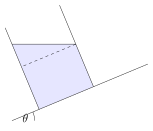
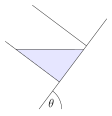
A tall container made of light material of negligible thickness has the form of a prism, with a square base of area \(a^2\). It contains a volume \(ka^3\) of fluid of uniform density. The container is held so that it stands on a rough plane, which is inclined at angle \(\theta\) to the horizontal, with two of the edges of the base of the container horizontal. In the case \(k > \frac12 \tan\theta\), show that the centre of mass of the fluid is at a distance \(x\) from the lower side of the container and at a distance \(y\) from the base of the container, where \[ \frac x a = \frac12 - \frac {\tan\theta}{12k}\;, \ \ \ \ \ \ \frac y a = \frac k 2 + \frac{\tan^2\theta}{24k}\;. \] Determine the corresponding coordinates in the case \(k < \frac12 \tan\theta\). The container is now released. Given that \(k < \frac12\), show that the container will topple if \(\theta >45^\circ\).
Solution:
1996 Paper 2 Q9
A child's toy consists of a solid cone of height \(\lambda a\) and a solid hemisphere of radius \(a\), made out of the same uniform material and fastened together so that their plane faces coincide. (Thus the diameter of the hemisphere is equal to that of the base of the cone.) Show that if \(\lambda < \sqrt{3}\) the toy will always move to an upright position if placed with the surface of the hemisphere on a horizontal table, but that if \(\lambda > \sqrt{3}\) the toy may overbalance. Show, however, that if the toy is placed with the surface of the cone touching the table it will remain there whatever the value of \(\lambda\). [The centre of gravity of a uniform solid cone of height \(h\) is a height \(h/4\) above its base. The centre of gravity of a uniform solid hemisphere of radius \(a\) is at distance \(3a/8\) from the centre of its base.]
Solution:

