Problems
Filters
8 problems found
2022 Paper 2 Q3
The Fibonacci numbers are defined by \(F_0 = 0\), \(F_1 = 1\) and, for \(n \geqslant 0\), \(F_{n+2} = F_{n+1} + F_n\).
- Prove that \(F_r \leqslant 2^{r-n} F_n\) for all \(n \geqslant 1\) and all \(r \geqslant n\).
- Let \(S_n = \displaystyle\sum_{r=1}^{n} \frac{F_r}{10^r}\). Show that \[\sum_{r=1}^{n} \frac{F_{r+1}}{10^{r-1}} - \sum_{r=1}^{n} \frac{F_r}{10^{r-1}} - \sum_{r=1}^{n} \frac{F_{r-1}}{10^{r-1}} = 89S_n - 10F_1 - F_0 + \frac{F_n}{10^n} + \frac{F_{n+1}}{10^{n-1}}\,.\]
- Show that \(\displaystyle\sum_{r=1}^{\infty} \frac{F_r}{10^r} = \frac{10}{89}\) and that \(\displaystyle\sum_{r=7}^{\infty} \frac{F_r}{10^r} < 2 \times 10^{-6}\). Hence find, with justification, the first six digits after the decimal point in the decimal expansion of \(\dfrac{1}{89}\).
- Find, with justification, a number of the form \(\dfrac{r}{s}\) with \(r\) and \(s\) both positive integers less than \(10000\) whose decimal expansion starts \[0.0001010203050813213455\ldots\,.\]
2018 Paper 1 Q6
Use the identity \[ 2 \sin P\,\sin Q = \cos(Q-P)-\cos(Q+P)\, \] to show that \[ 2\sin\theta \,\big (\sin\theta + \sin 3\theta + \cdots + \sin (2n-1)\theta\,\big ) = 1-\cos 2n\theta \,. \]
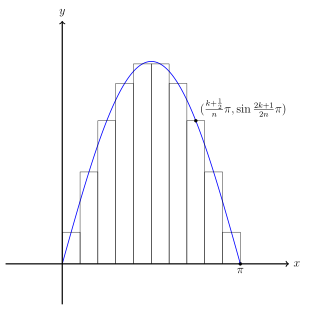
- Let \(A_n\) be the approximation to the area under the curve \(y=\sin x\) from \(x=0\) to \(x=\pi\), using \(n\) rectangular strips each of width \(\frac{{\displaystyle \pi}}{\displaystyle n}\), such that the midpoint of the top of each strip lies on the curve. Show that \[ A_n \sin \left( \frac{\pi}{2n} \right) = \frac \pi n\,. \]
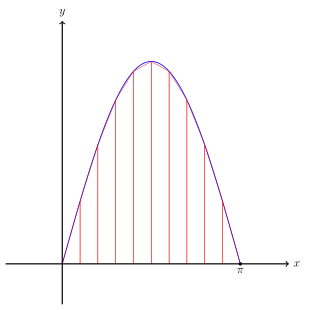
- Let \(B_n\) be the approximation to the area under the curve \(y=\sin x\) from \(x=0\) to \(x=\pi\,\), using the trapezium rule with \(n\) strips each of width \(\frac{\displaystyle \pi}{ \displaystyle n}\). Show that \[B_n \sin \left( \frac{\pi}{2n} \right) = \frac{\pi}{n} \cos \left( \frac{\pi}{2n} \right) . \]
- Show that \[ \frac{1}{2}(A_n + B_n) = B_{2n}\,, \] and that \[ A_n B_{2n} = A^2_{2n}\, . \]
Solution: \begin{align*} && 2\sin\theta \,\big (\sin\theta + \sin 3\theta + \cdots + \sin (2n-1)\theta\,\big ) &= 2\sin\theta\sin\theta + 2\sin\theta\sin 3\theta + \cdots + 2\sin\theta\sin (2n-1)\theta \\ &&&= \cos((1-1)\theta) - \cos((1+1)\theta)+\cos((3-1)\theta)-\cos((3+1)\theta) + \cdots + \cos (((2n-1)-1)\theta) -\cos(((2n-1)+1)\theta) \\ &&&= \cos 0 - \cos(2n\theta) \\ &&&= 1 - \cos 2n \theta \end{align*}
- \(\,\)
Therefore the area is: \begin{align*} A_n &= \frac{\pi}{n} \sin \left ( \frac{\pi}{2n} \right) + \frac{\pi}{n} \sin \left ( \frac{3\pi}{2n} \right) + \frac{\pi}{n} \sin \left ( \frac{5\pi}{2n} \right) + \cdots \frac{\pi}{n} \sin \left ( \frac{(2n-1)\pi}{2n} \right) \\ &= \frac{\pi}{n} \left( \frac{1-\cos \frac{2n \pi}{2n}}{2\sin \frac{\pi}{2n}} \right) \\ &= \frac{\pi}{n} \frac{1}{\sin \frac{\pi}{2n}} \end{align*} as required
- Therefore the area is: \begin{align*} && B_n &= \frac{\pi}{n} \frac{\sin(0)+\sin(\frac{\pi}{n})}{2}+\frac{\pi}{n} \frac{\sin(\frac{\pi}n)+\sin(\frac{2\pi}{n})}{2} + \cdots \frac{\pi}{n} \frac{\sin(\frac{(n-1)\pi}{n})+\sin(\frac{n\pi}{n})}{2} \\ &&&= \frac{\pi}{n} \left ( \sin \frac{\pi}{n} + \sin \frac{2\pi}{n} + \cdots+\sin \frac{(n-1)\pi}{n} \right) \\ \Rightarrow && 2\sin \left ( \frac{\pi}{2n} \right)B_n &= \frac{\pi}{2} \left (2\sin \left ( \frac{\pi}{2n} \right)\sin \frac{\pi}{n} + 2\sin \left ( \frac{\pi}{2n} \right)\sin \frac{2\pi}{n} + \cdots+2\sin \left ( \frac{\pi}{2n} \right)\sin \frac{(n-1)\pi}{n} \right) \\ &&&= \frac{\pi}2 \left ( \cos \frac{\pi}{2n} - \cos \frac{3\pi}{n} + \cos\frac{3\pi}{2n} - \cos \frac{5\pi}{2n} + \cos \frac{(2n-3)\pi}{2n} - \cos \frac{(2n-1)\pi}{2n} \right) \\ &&&= \frac{\pi}{n} \left ( \cos \frac{\pi}{2n} - \cos \left ( \pi - \frac{\pi}{2n} \right) \right) \\ &&&= 2 \frac{\pi}{n} \cos \frac{\pi}{2n} \\ \Rightarrow && \sin \left ( \frac{\pi}{2n} \right)B_n &= \frac{\pi}n \cos \frac{\pi}{2n} \end{align*} as required
- \begin{align*} \frac12(A_n+B_n) &= \frac12 \frac{\pi}{n} \frac{1}{\sin \frac{\pi}{2n}} \left ( 1 + \cos \frac{\pi}{2n} \right) \\ &= \frac{\pi}{n}\frac1{2 \sin \frac{\pi}{2n}} \left (2 \cos^2 \frac{\pi}{4n} \right) \\ &=\frac{\pi}{n} \frac{1}{4 \sin \frac{\pi}{4n} \cos \frac{\pi}{4n}} \left (2 \cos^2 \frac{\pi}{4n} \right) \\ &= \frac{\pi}{2n} \frac{\cos \frac{\pi}{4n}}{\sin \frac{\pi}{4n}} \\ &= B_{2n} \\ \\ A_nB_{2n} &= \frac{\pi}{n\sin \frac{\pi}{2n}} \cdot \frac{\pi}{2n} \frac{\cos \frac{\pi}{4n}}{\sin \frac{\pi}{4n}} \\ &= \frac{\pi^2}{(2n)^2} \frac{\cos \frac{\pi}{4n}}{\sin^2 \frac{\pi}{4n} \cos \frac{\pi}{4n}} \\ &= \left ( \frac{\pi}{2n} \frac{1}{\sin \frac{\pi}{4n}}\right)^2 \\ &= A_{2n}^2 \end{align*}
2017 Paper 3 Q11
A railway truck, initially at rest, can move forwards without friction on a long straight horizontal track. On the truck, \(n\) guns are mounted parallel to the track and facing backwards, where \(n>1\). Each of the guns is loaded with a single projectile of mass \(m\). The mass of the truck and guns (but not including the projectiles) is \(M\). When a gun is fired, the projectile leaves its muzzle horizontally with a speed \(v-V\) relative to the ground, where \(V\) is the speed of the truck immediately before the gun is fired.
- All \(n\) guns are fired simultaneously. Find the speed, \(u\), with which the truck moves, and show that the kinetic energy, \(K\), which is gained by the system (truck, guns and projectiles) is given by \[ K= \tfrac{1}{2}nmv^2\left(1 +\frac{nm}{M} \right) . \]
- Instead, the guns are fired one at a time. Let \(u_r\) be the speed of the truck when \(r\) guns have been fired, so that \(u_0= 0\). Show that, for \(1\le r \le n\,\), \[ u_r - u_{r-1} = \frac{mv}{M+(n-r)m} \tag{\(*\)} \] and hence that \(u_n < u\,\).
- Let \(K_r\) be the total kinetic energy of the system when \(r\) guns have been fired (one at a time), so that \(K_0 = 0\). Using \((*)\), show that, for \(1\le r\le n\,\), \[ K_r -K_{r-1} = \tfrac 12 mv^2 + \tfrac12 mv (u_r-u_{r-1}) \] and hence show that \[ K_n = \tfrac{1}{2}nmv^2 +\tfrac{1}{2}mvu_n \,. \] Deduce that \(K_n < K\).
Solution:
- \(\,\) \begin{align*} \text{COM}: && 0 &= nm(v-0) - Mu \\ \Rightarrow && u &= \frac{nm}{M}v \\ \\ \Rightarrow && \text{K.E.} &= \underbrace{\tfrac12 nmv^2}_{\text{projectiles}} + \underbrace{\tfrac12Mu^2}_{\text{guns and truck}} \\ &&&= \tfrac12nmv^2 + \tfrac12M \frac{n^2m^2}{M^2}v^2 \\ &&&= \tfrac12 nmv^2 \left (1 + \frac{nm}{M} \right) \end{align*}
- \(\,\) \begin{align*} \text{COM}: && ((n-r+1)m+M)u_{r-1} &= -m(v-u_{r-1})+ ((n-r)m+M)u_r \\ \Rightarrow && mv &= -((n-r+1)m+M-m)u_{r-1}+((n-r)m+M)u_r \\ \Rightarrow && u_r-u_{r-1} &= \frac{mv}{M+(n-r)m} \\ \\ && u_n &= \frac{mv}{M+(n-1)m} + \frac{mv}{M+(n-2)m} + \cdots + \frac{mv}{M} \\ &&&< \frac{mv}M + \cdots + \frac{mv}{M} \\ &&&= \frac{mn}{M}v = u \end{align*}
- \(\,\) \begin{align*} && K_r &= \underbrace{K_{r-1}-\frac12(m(n-r+1)+M)u_{r-1}^2}_{\text{energy of already dispersed projectiles}} + \frac12m(v-u_{r-1})^2 + \frac12(m(n-r)+M)u_r^2 \\ \Rightarrow && K_r-K_{r-1} &= \tfrac12(u_r^2-u_{r-1}^2)(M+m(n-r))+\tfrac12mv^2-mvu_{r-1} \\ &&&=\tfrac12mv^2+ \tfrac12(u_r+u_{r-1})mv-mvu_{r-1} \\ &&&= \tfrac12mv^2 + \tfrac12mv(u_r-u_{r-1}) \\ \\ && K_n &= \frac12nmv^2 + \tfrac12mv(u_n - u_0) \\ &&&= \tfrac12nmv^2 + \tfrac12mvu_n \\ &&&< \tfrac12nmv^2 + \tfrac12mvu \\ &&&= \tfrac12nmv^2 + \tfrac12mv \frac{nm}{M}v \\ &&&= \tfrac12nmv^2 \left (1 +\frac{m}{M} \right) \\ &&&\leq K \end{align*}
1999 Paper 1 Q8
The function \(\f\) satisfies \(0\leqslant\f(t)\leqslant K\) when \(0\leqslant t\leqslant x\). Explain by means of a sketch, or otherwise, why \[0\leqslant\int_{0}^{x} \f (t)\,{\mathrm d}t \leqslant Kx.\] By considering \(\displaystyle \int_{0}^{1}\frac{t}{n(n-t)}\,{\mathrm d}t\), or otherwise, show that, if \(n>1\), \[ 0\le \ln \left( \frac n{n-1}\right) -\frac 1n \le \frac 1 {n-1} - \frac 1n \] and deduce that \[ 0\le \ln N -\sum_{n=2}^N \frac1n \le 1. \] Deduce that as \(N\to \infty\) \[ \sum_{n=1}^N \frac1n \to\infty. \] Noting that \(2^{10}=1024\), show also that if \(N<10^{30}\) then \[ \sum_{n=1}^N \frac1n <101. \]
1998 Paper 2 Q4
The integral \(I_n\) is defined by $$I_n=\int_0^\pi(\pi/2-x)\sin(nx+x/2)\,{\rm cosec}\,(x/2)\,\d x,$$ where \(n\) is a positive integer. Evaluate \(I_n-I_{n-1}\), and hence evaluate \(I_n\) leaving your answer in the form of a sum.
Solution: \begin{align*} && I_n - I_{n-1} &= \int_0^\pi \left ( \frac{\pi}{2} - x \right) \left ( \sin\left(nx + \frac{x}{2}\right) - \sin \left ((n-1)x + \frac{x}{2} \right)\right) \cosec \frac{x}{2} \d x \\ &&&= \int_0^\pi \left ( \frac{\pi}{2} - x \right) \left (2 \sin \left ( \frac{nx + \frac{x}{2} - (n-1)x - \frac{x}{2} }{2}\right)\cos nx \right) \cosec \frac{x}{2} \d x \\ &&&= \int_0^\pi \left ( \frac{\pi}{2} - x \right) \left (2 \sin \left ( \frac{x}{2}\right)\cos nx \right) \cosec \frac{x}{2} \d x \\ &&&=2 \int_0^\pi \left ( \frac{\pi}{2} - x \right) \cos nx \d x \\ &&&=\pi \left [ \frac{\sin nx}{n}\right]_0^{\pi} - 2\int_0^\pi x \cos n x \d x \\ &&&= 0 - 2\left[ \frac{x \sin nx}{n} \right]_0^{\pi} + 2\int_0^\pi \frac{\sin nx}{n} \d x \\ &&&= 2\left[ -\frac{\cos nx}{n^2} \right]_0^{\pi} \\ &&&=2 \frac{1-(-1)^{n}}{n^2} \\ \\ && I_0 &= \int_0^\pi (\pi/2 - x) \d x =0 \\ \Rightarrow && I_{2k+2} = I_{2k+1} &= 4 \left (\frac{1}{1^2} + \frac{1}{3^2} + \cdots + \frac{1}{(2k+1)^2} \right) \end{align*}
1996 Paper 1 Q6
Let \(\mathrm{f}(x)=\dfrac{\sin(n+\frac{1}{2})x}{\sin\frac{1}{2}x}\) for \(0 < x\leqslant\pi.\)
- Using the formula \[ 2\sin\tfrac{1}{2}x\cos kx=\sin(k+\tfrac{1}{2})x-\sin(k-\tfrac{1}{2})x \] (which you may assume), or otherwise, show that \[ \mathrm{f}(x)=1+2\sum_{k=1}^{n}\cos kx\,. \]
- Find \({\displaystyle \int_{0}^{\pi}\mathrm{f}(x)\,\mathrm{d}x}\) and \({\displaystyle \int_{0}^{\pi}\mathrm{f}(x)\cos x\,\mathrm{d}x}.\)
Solution:
- \(\,\) \begin{align*} && 2\sin \tfrac12 x \sum_{k=1}^n \cos kx &= \sum_{k=1}^n 2\sin \tfrac12 x \cos kx \\ &&&= \sum_{k=1}^n \left ( \sin(k+\tfrac12)x - \sin(k - \tfrac12)x \right) \\ &&&= \left ( \sin\tfrac32x - \sin\tfrac12x \right) + \\ &&&\quad \quad \left ( \sin\tfrac52x - \sin \tfrac32 x \right) + \\ &&&\quad \quad \quad +\cdots + \\ &&&\quad \quad \quad \quad +\left ( \sin(n+\tfrac12)x - \sin(n - \tfrac12)x \right) \\ &&&= \sin(n+\tfrac12)x - \sin \tfrac12 x \\ \Rightarrow && \sin(n+\tfrac12)x &= \sin \tfrac12 x + 2\sin \tfrac12 x \sum_{k=1}^n \cos kx \\ \Rightarrow && f(x) &= 1 + 2 \sum_{k=1}^n \cos kx \end{align*}
- \(\,\) \begin{align*} && \int_0^{\pi} f(x) \d x &= \int_0^{\pi} \left (1 + 2 \sum_{k=1}^n \cos kx \right) \d x \\ &&&= \pi + 2 \left [ \sum_{k=1}^n \frac{1}{k} \sin k x\right]_0^\pi \\ &&&= \pi \\ \\ && \int_0^{\pi} f(x) \cos x \d x &= \int_0^{\pi} \left (\cos x + 2 \sum_{k=1}^n \cos kx \cos x \right) \d x \\ &&&= 0 + \sum_{k=1}^n \left ( \int_0^{\pi} 2 \cos k x \cos x \d x \right) \\ &&&= \sum_{k=1}^n \left ( \int_0^{\pi} (\cos (k+1)x - \cos (k-1) x)\d x\right) \\ &&&= -\pi \end{align*}
1995 Paper 1 Q3
- If \(\mathrm{f}(r)\) is a function defined for \(r=0,1,2,3,\ldots,\) show that \[ \sum_{r=1}^{n}\left\{ \mathrm{f}(r)-\mathrm{f}(r-1)\right\} =\mathrm{f}(n)-\mathrm{f}(0). \]
- If \(\mathrm{f}(r)=r^{2}(r+1)^{2},\) evaluate \(\mathrm{f}(r)-\mathrm{f}(r-1)\) and hence determine \({\displaystyle \sum_{r=1}^{n}r^{3}.}\)
- Find the sum of the series \(1^{3}-2^{3}+3^{3}-4^{3}+\cdots+(2n+1)^{3}.\)
Solution:
- \(\,\) \begin{align*} && \sum_{r=1}^n \left (f(r) - f(r-1) \right) &= \cancel{f(1)} - f(0) + \cdots\\ &&&\quad\, \cancel{\f(2)}-\cancel{f(1)} + \cdots \\ &&&\quad\, \cancel{f(3)}-\cancel{f(2)} + \cdots \\ &&&\quad\, +\cdots + \cdots \\ &&&\quad\, \cancel{f(n-1)}-\cancel{f(n-2)} + \cdots \\ &&&\quad\, f(n)-\cancel{f(n-1)} \\ &&&=f(n) - f(0) \end{align*}
- If \(f(r) = r^2(r+1)^2\) then \begin{align*} && f(r) - f(r-1) &= r^2(r+1)^2 - (r-1)r^2 \\ &&&= r^2((r+1)^2-(r-1)^2) \\ &&&=4r^3 \end{align*} Therefore \begin{align*} && \sum_{r=1}^n 4r^3 &= n^2(n+1)^2-0 \\ \Rightarrow && \sum_{r=1}^n r^3 &= \frac{n^2(n+1)^2}{4} \\ \end{align*}
- So \begin{align*} && \sum_{r=1}^{2n+1} (-1)^{r-1}r^3 &= \sum_{r=1}^{2n+1} r^3 - 2 \sum_{r=1}^n (2r)^3 \\ &&&= \frac14(2n+1)^2(2n+2)^2 - 8 \frac{n^2(n+1)^2}{4} \\ &&&= (2n+1)^2(n+1)^2 - 2n^2(n+1)^2 \\ &&&= (n+1)^2(4n^2+4n+1 - 2n^2) \\ &&&= (n+1)^2(2n^2+4n+1) \end{align*}
1991 Paper 3 Q1
- Evaluate \[ \sum_{r=1}^{n}\frac{6}{r(r+1)(r+3)}. \]
- Expand \(\ln(1+x+x^{2}+x^{3})\) as a series in powers of \(x\), where \(\left|x\right|<1\), giving the first five non-zero terms and the general term.
- Expand \(\mathrm{e}^{x\ln(1+x)}\) as a series in powers of \(x\), where \(-1 < x\leqslant1\), as far as the term in \(x^{4}\).
Solution:
- \begin{align*} && \frac{6}{r(r+1)(r+3)} &= \frac{2}{r} - \frac{3}{r+1} + \frac{1}{r+3} \\ \Rightarrow && \sum_{r=1}^n \frac{6}{r(r+1)(r+3)} &= \sum_{r=1}^n \l \frac{2}{r} - \frac{3}{r+1} + \frac{1}{r+3} \r \\ &&&= \sum_{r=1}^n \frac{2}{r} - \sum_{r=1}^n \frac{3}{r+1} + \sum_{r=1}^n \frac{1}{r+3} \\ &&&= \sum_{r=1}^n \frac{2}{r} - \sum_{r=2}^{n+1} \frac{3}{r} + \sum_{r=3}^{n+2} \frac{1}{r} \\ &&& = \frac{2}{1} + \frac{2}{2} - \frac{3}{2} - \frac{3}{n+1} + \frac{1}{n+1} + \frac{1}{n+2} \\ &&& = \frac{3}{2} - \frac{2}{n+1} + \frac{1}{n+2} \end{align*}
- \begin{align*} && \ln (1 + x+ x^2 + x^3) &= \ln \l \frac{1-x^4}{1-x} \r \\ &&&= \ln (1-x^4) - \ln(1-x) \\ &&&= \sum_{k=1}^{\infty} -\frac{x^{4k}}{k} - \sum_{k=1}^{\infty} - \frac{x^k}{k} \\ &&&= x + \frac12x^2+\frac13x^3-\frac34x^4+\frac15x^5 + \cdots \\ &&&= \sum_{k=1}^{\infty}a_k x^k \end{align*} Where \(a_k = \frac{1}{k}\) if \(k \neq 0 \pmod{4}\) otherwise \(a_k = -\frac{3}{k}\) if \(k \equiv 0 \pmod{4}\)
- \begin{align*} \exp(x \ln (1+x) ) &= \exp\l x \l x-\frac12x^2+\frac13x^3-\cdots \r \r \\ &= \exp\l x^2-\frac12x^3+\frac13x^4 \r \\ &= 1 + \l x^2-\frac12x^3+\frac13x^4 \r + \frac12 \l x^2-\frac12x^3+\frac13x^4 \r^2 + \cdots \\ &= 1 + x^2-\frac12x^3+\frac13x^4 + \frac12x^4 + \cdots \\ &= 1 + x^2 -\frac12x^3+\frac56x^4+\cdots \end{align*}