Problems
Filters
3 problems found
2018 Paper 1 Q10
A train is made up of two engines, each of mass \(M\), and \(n\) carriages, each of mass \(m\). One of the engines is at the front of the train, and the other is coupled between the \(k\)th and \((k+1)\)th carriages. When the train is accelerating along a straight, horizontal track, the resistance to the motion of each carriage is \(R\) and the driving force on each engine is \(D\), where \(2D >nR\,\). The tension in the coupling between the engine at the front and the first carriage is \(T\).
- Show that \[ T = \frac{n(mD+MR)}{nm+2M}\,. \]
- Show that \(T\) is greater than the tension in any other coupling provided that \(k> \frac12n\,\).
- Show also that, if \(k> \frac12n\,\), then at least one of the couplings is in compression (that is, there is a negative tension in the coupling).
Solution:
- \(\,\)
\begin{align*} \text{N2}(\leftarrow, \text{first engine}): && D-T &= Ma \\ \text{N2}(\leftarrow, \text{rest of train}): && T-nR+D &= (M+nm)a \\ \Rightarrow && \frac{D-T}{M} &= \frac{T+D-nR}{M+nm} \\ \Rightarrow && T \left ( \frac{1}{M+nm}+\frac{1}{M} \right) &= \frac{D}{M} + \frac{nR-D}{M+nm} \\ \Rightarrow && T \left ( 2M+nm\right) &= DM +Dnm + nRM - DM \\ &&&= n(mD+MR) \\ \Rightarrow && T &= \frac{n(mD+MR)}{2M+nm} \end{align*}
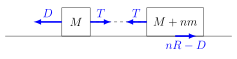
- The greatest coupling must occur behind an engine, because each carriage behind an engine acts as a drag.
Therefore we need only consider the couple between the second engine and the rest of the carriages:
\begin{align*} \text{N2}(\leftarrow, \text{up to second engine}): && 2D - T_2 - kR &= (2M+km)a \\ \text{N2}(\leftarrow, \text{everything else}): && T_2 - (n-k)R &= (n-k)ma \\ \Rightarrow && \frac{2D-T_2-kR}{2M+km} &= \frac{T_2-(n-k)R}{(n-k)m} \\ \Rightarrow && T_2 \left (\frac{1}{(n-k)m} + \frac{1}{2M+km} \right) &= \frac{2D-kR}{2M+km} + \frac{R}{m} \\ \Rightarrow && T_2 \left (2M+ nm \right) &= (2D-kR)m(n-k) + R(2M+km)(n-k) \\ \Rightarrow && T_2 &= \frac{(n-k)\left (2Dm+2RM \right)}{2M+nm} \\ &&&= \frac{2(n-k)(mD + MR)}{2M+nm} \end{align*} Therefore \(T > T_2\) provided \(2(n-k) < n \Leftrightarrow k > \frac12n\)
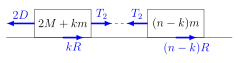
- If there is a coupling which is in negative tension, it must be between the two engines. In particular, if there is one, there must be one directly in front of the first engine.
\begin{align*} \text{N2}(\leftarrow, \text{before second engine}): && D - T_3 - kR &= (M+km)a \\ \text{N2}(\leftarrow, \text{everything else}): && T_3 +D- (n-k)R &= (M+(n-k)m)a \\ \Rightarrow && \frac{D-T_3-kR}{M+km} &= \frac{T_3+D-(n-k)R}{M+(n-k)m} \\ \Rightarrow && T_3 \left ( \frac{1}{M+(n-k)m} + \frac{1}{M+km} \right) &= \frac{D-(n-k)R}{M+(n-k)m}+\frac{kR-D}{M+km} \\ \Rightarrow && T_3 (2M+nm) &= (D-(n-k)R)(M+km)+(kR-D)(M+(n-k)m) \\ &&&= D(M+km-M-(n-k)m) + R(kM+k(n-k)m-(n-k)M-k(n-k)m) \\ &&&= D(n-2k)m+RM(2k-n)m \\ &&&= (n-2k)m(D-RM) \end{align*} Therefore \(T_3\) is negative if \(k > \frac12n\) so there are some connections in compression.
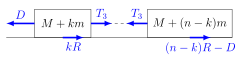
1997 Paper 1 Q7
Find constants \(a_{1}\), \(a_{2}\), \(u_{1}\) and \(u_{2}\) such that, whenever \({\mathrm P}\) is a cubic polynomial, \[\int_{-1}^{1}{\mathrm P}(t)\,{\mathrm d}t =a_{1}{\mathrm P}(u_{1})+a_{2}{\mathrm P}(u_{2}).\]
Solution: Since this is true for all cubic polynomials, it must be true in particular for \(1, x, x^2, x^3\), therefore: \begin{align*} \int_{-1}^{1} 1 {\mathrm d}t &=a_{1}+a_{2} &=2\\ \int_{-1}^{1} x {\mathrm d}t &=a_{1}u_1+a_{2}u_2 &= 0 \\ \int_{-1}^{1} x^2 {\mathrm d}t &=a_{1}u_1^2+a_{2}u_2^2 &= \frac23\\ \int_{-1}^{1} x^3 {\mathrm d}t &=a_{1}u_1^3+a_{2}u_2^3 &= 0\\ \end{align*} \begin{align*} && \begin{cases} a_{1}+a_{2} &=2 \\ a_{1}u_1+a_{2}u_2 &= 0 \\ a_{1}u_1^2+a_{2}u_2^2 &= \frac23\\ a_{1}u_1^3+a_{2}u_2^3 &= 0\\ \end{cases} \\ \Rightarrow && \begin{cases} a_{1}(u_1^2 - \frac13) + a_{2}(u_2^2 - \frac13) &= 0 \\ a_{1}u_1(u_1^2 - \frac13) + a_{2}u_2(u_2^2 - \frac13) &= 0 \end{cases} \\ \Rightarrow && \begin{cases} u_i = \pm \frac1{\sqrt{3}} \\ a_i = 1\end{cases} \end{align*} Therefore we have: \[\int_{-1}^{1}{\mathrm P}(t)\,{\mathrm d}t ={\mathrm P} \l \frac1{\sqrt{3}} \r+{\mathrm P}\l -\frac1{\sqrt{3}} \r \] [Note: this question is actually asking about Gauss-Legendre polynomials, and could be done directly by appealing to standard results]
1997 Paper 2 Q4
Show that, when the polynomial \({\rm p} (x)\) is divided by \((x-a)\), where \(a\) is a real number, the remainder is \({\rm p}(a)\).
- When the polynomial \({\rm p}(x)\) is divided by \(x-1,\,x-2,\,x-3\) the remainders are 3,1,5 respectively. Given that $${\rm p}(x)=(x-1)(x-2)(x-3){\rm q}(x)+{\rm r} (x),$$ where \({\rm q}(x)\) and \({\rm r}(x)\) are polynomials with \({\rm r}(x)\) having degree less than three, find \({\rm r}(x)\).
- Find a polynomial \({\rm P}(x)\) of degree \(n+1\), where \(n\) is a given positive integer, such that for each integer \(a\) satisfying \(0\le a\le n\), the remainder when \({\rm P}_n(x)\) is divided by \(x-a\) is \(a\).
Solution: Notice by polynomial division, we can write \(p(x) = (x-a)q(x) + r(x)\) where degree \(r(x) < 1\), ie \(r(x)\) is a constant. Evaluating at \(x = a\), we have \(p(a) = (a-a)q(a) + r(a) = r(a)\). Therefore \(r(a) = p(a)\) and since \(r(x)\) is a constant, it is always \(p(a)\).
- \(\,\) \begin{align*} && p(x) &= (x-1)(x-2)(x-3)q(x) + r(x) \\ && p(1) &= r(1) = 3 \\ && p(2) &= r(2) = 1 \\ && p(3) &= r(3) = 5 \end{align*} Therefore \(r(x)\) is a polynomial of degree \(2\) or less through \((1,3),(2,1), (3, 5)\) we can write this as \begin{align*} && r(x) &= 5\frac{(x-1)(x-2)}{(3-1)(3-2)} + 1\frac{(x-1)(x-3)}{(2-1)(2-3)} + 3\frac{(x-2)(x-3)}{(1-2)(1-3)} \\ &&&= \frac52(x^2-3x+2)-(x^2-4x+3) + \frac32(x^2-5x+6) \\ &&&= 3x^2-11x+11 \end{align*}
- Let \(P_n(x) = x(x-1)\cdots(x-n) + x\), then \(P_n(a) = a\)