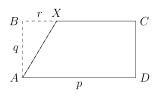
\(ABCD\) is a uniform rectangular lamina and \(X\) is a point on \(BC\,\). The lengths of \(AD\), \(AB\) and \(BX\) are \(p\,\), \(q\) and \(r\) respectively.
The triangle \(ABX\) is cut off the lamina.
Let \((a,b)\) be the position of the centre of gravity of the lamina, where the axes are such that the coordinates of \(A\,\), \(D\) and \(C\) are \((0,0)\,\), \((p,0)\) and \((p,q)\) respectively. Derive equations for \(a\) and \(b\) in terms of \(p\,\), \(q\) and \(r\,\).
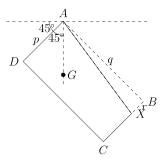
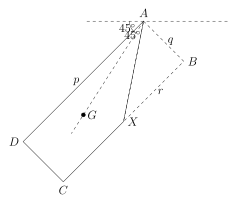
When the resulting trapezium is freely suspended from the point \(A\,\), the side \(AD\) is inclined at \(45^\circ\) below the horizontal.
Show that \(\displaystyle r = q - \sqrt{q^2 - 3pq + 3p^2}\,\). You should justify carefully the choice of sign in front of the square root.