Problems
Filters
4 problems found
2009 Paper 1 Q10
A triangular wedge is fixed to a horizontal surface. The base angles of the wedge are \(\alpha\) and \(\frac\pi 2-\alpha\). Two particles, of masses \(M\) and \(m\), lie on different faces of the wedge, and are connected by a light inextensible string which passes over a smooth pulley at the apex of the wedge, as shown in the diagram. The contacts between the particles and the wedge are smooth.
- Show that if \(\tan \alpha> \dfrac m M \) the particle of mass \(M\) will slide down the face of the wedge.
- Given that \(\tan \alpha = \dfrac{2m}M\), show that the magnitude of the acceleration of the particles is \[ \frac{g\sin\alpha}{\tan\alpha +2} \] and that this is maximised at \(4m^3=M^3\,\).
2008 Paper 2 Q11
A wedge of mass \(km\) has the shape (in cross-section) of a right-angled triangle. It stands on a smooth horizontal surface with one face vertical. The inclined face makes an angle \(\theta\) with the horizontal surface. A particle \(P\), of mass \(m\), is placed on the inclined face and released from rest. The horizontal face of the wedge is smooth, but the inclined face is rough and the coefficient of friction between \(P\) and this face is \(\mu\).
- When \(P\) is released, it slides down the inclined plane at an acceleration \(a\) relative to the wedge. Show that the acceleration of the wedge is \[ \frac {a \cos\theta}{k+1}\,. \] To a stationary observer, \(P\) appears to descend along a straight line inclined at an angle~\(45^\circ\) to the horizontal. Show that \[ \tan\theta = \frac k {k+1}\,. \] In the case \(k=3\), find an expression for \(a\) in terms of \(g\) and \(\mu\).
- What happens when \(P\) is released if \(\tan\theta \le \mu\)?
1998 Paper 2 Q10
A wedge of mass \(M\) rests on a smooth horizontal surface. The face of the wedge is a smooth plane inclined at an angle \(\alpha\) to the horizontal. A particle of mass \(m\) slides down the face of the wedge, starting from rest. At a later time \(t\), the speed \(V\) of the wedge, the speed \(v\) of the particle and the angle \(\beta\) of the velocity of the particle below the horizontal are as shown in the diagram.
- \(V\sin\alpha=v\sin(\beta-\alpha)\);
- \(\tan\beta=(1+m/M)\tan\alpha\);
- \(2gy=v^2(M+m\cos^2\beta)/M\).
1990 Paper 3 Q12
A uniform smooth wedge of mass \(m\) has congruent triangular end faces \(A_{1}B_{1}C_{1}\) and \(A_{2}B_{2}C_{2},\) and \(A_{1}A_{2},B_{1}B_{2}\) and \(C_{1}C_{2}\) are perpendicular to these faces. The points \(A,B\) and \(C\) are the midpoints of \(A_{1}A_{2},B_{1}B_{2}\) and \(C_{1}C_{2}\) respectively. The sides of the triangle \(ABC\) have lengths \(AB=AC=5a\) and \(BC=6a.\) The wedge is placed with \(BC\) on a smooth horizontal table, a particle of mass \(2m\) is placed at \(A\) on \(AC,\) and the system is released from rest. The particle slides down \(AC,\) strikes the table, bounces perfectly elastically and lands again on the table at \(D\). At this time the point \(C\) of the wedge has reached the point \(E\). Show that \(DE=\frac{192}{19}a.\)
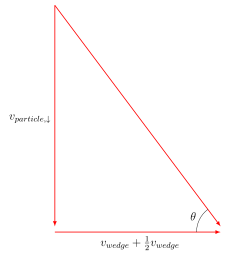
Solution: Conservation of energy, tells us that \(2m \cdot g \cdot 4a = 8amg\) is equal to \(\frac12 m v_{wedge}^2 + \frac12(2m)v_{particle}^2\). Conservation of momentum (horizontally) tells us that \(m v_{wedge}+2mv_{particle, \rightarrow} = 0 \Rightarrow v_{particle, \rightarrow} = -\frac12 v_{wedge}\).