Problems
Filters
14 problems found
2022 Paper 3 Q6
- Show that when \(\alpha\) is small, \(\cos(\theta + \alpha) - \cos\theta \approx -\alpha\sin\theta - \frac{1}{2}\alpha^2\cos\theta\). Find the limit as \(\alpha \to 0\) of \[ \frac{\sin(\theta+\alpha) - \sin\theta}{\cos(\theta+\alpha) - \cos\theta} \qquad (*) \] in the case \(\sin\theta \neq 0\). In the case \(\sin\theta = 0\), what happens to the value of expression \((*)\) when \(\alpha \to 0\)?
- A circle \(C_1\) of radius \(a\) rolls without slipping in an anti-clockwise direction on a fixed circle \(C_2\) with centre at the origin \(O\) and radius \((n-1)a\), where \(n\) is an integer greater than \(2\). The point \(P\) is fixed on \(C_1\). Initially the centre of \(C_1\) is at \((na, 0)\) and \(P\) is at \(\big((n+1)a, 0\big)\).
- Let \(Q\) be the point of contact of \(C_1\) and \(C_2\) at any time in the rolling motion. Show that when \(OQ\) makes an angle \(\theta\), measured anticlockwise, with the positive \(x\)-axis, the \(x\)-coordinate of \(P\) is \(x(\theta) = a(n\cos\theta + \cos n\theta)\), and find the corresponding expression for the \(y\)-coordinate, \(y(\theta)\), of \(P\).
- Find the values of \(\theta\) for which the distance \(OP\) is \((n-1)a\).
- Let \(\theta_0 = \dfrac{1}{n-1}\pi\). Find the limit as \(\alpha \to 0\) of \[ \frac{y(\theta_0 + \alpha) - y(\theta_0)}{x(\theta_0 + \alpha) - x(\theta_0)}\,. \] Hence show that, at the point \(\big(x(\theta_0),\, y(\theta_0)\big)\), the tangent to the curve traced out by \(P\) is parallel to \(OP\).
2020 Paper 3 Q6
- Sketch the curve \(y = \cos x + \sqrt{\cos 2x}\) for \(-\frac{1}{4}\pi \leqslant x \leqslant \frac{1}{4}\pi\).
- The equation of curve \(C_1\) in polar co-ordinates is \[ r = \cos\theta + \sqrt{\cos 2\theta} \qquad -\tfrac{1}{4}\pi \leqslant \theta \leqslant \tfrac{1}{4}\pi. \] Sketch the curve \(C_1\).
- The equation of curve \(C_2\) in polar co-ordinates is \[ r^2 - 2r\cos\theta + \sin^2\theta = 0 \qquad -\tfrac{1}{4}\pi \leqslant \theta \leqslant \tfrac{1}{4}\pi. \] Find the value of \(r\) when \(\theta = \pm\frac{1}{4}\pi\). Show that, when \(r\) is small, \(r \approx \frac{1}{2}\theta^2\). Sketch the curve \(C_2\), indicating clearly the behaviour of the curve near \(r=0\) and near \(\theta = \pm\frac{1}{4}\pi\). Show that the area enclosed by curve \(C_2\) and above the line \(\theta = 0\) is \(\dfrac{\pi}{2\sqrt{2}}\).
2010 Paper 3 Q10
A small bead \(B\), of mass \(m\), slides without friction on a fixed horizontal ring of radius \(a\). The centre of the ring is at \(O\). The bead is attached by a light elastic string to a fixed point \(P\) in the plane of the ring such that \(OP = b\), where \(b > a\). The natural length of the elastic string is \(c\), where \(c < b - a\), and its modulus of elasticity is \(\lambda\). Show that the equation of motion of the bead is \[ ma\ddot \phi = -\lambda\left( \frac{a\sin\phi}{c\sin\theta}-1\right)\sin(\theta+\phi) \,, \] where \(\theta=\angle BPO\) and \(\phi=\angle BOP\). Given that \(\theta\) and \(\phi\) are small, show that $a(\theta+\phi)\approx b\theta$. Hence find the period of small oscillations about the equilibrium position \(\theta=\phi =0\).
2009 Paper 2 Q2
The curve \(C\) has equation \[ y= a^{\sin (\pi \e^ x)}\,, \] where \(a>1\).
- Find the coordinates of the stationary points on \(C\).
- Use the approximations \(\e^t \approx 1+t\) and \(\sin t \approx t\) (both valid for small values of \(t\)) to show that \[ y\approx 1-\pi x \ln a \; \] for small values of \(x\).
- Sketch \(C\).
- By approximating \(C\) by means of straight lines joining consecutive stationary points, show that the area between \(C\) and the \(x\)-axis between the \(k\)th and \((k+1)\)th maxima is approximately \[ \Big( \frac {a^2+1}{2a} \Big) \ln \Big ( 1+ \big( k-\tfrac34)^{-1} \Big)\,. \]
Solution:
- \(\,\) \begin{align*} && y & = a^{\sin(\pi e^x)} \\ \Rightarrow && \frac{\d y}{\d x} &= a^{\sin(\pi e^x)} \cdot ( \ln a) \cdot (\cos (\pi e^x)) \cdot \pi e^x \\ \frac{\d y}{\d x} = 0: && 0 &= \cos(\pi e^x) \\ \Rightarrow && \pi e^x &= \left ( \frac{2n+1}{2} \right) \pi \\ \Rightarrow && x &= \ln \left ( \frac{2n+1}{2} \right) \\ && y &= a^{(-1)^n} \\ &&(x,y) &= \left (\ln \left ( \frac{2n+1}{2} \right), a^{(-1)^n} \right) \end{align*}
- \(\,\) \begin{align*} && y &= a^{\sin(\pi e^x)} \\ &&&= e^{\ln a \cdot \sin(\pi e^x)} \\ &&&\approx e^{\ln a \cdot \sin(\pi (1+x))} \\ &&&\approx e^{-\ln a \cdot \sin(\pi x)} \\ &&&\approx e^{-\ln a \cdot \pi x} \\ &&&\approx 1-( \pi\ln a) x \end{align*}
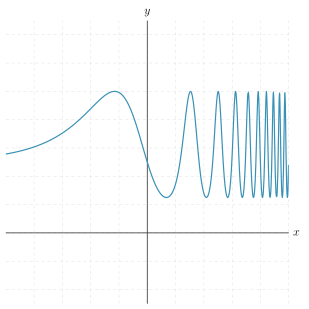
- The \(k\)th maxima is at \(\ln \left ( \frac{4(k-1)+1}{2}\right)\) and \(a\) ,and the \((k+1)\)th is at \(\ln \left ( \frac{4k+1}{2}\right)\). They have a minima between at \(\ln \left ( \frac{4k-3}{2}\right)\). \begin{align*} && \text{Area} &\approx \frac12 \left (\ln \left ( \frac{4k-1}{2}\right)- \ln \left ( \frac{4k-3}{2}\right)\right) \left ( a + \frac1a \right) + \frac12 \left ( \ln \left ( \frac{4k+1}{2}\right)-\ln \left ( \frac{4k-1}{2}\right)\right) \left ( a + \frac1a \right) \\ &&&= \frac{a^2+1}{2a} \ln \left (\frac{4k+1}{4k-3} \right) \\ &&&= \frac{a^2+1}{2a} \ln \left (1 + \frac{4}{4k-3} \right) \\ &&&= \frac{a^2+1}{2a} \ln \left (1 + \frac{1}{k-\tfrac34} \right) \\ &&&= \frac{a^2+1}{2a} \ln \left (1 + (k-\tfrac34)^{-1} \right) \\ \end{align*}
2006 Paper 1 Q4
By sketching on the same axes the graphs of \(y=\sin x\) and \(y=x\), show that, for \(x>0\):
- \(x>\sin x\,\);
- \(\dfrac {\sin x} {x} \approx 1\) for small \(x\).
2000 Paper 1 Q9
A child is playing with a toy cannon on the floor of a long railway carriage. The carriage is moving horizontally in a northerly direction with acceleration \(a\). The child points the cannon southward at an angle \(\theta\) to the horizontal and fires a toy shell which leaves the cannon at speed \(V\). Find, in terms of \(a\) and \(g\), the value of \(\tan 2\theta\) for which the cannon has maximum range (in the carriage). If \(a\) is small compared with \(g\), show that the value of \(\theta\) which gives the maximum range is approximately \[ \frac \pi 4 + \frac a {2g}, \] and show that the maximum range is approximately \(\displaystyle \frac {V^2} g + \frac {V^2a}{g^2}. \)
Solution: \begin{align*} && s_x &= V \cos \theta t + \frac12at^2 \\ && s_y &= V \sin \theta t - \frac12 gt^2 \\ \Rightarrow && T &= \frac{2V \sin \theta}g \\ \Rightarrow && s_{max} &= \frac{2V^2 \sin \theta \cos \theta}{g} + \frac12a \frac{4V^2 \sin^2 \theta}{g^2} \\ &&&= (g \sin 2 \theta+2a\sin^2 \theta)\frac{V^2}{g^2} \\ && \frac{\d s_{max}}{\d \theta} &= (2g \cos 2 \theta +4 a \cos \theta \sin \theta)\frac{V^2}{g^2} \\ &&&= (2g \cos 2\theta + 2a \sin2 \theta) \frac{V^2}{g^2} \\ \Rightarrow && \tan 2\theta &= -\frac{a}{g} \\ \Rightarrow && 2 \theta &\in (\frac{\pi}2, \pi) \\ \Rightarrow && \tan \left (\frac{\pi}{2} - 2 \theta\right) &=-\frac{a}{g} \\ \Rightarrow && \frac{\pi}{2} - 2 \theta&\approx -\frac{a}{g} \\ \Rightarrow && \theta &\approx \frac{\pi}{4} + \frac{a}{2g} \\ \\ && s_{max} & \approx \left (g \sin \left (\frac{\pi}{2} + \frac{a}{g} \right)+2a\sin^2 \left ( \frac{\pi}{4} + \frac{a}{2g}\right)\right)\frac{V^2}{g^2} \\ &&&\approx \left (g \cdot 1+2a\left( \frac{1}{\sqrt{2}}(\frac{a}{2g}+1)\right)^2\right)\frac{V^2}{g^2} \\ &&&\approx \left (g+a\left(1+\frac{a}{g}\right)^2\right)\frac{V^2}{g^2} \\ &&&\approx \left (g+a\right)\frac{V^2}{g^2} \\ &&&= \frac{V^2}{g} + \frac{V^2a}{g} \end{align*}
2000 Paper 2 Q3
The lengths of the sides \(BC\), \(CA\), \(AB\) of the triangle \(ABC\) are denoted by \(a\), \(b\), \(c\), respectively. Given that $$ b = 8+{\epsilon}_1, \, c=3+{\epsilon}_2,\, A=\tfrac{1}{3}\pi + {\epsilon}_3, $$ where \({\epsilon}_1\), \({\epsilon}_2\), and \( {\epsilon}_3\) are small, show that \(a \approx 7 + {\eta}\), where ${\eta}= {\left(13 \, {{\epsilon}_1}-2\,{\epsilon}_2 + 24{\sqrt 3} \;{{\epsilon}_3}\right)}/14$. Given now that $$ {\vert {\epsilon}_1} \vert \le 2 \times 10^{-3}, \ \ \ {\vert {\epsilon}_2} \vert \le 4\cdot 9\times 10^{-2}, \ \ \ {\vert {\epsilon}_3} \vert \le \sqrt3 \times 10^{-3}, $$ find the range of possible values of \({\eta}\).
Solution: The cosine rule states that: \(a^2 = b^2 + c^2 - 2bc \cos (A)\) Therefore \begin{align*} a^2 &= (8 + \epsilon_1)^2 + (3 + \epsilon_2)^2 - 2(8 + \epsilon_1) (3 + \epsilon_2)\cos \l \frac{\pi}{3} + \epsilon_3 \r \\ &\approx 64 + 16\epsilon_1 + 9 + 6\epsilon_2- 2(24 + 3\epsilon_1+8\epsilon_2) \cos \l \frac{\pi}{3} + \epsilon_3 \r \\ &= 73 + 16\epsilon_1+ 6\epsilon_2 - 2(24 + 3\epsilon_1+8\epsilon_2) \l \cos \l \frac{\pi}{3} \r \cos \epsilon_3 - \sin \l \frac{\pi}{3} \r \sin \epsilon_3 \r \\ &\approx 73 + 16\epsilon_1+ 6\epsilon_2 - (24 + 3 \epsilon_1+8\epsilon_2) + 24\sqrt{3}\epsilon_3 \\ &= 49 + 13 \epsilon_1 - 2\epsilon_2+24\sqrt{3}\epsilon_3 \\ &= 7^2 + 2 \cdot 7 \cdot \frac{13 \epsilon_1 - 2\epsilon_2+24\sqrt{3}\epsilon_3}{14} \\ &\approx \l 7 + \frac{13 \epsilon_1 - 2\epsilon_2+24\sqrt{3}\epsilon_3}{14} \r^2 \end{align*} In this approximation, we are ignoring all terms of order \(2\), and using the approximations \(\cos \varepsilon \approx 1, \sin \varepsilon \approx \varepsilon\) Therefore \(a \approx 7 + \frac{ 13 \epsilon_1 - 2\epsilon_2+24\sqrt{3}\epsilon_3}{14}\). \(\eta\) is maximised if \(\epsilon_1, \epsilon_3\) are and \(\epsilon_2\) is minimized, ie: \begin{align*} \eta &\leq \frac{13 \cdot 2 \cdot 10^{-3} - 2 \cdot 4.9 \cdot 10^{-2} + 24 \sqrt{3} \cdot \sqrt{3} \cdot 10^{-3}}{14} \\ &= 10^{-3} \cdot \frac{26 - 98 + 74}{14} \\ &= 10^{-3} \cdot \frac{1}{7}\end{align*} Similarly, it is maximised when signs are reversed, ie: \(| \eta | \leq 10^{-3} \cdot \frac{1}{7}\)
2000 Paper 2 Q5
It is required to approximate a given function \(\f(x)\), over the interval \(0 \le x \le 1\), by the linear function \(\lambda x\), where \(\lambda\) is chosen to minimise \[ \int_0^1 \big(\f(x)-\lambda x \big)^{\!2} \,\d x . \] Show that \[ \lambda = 3 \int_0^1 x\f(x)\,\d x. \] The residual error, \(R\), of this approximation process is such that \[ R^2 = \int_0^1 \big(\f(x)-\lambda x \big)^{\!2}\,\d x. \] Show that \[ R^2 = \int_0^1 \big(\f(x)\big)^{\!2}\,\d x -\tfrac{1}{3} \lambda ^2. \] Given now that \(\f(x)= \sin (\pi x/n)\), show that (i) for large \(n\), \(\lambda \approx \pi/n\) and (ii) \(\lim_{n \to \infty}R = 0.\) Explain why, prior to any calculation, these results are to be expected. [You may assume that, when \(\theta\) is small, $\sin \theta \approx \theta-\frac{1}{6}\theta^3$ and \(\cos \theta \approx 1 - \frac{1}{2}\theta^2.\)]
Solution: \begin{align*} && g(\lambda) &= \int_0^1 \big(\f(x)-\lambda x \big)^{\!2} \,\d x \\ &&&= \int_0^1 \left ( f(x)^2 -2\lambda xf(x) + \lambda^2 x^2\right) \d x \\ &&&= \frac13\lambda^2 - 2\lambda \int_0^1 x f(x) \d x + \int_0^1 f(x)^2 \d x \\ \end{align*} Differentiating (or completing the square) it is clear the minimum occurs when \(\displaystyle \lambda = 3 \int_0^1 xf(x) \d x\) \begin{align*} && R^2 &= \int_0^1 (f(x) - \lambda x )^2 \d x \\ &&&= \frac13\lambda^2 - 2\lambda \int_0^1 x f(x) \d x + \int_0^1 f(x)^2 \d x \\ &&&= \frac13 \left (\lambda -3\int_0^1 xf(x) \d x \right)^2 -\frac13 \left ( 3\int_0^1 xf(x) \d x \right)^2+\int_0^1 f(x)^2 \d x \\ \end{align*} When \(\lambda = 3\int_0^1 xf(x) \d x \) clearly this is the desired result. \begin{align*} && \lambda &= 3\int_0^1 xf(x) \d x \\ &&&= 3\int_0^1 x \sin(\pi x /n) \d x \\ &&&= 3 \left [-x \frac{n}{\pi} \cos (\pi x /n) \right]_0^1 + \frac{3n}{\pi} \int_0^1 \cos(\pi x /n) \d x \\ &&&= -\frac{3n}{\pi}\cos(\pi/n) + \frac{3n}{\pi} \left [ \frac{n}{\pi} \sin(\pi x /n)\right]_0^1 \\ &&&= -\frac{3n}{\pi} \cos(\pi/n) + \frac{3n^2}{\pi^2} \sin(\pi /n) \\ \text{for large }n: &&&\approx -\frac{3n}{\pi}\left ( 1 - \frac12\frac{\pi^2}{n^2} + o(1/n^4)\right) + \frac{3n^2}{\pi^2} \left (\frac{\pi}{n} - \frac16 \frac{\pi^3}{n^3} +o(1/n^5) \right) \\ &&&= \left (\frac32 -\frac12\right)\frac{\pi}{n} + o(1/n^3) \\ &&&= \frac{\pi}{n} + o(1/n^2) \end{align*} Therefore for large \(n\), \(\lambda \approx \frac{\pi}n\) \begin{align*} && \int_0^1 \sin^2(\pi x/n) \d x &= \frac12\int_0^1(1- \cos(2\pi x/n)) \d x\\ &&&= \frac12\left ( 1 - \frac{n}{2\pi}\left[\sin(2\pi x/n) \right]_0^1 \right) \\ &&&= \frac12 -\frac{n}{4\pi}\sin(2\pi /n) \\ \\ && R^2 &= \frac12 -\frac{n}{4\pi}\sin(2\pi /n) - \frac13 \left ( \frac{\pi}{n}+o(1/n^2)\right)^2 \\ &&&= \frac12 - \left ( \frac{1}{2} -\frac16\frac{\pi}{n}+o(1/n^3) \right) - o(1/n^2) \\ &&& = \frac16 \frac{\pi}{n} + o(1/n^2) \\ &&&\to 0 \text{ as } n \to \infty \end{align*} We should expect these results as for \(n\) very large \(\sin(\pi x/n) \approx \frac{\pi }{n}x\) so the best linear approximation is likely to be \(\lambda = \frac{\pi}{n}\) and we should expect it to improve to the point that we cannot tell the difference, ie \(R^2 \to 0\)
1999 Paper 1 Q5
For this question, you may use the following approximations, valid if \(\theta \) is small: \ \(\sin\theta \approx \theta\) and \(\cos\theta \approx 1-\theta^2/2\,\). A satellite \(X\) is directly above the point \(Y\) on the Earth's surface and can just be seen (on the horizon) from another point \(Z\) on the Earth's surface. The radius of the Earth is \(R\) and the height of the satellite above the Earth is \(h\).
- Find the distance \(d\) of \(Z\) from \(Y\) along the Earth's surface.
- If the satellite is in low orbit (so that \(h\) is small compared with \(R\)), show that $$d \approx k(Rh)^{1/2},$$ where \(k\) is to be found.
- If the satellite is very distant from the Earth (so that \(R\) is small compared with \(h\)), show that $$d\approx aR+b(R^2/h),$$ where \(a\) and \(b\) are to be found.
1999 Paper 2 Q8
Prove that $$ \sum_{k=0}^n \sin k\theta = \frac { \cos \tfrac12\theta - \cos (n+ \tfrac12) \theta} {2\sin \tfrac12\theta}\;. \tag{*}$$
- Deduce that, when \(n\) is large, \[ \sum_{k=0}^n \sin \left(\frac{k\pi}{n}\right) \approx \frac{2n}\pi\;. \]
- By differentiating \((*)\) with respect to \(\theta\), or otherwise, show that, when \(n\) is large, \[ \sum_{k=0}^n k \sin^2 \left(\frac{k\pi}{2n}\right) \approx \left(\frac{1}4 +\frac{1}{\pi^2} \right)n^2\;. \]
Solution: \begin{align*} && \sum_{k=0}^n \sin k\theta &= \textrm{Im} \left ( \sum_{k=0}^n e^{i k \theta}\right)\\ &&&= \textrm{Im} \left ( \frac{e^{i(n+1)\theta}-1}{e^{i \theta}-1} \right)\\ &&&= \textrm{Im} \left ( \frac{e^{i(n+\tfrac12)\theta}-e^{-i\theta/2}}{e^{i \theta/2}-e^{-i \theta/2}} \right)\\ &&&= \textrm{Im} \left ( \frac{(e^{i(n+\tfrac12)\theta}-e^{-i\theta/2})/2i}{(e^{i \theta/2}-e^{-i \theta/2})/2i} \right)\\ &&&= \textrm{Im} \left ( \frac{(e^{i(n+\tfrac12)\theta}-e^{-i\theta/2})/i}{2\sin \tfrac12 \theta} \right)\\ &&&= \frac{\cos \tfrac12 \theta - \cos(n+ \tfrac12)\theta}{2\sin \tfrac12 \theta} \end{align*}
- When \(n\) is large we have \begin{align*} &&\sum_{k=0}^n \sin \left(\frac{k\pi}{n}\right) &= \frac{\cos \frac{\pi}{2n} - \cos \frac{(2n + 1)\pi}{2n}}{2 \sin \frac{\pi}{2n}} \\ &&&= \frac{\cos \frac{\pi}{2n} +\cos \frac{\pi}{2n}}{2 \sin \frac{\pi}{2n}} \\ &&&\approx \frac{1- \frac{\pi^2}{4n^2}}{\frac{\pi}{2n}} \\ &&&= \frac{2n}{\pi} - \frac{\pi}{2n} \\ &&&\approx \frac{2n}{\pi} \end{align*}
- \(\,\) \begin{align*} && \sum_{k=0}^n \sin k\theta &= \frac { \cos \tfrac12\theta - \cos (n+ \tfrac12) \theta} {2\sin \tfrac12\theta} \\ \frac{\d }{\d \theta}: && \sum_{k=0}^n k\cos k\theta &= \frac { (-\tfrac12\sin\tfrac12\theta +(n+\tfrac12) \sin (n+ \tfrac12) \theta)2 \sin \tfrac12 \theta - (\cos \tfrac12\theta - \cos (n+ \tfrac12) \theta) \cos \tfrac12 \theta} {4\sin^2 \tfrac12\theta} \\ &&&= \frac{-\sin^2 \tfrac12 \theta+(2n+1)\sin(n+\tfrac12)\theta \sin \tfrac12 \theta-\cos^2\tfrac12 \theta+\cos(n+\frac12)\theta \cos\tfrac12 \theta}{4 \sin^2 \tfrac12 \theta} \\ &&&= \frac{(2n+1)\sin(n+\tfrac12)\theta \sin \tfrac12 \theta+\cos(n+\frac12)\theta \cos\tfrac12 \theta-1}{4 \sin^2 \tfrac12 \theta} \\ &&&= \frac{2n\sin(n+\tfrac12)\theta \sin \tfrac12 \theta+\cos n \theta-1}{4 \sin^2 \tfrac12 \theta} \\ \\ \Rightarrow && \sum_{k=0}^n k\left ( 1-2\sin^2 \left ( \frac{k\theta}{2} \right) \right) &= \frac{2n\sin(n+\tfrac12)\theta \sin \tfrac12 \theta+\cos n \theta-1}{4 \sin^2 \tfrac12 \theta} \\ \Rightarrow && \sum_{k=0}^n k\sin^2 \left ( \frac{k\theta}{2} \right) &= \frac{n(n+1)}{4} - \frac{2n\sin(n+\tfrac12)\theta \sin \tfrac12 \theta+\cos n \theta-1}{8 \sin^2 \tfrac12 \theta} \\ \theta = \frac{\pi}{n}: && \sum_{k=0}^n k\sin^2 \left ( \frac{k\pi}{2n} \right) &= \frac{n(n+1)}{4} - \frac{2n\sin(n+\tfrac12)\frac{\pi}{n}\sin \tfrac12 \frac{\pi}{n}+\cos n \frac{\pi}{n}-1}{8 \sin^2 \tfrac12 \frac{\pi}{n}} \\ &&&= \frac{n(n+1)}{4} - \frac{-2n \sin^2 \frac{\pi}{2n}-2}{8 \sin^2 \tfrac12 \frac{\pi}{n}} \\ &&&= \frac{n^2+n}{4} + \frac{n}{4} + \frac{1}{4\sin^2\frac{\pi}{2n}} \\ &&&\approx \frac{n^2}4 + \frac{n}{2}+ \frac{n^2}{\pi^2} \\ &&&= \left ( \frac14 + \frac{1}{\pi^2} \right)n^2 + \frac{n}{4} \\ &&&\approx \left ( \frac14 + \frac{1}{\pi^2} \right)n^2 \end{align*}
1992 Paper 1 Q6
Explain briefly, by means of a diagram, or otherwise, why \[ \mathrm{f}(\theta+\delta\theta)\approx\mathrm{f}(\theta)+\mathrm{f}'(\theta)\delta\theta, \] when \(\delta\theta\) is small. Two powerful telescopes are placed at points \(A\) and \(B\) which are a distance \(a\) apart. A very distant point \(C\) is such that \(AC\) makes an angle \(\theta\) with \(AB\) and \(BC\) makes an angle \(\theta+\phi\) with \(AB\) produced. (A sketch of the arrangement is given in the diagram.) \noindent
1992 Paper 2 Q1
Find the limit, as \(n\rightarrow\infty,\) of each of the following. You should explain your reasoning briefly. \begin{alignat*}{4} \mathbf{(i)\ \ } & \dfrac{n}{n+1}, & \qquad & \mathbf{(ii)\ \ } & \dfrac{5n+1}{n^{2}-3n+4}, & \qquad & \mathbf{(iii)\ \ } & \dfrac{\sin n}{n},\\ \\ \mathbf{(iv)\ \ } & \dfrac{\sin(1/n)}{(1/n)}, & & \mathbf{(v)}\ \ & (\arctan n)^{-1}, & & \mathbf{(vi)\ \ } & \dfrac{\sqrt{n+1}-\sqrt{n}}{\sqrt{n+2}-\sqrt{n}}. \end{alignat*}
Solution:
- \begin{align*} \lim_{n \to \infty} \frac{n}{n+1} &= \lim_{n \to \infty} \left (1 - \frac{1}{n+1} \right ) \\ &\underbrace{=}_{\text{sum of limits}} \lim_{n \to \infty} 1 - \lim_{n \to \infty} \frac{1}{n+1}\\ &= 1 \end{align*}
- \begin{align*} \lim_{n \to \infty} \frac{5n+1}{n^2-3n+4} &= \lim_{n \to \infty} \frac{5/n + 1/n^2}{1-3/n+ 4/n^2} \\ &\underbrace{=}_{\text{ratio of limits}} \frac{\displaystyle \lim_{n \to \infty}(5/n + 1/n^2)}{\displaystyle \lim_{n \to \infty}(1-3/n+ 4/n^2)} \\ &= \frac{0}{1} = 0 \end{align*}
- \begin{align*} && \lvert \frac{\sin n}{n} \rvert &\leq \frac{1}{n} \quad \quad (n \geq 1) \\ \Rightarrow && \lim_{n \to \infty} \lvert \frac{\sin n}{n} \rvert &\leq \lim_{n \to \infty}\frac{1}{n} \\ &&&= 0\\ \Rightarrow && \lim_{n \to \infty} \frac{\sin n}{n} &= 0 \end{align*}
- First note that \(\displaystyle \lim_{x \to 0} \frac{\sin x}{x} \to 1\), then \(\frac1n\) is a sequence converging to zero, therefore \(\frac{\sin 1/n}{1/n}\) also must tend to \(1\).
- Note that \(\lim_{x \to \infty} \tan^{-1} x = \frac{\pi}{2}\) and since \(n\) is a sequence tending to infinity we must have \(\lim_{n \to \infty} \tan^{-1} n = \frac{\pi}{2}\)
- \begin{align*} \lim_{n \to \infty} \dfrac{\sqrt{n+1}-\sqrt{n}}{\sqrt{n+2}-\sqrt{n}} &= \lim_{n \to \infty} \dfrac{\frac{1}{\sqrt{n+1}+\sqrt{n}}}{\frac{2}{\sqrt{n+2}+\sqrt{n}}} \\ &= \frac12 \lim_{n \to \infty} \dfrac{\sqrt{n+2}+\sqrt{n}}{\sqrt{n+1}+\sqrt{n}}\\ &= \frac12 \lim_{n \to \infty} \dfrac{\sqrt{1+2/n}+\sqrt{1}}{\sqrt{1+1/n}+\sqrt{1}}\\ &= \frac12 \end{align*}
1990 Paper 1 Q8
Show that \[ \cos\left(\frac{\alpha}{2}\right)\cos\left(\frac{\alpha}{4}\right)=\frac{\sin\alpha}{4\sin\left(\dfrac{\alpha}{4}\right)}\,, \] where \(\alpha\neq k\pi\), \(k\) is an integer. Prove that, for such \(\alpha\), \[ \cos\left(\frac{\alpha}{2}\right)\cos\left(\frac{\alpha}{4}\right)\cdots\cos\left(\frac{\alpha}{2^{n}}\right)=\frac{\sin\alpha}{2^{n}\sin\left(\dfrac{\alpha}{2^{n}}\right)}\,, \] where \(n\) is a positive integer. Deduce that \[ \alpha=\frac{\sin\alpha}{\cos\left(\dfrac{\alpha}{2}\right)\cos\left(\dfrac{\alpha}{4}\right)\cos\left(\dfrac{\alpha}{8}\right)\cdots}\,, \] and hence that \[ \frac{\pi}{2}=\frac{1}{\sqrt{\frac{1}{2}}\sqrt{\frac{1}{2}+\frac{1}{2}\sqrt{\frac{1}{2}}}\sqrt{\frac{1}{2}+\frac{1}{2}\sqrt{\frac{1}{2}+\frac{1}{2}\sqrt{\frac{1}{2}}}}\cdots}\,. \]
Solution: \begin{align*} &&\sin \alpha &= 2 \sin \frac{\alpha}{2} \cos \frac{\alpha}{2} \\ &&&= 4 \sin \frac{\alpha}{4} \cos \frac{\alpha}{4} \cos \frac{\alpha}{2} \\ \Rightarrow && \frac{\sin \alpha}{4 \sin \frac{\alpha}{4}} &= \cos \frac{\alpha}{2} \cos \frac{\alpha}{4} \end{align*} We proceed by induction on \(n\). Clearly this is true for \(n = 1\) (as we just established). Assume it is true for \(n=k\). Then: \begin{align*} && \frac{\sin \alpha}{2^n \sin \frac{\alpha}{2^n}} &= \cos\left(\frac{\alpha}{2}\right)\cos\left(\frac{\alpha}{4}\right)\cdots\cos\left(\frac{\alpha}{2^{n}}\right) \\ \Rightarrow && \frac{\sin \alpha}{2^{n+1} \sin \frac{\alpha}{2^{n+1}} \cos \frac{\alpha}{2^{n+1}}} &= \cos\left(\frac{\alpha}{2}\right)\cos\left(\frac{\alpha}{4}\right)\cdots\cos\left(\frac{\alpha}{2^{n}}\right) \\ \Rightarrow && \frac{\sin \alpha}{2^{n+1} \sin \frac{\alpha}{2^{n+1}} } &= \cos\left(\frac{\alpha}{2}\right)\cos\left(\frac{\alpha}{4}\right)\cdots\cos\left(\frac{\alpha}{2^{n}}\right)\cos \left ( \frac{\alpha}{2^{n+1}} \right) \\ \end{align*} Therefore it is true for \(n=k+1\) Therefore since it is true for \(n=1\) and if it is true for \(n=k\) it is also true for \(n=k+1\) by the principle of mathematical induction it is true for all \(n \geq 1\) \begin{align*} \lim_{n \to \infty} \frac{\sin \alpha}{\cos\left(\frac{\alpha}{2}\right)\cdots\cos\left(\frac{\alpha}{2^{n}}\right)} &= \lim_{n \to \infty} 2^n \sin \frac{\alpha}{2^n} \\ &= \lim_{n \to \infty} \alpha \frac{\sin \frac{\alpha}{2^n}}{\frac{\alpha}{2^n}} \\ &= \alpha \lim_{t \to 0} \frac{\sin t}{t} \\ &= \alpha \end{align*} When \(\alpha = \frac{\pi}{2}\) notice that \(\sin \alpha =1\), \(\cos \frac{\alpha}{2} = \sqrt{\frac12}\) and \(2\cos^2 \frac{\alpha}{2^{n+1}}-1 = \cos \frac{\alpha}{2} \Rightarrow \cos \frac{\alpha}{2^{n+1}} = \sqrt{\frac12 + \cos \frac{\alpha}{2^n}}\) exactly the series we see.
1990 Paper 3 Q10
By considering the graphs of \(y=kx\) and \(y=\sin x,\) show that the equation \(kx=\sin x,\) where \(k>0,\) may have \(0,1,2\) or \(3\) roots in the interval \((4n+1)\frac{\pi}{2} < x < (4n+5)\frac{\pi}{2},\) where \(n\) is a positive integer. For a certain given value of \(n\), the equation has exactly one root in this interval. Show that \(k\) lies in an interval which may be written \(\sin\delta < k < \dfrac{2}{(4n+1)\pi},\) where \(0 < \delta < \frac{1}{2}\pi\) and \[ \cos\delta=\left((4n+5)\frac{\pi}{2}-\delta\right)\sin\delta. \] Show that, if \(n\) is large, then \(\delta\approx\dfrac{2}{(4n+5)\pi}\) and obtain a second, improved, approximation.
Solution:

- be below \(((4n+1)\tfrac{\pi}{2}, 1)\) and
- not touch the second gradient