Problems
Filters
4 problems found
2025 Paper 2 Q9
Points \(A\) and \(B\) are at the same height and a distance \(\sqrt{2}r\) apart. Two small, spherical particles of equal mass, \(P\) and \(Q\), are suspended from \(A\) and \(B\), respectively, by light inextensible strings of length \(r\). Each particle individually may move freely around and inside a circle centred at the point of suspension. The particles are projected simultaneously from points which are a distance \(r\) vertically below their points of suspension, directly towards each other and each with speed \(u\). When the particles collide, the coefficient of restitution in the collision is \(e\).
- Show that, immediately after the collision, the horizontal component of each particle's velocity has magnitude \(\frac{1}{2}ev\sqrt{2}\), where \(v^2 = u^2 - gr(2 - \sqrt{2})\) and write down the vertical component in terms of \(v\).
- Show that the strings will become taut again at a time \(t\) after the collision, where \(t\) is a non-zero root of the equation \[(r - evt)^2 + \left(-r + vt - \frac{1}{2}\sqrt{2}gt^2\right)^2 = 2r^2.\]
- Show that, in terms of the dimensionless variables \[z = \frac{vt}{r} \quad \text{and} \quad c = \frac{\sqrt{2}v^2}{rg}\] this equation becomes \[\left(\frac{z}{c}\right)^3 - 2\left(\frac{z}{c}\right)^2 + \left(\frac{2}{c} + 1 + e^2\right)\left(\frac{z}{c}\right) - \frac{2}{c}(1 + e) = 0.\]
- Show that, if this equation has three equal non-zero roots, \(e = \frac{1}{3}\) and \(v^2 = \frac{9}{2}\sqrt{2}rg\). Explain briefly why, in this case, no energy is lost when the string becomes taut.
- In the case described in (iv), the particles have speed \(U\) when they again reach the points of their motion vertically below their points of suspension. Find \(U^2\) in terms of \(r\) and \(g\).
Solution:

- Assuming the particles have mass \(m\), and speed \(v\) just before collision, then \begin{align*} \text{COE}: && \underbrace{\frac12 m u^2}_{\text{initial kinetic energy}} + \underbrace{0}_{\text{initial GPE}} &= \underbrace{\frac12m v^2}_{\text{kinetic energy just before collision}} + \underbrace{mgr\left(1-\frac1{\sqrt{2}}\right)}_{\text{GPE just before collision}} \\ \Rightarrow && v^2 &= u^2 - gr(2-\sqrt{2}) \end{align*} Therefore the particles has velocity \(\frac{\sqrt{2}}2v \binom{\pm 1}{1}\) before the collision. By symmetry, the impulse between the particles will be horizontal, so the vertical velocities will be unchanged at \(\frac{\sqrt{2}}{2}v\). By conservation of momentum (or symmetry) the particles will have equal but opposite velocities after the collision (say \(w\)) satisfying: \[ e = \frac{2w}{2\frac{\sqrt{2}}{2}v} \] ie \(w = \frac{\sqrt{2}}2 e v\) as required.
- Once the particles have rebounded, they will be projectiles whilst the strings are slack. If we consider the left-most point \(A = (0,0)\) then the particles colide at \(\left ( \frac{\sqrt{2}}{2}, -\frac{\sqrt{2}}{2} \right)\) and the position at time \(t\) after the collision (before the string goes slack) will be: \begin{align*} \mathbf{x}_t &= \frac{\sqrt{2}}{2}r\binom{1}{-1} + \frac{\sqrt{2}}{2} vt \binom{-e}{1} + \frac12 gt^2 \binom{0}{-1} \end{align*} The string will go taught when \(|\mathbf{x}_t|^2 = r^2\), ie \begin{align*} && r^2 &= \left ( \frac{\sqrt{2}}{2} r - \frac{\sqrt{2}}{2}evt \right)^2 + \left (-\frac{\sqrt{2}}{2} r + \frac{\sqrt{2}}{2}vt -\frac12 gt^2 \right)^2 \\ \Rightarrow && r^2 &= \frac12 \left (r - evt \right)^2 + \frac12 \left (-r+vt - \frac{\sqrt{2}}{2}gt^2 \right)^2 \\ \Rightarrow && 2r^2 &= \left (r - evt \right)^2 + \left (-r+vt - \frac{\sqrt{2}}{2}gt^2 \right)^2 \\ \end{align*} as required.
- Suppose \(z = \frac{vt}{r}\), \(c = \frac{\sqrt{2}v^2}{rg}\), then \begin{align*} && 2r^2 &= \left (r - evt \right)^2 + \left (-r+vt - \frac{\sqrt{2}}{2}gt^2 \right)^2 \\ \Leftrightarrow && 2 &= \left (1 - e\frac{vt}{r} \right)^2 + \left (-1 + \frac{vt}{r}- \frac{\sqrt{2}}{2} \frac{gt^2}{r} \right)^2 \\ \Leftrightarrow && 2 &= \left (1 - ez \right)^2 + \left (-1 +z- \frac{v^2t^2}{r^2} \frac{gr}{\sqrt{2}v^2}\right)^2 \\ \Leftrightarrow && 2 &= \left (1 - ez \right)^2 + \left (-1 +z- \frac{z^2}{c} \right)^2 \\ \Leftrightarrow && 2 &= 1-2ez + e^2z^2 + 1 + z^2 +\frac{z^4}{c^2} - 2z-2\frac{z^3}{c}+2\frac{z^2}{c} \\ \Leftrightarrow && 0 &= z(-2e-2) + z^2(e^2+1 + \frac{2}{c}) + z^3(-\frac{2}{c}) + z^4 \frac{1}{c^2} \\ \underbrace{\Leftrightarrow}_{z \neq 0} && 0 &= \left ( \frac{z}{c} \right)^3 - 2\left ( \frac{z}{c} \right)^2 + \left ( \frac{z}{c} \right) (1 + e^2 + \frac{2}{c} ) - \frac{2}{c}(1+e) \end{align*} as required, (where on the last step we divide by \(z/c\)).
- If a cubic has \(3\) equal, non-zero roots then it must have the form \((z-a)^3 = z^3 -3az^2 + 3a^2 z -a^3 = 0\), so \(3a = 2\), and so the expansion must be \(\left ( \frac{z}{c} \right)^3 - 2\left ( \frac{z}{c} \right)^2 + \frac{4}{3}\left ( \frac{z}{c} \right) - \frac{8}{27} = 0\) \begin{align*} && \frac{2}{c}(1+e) &= \frac{8}{27} \\ \Rightarrow && \frac{2}{c} &= \frac{8}{27} \frac{1}{1+e} \\ && 1 + e^2 + \frac{2}{c} &= \frac43 \\ \Rightarrow && e^2 + \frac{8}{27(1+e)} &= \frac{1}{3} \\ \Rightarrow && 27(1+e)e^2+8 &= 9(1+e) \\ \Rightarrow && 27e^3 + 27e^2-9e-1 &= 0 \\ \Rightarrow && (3e-1)(9e^2+12e+1) &= 0 \end{align*} The only (positive) root is \(e = \frac13\), therefore \(e = \frac13\). We must also have \begin{align*} && \frac{2}{c} \frac43 &= \frac{8}{27} \\ \Rightarrow && c &= 9 \\ \Rightarrow && \frac{\sqrt{2}v^2}{rg} &= 9 \\ \Rightarrow && v^2 &= \frac{9\sqrt{2}rg}{2} \end{align*} as required. If we consider the path of the particle acting as a projectile, iff the path is tangent to the circle then there will be exactly one solution for \(z/c\) and (importantly) it will be a repeated root. Therefore the particle rejoins the circle at a tangent and the tension is acting perpendicularly to the direction of motion (ie no energy loss).
- Since the only energy lost is lost in the collision, we can apply conservation of energy again: \begin{align*} \text{COE:} && \frac12 m U^2 &= \frac12 m \frac12v^2(1+e^2) + mgr\left (1 - \frac1{\sqrt{2}} \right) \\ \Rightarrow && U^2 &= \frac12 \frac{9 \sqrt{2}}{2}gr(1+\frac19) + gr(2 - \sqrt{2}) \\ &&&= \left (\frac{5\sqrt{2}}{2}+2 - \sqrt{2} \right)gr \\ &&&= \left (\frac{4+3\sqrt{2}}{2} \right)gr \end{align*}
2010 Paper 2 Q9
Two points \(A\) and \(B\) lie on horizontal ground. A particle \(P_1\) is projected from \(A\) towards \(B\) at an acute angle of elevation \(\alpha\) and simultaneously a particle \(P_2\) is projected from \(B\) towards \(A\) at an acute angle of elevation \(\beta\). Given that the two particles collide in the air a horizontal distance \(b\) from \(B\), and that the collision occurs after \(P_1\) has attained its maximum height \(h\), show that \[ 2h \cot\beta < b < 4h \cot\beta \hphantom{\,,} \] and \[ 2h \cot\alpha < a < 4h \cot\alpha \,, \] where \(a\) is the horizontal distance from \(A\) to the point of collision.
2006 Paper 1 Q10
A particle \(P\) is projected in the \(x\)-\(y\) plane, where the \(y\)-axis is vertical and the \(x\)-axis is horizontal. The particle is projected with speed \(V\) from the origin at an angle of \(45 ^\circ\) above the positive \(x\)-axis. Determine the equation of the trajectory of \(P\). The point of projection (the origin) is on the floor of a barn. The roof of the barn is given by the equation \(y= x \tan \alpha +b\,\), where \(b>0\) and \(\alpha\) is an acute angle. Show that, if the particle just touches the roof, then \(V(-1+ \tan\alpha) =-2 \sqrt{bg}\); you should justify the choice of the negative root. If this condition is satisfied, find, in terms of \(\alpha\), \(V\) and \(g\), the time after projection at which touching takes place. A particle \(Q\) can slide along a smooth rail fixed, in the \(x\)-\(y\) plane, to the under-side of the roof. It is projected from the point \((0,b)\) with speed \(U\) at the same time as \(P\) is projected from the origin. Given that the particles just touch in the course of their motions, show that \[ 2 \sqrt 2 \, U \cos \alpha = V \big(2 + \sin\alpha\cos\alpha -\sin^2\alpha) . \]
2003 Paper 1 Q11
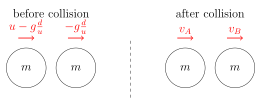
A smooth plane is inclined at an angle \(\alpha\) to the horizontal. \(A\) and \(B\) are two points a distance \(d\) apart on a line of greatest slope of the plane, with \(B\) higher than \(A\). A particle is projected up the plane from \(A\) towards \(B\) with initial speed \(u\), and simultaneously another particle is released from rest at \(B\,\). Show that they collide after a time \(\displaystyle {d /u}\,\). The coefficient of restitution between the two particles is \(e\) and both particles have mass \(m\,\). Show that the loss of kinetic energy in the collision is \(\frac14 {m u^2 \big( 1 - e^2 \big) }\,\).
Solution: We can `ignore' the fact that they are both accelerating, because the acceleration is the same for both object so it will "cancel" out. Therefore the time taken is the same as if the object has to travel distance \(d\) at speed \(u\), ie \(d/u\). \begin{align*} && u_A &= u - g \frac{d}{u} \\ && u_B &= -g\frac{d}{u} \end{align*}