Problems

Filters
Clear Filters

2 problems found

2014 Paper 1 Q7
D: 1516.0 B: 1500.0

In the triangle \(OAB\), the point \(D\) divides the side \(BO\) in the ratio \(r:1\) (so that \(BD = rDO\)), and the point \(E\) divides the side \(OA\) in the ratio \(s:1\) (so that \(OE =s EA\)), where \(r\) and \(s\) are both positive.

  1. The lines \(AD\) and \(BE\) intersect at \(G\). Show that \[ \mathbf{g}= \frac{rs}{1+r+rs} \, \mathbf{a} + \frac 1 {1+r+rs} \, \mathbf{b} \,, \] where \(\mathbf{a}, \mathbf{b}\) and \(\mathbf{g}\) are the position vectors with respect to \(O\) of \(A\), \(B\) and \(G\), respectively.
  2. The line through \(G\) and \(O\) meets \(AB\) at \(F\). Given that \(F\) divides \(AB\) in the ratio \(t:1\), find an expression for \(t\) in terms of \(r\) and \(s\).


Solution:
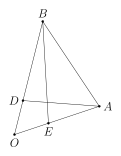
TikZ diagram
Notice that \(\mathbf{d} = \frac{1}{r+1} \mathbf{b}\) and \(\mathbf{e} = \frac{s}{s+1}\mathbf{a}\). We must also have that the line \(AD\) is \(\mathbf{a} + \lambda \left (\mathbf{a} - \frac{1}{r+1} \mathbf{b}\right)\) and \(BE\) is \(\mathbf{b} + \mu \left (\mathbf{b} - \frac{s}{s+1} \mathbf{a}\right)\) at their point of intersection we must have \begin{align*} && \mathbf{a} + \lambda \left (\mathbf{a} - \frac{1}{r+1} \mathbf{b}\right) &= \mathbf{b} + \mu \left (\mathbf{b} - \frac{s}{s+1} \mathbf{a}\right) \\ [\mathbf{a}]: && 1 + \lambda &= -\frac{\mu s}{s+1} \\ [\mathbf{b}]: && -\frac{\lambda}{r+1} &= 1 + \mu \\ \Rightarrow && \lambda &= -\frac{1+s+\mu s}{s+1} \\ \Rightarrow && \mu &= \frac{1+s+\mu s}{(1+r)(1+s)} - 1 \\ \Rightarrow && (1+r+rs)\mu &= 1+s - 1 - r - s - rs \\ \Rightarrow && \mu &= -\frac{r+rs}{1+r+rs} \\ \Rightarrow && \mathbf{g} &= \mathbf{b} -\frac{r+rs}{1+r+rs}\left (\mathbf{b} - \frac{s}{s+1} \mathbf{a}\right) \\ &&&= \frac{rs}{1+r+rs} \, \mathbf{a} + \frac 1 {1+r+rs} \, \mathbf{b} \end{align*} \item The line \(OG\) is \(\lambda \mathbf{g}\). The line \(AB\) is \(\mathbf{a} + \mu(\mathbf{b}-\mathbf{a})\), so we need \begin{align*} && \lambda \mathbf{g} &= \mathbf{a} + \mu(\mathbf{b}-\mathbf{a}) \\ [\mathbf{a}]: && \lambda \frac{rs}{1+r+rs} &= 1-\mu \\ [\mathbf{b}]: && \lambda \frac{1}{1+r+rs} &= \mu \\ \Rightarrow && \lambda \frac{1+rs}{1+r+rs} &= 1 \\ \Rightarrow && \lambda &= \frac{1+r+rs}{1+rs} \\ \Rightarrow && \mu &= \frac{1}{1+rs} \end{align*} Therefore the line is divided in the ratio \(rs : 1\), and therefore we have proven Ceva's Theorem.

2008 Paper 2 Q8
D: 1600.0 B: 1484.0

The points \(A\) and \(B\) have position vectors \(\bf a\) and \(\bf b\), respectively, relative to the origin \(O\). The points \(A\), \(B\) and \(O\) are not collinear. The point \(P\) lies on \(AB\) between \(A\) and \(B\) such that \[ AP : PB = (1-\lambda):\lambda\,. \] Write down the position vector of \(P\) in terms of \(\bf a\), \(\bf b\) and \(\lambda\). Given that \(OP\) bisects \(\angle AOB\), determine \(\lambda\) in terms of \(a\) and \(b\), where \(a=\vert \bf a\vert\) and $b=\vert \mathbf{b}\vert\(. The point \)Q\( also lies on \)AB\( between \)A\( and \)B\(, and is such that \)AP=BQ$. Prove that $$OQ^2-OP^2=(b-a)^2\,.$$


Solution:

TikZ diagram
\(\mathbf{p} = \lambda \mathbf{a} +(1- \lambda) \mathbf{b}\) Applying the Sine rule, we can see that: \begin{align*} && \frac{OA}{\sin \angle APO} = \frac{AP}{\sin \angle AOP} \\ && \frac{OB}{\sin \angle BPO} = \frac{BP}{\sin \angle BOP} \\ \end{align*} But \(\angle AOP = \angle BOP = \frac12 \angle AOP\) (since \(OP\) bisects the angle) and \(\angle APO = 180^{\circ} -\angle BPO\), so their sines are also equal. Therefore \begin{align*} && \frac{a}{AP} &= \frac{b}{BP} \\ \Rightarrow && \frac{a}{b} &= \frac{1-\lambda}{\lambda} \\ \Rightarrow && \lambda &= \frac{b}{a+b} \end{align*} Note that \(\mathbf{p} = \frac{b\mathbf{a} + a \mathbf{b}}{a+b} = \mathbf{a} + \frac{a}{a+b}(\mathbf{b}-\mathbf{a})\) and \(\mathbf{q} = \mathbf{b} +\frac{a}{a+b}(\mathbf{a}-\mathbf{b}) = \frac{a\mathbf{a} +b \mathbf{b}}{a+b}\) Therefore \begin{align*} && OQ^2 &= \frac{1}{(a+b)^2} \left (a\mathbf{a} + b \mathbf{b} \right)\cdot \left (a\mathbf{a} + b \mathbf{b} \right) \\ &&&= \frac{a^4+b^4+2ab\mathbf{a}\cdot\mathbf{b}}{(a+b)^2} \\ &&OP^2 &= \frac{1}{(a+b)^2} \left (b\mathbf{a} + a \mathbf{b} \right)\cdot \left (b\mathbf{a} + a \mathbf{b} \right) \\ &&&= \frac{2a^2b^2+2ab\mathbf{a}\cdot\mathbf{b}}{(a+b)^2} \\ \\ && OQ^2 - OP^2 &= \frac{a^4+b^4-2a^2b^2}{(a+b)^2} \\ &&&= \frac{(a^2-b^2)^2}{(a+b)^2} \\ &&&= (a-b)^2 \end{align*}