Problems

Filters
Clear Filters

1 problem found

1996 Paper 2 Q10
D: 1600.0 B: 1516.0

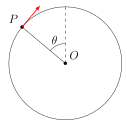
The plot of `Rhode Island Red and the Henhouse of Doom' calls for the heroine to cling on to the circumference of a fairground wheel of radius \(a\) rotating with constant angular velocity \(\omega\) about its horizontal axis and then let go. Let \(\omega_{0}\) be the largest value of \(\omega\) for which it is not possible for her subsequent path to carry her higher than the top of the wheel. Find \(\omega_{0}\) in terms of \(a\) and \(g\). If \(\omega>\omega_{0}\) show that the greatest height above the top of the wheel to which she can rise is \[\frac{a}{2}\left(\frac{\omega}{\omega_{0}} -\frac{\omega_{0}}{\omega}\right)^{\!\!2}.\]


Solution:
TikZ diagram
\begin{align*} \uparrow: && v &= u + at \\ \Rightarrow && T &= \frac{a \omega \sin \theta}{g} \\ && s &= ut + \frac12 gt^2 \\ \Rightarrow && s &= a\omega \sin \theta \cdot \frac{a \omega \sin \theta}{g} - \frac12 g \left ( \frac{a \omega \sin \theta}{g} \right) ^2 \\ &&&= \frac1{2g} a^2 \omega^2 \sin^2 \theta \\ s < \text{distance to top}: && \frac1{2g} a^2 \omega^2 \sin^2 \theta &< a(1- \cos \theta) \\ \Rightarrow && \omega^2 &< \frac{2g}{a} \frac{1-\cos \theta}{\sin^2 \theta} \\ &&&= \frac{2g}{a} \frac{2 \sin^2 \tfrac12 \theta}{4 \sin^2 \tfrac12 \theta \cos^2 \tfrac12 \theta} \\ &&&= \frac{g}{a} \sec^2 \tfrac12 \theta \\ &&&\leq \frac{g}{a} \tag{since it holds for all \(\theta\) it holds for min \(\theta\)}\\ \Rightarrow && \omega_0 &= \sqrt{\frac{g}{a}} \\ \\ && \text{max height} &= \frac1{2g} a^2 \omega^2 \sin^2 \theta - a(1-\cos \theta) \\ &&&= \frac1{2g} a^2 \omega^2 (1-\cos^2 \theta) - a(1-\cos \theta) \\ &&&= \frac{a}{2} \left (- \frac{\omega^2}{\omega_0^2} \cos^2 \theta + 2 \cos \theta + \frac{\omega^2}{\omega_0^2}-2 \right) \\ &&&= \frac{a}{2} \left (-\left (\frac{\omega_0}{\omega}- \frac{\omega}{\omega_0} \cos \theta \right)^2 + \frac{\omega^2}{\omega_0^2}-2+\frac{\omega_0^2}{\omega^2} \right) \\ &&&= \frac{a}{2} \left ( \frac{\omega}{\omega_0} - \frac{\omega_0}{\omega} \right)^2 - \frac{a}{2} \left (\frac{\omega_0}{\omega}- \frac{\omega}{\omega_0} \cos \theta \right)^2 \end{align*} If \(\omega > \omega_0\) we can find a \(\theta\) such that the second bracket is \(0\), hence the maximium height is as desired.