Problems
Filters
2 problems found
2017 Paper 2 Q9
Two identical rough cylinders of radius \(r\) and weight \(W\) rest, not touching each other but a negligible distance apart, on a horizontal floor. A thin flat rough plank of width \(2a\), where \(a < r\), and weight \(kW\) rests symmetrically and horizontally on the cylinders, with its length parallel to the axes of the cylinders and its faces horizontal. A vertical cross-section is shown in the diagram below.
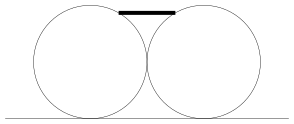
- Let \(F\) be the frictional force between one cylinder and the floor, and let \(R\) be the normal reaction between the plank and one cylinder. Show that \[ R\sin\theta = F(1+\cos\theta)\,, \] where \(\theta\) is the acute angle between the plank and the tangent to the cylinder at the point of contact. Deduce that \(2\sin\theta \le 1+\cos\theta\,\).
- Show that \[ N= \left( 1+\frac2 k\right)\left(\frac{1+\cos\theta}{\sin\theta} \right) F \,, \] where \(N\) is the normal reaction between the floor and one cylinder. Write down the condition that the cylinder does not slip on the floor and show that it is satisfied with no extra restrictions on \(\theta\).
- Show that \(\sin\theta\le\frac45\,\) and hence that \(r\le5a\,\).
Solution:
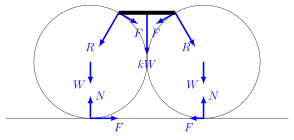
- \(\,\) \begin{align*} \text{N2}(\rightarrow, \text{ one cylinder}): && F\cos \theta + F - R \sin \theta &= 0 \\ \Rightarrow && F(1+\cos \theta) &= R \sin \theta \\ && F \leq \tfrac12 R \\ \Rightarrow && R \sin \theta &\leq \frac12 R(1+\cos \theta) \\ \Rightarrow && 2 \sin \theta &\leq 1 + \cos \theta \end{align*}
- \(\,\) \begin{align*} \text{N2}(\uparrow, \text{system}): && 2N-(k+2)W &= 0 \\ \Rightarrow && W &= \left ( \frac{2}{k+2} \right)N \\ \text{N2}(\uparrow, \text{one cylinder}): && N - W - R\cos \theta -F\sin \theta &= 0 \\ \Rightarrow && N - \left ( \frac{2}{k+2} \right)N - F \left ( \frac{1+\cos \theta}{\sin \theta} \right) \cos \theta - F \sin \theta &= 0 \\ \Rightarrow && \left ( \frac{k}{k+2} \right)N &= \left ( \frac{\cos \theta + \cos^2 \theta + \sin^2 \theta}{\sin \theta} \right) F\\ \Rightarrow && N &= \left ( 1 + \frac2{k} \right) \left ( \frac{\cos \theta + 1}{\sin \theta} \right) F \end{align*} The cylinder does not slip if \(F \leq \tfrac12 N\), ie \begin{align*} && N &\leq \left ( 1 + \frac2{k} \right) \left ( \frac{\cos \theta + 1}{\sin \theta} \right) \frac12 N \\ \Rightarrow && 2\sin \theta &\leq \left ( 1 + \frac2{k} \right) \left ( \cos \theta + 1 \right) \end{align*} but since \(2 \sin \theta \leq (1 + \cos \theta)\) and \((1+\frac2k) > 1\) this inequality is obviously satisfied.
- We can notice that \(2\sin \theta = 1 + \cos \theta\) is satisfied by a \(3-4-5\) triangle, where \(\sin \theta = 4/5, \cos \theta = 3/5\) and hence if \(\sin \theta \leq \frac45\) the condition must hold.
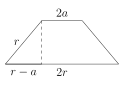
So \(\sin \theta = \frac{r-a}{r} \leq \frac45 \Rightarrow 5r-5a \leq 4r \Rightarrow r \leq 5a\)
1988 Paper 1 Q13
A piece of circus apparatus consists of a rigid uniform plank of mass 1000\(\,\)kg, suspended in a horizontal position by two equal light vertical ropes attached to the ends. The ropes each have natural length 10\(\,\)m and modulus of elasticity 490\(\,\)000 N. Initially the plank is hanging in equilibrium. Nellie, an elephant of mass 4000\(\,\)kg, lands in the middle of the plank while travelling vertically downwards at speed 5\(\,\)ms\(^{-1}.\) While carrying Nellie, the plank comes instantaneously to rest at a negligible height above the floor, and at this instant Nellie steps nimbly and gently off the plank onto the floor. Assuming that the plank remains horizontal, and the rope remain vertical, throughout the motion, find to three significant figures its initial height above the floor. During the motion after Nellie alights, do the ropes ever become slack? {[}Take \(g\) to be \(9.8\mbox{\,\ ms}^{-1}.\){]}
Solution: In the initial position, since the system is in equilibrium the tension in the two ropes must be \(500g\). Therefore since \(T = \frac{\lambda x}{l} \Rightarrow x = \frac{10 \cdot 500 g}{490\, 000} = \frac1{10}\) so the initial extension is \(\frac1{10}\) By conservation of momentum, if the initial speed of the plank + Nellie is \(V\), we must have \(4000 \cdot 5 = 5000 V \Rightarrow V = 4\) \begin{array}{ccc} & \text{GPE} & \text{EPE} & \text{KE} \\ \hline \text{Initially} & 5000gh & 2 \cdot \frac12 \frac{\lambda}{l} \frac{1}{100} & \frac12 \cdot 5000 \cdot 4^2 \\ & 49\,000h & 490 & 40\,000 \\ \text{Finally} & 0 & 2 \cdot \frac12 \frac{\lambda}{l} (h + \frac1{10})^2 & 0 \\ & 0 & 49\,000 (h+\frac1{10})^2 & 0 \end{array} By conservation of energy, we can set up a quadratic: \begin{align*} && 49\,000 (h+\frac1{10})^2 &= 49\,000h + 40\,490 \\ \Rightarrow && 49\,000(h + \frac1{10})^2 &= 49\,000(h + \frac1{10})+35\, 590 \\ \Rightarrow&& h + \frac1{10} &= 1.488092\cdots \\ \Rightarrow && h &= 1.49 \,\, (3\text{ s.f.}) \end{align*} When she gets off the plank, it will move according to: \begin{align*} \text{N2}(\uparrow): && \frac{\lambda x}{l} -1000g &= -1000 \ddot{x} \\ && 49 x-g &= -\ddot{x} \\ \Rightarrow && x &= A \sin 7t + B \cos 7t + 0.2 \\ && x(0) = 1.49, &x'(0) = 0 \\ \Rightarrow && B = -1.69, & A=0 \end{align*} If we continued under this motion the string would definitely reach a point \(0.1\) above \(0\), and therefore the ropes would go slack.