Problems
Filters
1 problem found
1990 Paper 3 Q12
A uniform smooth wedge of mass \(m\) has congruent triangular end faces \(A_{1}B_{1}C_{1}\) and \(A_{2}B_{2}C_{2},\) and \(A_{1}A_{2},B_{1}B_{2}\) and \(C_{1}C_{2}\) are perpendicular to these faces. The points \(A,B\) and \(C\) are the midpoints of \(A_{1}A_{2},B_{1}B_{2}\) and \(C_{1}C_{2}\) respectively. The sides of the triangle \(ABC\) have lengths \(AB=AC=5a\) and \(BC=6a.\) The wedge is placed with \(BC\) on a smooth horizontal table, a particle of mass \(2m\) is placed at \(A\) on \(AC,\) and the system is released from rest. The particle slides down \(AC,\) strikes the table, bounces perfectly elastically and lands again on the table at \(D\). At this time the point \(C\) of the wedge has reached the point \(E\). Show that \(DE=\frac{192}{19}a.\)
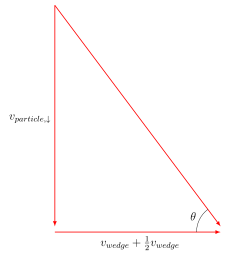
Solution: Conservation of energy, tells us that \(2m \cdot g \cdot 4a = 8amg\) is equal to \(\frac12 m v_{wedge}^2 + \frac12(2m)v_{particle}^2\). Conservation of momentum (horizontally) tells us that \(m v_{wedge}+2mv_{particle, \rightarrow} = 0 \Rightarrow v_{particle, \rightarrow} = -\frac12 v_{wedge}\).