Problems

Filters
Clear Filters

2 problems found

1991 Paper 3 Q14
D: 1700.0 B: 1486.2

TikZ diagram
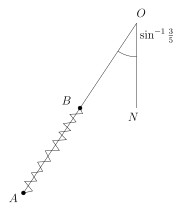
The end \(O\) of a smooth light rod \(OA\) of length \(2a\) is a fixed point. The rod \(OA\) makes a fixed angle \(\sin^{-1}\frac{3}{5}\) with the downward vertical \(ON,\) but is free to rotate about \(ON.\) A particle of mass \(m\) is attached to the rod at \(A\) and a small ring \(B\) of mass \(m\) is free to slide on the rod but is joined to a spring of natural length \(a\) and modulus of elasticity \(kmg\). The vertical plane containing the rod \(OA\) rotates about \(ON\) with constant angular velocity \(\sqrt{5g/2a}\) and \(B\) is at rest relative to the rod. Show that the length of \(OB\) is \[ \frac{(10k+8)a}{10k-9}. \] Given that the reaction of the rod on the particle at \(A\) makes an angle \(\tan^{-1}\frac{13}{21}\) with the horizontal, find the value of \(k\). Find also the magnitude of the reaction between the rod and the ring \(B\).

1987 Paper 3 Q13
D: 1500.0 B: 1500.0

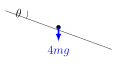
A uniform rod, of mass \(3m\) and length \(2a,\) is freely hinged at one end and held by the other end in a horizontal position. A rough particle, of mass \(m\), is placed on the rod at its mid-point. If the free end is then released, prove that, until the particle begins to slide on the rod, the inclination \(\theta\) of the rod to the horizontal satisfies the equation \[ 5a\dot{\theta}^{2}=8g\sin\theta. \] The coefficient of friction between the particle and the rod is \(\frac{1}{2}.\) Show that, when the particle begins to slide, \(\tan\theta=\frac{1}{26}.\)


Solution:
TikZ diagram
While the particle is not sliding, we can consider the whole system. Considering the moment of inertia about the end, we have: \begin{align*} I &= \frac13 \cdot 3m \cdot (2a)^2 + m a^2 \\ &= 5ma^2 \end{align*} Taking the level of the pivot as the \(0\) GPE level, the initial energy is \(0\). The energy once it has rotated through an angle \(\theta\) is: \begin{align*} && 0 &= \text{rotational ke} + \text{gpe} \\ &&&= \frac12 I \dot{\theta}^2 - 4mg \sin \theta \\ &&&= \frac12 5am \dot{\theta}^2 -4mg \sin \theta \\ \Rightarrow && 5a\dot{\theta}^2 &= 8g \sin \theta \end{align*} as required. We also have \(5a \ddot{\theta} = 4g \cos \theta\) The acceleration towards the pivot required to maintain circular motion is \(m \frac{v^2}{r} = m a \dot{\theta}^2\). When we are on the point of sliding:
TikZ diagram
\begin{align*} \text{N2}(\nearrow): && R - mg\cos \theta &= -ma \ddot{\theta} \\ \Rightarrow && R &= mg \cos \theta - ma \frac{4mg \cos \theta}{5a} \\ &&&= \frac15mg \cos \theta \end{align*} Therefore we must have: \begin{align*} \text{N2}(\nwarrow):&&\mu R - mg \sin \theta &= ma \dot{\theta}^2 \\ && \frac12 \cdot \frac 15 mg \cos \theta &= m \frac{13}5 g \sin \theta \\ \Rightarrow && \tan \theta &= \frac{1}{26} \end{align*}