Problems
Filters
2 problems found
2006 Paper 2 Q14
Sketch the graph of \[ y= \dfrac1 { x \ln x} \text{ for \(x>0\), \(x\ne1\)}.\] You may assume that \(x\ln x \to 0\) as \(x\to 0\). The continuous random variable \(X\) has probability density function \[ \f(x) = \begin{cases} \dfrac \lambda {x\ln x}& \text{for \(a\le x \le b\)}\;, \\[3mm] \ \ \ 0 & \text{otherwise }, \end{cases} \] where \(a\), \(b\) and \(\lambda\) are suitably chosen constants.
- In the case \(a=1/4\) and \(b=1/2\), find \(\lambda\,\).
- In the case \(\lambda=1\) and \(a>1\), show that \(b=a^\e\).
- In the case \(\lambda =1\) and \(a=\e\), show that \(\P(\e^{3/2}\le X \le \e^2)\approx \frac {31}{108}\,\).
- In the case \(\lambda =1\) and \(a=\e^{1/2}\), find \(\P(\e^{3/2}\le X \le \e^2)\;\).
Solution:
- \begin{align*} 1 &= \int_{1/4}^{1/2} \frac{\lambda}{x\ln x} \, dx \\ &= \lambda\left [ \ln |\ln x| \right ]_{1/4}^{1/2} \\ &= \lambda \l \ln |-\ln 2| - \ln |-2 \ln 2| \r \\ &= \lambda (-\ln 2) \end{align*} So \(\lambda = -\frac{1}{\ln 2} = \frac{1}{\ln \frac12}\)
- \begin{align*} 1 &= \int_{a}^{b} \frac{1}{x\ln x} \, dx \\ &= \left [ \ln |\ln x| \right ]_{a}^{b} \\ &= \l \ln \ln b - \ln \ln a \r \\ &= \ln \l \frac{\ln b}{\ln a} \r \\ \end{align*} So \(b = e^{a}\)
- If \(\lambda = 1, a = e, b = e^e\), then \begin{align*} \P(\e^{3/2}\le X \le \e^2) &= \int_{e^{3/2}}^{e^2} \frac{1}{x \ln x} \, dx \\ &= \left [ \ln \ln x \right]_{e^{3/2}}^{e^2} \\ &= \ln 2 - \ln \frac{3}{2} \\ &= \ln \frac{4}{3} \\ &= \ln \l 1 + \frac{1}{3} \r \\ &\approx \frac{1}{3} - \frac{1}{2 \cdot 3^2} + \frac{1}{3 \cdot 3^3} - \frac{1}{4 \cdot 3^4} \\ &= \frac{31}{108} \end{align*}
- Note that \(2 > e^{\frac12} > 1\) so \(a = e^{\frac12}, b = e^{\frac{e}2}\). Since \(3 > e \Rightarrow e^{3/2} > e^{\frac{e}{2}}\) this probability is out of range, therefore \(\P(\e^{3/2}\le X \le \e^2) = 0\)
2004 Paper 2 Q12
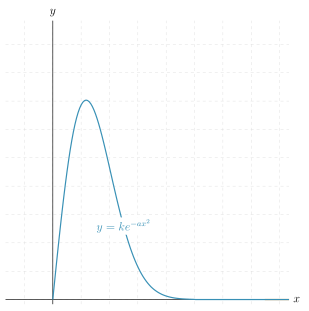
Sketch the graph, for \(x \ge 0\,\), of $$ y = kx\e^{-ax^2} \;, $$ where \(a\) and \(k\) are positive constants. The random variable \(X\) has probability density function \(\f(x)\) given by \begin{equation*} \f(x)= \begin{cases} kx\e^{-ax^2} & \text{for \(0 \le x \le 1\)}\\[3pt] 0 & \text{otherwise}. \end{cases} \end{equation*} Show that \(\displaystyle k=\frac{2a}{1-\e^{-a}}\) and find the mode \(m\) in terms of \(a\,\), distinguishing between the cases \(a < \frac12\) and \(a > \frac12\,\). Find the median \(h\) in terms of \(a\), and show that \(h > m\) if \(a > -\ln\left(2\e^{-1/2} - 1\right).\) Show that, \(-\ln\left(2\e^{-1/2}-1\right)> \frac12 \,\). Show also that, if \(a > -\ln\left(2\e^{-1/2} - 1\right) \,\), then $$ P(X > m \;\vert\; X < h) = {{2\e^{-1/2}-\e^{-a}-1} \over 1-\e^{-a}}\;. $$
Solution: