Problems
Filters
4 problems found
2022 Paper 2 Q12
The random variable \(X\) has probability density function \[\mathrm{f}(x) = \begin{cases} kx^n(1-x) & 0 \leqslant x \leqslant 1\,,\\ 0 & \text{otherwise}\,,\end{cases}\] where \(n\) is an integer greater than 1.
- Show that \(k = (n+1)(n+2)\) and find \(\mu\), where \(\mu = \mathrm{E}(X)\).
- Show that \(\mu\) is less than the median of \(X\) if \[6 - \frac{8}{n+3} < \left(1 + \frac{2}{n+1}\right)^{n+1}.\] By considering the first four terms of the expansion of the right-hand side of this inequality, or otherwise, show that the median of \(X\) is greater than \(\mu\).
- You are given that, for positive \(x\), \(\left(1 + \dfrac{1}{x}\right)^{x+1}\) is a decreasing function of \(x\). Show that the mode of \(X\) is greater than its median.
Solution:
- \(\,\) \begin{align*} && 1 &= \int_0^1 kx^n(1-x) \d x \\ &&&= k\left [\frac{x^{n+1}}{n+1} - \frac{x^{n+2}}{n+2} \right]_0^1 \\ &&&= \frac{k}{(n+1)(n+2)} \\ \Rightarrow && k &= (n+1)(n+2) \\ \\ && \E[X] &= \int_0^1 kx^{n+1}(1-x) \d x \\ &&&= k\left [ \frac{x^{n+2}}{n+2} - \frac{x^{n+3}}{n+3} \right]_0^1 \\ &&&= \frac{(n+1)(n+2)}{(n+2)(n+3)} \\ &&&= \frac{n+1}{n+3} \end{align*}
- If \(\mu\) is less than the median then \begin{align*} && \frac12 &> \int_0^{\mu} kx^{n}(1-x) \d x \\ &&&= \left [k \frac{x^{n+1}}{n+1} - \frac{x^{n+2}}{n+2} \right]_0^\mu \\ &&&= \mu^{n+1}\left ((n+2) - (n+1) \frac{n+1}{n+3} \right) \\ \Rightarrow && \left ( 1 + \frac{2}{n+1} \right)^{n+1} &> 2 \frac{(n+2)(n+3) - (n+1)^2}{n+3} \\ &&&= \frac{6n+10}{n+3} = 6 - \frac{8}{n+3} \end{align*} \begin{align*} && \left ( 1 + \frac{2}{n+1} \right)^{n+1} &= 1 + (n+1) \frac{2}{n+1} + \frac{(n+1)n}{2} \frac{4}{(n+1)^2} + \frac{(n+1)n(n-1)}{6} \frac{8}{(n+1)^3} + \cdots \\ &&&= 1 + 2 + \frac{2n}{n+1} + \frac{4n(n-1)}{3(n+1)^2} + \cdots \\ &&&= 5 - \frac{2}{n+1} + \frac{4((n+1)^2-3(n+1)+3)}{3(n+1)^2} \\ &&&= 6 + \frac13 - \frac{6}{n+1} - \frac{4}{3(n+1)^2} \\ &&&> 6 - \frac{8}{n+3} \end{align*} as required.
- To find the mode, we need to find the maximum of \(x^n(1-x)\) which occurs when \(nx^{n-1}(1-x) - x^n = x^{n-1}(n-(n+1)x)\) ie where \(x = \frac{n}{n+1}\), therefore we need to look at: \begin{align*} && \mathbb{P}(X \leq \tfrac{n}{n+1}) &= \int_0^{n/(n+1)} k x^n(1-x) \d x \\ &&&= \frac{n^{n+1}}{(n+1)^{n+1}} \left ( (n+2) - (n+1) \frac{n}{n+1} \right) \\ &&&= 2\frac{n^{n+1}}{(n+1)^{n+1}} \\ &&&= 2 \left ( \frac{1}{1+\frac1n} \right)^{n+1} \\ &&&\geq 2 \frac{1}{(1 + \frac11)^2} = \frac12 \end{align*} as required
2014 Paper 3 Q12
The random variable \(X\) has probability density function \(f(x)\) (which you may assume is differentiable) and cumulative distribution function \(F(x)\) where \(-\infty < x < \infty \). The random variable \(Y\) is defined by \(Y= \e^X\). You may assume throughout this question that \(X\) and \(Y\) have unique modes.
- Find the median value \(y_m\) of \(Y\) in terms of the median value \(x_m\) of \(X\).
- Show that the probability density function of \(Y\) is \(f(\ln y)/y\), and deduce that the mode \(\lambda\) of \(Y\) satisfies \(\f'(\ln \lambda) = \f(\ln \lambda)\).
- Suppose now that \(X \sim {\rm N} (\mu,\sigma^2)\), so that \[ f(x) = \frac{1}{\sigma \sqrt{2\pi}\,} \e^{-(x-\mu)^2/(2\sigma^2)} \,. \] Explain why \[\frac{1}{\sigma \sqrt{2\pi}\,} \int_{-\infty}^{\infty}\e^{-(x-\mu-\sigma^2)^2/(2\sigma^2)} \d x = 1 \] and hence show that \( \E(Y) = \e ^{\mu+\frac12\sigma^2}\).
- Show that, when \(X \sim {\rm N} (\mu,\sigma^2)\), \[ \lambda < y_m < \E(Y)\,. \]
Solution:
- \begin{align*} && \frac12 &= \mathbb{P}(X \leq x_m) \\ \Leftrightarrow && \frac12 &= \mathbb{P}(e^X \leq e^{x_m} = y_m) \end{align*} Therefore the median is \(y_m = e^{x_m}\)
- \begin{align*} && \mathbb{P}(Y \leq y) &= \mathbb{P}(e^X \leq y) \\ &&&= \mathbb{P}(X \leq \ln y) \\ &&&= F(\ln y) \\ \Rightarrow && f_Y(y) &= f(\ln y)/y \\ \\ && f'_Y(y) &= \frac{f'(\ln y) - f(\ln y)}{y^2} \end{align*} Therefore since the mode satisfies \(f'_Y = 0\) we must have \(f'(\ln \lambda ) = f(\ln \lambda)\)
- This is the integral of the pdf of \(N(\mu + \sigma^2, \sigma^2)\) and therefore is clearly \(1\). \begin{align*} && \E[Y] &= \int_{-\infty}^{\infty} e^x \cdot \frac{1}{\sqrt{2\pi \sigma^2}} e^{-(x-\mu)^2/(2\sigma^2)} \d x \\ &&&= \frac{1}{\sqrt{2\pi \sigma^2}} \int_{-\infty}^{\infty} \exp (x - (x-\mu)^2/(2\sigma^2)) \d x\\ &&&= \frac{1}{\sqrt{2\pi \sigma^2}} \int_{-\infty}^{\infty} \exp ((2x \sigma^2- (x-\mu)^2)/(2\sigma^2)) \d x\\ &&&= \frac{1}{\sqrt{2\pi \sigma^2}} \int_{-\infty}^{\infty} \exp (-(x-\mu-\sigma^2)^2+2\mu \sigma^2-\sigma^4)/(2\sigma^2)) \d x\\ &&&= \frac{1}{\sqrt{2\pi \sigma^2}} \int_{-\infty}^{\infty} \exp (-(x-\mu+\sigma^2)^2)/(2\sigma^2)+\mu +\frac12\sigma^2) \d x\\ &&&= \e^{\mu +\frac12\sigma^2}\frac{1}{\sqrt{2\pi \sigma^2}} \int_{-\infty}^{\infty} \exp (-(x-\mu-\sigma^2)^2)/(2\sigma^2)) \d x\\ &&&= \e^{\mu +\frac12\sigma^2} \end{align*}
- Notice that \(y_m = e^\mu < e^{\mu + \tfrac12 \sigma^2} = \E[Y]\), so it suffices to prove that \(\lambda < e^{\mu}\) Notice that \(f'(x) - f(x) = f(x)[-(x-\mu)/\sigma^2 - 1]\) and therefore \(\ln y - \mu = -\sigma^2\) so \(\lambda = e^{\mu - \sigma^2}\) which is clearly less than \(e^{\mu}\) as required.
2012 Paper 2 Q12
A modern villa has complicated lighting controls. In order for the light in the swimming pool to be on, a particular switch in the hallway must be on and a particular switch in the kitchen must be on. There are four identical switches in the hallway and four identical switches in the kitchen. Guests cannot tell whether the switches are on or off, or what they control. Each Monday morning a guest arrives, and the switches in the hallway are either all on or all off. The probability that they are all on is \(p\) and the probability that they are all off is \(1-p\). The switches in the kitchen are each on or off, independently, with probability \(\frac12\).
- On the first Monday, a guest presses one switch in the hallway at random and one switch in the kitchen at random. Find the probability that the swimming pool light is on at the end of this process. Show that the probability that the guest has pressed the swimming pool light switch in the hallway, given that the light is on at the end of the process, is \(\displaystyle \frac{1-p}{1+2p}\).
- On each of seven Mondays, guests go through the above process independently of each other, and each time the swimming pool light is found to be on at the end of the process. Given that the most likely number of days on which the swimming pool light switch in the hallway was pressed is 3, show that \(\frac14 < p < \frac{5}{14}\).
Solution:
- \(\,\) \begin{align*} && \mathbb{P}(\text{hall switch on}) &= \underbrace{p \cdot \frac34 }_{\text{already on and not flipped}}+ \underbrace{(1-p) \cdot \frac14}_{\text{not on and flipped}} \\ &&&= \frac14 +\frac12 p\\ && \mathbb{P}(\text{kitchen on}) &= \frac12 \\ \Rightarrow && \mathbb{P}(\text{pool is on}) &= \frac18 + \frac14p \end{align*} \begin{align*} && \mathbb{P}(\text{flipped hall switch} | \text{pool on}) &= \frac{\mathbb{P}(\text{flipped hall and pool on})}{\mathbb{P}(\text{pool on})} \\ &&&= \frac{(1-p)\frac14 \cdot \frac 12}{\frac18 + \frac14 p} \\ &&&= \frac{1-p}{1+2p} \end{align*}
- The number of days the swimming pool light was pressed is \(X = B\left (7, \frac{1-p}{1+2p} \right)\), and we have that \(\mathbb{P}(X = 2) < \mathbb{P}(X = 3) > \mathbb{P}(X=4)\) (since the binomial is unimodal). Let \(q = \frac{1-p}{1+2p} \) \begin{align*} && \mathbb{P}(X = 2) &< \mathbb{P}(X = 3) \\ \Rightarrow && \binom{7}{2} q^2(1-q)^5 &< \binom{7}{3}q^3(1-q)^4 \\ \Rightarrow && 21(1-q) &< 35q \\ \Rightarrow && 21 &< 56q \\ \Rightarrow && \frac{3}{8} &< \frac{1-p}{1+2p} \\ \Rightarrow && 3+6p &< 8-8p \\ \Rightarrow && 14p &< 5\\ \Rightarrow && p &< \frac5{14} \\ \\ && \mathbb{P}(X = 3) &> \mathbb{P}(X = 4) \\ \Rightarrow && \binom{7}{3} q^3(1-q)^4 &> \binom{7}{4}q^4(1-q)^3 \\ \Rightarrow &&(1-q)&> q \\ \Rightarrow && \frac12 &> q \\ \Rightarrow && \frac12 &> \frac{1-p}{1+2p} \\ \Rightarrow && 1+2p &> 2-2p \\ \Rightarrow && 4p &> 1\\ \Rightarrow && p &> \frac1{4} \end{align*} Therefore \(\frac14 < p < \frac{5}{14}\) as required.
2004 Paper 2 Q12
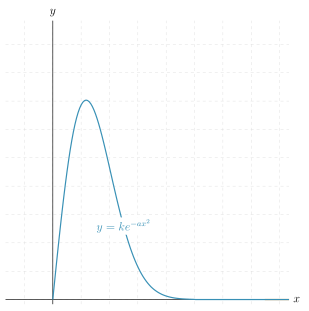
Sketch the graph, for \(x \ge 0\,\), of $$ y = kx\e^{-ax^2} \;, $$ where \(a\) and \(k\) are positive constants. The random variable \(X\) has probability density function \(\f(x)\) given by \begin{equation*} \f(x)= \begin{cases} kx\e^{-ax^2} & \text{for \(0 \le x \le 1\)}\\[3pt] 0 & \text{otherwise}. \end{cases} \end{equation*} Show that \(\displaystyle k=\frac{2a}{1-\e^{-a}}\) and find the mode \(m\) in terms of \(a\,\), distinguishing between the cases \(a < \frac12\) and \(a > \frac12\,\). Find the median \(h\) in terms of \(a\), and show that \(h > m\) if \(a > -\ln\left(2\e^{-1/2} - 1\right).\) Show that, \(-\ln\left(2\e^{-1/2}-1\right)> \frac12 \,\). Show also that, if \(a > -\ln\left(2\e^{-1/2} - 1\right) \,\), then $$ P(X > m \;\vert\; X < h) = {{2\e^{-1/2}-\e^{-a}-1} \over 1-\e^{-a}}\;. $$
Solution: