Problems
Filters
19 problems found
2025 Paper 3 Q11
- Let \(\lambda > 0\). The independent random variables \(X_1, X_2, \ldots, X_n\) all have probability density function $$f(t) = \begin{cases} \lambda e^{-\lambda t} & t \geq 0 \\ 0 & t < 0 \end{cases}$$ and cumulative distribution function \(F(x)\). The value of random variable \(Y\) is the largest of the values \(X_1, X_2, \ldots, X_n\). Show that the cumulative distribution function of \(Y\) is given, for \(y \geq 0\), by $$G(y) = (1 - e^{-\lambda y})^n$$
- The values \(L(\alpha)\) and \(U(\alpha)\), where \(0 < \alpha \leq \frac{1}{2}\), are such that $$P(Y < L(\alpha)) = \alpha \text{ and } P(Y > U(\alpha)) = \alpha$$ Show that $$L(\alpha) = -\frac{1}{\lambda}\ln(1 - \alpha^{1/n})$$ and write down a similar expression for \(U(\alpha)\).
- Use the approximation \(e^t \approx 1 + t\), for \(|t|\) small, to show that, for sufficiently large \(n\), $$\lambda L(\alpha) \approx \ln(n) - \ln\left(\ln\left(\frac{1}{\alpha}\right)\right)$$
- Hence show that the median of \(Y\) tends to infinity as \(n\) increases, but that the width of the interval \(U(\alpha) - L(\alpha)\) tends to a value which is independent of \(n\).
- You are given that, for \(|t|\) small, \(\ln(1 + t) \approx t\) and that \(e^3 \approx 20\). Show that, for sufficiently large \(n\), there is an interval of width approximately \(4\lambda^{-1}\) in which \(Y\) lies with probability \(0.9\).
Solution:
- Note that \(\displaystyle F(y) = \mathbb{P}(X_i < y) = \int_0^y \lambda e^{-\lambda t} \d t = 1-e^{-\lambda y}\). Notice also that \begin{align*} G(y) &= \mathbb{P}(Y < y) \\ &= \mathbb{P}(\max_i(X_i) < y) \\ &= \mathbb{P}(X_i < y \text{ for all }i) \\ &= \prod_{i=1}^n \mathbb{P}(X_i < y) \\ &= \prod_{i=1}^n (1-e^{-\lambda y})\\ &= (1-e^{-\lambda y})^n \end{align*} as required.
- \begin{align*} && \mathbb{P}(Y < L(\alpha)) &= \alpha \\ \Rightarrow && (1-e^{-\lambda L(\alpha)})^n &= \alpha \\ \Rightarrow && 1-e^{-\lambda L(\alpha)} &= \alpha^{\tfrac1n} \\ \Rightarrow && L(\alpha) &= -\frac{1}{\lambda}\ln \left (1-\alpha^{\tfrac1n} \right) \end{align*} Notice also: \begin{align*} && \mathbb{P}(Y > U(\alpha)) &= \alpha \\ \Rightarrow && 1 - (1-e^{-\lambda U(\alpha)})^n &= \alpha \\ \Rightarrow && U(\alpha) &= -\frac{1}{\lambda}\ln \left ( 1-(1-\alpha)^{\tfrac1n} \right) \end{align*}
- \begin{align*} \lambda L(\alpha) &= -\ln \left (1-\alpha^{\tfrac1n} \right) \\ &= -\ln \left (1-e^{\tfrac1n \ln \alpha} \right) \\ &\approx - \ln \left ( 1 - 1 - \frac1n \ln \alpha\right) \tag{\(e^t \approx 1 + t\)} \\ &= -\ln \left ( \frac{1}{n} \ln \frac{1}\alpha \right) \\ &= - \ln \frac{1}{n} - \ln \left ( \ln \frac{1}{\alpha} \right )\\ &= \ln n - \ln \left ( \ln \left ( \frac{1}{\alpha} \right ) \right) \end{align*} since if \(n\) is large, \(\frac{\ln \alpha}{n}\) is small.
- The median is the value where \(\mathbb{P}(Y < M) = \frac12\), or in other words \(L(\frac12)\), but this is \(\approx \frac{\ln n - \ln (\ln 2)}{\lambda} \to \infty\). \begin{align*} && \lambda U(\alpha) &\approx \ln n - \ln \left ( \ln \left ( \frac{1}{1-\alpha} \right ) \right) \\ \Rightarrow && \lambda(U(\alpha) - L(\alpha)) &\approx -\ln \left ( \ln \left ( \frac{1}{1-\alpha} \right ) \right)+ \ln \left ( \ln \left ( \frac{1}{\alpha} \right ) \right) \\ \Rightarrow && U(\alpha) - L(\alpha) &\to \frac{1}{\lambda} \left ( \ln \left ( \ln \left ( \frac{1}{\alpha} \right ) \right)-\ln \left ( \ln \left ( \frac{1}{1-\alpha} \right ) \right ) \right) \end{align*} which doesn't depend on \(n\).
- Suppose \(\alpha = \frac{1}{20}\) then \begin{align*} U(\alpha) - L(\alpha) &\approx \frac{1}{\lambda} \left (\ln \ln 20 - \ln \ln \frac{20}{19} \right) \\ &= \lambda^{-1} \left (\ln \ln 20 - \ln \ln (1 + \frac{1}{19}) \right) \\ &\approx \lambda^{-1} \left (\ln 3 - \ln \frac{1}{19} \right) \tag{\(\ln(1+t) \approx t\)} \\ &\approx \lambda^{-1} \ln 3 \cdot 19 \\ &\approx \lambda^{-1} (1 + 3) \\ &\approx 4\lambda^{-1} \end{align*} [Note that \(\ln \ln 20 - \ln \ln \frac{20}{19} = 4.0673\ldots\)]
2023 Paper 2 Q12
Each of the independent random variables \(X_1, X_2, \ldots, X_n\) has the probability density function \(\mathrm{f}(x) = \frac{1}{2}\sin x\) for \(0 \leqslant x \leqslant \pi\) (and zero otherwise). Let \(Y\) be the random variable whose value is the maximum of the values of \(X_1, X_2, \ldots, X_n\).
- Explain why \(\mathrm{P}(Y \leqslant t) = \big[\mathrm{P}(X_1 \leqslant t)\big]^n\) and hence, or otherwise, find the probability density function of \(Y\).
- Find an expression for \(m(n)\) in terms of \(n\). How does \(m(n)\) change as \(n\) increases?
- Show that
\[\mu(n) = \pi - \frac{1}{2^n}\int_0^{\pi} (1-\cos x)^n\,\mathrm{d}x\,.\]
- Show that \(\mu(n)\) increases with \(n\).
- Show that \(\mu(2) < m(2)\).
2022 Paper 2 Q12
The random variable \(X\) has probability density function \[\mathrm{f}(x) = \begin{cases} kx^n(1-x) & 0 \leqslant x \leqslant 1\,,\\ 0 & \text{otherwise}\,,\end{cases}\] where \(n\) is an integer greater than 1.
- Show that \(k = (n+1)(n+2)\) and find \(\mu\), where \(\mu = \mathrm{E}(X)\).
- Show that \(\mu\) is less than the median of \(X\) if \[6 - \frac{8}{n+3} < \left(1 + \frac{2}{n+1}\right)^{n+1}.\] By considering the first four terms of the expansion of the right-hand side of this inequality, or otherwise, show that the median of \(X\) is greater than \(\mu\).
- You are given that, for positive \(x\), \(\left(1 + \dfrac{1}{x}\right)^{x+1}\) is a decreasing function of \(x\). Show that the mode of \(X\) is greater than its median.
Solution:
- \(\,\) \begin{align*} && 1 &= \int_0^1 kx^n(1-x) \d x \\ &&&= k\left [\frac{x^{n+1}}{n+1} - \frac{x^{n+2}}{n+2} \right]_0^1 \\ &&&= \frac{k}{(n+1)(n+2)} \\ \Rightarrow && k &= (n+1)(n+2) \\ \\ && \E[X] &= \int_0^1 kx^{n+1}(1-x) \d x \\ &&&= k\left [ \frac{x^{n+2}}{n+2} - \frac{x^{n+3}}{n+3} \right]_0^1 \\ &&&= \frac{(n+1)(n+2)}{(n+2)(n+3)} \\ &&&= \frac{n+1}{n+3} \end{align*}
- If \(\mu\) is less than the median then \begin{align*} && \frac12 &> \int_0^{\mu} kx^{n}(1-x) \d x \\ &&&= \left [k \frac{x^{n+1}}{n+1} - \frac{x^{n+2}}{n+2} \right]_0^\mu \\ &&&= \mu^{n+1}\left ((n+2) - (n+1) \frac{n+1}{n+3} \right) \\ \Rightarrow && \left ( 1 + \frac{2}{n+1} \right)^{n+1} &> 2 \frac{(n+2)(n+3) - (n+1)^2}{n+3} \\ &&&= \frac{6n+10}{n+3} = 6 - \frac{8}{n+3} \end{align*} \begin{align*} && \left ( 1 + \frac{2}{n+1} \right)^{n+1} &= 1 + (n+1) \frac{2}{n+1} + \frac{(n+1)n}{2} \frac{4}{(n+1)^2} + \frac{(n+1)n(n-1)}{6} \frac{8}{(n+1)^3} + \cdots \\ &&&= 1 + 2 + \frac{2n}{n+1} + \frac{4n(n-1)}{3(n+1)^2} + \cdots \\ &&&= 5 - \frac{2}{n+1} + \frac{4((n+1)^2-3(n+1)+3)}{3(n+1)^2} \\ &&&= 6 + \frac13 - \frac{6}{n+1} - \frac{4}{3(n+1)^2} \\ &&&> 6 - \frac{8}{n+3} \end{align*} as required.
- To find the mode, we need to find the maximum of \(x^n(1-x)\) which occurs when \(nx^{n-1}(1-x) - x^n = x^{n-1}(n-(n+1)x)\) ie where \(x = \frac{n}{n+1}\), therefore we need to look at: \begin{align*} && \mathbb{P}(X \leq \tfrac{n}{n+1}) &= \int_0^{n/(n+1)} k x^n(1-x) \d x \\ &&&= \frac{n^{n+1}}{(n+1)^{n+1}} \left ( (n+2) - (n+1) \frac{n}{n+1} \right) \\ &&&= 2\frac{n^{n+1}}{(n+1)^{n+1}} \\ &&&= 2 \left ( \frac{1}{1+\frac1n} \right)^{n+1} \\ &&&\geq 2 \frac{1}{(1 + \frac11)^2} = \frac12 \end{align*} as required
2019 Paper 2 Q12
The random variable \(X\) has the probability density function on the interval \([0, 1]\): $$f(x) = \begin{cases} nx^{n-1} & 0 \leq x \leq 1, \\ 0 & \text{elsewhere}, \end{cases}$$ where \(n\) is an integer greater than 1.
- Let \(\mu = E(X)\). Find an expression for \(\mu\) in terms of \(n\), and show that the variance, \(\sigma^2\), of \(X\) is given by $$\sigma^2 = \frac{n}{(n + 1)^2(n + 2)}.$$
- In the case \(n = 2\), show without using decimal approximations that the interquartile range is less than \(2\sigma\).
- Write down the first three terms and the \((k + 1)\)th term (where \(0 \leq k \leq n\)) of the binomial expansion of \((1 + x)^n\) in ascending powers of \(x\). By setting \(x = \frac{1}{n}\), show that \(\mu\) is less than the median and greater than the lower quartile. Note: You may assume that $$1 + \frac{1}{1!} + \frac{1}{2!} + \frac{1}{3!} + \cdots < 4.$$
Solution:
- \(\,\) \begin{align*} && \mu &= \E[X] \\ &&&= \int_0^1 x f(x) \d x \\ &&&= \int_0^1 nx^n \d x \\ &&&= \frac{n}{n+1} \\ \\ && \var[X] &= \sigma^2 \\ &&&= \E[X^2] - \mu^2 \\ &&&= \int_0^1 x^2 f(x) \d x - \mu^2 \\ &&&= \int_0^1 nx^{n+1} \d x - \mu^2 \\ &&&= \frac{n}{n+2} - \frac{n^2}{(n+1)^2} \\ &&&= \frac{n(n+1)^2 - n^2(n+2)}{(n+1)^2(n+2)} \\ &&&= \frac{n}{(n+1)^2(n+2)} \end{align*}
- \(\,\) \begin{align*} && \frac14 &= \int_0^{Q_1} 2x \d x \\ &&&= Q_1^2 \\ \Rightarrow && Q_1 &= \frac12 \\ && \frac34 &= \int_0^{Q_3} 2x \d x \\ &&&= Q_3^2 \\ \Rightarrow && Q_3 &= \frac{\sqrt{3}}2 \\ \\ \Rightarrow && IQR &= Q_3 - Q_1 = \frac{\sqrt{3}-1}{2} \\ && 2 \sigma &= 2\sqrt{\frac{2}{3^2 \cdot 4}} \\ &&&= \frac{\sqrt{2}}{3} \\ \\ && 2\sigma - IRQ &= \frac{\sqrt{2}}{3} - \frac{\sqrt{3}-1}{2} \\ &&&= \frac{2\sqrt{2}-3\sqrt{3}+3}{6} \\ && (3+2\sqrt{2})^2 &= 17+12\sqrt{2} > 29 \\ && (3\sqrt{3})^2 &= 27 \end{align*} Therefore \(2\sigma > IQR\)
- \[ (1+x)^n = 1 + nx + \frac{n(n-1)}2 x^2 + \cdots + \binom{n}{k} x^k+ \cdots \] \begin{align*} && Q_1^{-n} &= 4 \\ && Q_2^{-n} &= 2\\ && \mu &=\frac{n}{n+1} \\ \Rightarrow && \mu^{-n} &= \left (1 + \frac1n \right)^n\\ &&&\geq 1 + n \frac1n + \cdots > 2 \\ \Rightarrow && \mu &< Q_2 \\ \\ && \mu^{-n} &= \left (1 + \frac1n \right)^n\\ &&&= 1 + n \frac1n + \frac{n(n-1)}{2!} \frac{1}{n^2} + \cdots + \frac{n(n-1) \cdots (n-k+1)}{k!} \frac{1}{n^k} + \cdots \\ &&&= 1 + 1 + \left (1 - \frac1n \right ) \frac1{2!} + \cdots + \left (1 - \frac1n \right)\cdot\left (1 - \frac2n \right) \cdots \left (1 - \frac{k-1}n \right) \frac{1}{k!} + \cdots \\ &&&< 1 + 1 + \frac1{2!} + \cdots + \frac1{k!} \\ &&&< 4 \\ \Rightarrow && \mu &> Q_1 \end{align*}
2014 Paper 1 Q13
A continuous random variable \(X\) has a triangular distribution, which means that it has a probability density function of the form \[ \f(x) = \begin{cases} \g(x) & \text{for \(a< x \le c\)} \\ \h(x) & \text{for \(c\le x < b\)} \\ 0 & \text{otherwise,} \end{cases} \] where \(\g(x)\) is an increasing linear function with \(\g(a)=0\), \(\h(x)\) is a decreasing linear function with \(\h(b) =0\), and \(\g(c)=\h(c)\). Show that \(\g(x) = \dfrac{2(x-a)}{(b-a)(c-a)}\) and find a similar expression for \(\h(x)\).
- Show that the mean of the distribution is \(\frac13(a+b+c)\).
- Find the median of the distribution in the different cases that arise.
Solution: Since \(\int f(x) \, dx = 1\), and \(f(x)\) is a triangle with base \(b-a\), it must have height \(\frac{2}{b-a}\) in order to have the desired area. Since \(g(a) = 0, g(c) = \frac{2}{b-a}\), \(g(x) = A(x-a)\) and \(\frac{2}{b-a} = A (c-a) \Rightarrow g(x) = \frac{2(x-a)}{(b-a)(c-a)}\) as required. Similarly, \(h(x) = B(x-b)\) and \(\frac{2}{b-a} = B(c-b) \Rightarrow h(x) = \frac{2(b-x)}{(b-a)(b-c)}\) The mean of the distribution will be: \begin{align*} \int_a^b xf(x) \, dx &= \int_a^c xg(x) \, dx + \int_c^b xh(x) \, dx \\ &= \frac{2}{(b-a)(c-a)} \int_a^c x(x-a) dx + \frac{2}{(b-a)(b-c)} \int_c^b x(b-x) \, dx \\ &= \frac{2}{(b-a)} \l \frac{1}{c-a} \left [ \frac{x^3}{3} - a\frac{x^2}{2} \right ]_a^c + \frac{1}{b-c} \left [ b\frac{x^2}{2} - \frac{x^3}{3} \right ]_c^b\r \\ &= \frac{2}{(b-a)} \l \frac{1}{c-a} \l \frac{c^3}{3} - a\frac{c^2}{2} - \frac{a^3}{3} + \frac{a^3}{2} \r + \frac{1}{b-c} \l \frac{b^3}{2} - \frac{b^3}{3} - \frac{bc^2}{2} + \frac{c^3}{3} \r \r \\ &= \frac{2}{(b-a)} \l \l \frac{c^2+ac+a^2}{3} - \frac{a(a+c)}{2} \r +\l \frac{b(b+c)}{2} - \frac{b^2+bc+c^2}{3} \r\r \\ &= \frac{2}{(b-a)} \l \frac{2c^2+2ac+2a^2}{6} - \frac{3a^2+3ac}{6} + \frac{3b^2+3bc}{6} - \frac{2b^2+2bc+2c^2}{6} \r \\ &= \frac{2}{(b-a)} \l \frac{-a^2+b^2-ac+bc}{6} \r \\ &= \frac{a+b+c}{3} \\ \end{align*} The median \(M\) satisfies: \begin{align*} && \int_a^M f(x) \, dx &= \frac12 \\ \end{align*} The left hand triangle will have area: \(\frac{c-a}{b-a}\) which will be \(\geq \frac12\) if \(c \geq \frac{a+b}{2}\). In this case we need \begin{align*} && \frac{(M-a)^2}{(b-a)(c-a)} &= \frac12 \\ \Rightarrow && M &= a + \sqrt{\frac12 (b-a)(c-a)} \end{align*} Otherwise, we need: \begin{align*} && \frac{(b-M)^2}{(b-a)(b-c)} &= \frac12 \\ \Rightarrow && M &= b - \sqrt{\frac12 (b-a)(b-c)} \end{align*} These are consistent, if \(c = \frac{b+a}{2}\)
2014 Paper 3 Q12
The random variable \(X\) has probability density function \(f(x)\) (which you may assume is differentiable) and cumulative distribution function \(F(x)\) where \(-\infty < x < \infty \). The random variable \(Y\) is defined by \(Y= \e^X\). You may assume throughout this question that \(X\) and \(Y\) have unique modes.
- Find the median value \(y_m\) of \(Y\) in terms of the median value \(x_m\) of \(X\).
- Show that the probability density function of \(Y\) is \(f(\ln y)/y\), and deduce that the mode \(\lambda\) of \(Y\) satisfies \(\f'(\ln \lambda) = \f(\ln \lambda)\).
- Suppose now that \(X \sim {\rm N} (\mu,\sigma^2)\), so that \[ f(x) = \frac{1}{\sigma \sqrt{2\pi}\,} \e^{-(x-\mu)^2/(2\sigma^2)} \,. \] Explain why \[\frac{1}{\sigma \sqrt{2\pi}\,} \int_{-\infty}^{\infty}\e^{-(x-\mu-\sigma^2)^2/(2\sigma^2)} \d x = 1 \] and hence show that \( \E(Y) = \e ^{\mu+\frac12\sigma^2}\).
- Show that, when \(X \sim {\rm N} (\mu,\sigma^2)\), \[ \lambda < y_m < \E(Y)\,. \]
Solution:
- \begin{align*} && \frac12 &= \mathbb{P}(X \leq x_m) \\ \Leftrightarrow && \frac12 &= \mathbb{P}(e^X \leq e^{x_m} = y_m) \end{align*} Therefore the median is \(y_m = e^{x_m}\)
- \begin{align*} && \mathbb{P}(Y \leq y) &= \mathbb{P}(e^X \leq y) \\ &&&= \mathbb{P}(X \leq \ln y) \\ &&&= F(\ln y) \\ \Rightarrow && f_Y(y) &= f(\ln y)/y \\ \\ && f'_Y(y) &= \frac{f'(\ln y) - f(\ln y)}{y^2} \end{align*} Therefore since the mode satisfies \(f'_Y = 0\) we must have \(f'(\ln \lambda ) = f(\ln \lambda)\)
- This is the integral of the pdf of \(N(\mu + \sigma^2, \sigma^2)\) and therefore is clearly \(1\). \begin{align*} && \E[Y] &= \int_{-\infty}^{\infty} e^x \cdot \frac{1}{\sqrt{2\pi \sigma^2}} e^{-(x-\mu)^2/(2\sigma^2)} \d x \\ &&&= \frac{1}{\sqrt{2\pi \sigma^2}} \int_{-\infty}^{\infty} \exp (x - (x-\mu)^2/(2\sigma^2)) \d x\\ &&&= \frac{1}{\sqrt{2\pi \sigma^2}} \int_{-\infty}^{\infty} \exp ((2x \sigma^2- (x-\mu)^2)/(2\sigma^2)) \d x\\ &&&= \frac{1}{\sqrt{2\pi \sigma^2}} \int_{-\infty}^{\infty} \exp (-(x-\mu-\sigma^2)^2+2\mu \sigma^2-\sigma^4)/(2\sigma^2)) \d x\\ &&&= \frac{1}{\sqrt{2\pi \sigma^2}} \int_{-\infty}^{\infty} \exp (-(x-\mu+\sigma^2)^2)/(2\sigma^2)+\mu +\frac12\sigma^2) \d x\\ &&&= \e^{\mu +\frac12\sigma^2}\frac{1}{\sqrt{2\pi \sigma^2}} \int_{-\infty}^{\infty} \exp (-(x-\mu-\sigma^2)^2)/(2\sigma^2)) \d x\\ &&&= \e^{\mu +\frac12\sigma^2} \end{align*}
- Notice that \(y_m = e^\mu < e^{\mu + \tfrac12 \sigma^2} = \E[Y]\), so it suffices to prove that \(\lambda < e^{\mu}\) Notice that \(f'(x) - f(x) = f(x)[-(x-\mu)/\sigma^2 - 1]\) and therefore \(\ln y - \mu = -\sigma^2\) so \(\lambda = e^{\mu - \sigma^2}\) which is clearly less than \(e^{\mu}\) as required.
2011 Paper 2 Q13
What property of a distribution is measured by its skewness?
- One measure of skewness, \(\gamma\), is given by \[ \displaystyle \gamma= \frac{ \E\big((X-\mu)^3\big)}{\sigma^3}\,, \] where \(\mu\) and \(\sigma^2\) are the mean and variance of the random variable \(X\). Show that \[ \gamma = \frac{ \E(X^3) -3\mu \sigma^2 - \mu^3}{\sigma^3}\,. \] The continuous random variable \(X\) has probability density function \(\f\) where \[ \f(x) = \begin{cases} 2x & \text{for } 0\le x\le 1\,, \\[2mm] 0 & \text{otherwise}\,. \end{cases} \] Show that for this distribution \(\gamma= -\dfrac{2\sqrt2}{5}\).
- The decile skewness, \(D\), of a distribution is defined by \[D= \frac { {\rm F}^{-1}(\frac9{10}) - 2{\rm F} ^{-1}(\frac12) + {\rm F}^{-1} (\frac1{10}) } {{\rm F}^{-1}(\frac9{10}) - {\rm F} ^{-1} (\frac1{10})}\,, \] where \({\rm F}^{-1}\) is the inverse of the cumulative distribution function. Show that, for the above distribution, \( D= 2 -\sqrt5\,.\) The Pearson skewness, \(P\), of a distribution is defined by \[ P = \frac{3(\mu-M)}{\sigma} \,,\] where \(M\) is the median. Find \(P\) for the above distribution and show that \(D > P > \gamma\,\).
Solution: Skewness is a measure of the symmetry (specifically the lack-thereof) in the distribution. How much mass is there on one side rather than another.
- \(\,\) \begin{align*} && \gamma &= \frac{\E \left [ (X - \mu)^3 \right ]}{\sigma^3} \\ &&&= \frac{\E \left [ X^3 - 3\mu X^2 + 3\mu^2 X - \mu^3 \right ]}{\sigma^3} \\ &&&= \frac{\E [ X^3 ]- 3\mu \E[X^2] + 3\mu^2 \E[X] - \mu^3 }{\sigma^3} \\ &&&= \frac{\E [ X^3 ]- 3\mu (\mu^2 + \sigma^2) + 3\mu^2\cdot \mu- \mu^3 }{\sigma^3} \\ &&&= \frac{\E [ X^3 ]- 3\mu \sigma^2 - \mu^3 }{\sigma^3} \\ \end{align*} \begin{align*} && f(x) &= \begin{cases} 2x & \text{for } 0\le x\le 1\,, \\[2mm] 0 & \text{otherwise}\,. \end{cases} \\ && \E[X] &= \int_0^1 2x^2 \d x \\ &&&= \frac23 \\ && \E[X^2] &= \int_0^1 2x^3 \d x \\ &&&= \frac12 \\ && \E[X^3] &= \int_0^1 2x^4 \d x \\ &&&= \frac25 \\ \\ && \mu &= \frac23 \\ && \sigma^2 &= \frac12 - \frac49 = \frac{1}{18} \\ && \gamma &= \frac{\frac25 - 3 \cdot \frac23 \cdot \frac1{18} - \frac8{27}}{\frac{1}{54\sqrt2}} \\ &&&= -\frac{2\sqrt2}{5} \end{align*}
- First note that \(\displaystyle F(x) = \int_0^x 2t \d t = x^2\) for \(x \in [0,1]\). In particular, \(F^{-1}(x) = \sqrt{x}\), so \begin{align*} && D &= \frac { {\rm F}^{-1}(\frac9{10}) - 2{\rm F} ^{-1}(\frac12) + {\rm F}^{-1} (\frac1{10}) } {{\rm F}^{-1}(\frac9{10}) - {\rm F} ^{-1} (\frac1{10})} \\ &&&= \frac{\sqrt{\frac9{10}} - 2 \sqrt{\frac5{10}} + \sqrt{\frac1{10}}}{\sqrt{\frac9{10}}-\sqrt{\frac1{10}}} \\ &&&= \frac{3-2\sqrt5+1}{3 - 1} \\ &&&= \frac{4-2\sqrt5}{2} = 2-\sqrt5 \end{align*} \begin{align*} && P &= \frac{3(\mu - M)}{\sigma} \\ &&&= \frac{3(\frac23 - \sqrt{\frac12})}{\frac{1}{3\sqrt2}} \\ &&&= 6 \sqrt2 - 9 \end{align*} First we compare \(P\) and \(D\), \(6\sqrt2-9\) and \(2-\sqrt5\) \begin{align*} && D & > P \\ \Leftrightarrow && 2-\sqrt5 &> 6\sqrt2 - 9 \\ \Leftrightarrow && 11 -6\sqrt2 &> \sqrt 5 \\ \Leftrightarrow && (121 + 72 - 132\sqrt2) & > 5 \\ \Leftrightarrow && 188 & > 132\sqrt2 \\ \Leftrightarrow && 47 & > 33 \sqrt 2\\ \Leftrightarrow && 2209 & > 2178 \end{align*} also \begin{align*} && P &> \gamma \\ \Leftrightarrow && 6\sqrt2 - 9 &> -\frac{2\sqrt2}{5} \\ \Leftrightarrow && 30\sqrt2 - 45 & > -2\sqrt2 \\ \Leftrightarrow && 32 \sqrt 2 &> 45 \\ \Leftrightarrow && 2048 &> 2025 \end{align*}
2010 Paper 2 Q12
The continuous random variable \(X\) has probability density function \(\f(x)\), where \[ \f(x) = \begin{cases} a & \text {for } 0\le x < k \\ b & \text{for } k \le x \le 1\\ 0 & \text{otherwise}, \end{cases} \] where \(a > b > 0\) and \(0 < k < 1\). Show that \(a > 1\) and \(b < 1\).
- Show that \[ \E(X) = \frac{1-2b+ab}{2(a-b)}\,. \]
- Show that the median, \(M\), of \(X\) is given by \(\displaystyle M=\frac 1 {2a}\) if \(a+b\ge 2ab\) and obtain an expression for the median if \(a+b\le 2ab\).
- Show that \(M < \E(X)\,\).
Solution: \begin{align*} && 1 &= \int_0^1 f(x) \d x \\ &&&= ak + b(1-k) \\ &&&= b + (a-b)k \\ \Rightarrow && k &= \frac{1-b}{a-b} \\ \Rightarrow && b & < 1 \tag{\(0 < k, \,a > b\)} \\ && k &> 1 \\ \Rightarrow && a-b & > 1-b \\ \Rightarrow && a > 1 \end{align*}
- \(\,\) \begin{align*} && \E[X] &= \int_0^1 x \cdot f(x) \d x \\ &&&= \int_0^k ax \d x + \int_k^1 b x \d x \\ &&&= a \frac{k^2}{2} + b \frac{1-k^2}{2} \\ &&&= \frac12b + (a-b) \frac{(1-b)^2}{2(a-b)^2} \\ &&&= \frac{(1-b)^2+b(a-b)}{2(a-b)} \\ &&&= \frac{1-2b+ab}{2(a-b)} \end{align*}
- \(\,\) The median \(M\) satisfies \[\frac12 = \int_0^M f(x) \d x \] If \(ka = \frac{a-ab}{a-b} \leq \frac12 \Leftrightarrow 2a-2ab \leq a-b \Leftrightarrow a+b \leq 2ab\) then \(M > k\) otherwise \(M < k\). In the latter case: \begin{align*} && \frac12 &= Ma \\ \Rightarrow && M &= \frac{1}{2M} \end{align*} In the former case \begin{align*} && \frac12 &= ka + (M-k)b \\ &&&= k(a-b) + Mb \\ &&&= 1-b + M b \\ \Rightarrow && M &= 1-\frac1{2b} \end{align*}
2009 Paper 2 Q12
A continuous random variable \(X\) has probability density function given by \[ \f(x) = \begin{cases} 0 & \mbox{for } x<0 \\ k\e^{-2 x^2} & \mbox{for } 0\le x< \infty \;,\\ \end{cases} \] where \(k\) is a constant.
- Sketch the graph of \(\f(x)\).
- Find the value of \(k\).
- Determine \(\E(X)\) and \(\var(X)\).
- Use statistical tables to find, to three significant figures, the median value of \(X\).
Solution:
- \par

- Let \(Y \sim N(0,\frac14)\), then: \begin{align*} &&\int_0^\infty \frac{1}{\sqrt{2 \pi \cdot \frac14}} e^{-2x^2} \, dx &= \frac12\\ \Rightarrow && \int_0^\infty e^{-2x^2} &= \frac{\sqrt{\pi}}{2 \sqrt{2}} \\ \Rightarrow && k &= \boxed{\frac{2\sqrt{2}}{\sqrt{\pi}}} \end{align*}
- \begin{align*} \mathbb{E}[X] &= \int_0^\infty x f(x) \, dx \\ &= \frac{2\sqrt{2}}{\sqrt{\pi}}\int_0^\infty x e^{-2x^2}\, dx \\ &= \frac{2\sqrt{2}}{\sqrt{\pi}} \left [-\frac{1}{4}e^{-2x^2} \right]_0^\infty \\ &= \frac{1}{\sqrt{2\pi}} \\ \end{align*} In order to calculate \(\mathbb{E}(X^2)\) it is useful to consider the related computation \(\mathbb{E}(Y^2)\). In fact, by symmetry, these will be the same values. Therefore \(\mathbb{E}(X^2) = \mathbb{E}(Y^2) = \mathrm{Var}(Y) = \frac{1}{4}\) (since \(\mathbb{E}(Y) = 0\)). Therefore \(\mathrm{Var}(Y) = \mathbb{E}(Y^2) - \mathbb{E}(Y)^2 = \frac14 - \frac{1}{2\pi}\)
- \begin{align*} && \mathbb{P}(X < x) &= \frac12 \\ \Leftrightarrow && 2\mathbb{P}(0 \leq Y < x) &= \frac12 \\ \Leftrightarrow && 2\l \mathbb{P}(Y < x) - \frac12 \r &= \frac12 \\ \Leftrightarrow && \mathbb{P}(Y < x)&= \frac34 \\ \Leftrightarrow && \mathbb{P}(\frac{Y-0}{1/2} < \frac{x}{1/2})&= \frac34 \\ \Leftrightarrow && \mathbb{P}(Z < \frac{x}{1/2})&= \frac34 \\ \Leftrightarrow && \Phi(2x)&= \frac34 \\ \Leftrightarrow && 2x &= 0.6744895\cdots \\ \Leftrightarrow && x &= 0.3372\cdots \\ \Leftrightarrow && &= 0.337 \, (3 \text{sf}) \\ \end{align*}
2008 Paper 1 Q12
In this question, you may use without proof the results: \[ \sum_{r=1}^n r = \tfrac12 n(n+1) \qquad\text{and}\qquad \sum_{r=1}^n r^2 = \tfrac1 6 n(n+1)(2n+1)\,. \] The independent random variables \(X_1\) and \(X_2\) each take values \(1\), \(2\), \(\ldots\), \(N\), each value being equally likely. The random variable \(X\) is defined by \[ X= \begin{cases} X_1 & \text { if } X_1\ge X_2\\ X_2 & \text { if } X_2\ge X_1\;. \end{cases} \]
- Show that \(\P(X=r) = \dfrac{2r-1}{N^2}\,\) for \(r=1\), \(2\), \(\ldots\), \(N\).
- Find an expression for the expectation, \(\mu\), of \(X\) and show that \(\mu=67.165\) in the case \(N=100\).
- The median, \(m\), of \(X\) is defined to be the integer such that \(\P(X\ge m) \ge \frac 12\) and \(\P(X\le m)\ge \frac12\). Find an expression for \(m\) in terms of \(N\) and give an explicit value for \(m\) in the case \(N=100\).
- Show that when \(N\) is very large, \[ \frac \mu m \approx \frac {2\sqrt2}3\,. \]
Solution: \begin{align*} \P(X = r) &= \P(X_1 = r, X_2 \leq r) + \P(X_2 = r, X_1 < r) \\ &= \P(X_1 = r) \P(X_2 \leq r) + \P(X_2 = r)\P( X_1 < r) \\ &= \frac{1}{N} \frac{r}{N} + \frac{1}{N} \frac{r-1}{N} \\ &= \frac{2r-1}{N^2} \end{align*} \begin{align*} \E(X) &= \sum_{r=1}^N r \P(X = r) \\ &= \sum_{r=1}^N \frac{2r^2 - r}{N^2} \\ &= \frac{1}{N^2} \l \frac{N(N+1)(2N+1)}{3} - \frac{N(N+1)}{2} \r \\ &= \frac{N+1}{N} \l \frac{4N-1}{6} \r \end{align*} When \(N = 100\), this is equal to \(\frac{101 \cdot 399}{6 \cdot 100} = \frac{101 \cdot 133}{200} = 67.165\) \begin{align*} &&\frac12 &\leq \P(X \leq m) \\ &&&=\sum_{r=1}^m \P(X=r) \\ &&&=\sum_{r=1}^m \frac{2r-1}{N^2} \\ &&&= \frac{1}{N^2} \l m(m+1) - m \r \\ &&&= \frac{m^2}{N^2} \\ \Rightarrow && m^2 &\geq \frac{N^2}{2} \\ \Rightarrow && m &\geq \frac{N}{\sqrt{2}} \\ \Rightarrow && m &= \left \lceil \frac{N}{\sqrt{2}} \right \rceil \end{align*} When \(N = 100\), \(100/\sqrt{2} = \sqrt{2}50\). \(\sqrt{2} > 1.4 \Rightarrow 50\sqrt{2} > 70\) \(\sqrt{2} < 1.42 \Rightarrow 50 \sqrt{2} < 71\), therefore \(\displaystyle \left \lceil \frac{100}{\sqrt{2}} \right \rceil = 71\) \begin{align*} \lim_{N \to \infty} \frac{\frac{(N+1)(4N-1)}{6N}}{ \left \lceil\frac{N}{\sqrt{2}} \right \rceil} &= \lim_{N \to \infty} \frac{\sqrt{2}}{3}\l \frac{4N^2 +3N - 1}{2N^2} \r \tag{since the floor will be irrelevant}\\ &= \lim_{N \to \infty} \frac{\sqrt{2}}{3}\l 2 + \frac{3}{2N} - \frac{1}{N^2} \r \\ &= \lim_{N \to \infty} \frac{2\sqrt{2}}{3} \end{align*}
2007 Paper 2 Q14
The random variable \(X\) has a continuous probability density function \(\f(x)\) given by \begin{equation*} \f(x) = \begin{cases} 0 & \text{for } x \le 1 \\ \ln x & \text{for } 1\le x \le k\\ \ln k & \text{for } k\le x \le 2k\\ a-bx & \text{for } 2k \le x \le 4k \\ 0 & \text{for } x\ge 4k \end{cases} \end{equation*} where \(k\), \(a\) and \(b\) are constants.
- Sketch the graph of \(y=\f(x)\).
- Determine \(a\) and \(b\) in terms of \(k\) and find the numerical values of \(k\), \(a\) and \(b\).
- Find the median value of \(X\).
Solution:

- Since \(f(x)\) is continuous, \(a -bx\) joins \((2k, \ln k)\) and \((4k ,0)\). ie it has a gradient of \(\frac{-\ln k}{2k}\) and is zero at \(4k\), hence \(\displaystyle b = -\frac{\ln k}{2k}, a = 2\ln k\). The \(3\) sections have areas \(\int_1^k \ln x \d x = k \ln k -k +1\), \(k \ln k, k \ln k\). Therefore \begin{align*} &&1&= 3k\ln k - k +1 \\ \Rightarrow &&0 &= k(3\ln k - 1) \\ \Rightarrow &&\ln k &= \frac13 \\ \Rightarrow &&k &= e^{1/3} \\ && a &= \frac23 \\ && b&= -\frac16e^{-1/3} \end{align*}
- Clearly \(1 > k \ln k > \frac{1}{3}\), therefore the median must lie between \(k\) and \(2k\). So we need, \(\frac12\) to be the area of the rectangle + the triangle, ie: \begin{align*} && \frac12 &= k \ln k + (2k-M) \ln k \\ &&&= \frac13 k + \frac13 (2k - M) \\ \Rightarrow && M &= 3k - \frac32 \\ \Rightarrow && M &= 3e^{1/3} - \frac32 \end{align*}
2005 Paper 1 Q14
The random variable \(X\) can take the value \(X=-1\), and also any value in the range \(0\le X <\infty\,\). The distribution of \(X\) is given by \[ \P(X=-1) =m \,, \ \ \ \ \ \ \ \P(0\le X\le x) = k(1-\e^{-x})\,, \] for any non-negative number \(x\), where \(k\) and \(m\) are constants, and \(m <\frac12\,\).
- Find \(k\) in terms of \(m\).
- Show that \(\E(X)= 1-2m\,\).
- Find, in terms of \(m\), \(\var (X)\) and the median value of \(X\).
- Given that \[ \int_0^\infty y^2 \e^{-y^2} \d y = \tfrac14 \sqrt{ \pi}\;,\] find \(\E\big(\vert X \vert^{\frac12}\big)\,\) in terms of \(m\).
Solution:
- We must have the total probability summing to \(1\), therefore \(1 =m + k\) (as \(x \to \infty\)) therefore \(k = 1-m\).
- \(\,\) \begin{align*} && \E[X] &= \mathbb{P}(X=-1) \cdot (-1) + \int_0^{\infty} kx e^{-x} \d x \\ &&&= -m + (1-m) = 1-2m \end{align*}
- \(\,\) \begin{align*} && \var[X] &= \E[X^2]-\E[X]^2 \\ &&&= \mathbb{P}(X=-1)\cdot(-1)^2 + (1-m)\int_0^{\infty} x^2e^{-x} \d x - (1-2m)^2 \\ &&&= m + (1-m)(1+1^2) - (1-2m)^2 \\ &&&= 3-4m - 1+4m -4m^2 \\ &&&= 2(1-m^2) \end{align*} To find the median \(q\), we need \begin{align*} && \frac12 &= \mathbb{P}(X \leq q) \\ &&&= m + (1-m)(1-e^{-q}) \\ \Rightarrow && e^{-q} &= 1-\frac{\frac12-m}{1-m} \\ &&&= \frac{1-m - \frac12+m}{1-m} \\ &&&= \frac{1}{2(1-m)} \\ \Rightarrow && q &= \ln 2(1-m) \end{align*}
- \(\,\) \begin{align*} && \E\left [|X|^{\frac12}\right] &= \mathbb{P}(X=-1) \cdot 1 + \int_0^{\infty} \sqrt{x} (1-m)e^{-x} \d x \\ &&&= m + (1-m)\int_0^\infty \sqrt{x} e^{-x} \d x \\ u^2 = x, \d x = 2u \d u : &&&= m + (1-m) \int_{u=0}^{u=\infty} u e^{-u^2} \cdot 2u \d u \\ &&&= m + 2(1-m) \int_0^{\infty} u^2 e^{-u^2} \d u \\ &&&= m + (1-m)\frac{\sqrt{\pi}}2 \end{align*}
2005 Paper 3 Q14
In this question, you may use the result \[ \displaystyle \int_0^\infty \frac{t^m}{(t+k)^{n+2}} \; \mathrm{d}t =\frac{m!\, (n-m)!}{(n+1)! \, k^{n-m+1}}\;, \] where \(m\) and \(n\) are positive integers with \(n\ge m\,\), and where \(k>0\,\). The random variable \(V\) has density function \[ \f(x) = \frac{C \, k^{a+1} \, x^a}{(x+k)^{2a+2}} \quad \quad (0 \le x < \infty) \;, \] where \(a\) is a positive integer. Show that \(\displaystyle C = \frac{(2a+1)!}{a! \, a!}\;\). Show, by means of a suitable substitution, that \[ \int_0^v \frac{x^a}{(x+k)^{2a+2}} \; \mathrm{d}x = \int_{\frac{k^2}{v}}^\infty \frac{u^a}{(u+k)^{2a+2}} \; \mathrm{d}u \] and deduce that the median value of \(V\) is \(k\). Find the expected value of \(V\). The random variable \(V\) represents the speed of a randomly chosen gas molecule. The time taken for such a particle to travel a fixed distance \(s\) is given by the random variable \(\ds T=\frac{s}{V}\). Show that \begin{equation} \mathbb{P}( T < t) = \ds \int_{\frac{s}{t}}^\infty \frac{C \, k^{a+1} \, x^a}{(x+k)^{2a+2}}\; \mathrm{d}x \tag{\( *\)} \end{equation} and hence find the density function of \(T\). You may find it helpful to make the substitution \(\ds u = \frac{s}{x}\) in the integral \((*)\). Hence show that the product of the median time and the median speed is equal to the distance \(s\), but that the product of the expected time and the expected speed is greater than \(s\).
Solution: \begin{align*} && f(x) &= \frac{C \, k^{a+1} \, x^a}{(x+k)^{2a+2}} \\ \Rightarrow && 1 &= \int_0^{\infty} f(x) \d x \\ &&&= \int_0^{\infty} \frac{C \, k^{a+1} \, x^a}{(x+k)^{2a+2}} \d x \\ &&&= Ck^{a+1} \int_0^{\infty} \frac{x^a}{(x+k)^{2a+2} }\d x \\ &&&= Ck^{a+1} \frac{a!(2a-a)!}{(2a+1)!k^{2a-a+1}} \\ &&&= C \frac{a!a!}{(2a+1)!} \\ \Rightarrow && C &= \frac{(2a+1)!}{a!a!} \end{align*} \begin{align*} && I &= \int_0^v \frac{x^a}{(x+k)^{2a+2}} \d x\\ u = k^2/x, \d x = -k^2u^{-2} \d u: &&&= \int_{u = +\infty}^{u = k^2/v} \frac{k^{2a}u^{-a}}{(k^2u^{-1} +k)^{2a+2}}(-k^2u^{-2}) \d u \\ &&&= \int_{u = +\infty}^{u = k^2/v} \frac{k^{2a-2a-2}u^{2a+2-a}}{(k +u)^{2a+2}}(-k^2u^{-2}) \d u \\ &&&= \int_{ k^2/v}^{\infty} \frac{u^{a}}{(k +u)^{2a+2}} \d u \\ \end{align*} At the median we want a value \(M\) such that \(M = k^2/M\) ie \(M = k\) \begin{align*} && \mathbb{E}(V) &= \int_0^{\infty} x f(x) \d x \\ &&&= \frac{(2a+1)!k^{a+1}}{a!a!} \int_0^{\infty} \frac{x^{a+1}}{(x+k)^{2a+2}} \d x \\ &&&= \frac{(2a+1)!k^{a+1}}{a!a!} \frac{(a+1)!(2a-(a+1))!}{(2a+1)!k^{2a-(a+1)+1}}\\ &&&= \frac{k^{a+1}}{a!} \frac{(a+1)(a-1)!}{k^{a}} \\ &&&= \frac{k(a+1)}{a} = \frac{a+1}a k \end{align*} \begin{align*} && \mathbb{P}(T < t) &= \mathbb{P}(\frac{s}{V} < t) \\ &&&= \mathbb{P}(V > \frac{s}{t}) \\ &&&= \int_{s/t}^{\infty} f(x) \d x \\ &&&= \int_{s/t}^{\infty} \frac{C \, k^{a+1} \, x^a}{(x+k)^{2a+2}} \d x \\ \\ \Rightarrow && f_T(t) &= \frac{\d}{\d t} \left ( \mathbb{P}(T < t)\right) \\ &&&= \frac{\d}{\d t} \left ( \int_{s/t}^{\infty} \frac{C \, k^{a+1} \, x^a}{(x+k)^{2a+2}} \d x \right) \\ &&&= - \frac{C \, k^{a+1} \, \left ( \frac{s}{t} \right)^a}{(\frac{s}{t}+k)^{2a+2}} \cdot \left (-\frac{s}{t^2} \right) \\ &&&= \frac{Ck^{a+1}s^{a+1}t^{2a+2}}{t^{a+2}(s+kt)^{2a+2}} \\ &&&= \frac{C(ks)^{a+1}t^a}{(s+kt)^{2a+2}} \\ &&&= \frac{C(\frac{s}{k})^{a+1}t^a}{(\frac{s}{k}+t)^{2a+2}} \end{align*} Therefore \(T\) follows the same distribution, but with parameter \(s/k\) rather than \(k\). In particular it has median \(s/k\) (and the product of the medians is \(s\)). However, the product of the expected time and expected speed is \(\frac{a+1}{a} k \frac{a+1}{a} \frac{s}{k} = \left ( \frac{a+1}{a} \right)^2s > s\)
2004 Paper 2 Q12
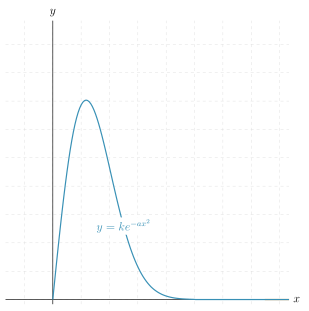
Sketch the graph, for \(x \ge 0\,\), of $$ y = kx\e^{-ax^2} \;, $$ where \(a\) and \(k\) are positive constants. The random variable \(X\) has probability density function \(\f(x)\) given by \begin{equation*} \f(x)= \begin{cases} kx\e^{-ax^2} & \text{for \(0 \le x \le 1\)}\\[3pt] 0 & \text{otherwise}. \end{cases} \end{equation*} Show that \(\displaystyle k=\frac{2a}{1-\e^{-a}}\) and find the mode \(m\) in terms of \(a\,\), distinguishing between the cases \(a < \frac12\) and \(a > \frac12\,\). Find the median \(h\) in terms of \(a\), and show that \(h > m\) if \(a > -\ln\left(2\e^{-1/2} - 1\right).\) Show that, \(-\ln\left(2\e^{-1/2}-1\right)> \frac12 \,\). Show also that, if \(a > -\ln\left(2\e^{-1/2} - 1\right) \,\), then $$ P(X > m \;\vert\; X < h) = {{2\e^{-1/2}-\e^{-a}-1} \over 1-\e^{-a}}\;. $$
Solution:
2002 Paper 3 Q13
A continuous random variable is said to have an exponential distribution with parameter \(\lambda\) if its density function is \(\f(t) = \lambda \e ^{- \lambda t} \; \l 0 \le t < \infty \r\,\). If \(X_1\) and \(X_2\), which are independent random variables, have exponential distributions with parameters \(\lambda_1\) and \(\lambda_2\) respectively, find an expression for the probability that either \(X_1\) or \(X_2\) (or both) is less than \(x\). Prove that if \(X\) is the random variable whose value is the lesser of the values of \(X_1\) and \(X_2\), then \(X\) also has an exponential distribution. Route A and Route B buses run from my house to my college. The time between buses on each route has an exponential distribution and the mean time between buses is 15 minutes for Route A and 30 minutes for Route B. The timings of the buses on the two routes are independent. If I emerge from my house one day to see a Route A bus and a Route B bus just leaving the stop, show that the median wait for the next bus to my college will be approximately 7 minutes.