Problems
Filters
3 problems found
2024 Paper 3 Q3
Throughout this question, consider only \(x > 0\).
- Let
\[\mathrm{g}(x) = \ln\left(1 + \frac{1}{x}\right) - \frac{x+c}{x(x+1)}\]
where \(c \geqslant 0\).
- Show that \(y = \mathrm{g}(x)\) has positive gradient for all \(x > 0\) when \(c \geqslant \frac{1}{2}\).
- Find the values of \(x\) for which \(y = \mathrm{g}(x)\) has negative gradient when \(0 \leqslant c < \frac{1}{2}\).
- It is given that, for all \(c > 0\), \(\mathrm{g}(x) \to -\infty\) as \(x \to 0\).
Sketch, for \(x > 0\), the graphs of
\[y = \mathrm{g}(x)\]
in the cases
- \(c = \frac{3}{4}\),
- \(c = \frac{1}{4}\).
- The function \(\mathrm{f}\) is defined as
\[\mathrm{f}(x) = \left(1 + \frac{1}{x}\right)^{x+c}.\]
Show that, for \(x > 0\),
- \(\mathrm{f}\) is a decreasing function when \(c \geqslant \frac{1}{2}\);
- \(\mathrm{f}\) has a turning point when \(0 < c < \frac{1}{2}\);
- \(\mathrm{f}\) is an increasing function when \(c = 0\).
2022 Paper 2 Q6
In this question, you should consider only points lying in the first quadrant, that is with \(x > 0\) and \(y > 0\).
- The equation \(x^2 + y^2 = 2ax\) defines a \emph{family} of curves in the first quadrant, one curve for each positive value of \(a\). A second family of curves in the first quadrant is defined by the equation \(x^2 + y^2 = 2by\), where \(b > 0\).
- Differentiate the equation \(x^2 + y^2 = 2ax\) implicitly with respect to \(x\), and hence show that every curve in the first family satisfies the differential equation \[2xy\frac{\mathrm{d}y}{\mathrm{d}x} = y^2 - x^2.\] Find similarly a differential equation, independent of \(b\), for the second family of curves.
- Hence, or otherwise, show that, at every point with \(y \neq x\) where a curve in the first family meets a curve in the second family, the tangents to the two curves are perpendicular. A curve in the first family meets a curve in the second family at \((c,\,c)\), where \(c > 0\). Find the equations of the tangents to the two curves at this point. Is it true that where a curve in the first family meets a curve in the second family on the line \(y = x\), the tangents to the two curves are perpendicular?
- Given the family of curves in the first quadrant \(y = c\ln x\), where \(c\) takes any non-zero value, find, by solving an appropriate differential equation, a second family of curves with the property that at every point where a curve in the first family meets a curve in the second family, the tangents to the two curves are perpendicular.
- A family of curves in the first quadrant is defined by the equation \(y^2 = 4k(x + k)\), where \(k\) takes any non-zero value. Show that, at every point where one curve in this family meets a second curve in the family, the tangents to the two curves are perpendicular.
2018 Paper 1 Q4
The function \(\f\) is defined by \[ \phantom{\ \ \ \ \ \ \ \ \ \ \ \ (x>0, \ \ x\ne1)} \f(x) = \frac{1}{x\ln x} \left(1 - (\ln x)^2 \right)^2 \ \ \ \ \ \ \ \ \ \ \ \ (x>0, \ \ x\ne1) \,.\] Show that, when \(( \ln x )^2 = 1\,\), both \(\f(x)=0\) and \(\f'(x)=0\,\). The function \(F\) is defined by \begin{align*} F(x) = \begin{cases} \displaystyle \int_{ 1/\text{e}}^x \f(t) \; \mathrm{d}t & \text{ for } 0 < x < 1\,, \\[7mm] \displaystyle \int_{\text{e}}^x \f(t) \; \mathrm{d}t & \text{ for } x > 1\,. \\ \end{cases} \end{align*}
- Find \(F(x)\) explicitly and hence show that \(F(x^{-1})=F(x)\,\).
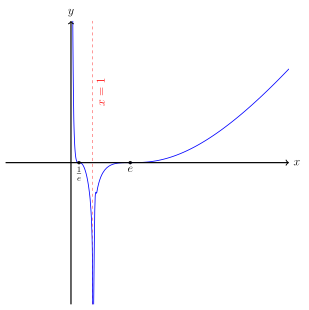
- Sketch the curve with equation \(y=F(x)\,\). [You may assume that \(\dfrac{ (\ln x)^k} x\to 0\) as \(x\to\infty\) for any constant \(k\).]
Solution: When \((\ln x)^2 = 1\) we have \(f(x) = \frac{1}{x\ln x}(1 - 1^2)^2 = 0\) \(f'(x) = \frac{2(1 - (\ln x)^2) \cdot (-2 \ln x ) \cdot \frac1x \cdot (x \ln x) - (\ln x +1)(1-(\ln x)^2)^2}{(x\ln x)^2} = \frac{2\cdot 0 \cdot (-2 \ln x ) \cdot \frac1x \cdot (x \ln x) - (\ln x +1) \cdot 0}{(x\ln x)^2} = 0\)
- First consider \(0 < x < 1\), so \begin{align*} && F(x) &= \int_{1/e}^x f(t) \d t \\ &&&= \int_{1/e}^x \frac{1}{t\ln t} \left(1 - (\ln t)^2 \right)^2 \d t \\ u = \ln t, \d u = \frac1t \d t: &&&= \int_{u=-1}^{u=\ln x} \frac{1}{u}(1-u^2)^2 \d u \\ &&&= \int_{-1}^{\ln x} \left ( u^3 - 2u+\frac1u \right) \d u \\ &&&= \left [ \frac{u^4}{4} - u^2+ \ln |u| \right]_{-1}^{\ln x} \\ &&&= \frac{(\ln x)^4}{4} -(\ln x)^2 + \ln |\ln x| - \frac14+1 \end{align*} Now consider \(x > 1\) \begin{align*} && F(x) &= \int_{e}^x f(t) \d t \\ &&&= \int_{e}^x \frac{1}{t\ln t} \left(1 - (\ln t)^2 \right)^2 \d t \\ u = \ln t, \d u = \frac1t \d t: &&&= \int_{u=1}^{u=\ln x} \frac{1}{u}(1-u^2)^2 \d u \\ &&&= \int_{1}^{\ln x} \left ( u^3 - 2u+\frac1u \right) \d u \\ &&&= \left [ \frac{u^4}{4} - u^2+ \ln |u| \right]_{1}^{\ln x} \\ &&&= \frac{(\ln x)^4}{4} -(\ln x)^2 + \ln| \ln x| - \frac14+1 \end{align*} Notice that \begin{align*} F(x^{-1}) &= \frac{(\ln x^{-1})^4}{4} -(\ln x^{-1})^2 + \ln| \ln x^{-1}| - \frac14+1 \\ &= \frac{(-\ln x)^4}{4} -(-\ln x)^2 + \ln| -\ln x| - \frac14+1 \\ &= \frac{(\ln x)^4}{4} -(\ln x)^2 + \ln| \ln x| - \frac14+1 \\ &= F(x) \end{align*}
- \(\,\)