Problems

Filters
Clear Filters

6 problems found

2007 Paper 1 Q9
D: 1516.0 B: 1485.5

A particle of weight \(W\) is placed on a rough plane inclined at an angle of \(\theta\) to the horizontal. The coefficient of friction between the particle and the plane is \(\mu\). A horizontal force \(X\) acting on the particle is just sufficient to prevent the particle from sliding down the plane; when a horizontal force \(kX\) acts on the particle, the particle is about to slide up the plane. Both horizontal forces act in the vertical plane containing the line of greatest slope. Prove that \[ \left( k-1 \right) \left( 1 + \mu^2 \right) \sin \theta \cos \theta = \mu \left( k + 1 \right) \] and hence that $\displaystyle k \ge \frac{ \left( 1+ \mu \right)^2} { \left( 1 - \mu \right)^2}$ .

2004 Paper 1 Q11
D: 1500.0 B: 1500.0

Two uniform ladders \(AB\) and \(BC\) of equal length are hinged smoothly at \(B\). The weight of \(AB\) is \(W\) and the weight of \(BC\) is \(4W \). The ladders stand on rough horizontal ground with \(\angle ABC=60^\circ\,\). The coefficient of friction between each ladder and the ground is \(\mu\). A decorator of weight \(7W\) begins to climb the ladder \(AB\) slowly. When she has climbed up \(\frac13\) of the ladder, one of the ladders slips. Which ladder slips, and what is the value of \(\mu\)?


Solution:

TikZ diagram
\begin{align*} \text{N2}(\rightarrow): && F_A - F_C &= 0\\ && F_A &= F_C \\ \text{N2}(\uparrow): && R_A + R_C - 7W - W - 4W &= 0\\ && R_A + R_C &= 12W \\ \overset{\curvearrowright}{A}: && \frac{1}{6}7W + \frac{1}{4}W + \frac{3}{4}4W - R_C &= 0 \\ \Rightarrow && R_C &= \frac{53}{12}W\\ \Rightarrow && R_A = 12W - \frac{53}{12}W &= \frac{91}{12}W \\ \overset{\curvearrowleft}{B}(AB): && \frac{1}{2}W + \frac{2}{3}7W - R_A+\sqrt{3}F_A &= 0 \\ \Rightarrow && F_A = \frac{1}{\sqrt{3}} \l \frac{91}{12}-\frac12-\frac{14}3\r W &= \frac{29}{12\sqrt{3}}W \end{align*} We know that the system is about to slip, so equality holds in one of \(F_A \leq \mu R_A\) or \(F_C \leq \mu R_C\). Since \(F_A = F_C\), we know it must occur for whichever of \(\mu R_A\) and \(\mu R_C\) is smaller. Since \(R_C\) is much smaller, this must be the ladder about to slip \(BC\) and \[ \mu = \frac{F_C}{R_C} = \frac{\frac{29}{12\sqrt{3}}W}{\frac{53}{12}W} = \boxed{\frac{29}{53\sqrt{3}}}\]

2003 Paper 2 Q9
D: 1600.0 B: 1484.0

\(AB\) is a uniform rod of weight \(W\,\). The point \(C\) on \(AB\) is such that \(AC>CB\,\). The rod is in contact with a rough horizontal floor at \(A\,\) and with a cylinder at \(C\,\). The cylinder is fixed to the floor with its axis horizontal. The rod makes an angle \({\alpha}\) with the horizontal and lies in a vertical plane perpendicular to the axis of the cylinder. The coefficient of friction between the rod and the floor is \(\tan \lambda_1\) and the coefficient of friction between the rod and the cylinder is \(\tan \lambda_2\,\). Show that if friction is limiting both at \(A\) and at \(C\), and \({\alpha} \ne {\lambda}_2 - {\lambda}_1\,\), then the frictional force acting on the rod at \(A\) has magnitude $$ \frac{ W\sin {\lambda}_1 \, \sin({\alpha}-{\lambda}_2)} {\sin ({\alpha}+{\lambda}_1-{\lambda}_2)} \;.$$ %and that %$$ %p=\frac{\cos{\alpha} \, \sin({\alpha}+{\lambda}_1-{\lambda}_2)} %{2\cos{\lambda}_1 \, \sin {\lambda}_2}\;. %$$

2000 Paper 1 Q11
D: 1500.0 B: 1484.0

A rod \(AB\) of length 0.81 m and mass 5 kg is in equilibrium with the end \(A\) on a rough floor and the end \(B\) against a very rough vertical wall. The rod is in a vertical plane perpendicular to the wall and is inclined at \(45^{\circ}\) to the horizontal. The centre of gravity of the rod is at \(G\), where \(AG = 0.21\) m. The coefficient of friction between the rod and the floor is 0.2, and the coefficient of friction between the rod and the wall is 1.0. Show that the friction cannot be limiting at both \(A\) and \(B\). A mass of 5 kg is attached to the rod at the point \(P\) such that now the friction is limiting at both \(A\) and \(B\). Determine the length of \(AP\).

2000 Paper 3 Q10
D: 1700.0 B: 1500.0

A sphere of radius \(a\) and weight \(W\) rests on horizontal ground. A thin uniform beam of weight \(3\sqrt3\,W\) and length \(2a\) is freely hinged to the ground at \(X\), which is a distance \({\sqrt 3} \, a\) from the point of contact of the sphere with the ground. The beam rests on the sphere, lying in the same vertical plane as the centre of the sphere. The coefficients of friction between the beam and the sphere and between the sphere and the ground are \(\mu_1\) and \(\mu_2\) respectively. Given that the sphere is on the point of slipping at its contacts with both the ground and the beam, find the values of \(\mu_1\) and \(\mu_2\).


Solution:

TikZ diagram
The first important thing to observe is the angle at \(X\) is \(60^{\circ}\). Now we can start resolving: \begin{align*} \overset{\curvearrowleft}{X}: && 3\sqrt{3} W \cos 60^{\circ} a - R_1\sqrt{3}a &= 0 \tag{\(1\)}\\ \overset{\curvearrowleft}{O}: && \mu_2 R_2 a - \mu_1R_1a &= 0 \tag{\(2\)} \\ \text{N2}(\rightarrow): && \mu_2 R_2 + \mu_1R_1 \cos 60^{\circ} - R_1 \cos 30^{\circ} &= 0 \tag{\(3\)} \\ \text{N2}(\uparrow): && R_2 - W - \mu_1 R_1 \cos 30^{\circ} - R_1 \cos 60^{\circ} &= 0 \tag{\(4\)} \\ \Rightarrow && \frac{3}{2}W &= R_1 \tag{\((5)\) from \((1)\)} \\ && \mu_1 R_1 &= \mu_2 R_2 \tag{\(2\)}\\ && \mu_1 R_1 \l 1 + \frac{1}{2} \r - R_1 \frac{\sqrt{3}}2 &= 0 \tag{\((3)\) and \((2)\)} \\ && \mu_1 &= \frac{1}{\sqrt3} \\ \\ && R_2 - W - \frac{1}{\sqrt3} \frac{3}{2}W \frac{\sqrt3}{2} - \frac{3}2W \frac12 &= 0 \\ \Rightarrow && R_2 &= W \l 1 + \frac{3}{2}\r \tag{\(6\)} \\ \Rightarrow && \mu_2 &= \frac{\mu_1 R_1}{R_2} = \frac{1}{\sqrt{3}} \frac{3}{5} = \frac{\sqrt3}{5} \tag{\((5)\) and \((6)\)} \end{align*}

1993 Paper 2 Q12
D: 1600.0 B: 1484.0

TikZ diagram
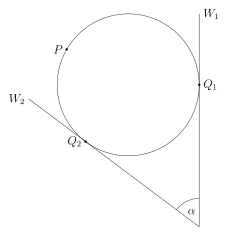
A uniform sphere of mass \(M\) and radius \(r\) rests between a vertical wall \(W_{1}\) and an inclined plane \(W_{2}\) that meets \(W_{1}\) at an angle \(\alpha.\) \(Q_{1}\) and \(Q_{2}\) are the points of contact of the sphere with \(W_{1}\) and \(W_{2}\) resectively, as shown in the diagram. A particle of mass \(m\) is attached to the sphere at \(P\), where \(PQ_{1}\) is a diameter, and the system is released. The sphere is on the point of slipping at \(Q_{1}\) and at \(Q_{2}.\) Show that if the coefficients of friction between the sphere and \(W_{1}\) and \(W_{2}\) are \(\mu_{1}\) and \(\mu_{2}\) respectively, then \[ m=\frac{\mu_{2}+\mu_{1}\cos\alpha-\mu_{1}\mu_{2}\sin\alpha}{(2\mu_{1}\mu_{2}+1)\sin\alpha+(\mu_{2}-2\mu_{1})\cos\alpha-\mu_{2}}M. \] If the sphere is on the point of rolling about \(Q_{2}\) instead of slipping, show that \[ m=\frac{M}{\sec\alpha-1}. \]


Solution:

TikZ diagram
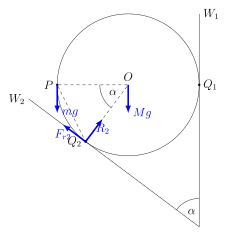
Since the sphere is on the point of slipping at both \(Q_1\) and \(Q_2\), \(F_{r1} = \mu_1 R_1\) and \(F_{r2} = \mu_2 R_2\) \begin{align*} \text{N2}(\uparrow): && -mg-Mg-\mu_1 R_1 + R_2 \sin \alpha + \mu_2 R_2 \cos \alpha &= 0 \\ \text{N2}(\rightarrow): && -R_1 + R_2 \cos \alpha - \mu_2 R_2 \sin \alpha &= 0 \\ \\ \Rightarrow && R_2 \cos \alpha - \mu_2 R_2 \sin \alpha &= R_1 \\ % && -mg-Mg+\mu_1 (R_2 \cos \alpha - \mu_2 R_2 \sin \alpha) + R_2 \sin \alpha + \mu_2 R_2 \cos \alpha &= 0 \\ % \\ \overset{\curvearrowleft}{O}: && mg - \mu_1 R_1 - \mu_2R_2 &= 0 \\ \Rightarrow && \mu_1 R_2 \l \cos \alpha - \mu_2 \sin \alpha \r - \mu_2 R_2 &= -mg \\ && \mu_1 (R_2 \cos \alpha - \mu_2 R_2 \sin \alpha) + R_2 \sin \alpha + \\ && \quad \quad \mu_2 R_2 \cos \alpha - \mu_1 R_2 \l \cos \alpha - \mu_2 \sin \alpha \r - \mu_2 R_2 &= Mg \\ \Rightarrow && \frac{\mu_2+\mu_1 \l \cos \alpha - \mu_2 \sin \alpha \r }{\mu_1 ( \cos \alpha - \mu_2 \sin \alpha) + \sin \alpha + \mu_2 \cos \alpha - \mu_1 \l \cos \alpha - \mu_2 \sin \alpha \r - \mu_2 } &= \frac{m}{M} \\ && \frac{\mu_2+\mu_1 \cos \alpha - \mu_1\mu_2 \sin \alpha }{\cos \alpha (-2\mu_1+\mu_2) + \sin \alpha (1 +2\mu_1\mu_2) -\mu_2} &= \frac{m}{M} \end{align*} If instead the sphere is about to roll about \(Q_2\), then the forces at \(Q_1\) will be \(0\), we can then take moments about \(Q_2\).
TikZ diagram
Looking at perpendicular distances from \(Q_2\) to \(O\) and \(P\) we have \(r \cos \alpha\) and \(r(1-\cos \alpha)\) \begin{align*} \overset{\curvearrowleft}{Q_2}: && mg (1 - \cos \alpha) - Mg \cos \alpha &= 0 \\ \Rightarrow && \frac{1}{\sec \alpha-1} &= \frac{m}{M} \end{align*}