Problems
Filters
6 problems found
2016 Paper 1 Q6
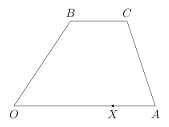
The sides \(OA\) and \(CB\) of the quadrilateral \(OABC\) are parallel. The point \(X\) lies on \(OA\), between \(O\) and \(A\). The position vectors of \(A\), \(B\), \(C\) and \(X\) relative to the origin \(O\) are \(\bf a\), \(\bf b\), \(\bf c\) and \(\bf x\), respectively. Explain why \(\bf c\) and \(\bf x\) can be written in the form \[ {\bf c} = k {\bf a} + {\bf b} \text{ and } {\bf x} = m {\bf a}\,, \] where \(k\) and \(m\) are scalars, and state the range of values that each of \(k\) and \(m\) can take. The lines \(OB\) and \(AC\) intersect at \(D\), the lines \(XD\) and \(BC\) intersect at \(Y\) and the lines \(OY\) and \(AB\) intersect at \(Z\). Show that the position vector of \(Z\) relative to \(O\) can be written as \[ \frac{ {\bf b} + mk {\bf a}}{mk+1}\,. \] The lines \(DZ\) and \(OA\) intersect at \(T\). Show that \[ OT \times OA = OX\times TA \text{ and } \frac 1 {OT} = \frac 1 {OX} + \frac 1 {OA} \,, \] where, for example, \(OT\) denotes the length of the line joining \(O\) and \(T\).
Solution:
2016 Paper 3 Q2
The distinct points \(P(ap^2 , 2ap)\), \(Q(aq^2 , 2aq)\) and \(R(ar^2,2ar)\) lie on the parabola \(y^2 = 4ax\), where \(a>0\). The points are such that the normal to the parabola at \(Q\) and the normal to the parabola at \(R\) both pass through \(P\).
- Show that \(q^2 +qp + 2 = 0\).
- Show that \(QR\) passes through a certain point that is independent of the choice of \(P\).
- Let \(T\) be the point of intersection of \(OP\) and \(QR\), where \(O\) is the coordinate origin. Show that \(T\) lies on a line that is independent of the choice of \(P\). Show further that the distance from the \(x\)-axis to \(T\) is less than \(\dfrac {\;a}{\sqrt2}\,\).
Solution:
- \begin{align*} && 2y \frac{\d y}{\d x} &= 4a \\ \Rightarrow && \frac{\d y}{\d x} &= \frac{2a}{y} \end{align*} Therefore we must have \begin{align*} && \underbrace{-\frac{2aq}{2a}}_{\text{gradient of normal}} &= \underbrace{\frac{2ap-2aq}{ap^2-aq^2}}_{\Delta y / \Delta x} \\ \Rightarrow && -q &= \frac{2}{p+q} \\ && 0 &= 2 + pq+q^2 \end{align*}
- We must have that \(q,r\) are the two roots of \(x^2+px+2 = 0\) \(QR\) has the equation: \begin{align*} && \frac{y-2aq}{x-aq^2} &= \frac{2ar-2aq}{ar^2-aq^2} \\ \Rightarrow && \frac{y-2aq}{x-aq^2} &= \frac{2}{r+q} \\ \Rightarrow && y &= \frac{2}{q+r}(x-aq^2) +2aq \\ && y &= -\frac{2}{p}x+2a\left(q-\frac{q^2}{q+r} \right) \\ &&y&= -\frac{2}{p}x+2a \frac{qr}{q+r} \\ && y &= -\frac{2}{p}x - 2a \frac{2}{p} \\ && y & = -\frac{2}{p}(x+2a) \end{align*} Therefore the point \((-2a,0)\) lies on all such lines.
- \(OP\) has equation \(y = \frac{2}{p} x\) \begin{align*} && y &= \frac{2}{p} x \\ && y & = -\frac{2}{p}(x+2a) \\ && 2y &= -\frac{4a}{p} \\ \Rightarrow && y &= -\frac{2a}{p} \\ && x &= -a \end{align*} Therefore \(T\left (-a, -\frac{2a}{p} \right)\) always lies on the line \(x = -a\) The distance to the \(x\)-axis from \(T\) is \(\frac{2a}{|p|}\). We need to show that \(p\) can't be too small. Specifically \(x^2+px+2 = 0\) must have \(2\) real roots, ie \(\Delta = p^2-8 \geq 0 \Rightarrow |p| \geq 2\sqrt{2}\), ie \(\frac{2a}{|p|} \leq \frac{2a}{2\sqrt{2}} = \frac{a}{\sqrt{2}}\) as required.
2012 Paper 1 Q4
The curve \(C\) has equation \(xy = \frac12\). The tangents to \(C\) at the distinct points \(P\big(p, \frac1{2p}\big)\) and \(Q\big(q, \frac1{2q}\big)\) where \(p\) and \(q\) are positive, intersect at \(T\) and the normals to \(C\) at these points intersect at \(N\). Show that \(T\) is the point \[ \left( \frac{2pq}{p+q}\,,\, \frac 1 {p+q}\right)\!. \] In the case \(pq=\frac12\), find the coordinates of \(N\). Show (in this case) that \(T\) and \(N\) lie on the line \(y=x\) and are such that the product of their distances from the origin is constant.
Solution: \begin{align*} && \frac{\d y}{\d x} &= -\frac1{2x^2} \\ \Rightarrow && \frac{y - \frac{1}{2p}}{x - p} &= - \frac{1}{2p^2} \\ \Rightarrow && y - \frac1{2p} &= -\frac{1}{2p^2}x +\frac1{2p} \\ \Rightarrow && y +\frac{1}{2p^2}x &= \frac1p \\ \Rightarrow && 2p^2 y + x &= 2p\\ \Rightarrow && 2q^2 y + x &= 2q \\ \Rightarrow && (p^2-q^2)y &= p-q \\ \Rightarrow && y &= \frac{1}{p+q} \\ && x &= \frac{2pq}{p+q} \end{align*} \begin{align*} \text{normal}: && \frac{y-\frac1{2p}}{x-p} &= 2p^2 \\ \Rightarrow && y - \frac1{2p} &= 2p^2x - 2p^3 \\ \Rightarrow && 2py -4p^3x &= 1-4p^4 \\ \Rightarrow && 2qy -4q^3x &= 1-4q^4 \\ pq = \tfrac12: && y - 2p^2 x &= q-2p^3 \\ && y - 2q^2 x &= p-2q^3 \\ \Rightarrow && (2q^2-2p^2)x &= q-p +2q^3-2p^3 \\ &&&= (q-p)(q+p+2q^2+1+2p^2) \\ \Rightarrow && x &= \frac{1+2(p^2+q^2)+1}{2(p+q)} \\ &&&= \frac{1+2(p^2+q^2+2pq-1)+1}{2(p+q)} \\ &&&= p+q\\ && y &= 2p^2 \left ( p+q \right) + q - 2p^3 \\ &&&= p+q \end{align*} So \(N(p+q, p+q)\) and \(T\left (\frac{1}{p+q}, \frac{1}{p+q} \right)\), so both points lie on \(y = x\). \[ OT \cdot ON = \frac{\sqrt{2}}{p+q} \cdot (p+q)\sqrt{2} = 2 \] which is clearly constant.
1994 Paper 3 Q3
Describe geometrically the possible intersections of a plane with a sphere. Let \(P_{1}\) and \(P_{2}\) be the planes with equations \begin{alignat*}{1} 3x-y-1 & =0,\\ x-y+1 & =0, \end{alignat*} respectively, and let \(S_{1}\) and \(S_{2}\) be the spheres with equations \begin{alignat*}{1} x^{2}+y^{2}+z^{2} & =7,\\ x^{2}+y^{2}+z^{2}-6y-4z+10 & =0, \end{alignat*} respectively. Let \(C_{1}\) be the intersection of \(P_{1}\) and \(S_{1},\) let \(C_{2}\) be the intersection of \(P_{2}\) and \(S_{2}\) and let \(L\) be the intersection of \(P_{1}\) and \(P_{2}.\) Find the points where \(L\) meets each of \(S_{1}\) and \(S_{2}.\) Determine, giving your reasons, whether the circles \(C_{1}\) and \(C_{2}\) are linked.
1993 Paper 1 Q8
- Prove that the intersection of the surface of a sphere with a plane is always a circle, a point or the empty set. Prove that the intersection of the surfaces of two spheres with distinct centres is always a circle, a point or the empty set. {[}If you use coordinate geometry, a careful choice of origin and axes may help.{]}
- The parish council of Little Fitton have just bought a modern sculpture entitled `Truth, Love and Justice pouring forth their blessings on Little Fitton.' It consists of three vertical poles \(AD,BE\) and \(CF\) of heights 2 metres, 3 metres and 4 metres respectively. Show that \(\angle DEF=\cos^{-1}\frac{1}{5}.\) Vandals now shift the pole \(AD\) so that \(A\) is unchanged and the pole is still straight but \(D\) is vertically above \(AB\) with \(\angle BAD=\frac{1}{4}\pi\) (in radians). Find the new angle \(\angle DEF\) in radians correct to four figures.
1991 Paper 3 Q4
The point \(P\) moves on a straight line in three-dimensional space. The position of \(P\) is observed from the points \(O_{1}(0,0,0)\) and \(O_{2}(8a,0,0).\) At times \(t=t_{1}\) and \(t=t_{1}'\), the lines of sight from \(O_{1}\) are along the lines \[ \frac{x}{2}=\frac{z}{3},y=0\quad\mbox{ and }\quad x=0,\frac{y}{3}=\frac{z}{4} \] respectively. At times \(t=t_{2}\) and \(t=t_{2}'\), the lines of sight from \(O_{2}\) are \[ \frac{x-8a}{-3}=\frac{y}{1}=\frac{z}{3}\quad\mbox{ and }\quad\frac{x-8a}{-4}=\frac{y}{2}=\frac{z}{5} \] respectively. Find an equation or equations for the path of \(P\).