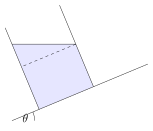
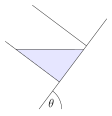
A tall container made of light material of negligible thickness has the form of a prism, with a square base of area \(a^2\). It contains a volume \(ka^3\) of fluid of uniform density. The container is held so that it stands on a rough plane, which is inclined at angle \(\theta\) to the horizontal, with two of the edges of the base of the container horizontal.
In the case \(k > \frac12 \tan\theta\), show that the centre of mass of the fluid is at a distance \(x\) from the lower side of the container and at a distance \(y\) from the base of the container, where
\[
\frac x a = \frac12 - \frac {\tan\theta}{12k}\;,
\ \ \ \ \ \
\frac y a = \frac k 2 + \frac{\tan^2\theta}{24k}\;.
\]
Determine the corresponding coordinates in the case \(k < \frac12 \tan\theta\).
The container is now released.
Given that \(k < \frac12\), show that the container will topple if \(\theta >45^\circ\).
Solution:
The fluid can be divided into a cuboid parallel to the slope and a right-angled triangle. If the height of the water on the longer side is \(\ell a\), then we have \(ka^3 = (\ell a - a\tan \theta)a^2 + \frac12 a^3\tan \theta \Rightarrow \ell = k + \frac12 \tan \theta\)
This is acceptable when \(k > \frac12 \tan \theta\).
The centre of mass of the cuboid will be \((\frac{a}{2}, \frac12 (k - \frac12 \tan \theta))\) and of the triangle will be \((\frac13 a, \frac13 \tan \theta + (k - \frac12 \tan \theta) )\)
Therefore we have:
\begin{align*}
&& \text{COM} && \text{mass} \\
\text{cuboid} && (\frac{a}{2}, \frac{a}2 (k - \frac12 \tan \theta)) && a^3(k - \frac12 \tan \theta) \\
\text{triangle} && (\frac13 a, \frac{a}3 \tan \theta + a(k - \frac12 \tan \theta) ) && a^3\frac12 \tan \theta \\
\text{whole system} && (x, y) && a^3k
\end{align*}
Therefore
\begin{align*}
&& a^3k x &= \frac{a}{2} \cdot a^3(k - \frac12 \tan \theta) + \frac13 a \cdot a^3\frac12 \tan \theta \\
&&&= a^4 \frac{k}{2} - \frac{1}{12}a^4 \tan \theta \\
\Rightarrow && \frac{x}{a} &= \frac12 - \frac{\tan \theta}{12 k} \\
\\
&& a^3k y &= \frac{a}2 (k - \frac12 \tan \theta) \cdot a^3(k - \frac12 \tan \theta) + \\
&&& \qquad\qquad \cdots + \l \frac{a}3 \tan \theta + a(k - \frac12 \tan \theta) \r \cdot a^3\frac12 \tan \theta \\
&&&= \frac{a^4k^2}{2} -\frac{a^4k \tan \theta}{2} + \frac{a^4 \tan^2 \theta}{8} - \frac{a^4 \tan^2 \theta}{12} + \frac{a^4k \tan \theta}{2} \\
\Rightarrow && \frac{y}{a} &= \frac{k}2 + \frac{\tan^2 \theta}{24k}
\end{align*}
If the water only fills up a prism, it's sides must be \(b\) and \(b\tan \theta \), therefore the volume is \(\frac12 ab^2 \tan \theta = ka^3 \Rightarrow b = a\sqrt{\frac{2k}{\tan \theta}}\)
The centre of mass will be at \(\l \frac13 a\sqrt{\frac{2k}{\tan \theta}}, a\sqrt{2k \tan \theta}\r\)
The container will topple if the centre of mass is outside the base, ie if the centre of mass \((x,y)\) lies above the line \(y = \tan (90^\circ- x) = \frac{1}{\tan \theta} x\). If \(\theta > 45^\circ\) then \(\tan \theta > 1\) and so we are in the \(\frac12 \tan \theta > \frac12 > k\) and so we are in the second case.
\begin{align*}
\frac{y}{x} &= \frac{\frac 13 a\sqrt{2k \tan \theta}}{\frac13 a\sqrt{\frac{2k}{\tan \theta}}} \\
&= \tan \theta
\end{align*}
\(\tan \theta > \frac{1}{\tan \theta} \Leftrightarrow \tan \theta > 1 \Leftrightarrow \theta > 45^\circ\).