Problems
Filters
32 problems found
2019 Paper 2 Q6
Note: You may assume that if the functions \(y_1(x)\) and \(y_2(x)\) both satisfy one of the differential equations in this question, then the curves \(y = y_1(x)\) and \(y = y_2(x)\) do not intersect.
- Find the solution of the differential equation $$\frac{dy}{dx} = y + x + 1$$ that has the form \(y = mx + c\), where \(m\) and \(c\) are constants. Let \(y_3(x)\) be the solution of this differential equation with \(y_3(0) = k\). Show that any stationary point on the curve \(y = y_3(x)\) lies on the line \(y = -x - 1\). Deduce that solution curves with \(k < -2\) cannot have any stationary points. Show further that any stationary point on the solution curve is a local minimum. Use the substitution \(Y = y + x\) to solve the differential equation, and sketch, on the same axes, the solutions with \(k = 0\), \(k = -2\) and \(k = -3\).
- Find the two solutions of the differential equation $$\frac{dy}{dx} = x^2 + y^2 - 2xy - 4x + 4y + 3$$ that have the form \(y = mx + c\). Let \(y_4(x)\) be the solution of this differential equation with \(y_4(0) = -2\). (Do not attempt to find this solution.) Show that any stationary point on the curve \(y = y_4(x)\) lies on one of two lines that you should identify. What can be said about the gradient of the curve at points between these lines? Sketch the curve \(y = y_4(x)\). You should include on your sketch the two straight line solutions and the two lines of stationary points.
Solution:
- Looking for solution of the form \(y = mx+c\) we find that \(m = mx+c+x+1 \Rightarrow m = -1, c = -2\).
At stationary points \(\frac{\d y}{\d x} = 0 \Rightarrow y = -x-1\).
If \(y_3(0)= k < -2\) then the solution curve lies below \(y = -x-2\) and therefore it cannot cross \(y = -x -2\) to reach \(y = -x-1\) for a stationary point.
Suppose \(Y = y+x\) then \(\frac{\d Y}{\d x} = \frac{\d y}{\d x} + 1=Y+2 \Rightarrow Y = Ae^x-2 \Rightarrow y= (k+2)e^x-x-2\)

- \(\,\)
\begin{align*}
&& m &= x^2 + (mx+c)^2 -2x(mx+c) - 4x+4(mx+c) + 3 \\
&&0&= (m^2-2m+1)x^2+(2mc-2c-4+4m)x + (c^2+4c+3-m)\\
\Rightarrow && m &= 1 \\
\Rightarrow && 0 &= c^2+4c+2 \\
\Rightarrow &&&= (c+2)^2-2 \\
\Rightarrow && c &= -2 \pm \sqrt{2}
\end{align*}
Therefore the lines are \(y = x -2-\sqrt{2}\) and \(y = x -2+\sqrt{2}\).
Any stationary point will satisfy \(y' = 0\), ie \(0 = x^2+y^2-2xy-4x+4y+3 = (x-y)^2-4(x-y)+3 = (x-y-3)(x-y-1)\) therefore they must lie on \(y = x-1\) or \(y = x-3\). Any point between these lines must have negative gradient (since one factor is positive and one factor is negative).

2018 Paper 1 Q8
The functions \(\s\) and \(\c\) satisfy \(\s(0)= 0\,\), \(\c(0)=1\,\) and \[ \s'(x) = \c(x)^2 ,\] \[ \c'(x)=-\s(x)^2. \] You may assume that \(\s\) and \(\c\) are uniquely defined by these conditions.
- Show that \(\s(x)^3+\c(x)^3\) is constant, and deduce that \(\s(x)^3+\c(x)^3=1\,\).
- Show that \[ \frac{\d }{\d x} \, \Big( \s(x) \c(x) \Big) = 2\c(x)^3-1 \] and find (and simplify) an expression in terms of \(\c(x)\) for $\dfrac{\d }{\d x} \left( \dfrac{\s(x)}{\c(x)} \right) $.
- Find the integrals \[ \int \s(x)^2 \, \d x \ \ \ \ \ \ \text{and} \ \ \ \ \ \ \int \s(x)^5 \, \d x \,. \]
- Given that \(\s\) has an inverse function, \(\s^{-1}\), use the substitution \(u = \s(x)\) to show that \[ \int \frac{1}{(1-u^3)^{\frac{2}{3}}} \, \d u = \s^{-1}(u) \, + \text{constant}. \]
- Find, in terms of \(u\), the integrals \[ \int \frac{1}{{(1-u^3)}^{\frac{4}{3}}} \, \d u \ \ \ \ \ \ \text{and} \ \ \ \ \ \ \int {(1-u^3)}^{\frac{1}{3}} \, \d u \,. \]
Solution: \begin{questionparts} \item \begin{align*} && \dfrac{\d }{\d x} \left( \s(x)^3 + \c(x)^3 \right) &= 3\s(x)^2\s'(x) + 3\c(x)^2 \c'(x) \\ &&&= 3\s(x)^2\c(x)^2 - 3\c(x)^2\s(x)^2 \\ &&&= 0 \\ \\ \Rightarrow && \s(x)^3 + \c(x)^3 &= \text{constant} \\ &&&= \s(0)^3 + \c(0)^3 \\ &&&= 1 \end{align*} \item \begin{align*} \frac{\d }{\d x} \, \Big( \s(x) \c(x) \Big) &= \s'(x) \c(x) + \s(x)\c'(x) \\ &= \c(x)^3 - \s(x)^3 \\ &= \c(x)^3 - (1-\c(x)^3) \\ &= 2\c(x)^3 - 1 \\ \\ \dfrac{\d }{\d x} \left( \dfrac{\s(x)}{\c(x)} \right) &= \frac{\s'(x)\c(x) - \s(x)\c'(x)}{\c(x)^2} \\ &= \frac{\c(x)^3 + \s(x)^3}{\c(x)^2} \\ &= \frac{1}{\c(x)^2} \\ \end{align*} \item \begin{align*} \int \s(x)^2 \d x &= -\int -\s(x)^2 \d x \\ &= -\int \c'(x) \d x \\ &= - \s(x) +C \\ \\ \int \s(x)^5 \, \d x &= \int \s(x)^2 \s(x)^3 \d x \\ &= \int \s(x)^2 (1 - \c(x)^3) \d x \\ &= -\int \c'(x) (1 - \c(x)^3) \d x \\ &= - c(x) + \frac{\c(x)^4}{4} + C \end{align*} \item If \(u = \s(x), \frac{\d u}{\d x} = \c(x)^2\) \begin{align*} \int \frac{1}{(1-u^3)^{\frac{2}{3}}} \, \d u &= \int \frac{1}{(1-\s(x)^3)^{\frac{2}{3}}} \c(x)^2 \d x \\ &= \int 1 \d x \\ &= x + C \\ &= \s^{-1}(u) + C \\ \\ \int \frac{1}{{(1-u^3)^{\frac{4}{3}}}} \d u &= \int \frac1{(1-\s(x)^3)^{\frac43} }\c(x)^2 \d x \\ &= \int \frac1{(\c(x)^3)^{\frac43}} \c(x)^2 \d x \\ &= \int \frac1{\c(x)^2} \d x \\ &= \frac{\s(x)}{\c(x)} + C \\ &= \frac{u}{(1-u^3)^{\frac13}} + C \\ \end{align*} \begin{align*} && \int {(1-u^3)}^{\frac{1}{3}} \, \d u &= \int (1-s(x)^3)^{\frac13} c(x)^2 \d x \\ &&&= \int \c(x)^3 \d x = I\\ &&&= \int \c(x) s'(x) \d x \\ &&&= \left [\c(x) \s(x) \right] + \int \s(x)^2 s(x) \d x \\ &&&= \c(x) \s(x) + \int (1 - \c(x)^3) \d x + C \\ &&&= \c(x) \s(x) + x - I + C \\ \Rightarrow && I &= \frac{x + \c(x) \s(x)}{2} + k \\ \Rightarrow && &= \frac12 \l \s^{-1}(u) + u \sqrt[3](1-u^3)\r + k \end{align*}
2018 Paper 2 Q8
- Use the substitution \(v= \sqrt y\) to solve the differential equation \[ \frac{\d y}{\d t} = \alpha y^{\frac12} - \beta y \ \ \ \ \ \ \ \ \ \ (y\ge0, \ \ t\ge0) \,, \] where \(\alpha\) and \(\beta\) are positive constants. Find the non-constant solution \(y_1(x)\) that satisfies \(y_1(0)=0\,\).
- Solve the differential equation \[ \frac{\d y}{\d t} = \alpha y^{\frac23} - \beta y \ \ \ \ \ \ \ \ \ \ (y\ge0, \ \ t\ge0) \,, \] where \(\alpha\) and \(\beta\) are positive constants. Find the non-constant solution \(y_2(x)\) that satisfies \(y_2(0)=0\,\).
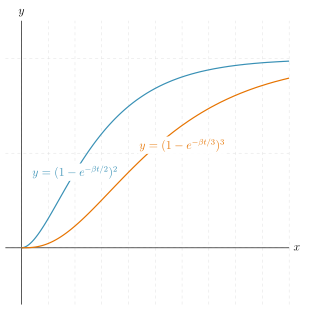
- In the case \(\alpha=\beta\), sketch \(y_1(x)\) and \(y_2(x)\) on the same axes, indicating clearly which is \(y_1(x)\) and which is \(y_2(x)\). You should explain how you determined the positions of the curves relative to each other.
Solution:
- Suppose \(v = \sqrt{y} \Rightarrow v^2 = y \Rightarrow 2v v' = y'\) so \begin{align*} && 2vv' &= \alpha v-\beta v^2 \\ \Rightarrow && 2v' &= \alpha - \beta v \\ \Rightarrow && v' + \frac{\beta}{2} v &= \frac{\alpha}{2} \\ \Rightarrow && \frac{\d}{\d t} \left (e^{\beta t/2} v \right) &= \frac{\alpha}{2} e^{\beta t/2} \\ \Rightarrow && e^{\beta t/2} v &=C+ \frac{\alpha}{\beta}e^{\beta t /2} \\ \Rightarrow && v &= Ce^{-\beta t/2} + \frac{\alpha}{\beta} \\ \Rightarrow && \sqrt{y} &= Ce^{-\beta t/2} + \frac{\alpha}{\beta} \\ y(0) = 0: && 0 &= C+\frac{\alpha}{\beta} \\ \Rightarrow && \sqrt{y} &= \frac{\alpha}{\beta} \left (1-e^{-\beta t/2} \right) \\ \Rightarrow && y &= \frac{ \alpha^2}{\beta^2} \left (1-e^{-\beta t/2} \right)^2 \end{align*}
- Try \(v = y^{1/3} \Rightarrow v^3 = y \Rightarrow 3v^2 v' = y'\) so \begin{align*} && y' &= \alpha v^2 - \beta y \\ \Rightarrow && 3v^2v' &= \alpha v^2 - \beta v^3 \\ \Rightarrow && v' +\frac{\beta}{3} v &= \frac{\alpha}{3} \\ \Rightarrow && (v e^{\beta t/3})' &= \frac{\alpha}{3}e^{\beta t/3} \\ \Rightarrow && v &= Ce^{-\beta t/3} + \frac{\alpha}{\beta} \\ v(0) = 0: && v &= \frac{\alpha}{\beta} \left (1 - e^{-\beta t/3} \right) \\ \Rightarrow && y &= \frac{\alpha^3}{\beta^3} \left (1 - e^{-\beta t/3} \right) ^3 \end{align*}
- \(y_1 = (1-e^{-\beta t/2})^2, y_2 = (1-e^{-\beta t/3})^3\)
By considering the differential equation, notice that \(0 < y_i < 1\) so \(y^{1/2} > y^{2/3}\) and therefore \(y_1' > y_2'\) and so \(y_1\) increases faster.
2014 Paper 2 Q5
Given that \(y=xu\), where \(u\) is a function of \(x\), write down an expression for \(\dfrac {\d y}{\d x}\).
- Use the substitution \(y=xu\) to solve \[ \frac {\d y}{\d x} = \frac {2y+x}{y-2x} \] given that the solution curve passes through the point \((1,1)\). Give your answer in the form of a quadratic in \(x\) and \(y\).
- Using the substitutions \(x=X+a\) and \(y=Y+b\) for appropriate values of \(a\) and \(b\), or otherwise, solve \[ \frac {\d y}{\d x} = \frac {x-2y-4} {2x+y-3}\,, \] given that the solution curve passes through the point \((1,1)\).
Solution: \begin{align*} \frac{\d y}{\d x} &= \frac{\d }{\d x} \l y \r \\ &= \frac{\d }{\d x} \l xu \r \\ &\underbrace{=}_{\text{product rule}} \frac{\d}{\d x} \l x \r u + x \frac{\d}{\d x} \l u \r \\ &= u + x \frac{\d u}{\d x} \end{align*} \begin{questionparts} \item \begin{align*} && \frac{\d y}{\d x} &= \frac{2y + x}{y - 2x} \\ && u + x \frac{\d u}{\d x} &= \frac{2u + 1}{u - 2} \\ && x \frac{\d u}{\d x} &= \frac{2u-1-u^2+2u}{u-2} \\ \Rightarrow && \int \frac{2-u}{u^2-4u+1} \d u &= \int \frac{1}{x} \d x \\ && \int \frac{2-u}{(u-2)^2-5} \d u &= \int \frac1x \d x \\ && -\frac12\ln| (u-2)^2 - 5| &= \ln x + C \\ (x,y) = (1,1): && - \ln 2 &= C \\ \Rightarrow && \ln x^2 &= \ln 4 - \ln |5 - (u-2)^2| \\ \Rightarrow && x^2 &= \frac{4}{5- (u-2)^2} \\ \Rightarrow && 4 & = x^2(5 - (\frac{y}{x} - 2)^2) \\ &&&= 5x^2 - (y-2x)^2 \\ &&&= x^2+4xy-y^2 \end{align*} \item It would be convienient if \(x-2y -4 = X-2Y\) and \(2x+y-3 = 2X+Y\), ie \(a-2b = 4\) and \(2a+b = 3\), ie \(a = 2, b = -1\). Now our differential equation is: \begin{align*} && \frac{\d Y}{\d X} &= \frac{X - 2Y}{2X+Y} \\ && \frac{\d X}{\d Y} &= \frac{2X + Y}{X-2Y} \end{align*} This is the same differential equation we have already solved, just with the roles of \(x\) and \(y\) interchanged with \(Y\) and \(X\) and with the point \((0,3)\) being on the curve, ie: \(Y^2 + 4XY-X^2 = c\) and \(c = 9\), therefore our equation is: \[ (y-1)^2 + 4(y-1)(x+2)-(x+2)^2 = 9\]
2013 Paper 1 Q7
- Use the substitution \(y=ux\), where \(u\) is a function of \(x\), to show that the solution of the differential equation \[ \frac{\d y}{\d x} = \frac x y + \frac y x \quad \quad (x > 0, y> 0) \] that satisfies \(y=2\) when \(x=1\) is \[ y= x\, \sqrt{4+2\ln x \, } ( x > \e^{-2}). \]
- Use a substitution to find the solution of the differential equation \[ \frac{\d y}{\d x} = \frac x y + \frac {2y} x \quad \quad (x > 0, y > 0) \] that satisfies \(y=2\) when \(x=1\).
- Find the solution of the differential equation \[ \frac{\d y}{\d x} = \frac {x^2} y + \frac {2y} x \quad \quad (x> 0, \ y> 0) \] that satisfies \(y=2\) when \(x=1\).
Solution:
- Let \(y = ux\), then \(\frac{\d y}{\d x} = x\frac{\d u}{\d x} = u\) and the differential equation becomes, \begin{align*} && xu' + u &= \frac{1}{u} +u \\ \Rightarrow && u' &= \frac{1}{ux} \\ \Rightarrow && u u' &= \frac1{x} \\ \Rightarrow && \frac12 u^2 &= \ln x + C \\ (x,y) = (1,2): && \frac12 4 &= C \\ \Rightarrow && \frac12 \frac{y^2}{x^2} &= \ln x + 2 \\ \Rightarrow && y^2 &= x^2 \l 2\ln x + 4 \r \\ \Rightarrow && y &= x \sqrt{4 + 2 \ln x} \quad (x > e^{-2}) \end{align*}
- Let \(y = ux^2\) then \begin{align*} && \frac{\d y}{\d x} &= \frac{x^2}{y} + \frac{2y}{x} \\ \Rightarrow && u' x^2 + 2x u &= \frac{1}{u} + 2x u \\ \Rightarrow && u' u &= \frac{1}{x^2} \\ \Rightarrow && \frac12 u^2 &= -\frac{1}{x} + C \\ (x,y) = (1,2): && 2 &= C - 1 \\ \Rightarrow && \frac12 \frac{y^2}{x^4} &= 3 - \frac{1}{x} \\ \Rightarrow && y &= x\sqrt{2(3x^2-x)}, \quad (x > \frac13) \end{align*}
2012 Paper 1 Q8
- Show that substituting \(y=xv\), where \(v\) is a function of \(x\), in the differential equation \[ xy \frac{\d y}{\d x} +y^2- 2x^2 =0 \quad (x\ne0) \] leads to the differential equation \[ xv\frac{\d v}{\d x} +2v^2 -2=0\,. \] Hence show that the general solution can be written in the form \[ x^2(y^2 -x^2) = C \,,\] where \(C\) is a constant.
- Find the general solution of the differential equation \[ y \frac{\d y}{\d x} +6x +5y=0\, \quad (x\ne0). \]
Solution:
- \(\,\) \begin{align*} && y &= xv \\ && y' &= v + xv' \\ \Rightarrow && 0 &= x^2 v \left ( v + x\frac{\d v}{\d x} \right) +(x^2v^2) - 2x^2 \\ &&&= 2x^2v^2 + x^3 v \frac{\d v}{\d x} - 2x^2 \\ \Rightarrow && 0 &= xv \frac{\d v}{\d x} + 2v^2-2 \\ \\ \Rightarrow && \frac{v}{1-v^2} \frac{\d v}{\d x} &= \frac{2}{x} \\ \Rightarrow && \int \frac{v}{1-v^2} \d v &=2 \ln |x| \\ \Rightarrow && -\frac12\ln |1-v^2| &= 2\ln |x| + C \\ \Rightarrow && 4\ln |x| + \ln |1-v^2| &= K \\ \Rightarrow && x^4(1-v^2) &= K \\ \Rightarrow && x^2(x^2-y^2) &= K \end{align*}
- \(\,\) \begin{align*} && 0 &= xv \left (v +x \frac{\d v}{\d x} \right) + 6x + 5xv \\ &&&= x^2 v \frac{\d v}{\d x} +xv^2 + 6x+5xv \\ \Rightarrow && 0 &= xv\frac{\d v}{\d x} +v^2 +5v+6 \\ \Rightarrow && -\int \frac{1}{x} \d x &=\int \frac{v}{v^2+5v+6} \d v \\ \Rightarrow && -\ln |x| &= \int \frac{v}{(v+2)(v+3)} \d v \\ &&&= \int \left (\frac{3}{v+3} - \frac{2}{v+2} \right) \d v \\ \Rightarrow && -\ln |x| &= 3\ln |v+3| - 2 \ln |v+2| + C\\ \Rightarrow && -\ln |x| &= \ln \frac{|v+3|^3}{|v+2|^2} + C \\ \Rightarrow && \frac{1}{|x|}|v+2|^2 &= A|v+3|^3 \\ \Rightarrow && \frac{1}{|x|}|\frac{y}{x} + 2|^2&= A|\frac{y}{x} + 3|^3 \\ \Rightarrow && \frac{1}{|x|^3} |y +2x|^2 &= \frac{A}{|x|^3}|y + 3x|^3 \\ \Rightarrow && (y+2x)^2 &= A|y+3x|^3 \end{align*}
2011 Paper 1 Q7
In this question, you may assume that \(\ln (1+x) \approx x -\frac12 x^2\) when \(\vert x \vert \) is small. The height of the water in a tank at time \(t\) is \(h\). The initial height of the water is \(H\) and water flows into the tank at a constant rate. The cross-sectional area of the tank is constant.
- Suppose that water leaks out at a rate proportional to the height of the water in the tank, and that when the height reaches \(\alpha^2 H\), where \(\alpha\) is a constant greater than 1, the height remains constant. Show that \[ \frac {\d h}{\d t } = k( \alpha^2 H -h)\,, \] for some positive constant \(k\). Deduce that the time \(T\) taken for the water to reach height \(\alpha H\) is given by \[ kT = \ln \left(1+\frac1\alpha\right)\,, \] and that \(kT\approx \alpha^{-1}\) for large values of \(\alpha\).
- Suppose that the rate at which water leaks out of the tank is proportional to \(\sqrt h\) (instead of \(h\)), and that when the height reaches \(\alpha^2 H\), where \(\alpha\) is a constant greater than 1, the height remains constant. Show that the time \(T'\) taken for the water to reach height \(\alpha H\) is given by \[ cT'=2\sqrt H \left( 1 - \sqrt\alpha +\alpha \ln \left(1+\frac1 {\sqrt\alpha} \right)\right)\, \] for some positive constant \(c\), and that \(cT'\approx \sqrt H\) for large values of \(\alpha\).
Solution:
- \begin{align*} \frac{\d h}{\d t} &= \underbrace{c}_{\text{flow in}} - \underbrace{kh}_{\text{flow out}} \end{align*}. We also know that when \(h = \alpha^2 H\), \(\frac{\d h}{\d t} = 0\), ie \(c - k \alpha^2 H = 0\) therefore: \[ \frac{\d h}{\d t} = k(\alpha^2 H - h) \] \begin{align*} && \frac{\d h}{\d t} &= k(\alpha^2 H - h) \\ && \int \frac{1}{\alpha^2 H - h} \d h &= \int k \d t \\ && - \ln |\alpha^2H -h| &= kt + C \\ t = 0, h = H: && -\ln |(1-\alpha^2 )H| &= C \\ \Rightarrow && kt &= \ln \left | \frac{(\alpha^2-1)H}{h-\alpha^2 H }\right | \\ && kT &= \ln \frac{(\alpha^2-1)H}{\alpha H - \alpha^2 H} \\ &&&= \ln \frac{1+\alpha}{\alpha} \\ &&&= \ln \left (1 + \frac1{\alpha} \right) \\ &&&\approx \frac1{\alpha} - \frac12 \frac1{\alpha^2}\\ &&&\approx \alpha^{-1} \end{align*}
- \begin{align*} && \frac{\d h}{\d t} &=c(\alpha \sqrt{H} - \sqrt{h}) \\ \Leftrightarrow && c \int_0^{T'} \d t&= \int_{H}^{\alpha H} \frac{1}{\alpha \sqrt{H}-\sqrt{h}} \d h \\ u = \sqrt{h/H}: && cT' &= \int_1^{\sqrt{\alpha}} \frac{1}{\alpha \sqrt{H} - \sqrt{H}u} 2\sqrt{H}u \d u \\ &&&= 2\sqrt{H}\int_1^{\sqrt{\alpha}} \frac{u}{\alpha - u} \d u \\ &&&= 2\sqrt{H}\int_1^{\sqrt{\alpha}} \frac{u - \alpha + \alpha}{\alpha - u} \d u \\ &&&= 2\sqrt{H}\left [-u - \alpha \ln |\alpha - u| \right]_1^{\sqrt{\alpha}} \\ &&&= 2\sqrt{H}\left ( -\sqrt{\alpha} + 1- \alpha \ln (\alpha - \sqrt{\alpha}) + \alpha \ln |\alpha - 1| \right) \\ &&&= 2\sqrt{H}\left (1-\sqrt{\alpha} + \alpha \ln \left ( \frac{\alpha-1}{\alpha - \sqrt{\alpha}} \right)\right)\\ &&&= 2\sqrt{H}\left (1-\sqrt{\alpha} + \alpha \ln \left ( \frac{\sqrt{\alpha}^2-1}{\sqrt{\alpha}(\sqrt{\alpha}-1)} \right)\right)\\ &&&= 2\sqrt{H}\left (1-\sqrt{\alpha} + \alpha \ln \left ( \frac{\sqrt{\alpha}+1}{\sqrt{\alpha}} \right)\right)\\ &&&= \boxed{2\sqrt{H}\left (1-\sqrt{\alpha} + \alpha \ln \left ( 1+\frac{1}{\sqrt{\alpha}} \right)\right)}\\ &&&\approx2\sqrt{H}\left (1-\sqrt{\alpha} + \alpha \left ( \frac{1}{\sqrt{\alpha}}-\frac12 \frac{1}{\alpha} \right)\right) \\ &&&=2\sqrt{H} \left ( 1 - \frac12 \right) \\ &&&= \sqrt{H} \end{align*} as required.
2011 Paper 3 Q1
- Find the general solution of the differential equation \[ \frac{\d u}{\d x} - \left(\frac { x +2}{x+1}\right)u =0\,. \]
- Show that substituting\(y=z\e^{-x}\) (where \(z\) is a function of \(x\)) into the second order differential equation \[ (x+1) \frac{\d ^2 y}{\d x^2} + x \frac{\d y}{\d x} -y = 0 \tag{\(*\)} \] leads to a first order differential equation for \(\dfrac{\d z}{\d x}\,\). Find \(z\) and hence show that the general solution of \((*)\) is \[ y= Ax + B\e^{-x}\,, \] where \(A\) and \(B\) are arbitrary constants.
- Find the general solution of the differential equation \[ (x+1) \frac{\d ^2 y}{\d x^2} + x \frac{\d y}{\d x} -y = (x+1)^2 . \]
Solution:
- \begin{align*} && 0 &= \frac{\d u}{\d x} - \left ( \frac{x+2}{x+1} \right)u \\ \Rightarrow && \int \frac1u \d u &= \int 1 + \frac1{x+1} \d x \\ \Rightarrow && \ln |u| &= x + \ln |x+1| + C \\ \Rightarrow && u &= A(x+1)e^x \end{align*}
- If \(y = ze^{-x}\), \(y' = (z'-z)e^{-x}\), \(y'' = (z''-2z'+z)e^{-x}\) \begin{align*} && 0 &= (x+1) \frac{\d ^2 y}{\d x^2} + x \frac{\d y}{\d x} -y \\ y = ze^{-x}: && 0 &= (x+1) \left ( \frac{\d^2 z}{\d x^2} - 2\frac{\d z}{\d x} +z\right)e^{-x} +x \left ( \frac{\d z}{\d x} -z\right)e^{-x} - ze^{-x} \\ &&&= (x+1) \frac{\d^2 z}{\d x^2} -(x+2)\frac{\d z}{\d x} \\ \Rightarrow && \frac{\d}{\d x} \left ( \frac{\d z}{\d x}\right) &= \left ( \frac{x+2}{x+1}\right) \frac{\d z}{\d x} \end{align*} Therefore \(\frac{\d z}{\d x} = A(x+1)e^x \) and so \begin{align*} z &= A \int (x+1)e^{x} \d x \\ &= A \left ( \left [ (x+1)e^x\right] - \int e^x \d x \right) \\ &= A(x+1)e^x - Ae^x + B \\ y &= Ax + Be^{-x} \end{align*}
- We have found the complementary solution. To find a particular integral consider \(y = ax^2 + bx + c\), then \(y' = 2ax+b, y'' = 2a\) and we have \begin{align*} && x^2+2x+1 &= 2a(x+1) + x(2ax+b) - (ax^2+bx+c) \\ \Rightarrow && x^2+2x+1 &= ax^2+ 2ax + 2a-c \\ \Rightarrow && a = 1, &c=1 \end{align*} so the general solution should be \[ y = Ax + Be^{-x} + x^2+1 \]
2010 Paper 1 Q6
Show that, if \(y=\e^x\), then \[ (x-1) \frac{\d^2 y}{\d x^2} -x \frac{\d y}{\d x} +y=0\,. \tag{\(*\)} \] In order to find other solutions of this differential equation, now let \(y=u\e^x\), where \(u\) is a function of \(x\). By substituting this into \((*)\), show that \[ (x-1) \frac{\d^2 u}{\d x^2} + (x-2) \frac{\d u}{\d x} =0\,. \tag{\(**\)} \] By setting \( \dfrac {\d u}{\d x}= v\) in \((**)\) and solving the resulting first order differential equation for \(v\), find \(u\) in terms of \(x\). Hence show that \(y=Ax + B\e^x\) satisfies \((*)\), where \(A\) and \(B\) are any constants.
Solution: \begin{align*} && y &= e^x \\ && y' &= e^x \\ && y'' &= e^x \\ \Rightarrow && (x-1)y'' - x y' + y &= (x-1)e^x - xe^x + e^x \\ &&&= 0 \end{align*} Suppose \(y = ue^x\) then \begin{align*} && y' &= u'e^x + ue^x \\ && y'' &= (u''+u')e^x + (u'+u)e^x \\ &&&= (u''+2u' +u)e^x \\ \\ && 0 &= (x-1)y'' - x y' + y \\ &&&= [(x-1)(u''+2u'+u) - x(u'+u)+u]e^x \\ &&&= [(x-1)u'' +(x-2)u']e^x \\ \Rightarrow && 0 &= (x-1)u'' + (x-2)u' \\ v = u': && 0 &= (x-1)v' + (x-2) v \\ \Rightarrow && \frac{v'}{v} &= -\frac{x-2}{x-1} \\ &&&= -1-\frac{1}{x-1} \\ \Rightarrow && \ln v &= -x - \ln(x-1) + C \\ \Rightarrow && v &= A(x-1)e^{-x} \\ && u &= \int Axe^{-x} - Ae^{-x} \d x \\ &&&= \left [-Axe^{-x} +Ae^{-x} \right] + \int Ae^{-x} \d x \\ &&&= -Axe^{-x} + D\\ \Rightarrow && y &= ue^x \\ &&&= -Ax + De^x \end{align*}
2008 Paper 3 Q6
In this question, \(p\) denotes \(\dfrac{\d y}{\d x}\,\).
- Given that \[ y=p^2 +2 xp\,, \] show by differentiating with respect to \(x\) that \[ \frac{\d x}{\d p} = -2 - \frac {2x} p . \] Hence show that \(x = -\frac23p +Ap^{-2}\,,\) where \(A\) is an arbitrary constant. Find \(y\) in terms of \(x\) if \(p=-3\) when \(x=2\).
- Given instead that \[ y=2xp +p \ln p\,,\] and that \(p=1\) when \(x=-\frac14\), show that \(x=-\frac12 \ln p - \frac14\,\) and find \(y\) in terms of \(x\).
2005 Paper 1 Q8
Show that, if \(y^2 = x^k \f(x)\), then $\displaystyle 2xy \frac{\mathrm{d}y }{ \mathrm{d}x} = ky^2 + x^{k+1} \frac{\mathrm{d}\f }{ \mathrm{d}x}$\,.
- By setting \(k=1\) in this result, find the solution of the differential equation \[ \displaystyle 2xy \frac{\mathrm{d}y }{ \mathrm{d}x} = y^2 + x^2 - 1 \] for which \(y=2\) when \(x=1\). Describe geometrically this solution.
- Find the solution of the differential equation \[ 2x^2y\displaystyle \frac{\mathrm{d}y}{\mathrm{d}x} = 2 \ln(x) - xy^2 \] for which \(y=1\) when \(x=1\,\).
2005 Paper 3 Q2
Find the general solution of the differential equation \(\displaystyle \frac{\mathrm{d}y}{\mathrm{d}x} = -\frac{xy}{x^2+a^2}\;\), where \(a\ne0\,\), and show that it can be written in the form \(\displaystyle y^2(x^2+a^2)= c^2\,\), where \(c\) is an arbitrary constant. Sketch this curve. Find an expression for \(\displaystyle \frac{\mathrm{d}}{\mathrm{d}x} (x^2+y^2)\) and show that \[ \frac{\mathrm{d^2}}{\mathrm{d}x^2} (x^2+y^2) = 2\left(1 -\frac {c^2}{(x^2+a^2)^2} \right) + \frac{8c^2x^2}{(x^2+a^2)^3}\;. \]
- Show that, if \(0 < c < a^2\), the points on the curve whose distance from the origin is least are \(\displaystyle \l 0\,,\;\pm \frac{c}{a}\r\).
- If \(c > a^2\), determine the points on the curve whose distance from the origin is least.
Solution: \begin{align*} && \frac{\d y}{\d x} &= - \frac{xy}{x^2+a^2} \\ \Rightarrow && \int \frac{1}{y} \d y &= \int -\frac{x}{x^2+a^2} \d x \\ && \ln |y| &= -\frac12 \ln |x^2 + a^2| + C \\ \Rightarrow && C' &= \ln y^2 + \ln (x^2+a^2) \\ \Rightarrow && c^2 &= y^2(x^2+a^2) \end{align*} (where the final constant \(c^2\) can be taken as a square since it is clearly positive).

- The shortest distance from the origin will have the first derivative as \(0\), ie \(x = 0\) or \(x^2 + a^2 = c\), but if \(c < a^2\) this can only occur for \(x = 0\), so the closest to the origin is \((0, \pm \frac{c}{a})\)
- If \(c > a^2\) then we can have \(x = 0\) or \(x = \pm \sqrt{c-a^2}\). Looking at the second derivative, when \(x = 0\) we have \(2(1- \frac{c^2}{a^4}) < 0\) which is a local maximum. When \(x = \pm\sqrt{c-a^2}\) we have \(8(c-a^2)c^2/c^3 > 0\) which is the minimum, therefore the points are \((\pm \sqrt{c-a^2}, c)\)

2004 Paper 2 Q8
Let \(x\) satisfy the differential equation $$ \frac {\d x}{\d t} = {\big( 1-x^n\big)\vphantom{\Big)}}^{\!1/n} $$ and the condition \(x=0\) when \(t=0 \,\).
- Solve the equation in the case \(n=1\) and sketch the graph of the solution for \(t > 0 \,\).
- Prove that \(1-x < (1-x^2)^{1/2} \) for \(0 < x < 1 \,\). Use this result to sketch the graph of the solution in the case \(n=2\) for \(0 < t < \frac12 \pi \,\), using the same axes as your previous sketch. By setting \(x=\sin y\,\), solve the equation in this case.
- Use the result (which you need not prove) \[ (1-x^2)^{1/2} < (1-x^3)^{1/3} \text{ \ \ for \ \ } 0 < x < 1 \;, \] to sketch, without solving the equation, the graph of the solution of the equation in the case \(n=3\) using the same axes as your previous sketches. Use your sketch to show that \(x=1\) at a value of \(t\) less than \(\frac12 \pi \,\).
Solution:
- \(\,\) \begin{align*}
&& \dot{x} &= (1-x) \\
\Rightarrow &&\int \frac{1}{1-x} \d x &= \int \d t \\
\Rightarrow && -\ln |1-x| &= t + C \\
t=0, x = 0: && -\ln 1 &= C \Rightarrow C = 0\\
\Rightarrow && -\ln|1-x| &= t \\
\Rightarrow && 1-x&= e^{-t} \\
\Rightarrow && x &= 1-e^{-t}
\end{align*}

- Notice that \((1-x^2)^{1/2} = (1-x)^{1/2}(1+x)^{1/2} > (1-x)^{1/2} > 1-x\)
\begin{align*} && \dot{x} &= \sqrt{1-x^2} \\ \Rightarrow && \int \frac{1}{\sqrt{1-x^2}} \d x &= t + C \\ x = \sin y, \d x = \cos y && \int \frac{\cos y}{\cos y} \d y &= t + C \\ \Rightarrow && y &= t + C \\ \Rightarrow && \sin^{-1} x &= t + C \\ t = 0, x = 0: && x &= \sin t \end{align*}

- \(\,\)
We know the gradient is steeper, so the solution must always be above \(\sin t\), which means it reaches \(1\) before \(\frac{\pi}{2}\)

2004 Paper 3 Q8
Show that if \[ {\mathrm{d}y \over \mathrm{d} x}=\f(x)y + {\g(x) \over y} \] then the substitution \(u = y^2\) gives a linear differential equation for \(u(x)\,\). Hence or otherwise solve the differential equation \[ {\mathrm{d}y \over \mathrm{d} x}={y \over x} - {1 \over y}\;. \] Determine the solution curves of this equation which pass through \((1 \,, 1)\,\), \((2\, , 2)\) and \((4 \, , 4)\) and sketch graphs of all three curves on the same axes.
Solution: \begin{align*} && \frac{\d y}{\d x} &= f(x) y + \frac{g(x)}{y} \\ && y \frac{\d y}{\d x} &= f(x) y^2 + g(x) \\ u = y^2: && \frac12 \frac{\d u}{\d x} &= f(x) u + g(x) \end{align*} Which is a linear differential equation for \(u\). \begin{align*} && \frac12 u' &= \frac1x u -1 \\ \Rightarrow && u' - \frac2xu &= -1 \\ \Rightarrow && \frac{1}{x^2} u' - \frac{2}{x^3} u &= -\frac{1}{x^2} \\ \Rightarrow && (\frac{u}{x^2})' &= - \frac{1}{x^2} \\ \Rightarrow && \frac{u}{x^2} &= \frac1x + C \\ \Rightarrow && u &= Cx^2 + x \\ \Rightarrow && y^2 &= Cx^2 + x \end{align*} If \((1,1)\) is on the curve then \(1 = C + 1 \Rightarrow C = 0 \Rightarrow y^2 = x\). If \((2,2)\) is on the curve then \(4 = 4C + 2 \Rightarrow C = \frac12 \Rightarrow y^2 = x + \frac12 x^2\). If \((3,3)\) is on the curve then \(9 = 9C + 3 \Rightarrow C = \frac23 \Rightarrow y^2 = x + \frac23 x^2\)

2003 Paper 1 Q8
A liquid of fixed volume \(V\) is made up of two chemicals \(A\) and \(B\,\). A reaction takes place in which \(A\) converts to \(B\,\). The volume of \(A\) at time \(t\) is \(xV\) and the volume of \(B\) at time \(t\) is \(yV\) where \(x\) and \(y\) depend on \(t\) and \(x+y=1\,\). The rate at which \(A\) converts into \(B\) is given by \(kVxy\,\), where \(k\) is a positive constant. Show that if both \(x\) and \(y\) are strictly positive at the start, then at time \(t\) \[ y= \frac {D\e^{kt}}{1+D \e^{kt}} \;, \] where \(D\) is a constant. Does \(A\) ever completely convert to \(B\,\)? Justify your answer.
Solution: We have \(\dot{A} = -kVxy\) or \(\dot{x}V = -kVxy\), ie \(\dot{x} = -kxy\) and similarly \(\dot{y} = kxy = k(1-y)y\). \begin{align*} && \frac{\d y}{\d t} &= ky(1-y) \\ \Rightarrow && \int k \d t &= \int \frac{1}{y(1-y)} \d y \\ \Rightarrow && kt &= \int \left ( \frac{1}{y} + \frac{1}{1-y} \right) \d y \\ &&&= \ln y - \ln (1-y) + C\\ \Rightarrow && kt &= \ln \frac{y}{D(1-y)} \\ \Rightarrow && De^{kt} &= \frac{y}{1-y} \\ \Rightarrow && y(1+De^{kt}) &= De^{kt} \\ \Rightarrow && y &= \frac{De^{kt}}{1+De^{kt}} \end{align*} As \(t \to \infty\) \(y \to \frac{D}{D} = 1\) so depending on how fine grained we want to go we might say that 'yes it completely converts' when there is an immeasurably small amount of \(A\) left, or we might say it doesn't since it only tends to \(1\) and never actually reaches it.