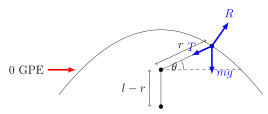
A long, inextensible string passes through a small fixed ring. One end of the string is attached to a particle of mass \(m,\) which hangs freely. The other end is attached to a bead also of mass \(m\) which is threaded on a smooth rigid wire fixed in the same vertical plane as the ring. The curve of the wire is such that the system can be in static equilibrium for all positions of the bead. The shortest distance between the wire and the ring is \(d(>0).\) Using plane polar coordinates centred on the ring, find the equation of the curve.
The bead is set in motion. Assuming that the string remains taut, show that the speed of the bead when it is a distance \(r\) from the ring is
\[
\left(\frac{r}{2r-d}\right)^{\frac{1}{2}}v,
\]
where \(v\) is the speed of the bead when \(r=d.\)
Solution:
Assume the total length of the string is \(l\). Then the total energy of the system (when nothing is moving) for a given \(\theta\) is: \(mg(r-l) + mgr \sin \theta\)
Since for a point in static equilibrium, the derivative of this must be \(0\), this must be constant. So: \(r\l \sin \theta + 1\r = C \Rightarrow r = \frac{C}{1+\sin \theta}\)
\(r\) will be smallest when \(\sin \theta = 1\), ie in polar coordinates, the equation should be \(r = \frac{2d}{1+\sin \theta}\)
Alternatively, by considering forces, the shape must be a parabola with the ring at the focus.
Considering the bead, it will have speed of \(r \dot{\theta}\) tangentially, and \(-\dot{r}\). The other particle will have speed \(\dot{r}\).
Differentiating wrt to \(t\)
\begin{align*}
&& 0 &= \dot{r}(\sin \theta + 1) + r \dot{\theta} \cos \theta \\
\Rightarrow && \dot{\theta} &= \frac{-\dot{r}(1+\sin \theta)}{r \cos \theta} \\
&&&= \frac{-\dot{r} 2d}{r^2 \sqrt{1-\l \frac{2d}{r}-1\r^2}} \\
&&&= \frac{-2d\dot{r}}{r^2\sqrt{\frac{r^2-(2d-r)^2}{r^2}}} \\
&&&= \frac{-d\dot{r}}{r\sqrt{dr-d^2}}
\end{align*}
By conservation of energy (since GPE is constant throughout the system, KE must be constant):
\begin{align*}
&& \frac12 m (r^2 \dot{\theta}^2+\dot{r}^2) +\frac12 m \dot{r}^2 &= \frac12mv^2 \\
\Rightarrow && v^2 &= r^2 \dot{\theta}^2 + 2\dot{r}^2 \\
&&&= r^2 \frac{d^2\dot{r}^2}{r^2(dr-d^2)} + 2\dot{r}^2 \\
&&&= \dot{r}^2 \l \frac{d }{r-d} + 2 \r \\
&&&= \dot{r}^2 \l \frac{2r-d}{r-d} \r \\
\Rightarrow && v &= \dot{r} \l \frac{2r-d}{r-d} \r^{\frac12} \\
\Rightarrow && \dot{r} &= \l \frac{r-d}{2r-d} \r^{\frac12} v \\
\Rightarrow && u^2 &= r^2 \dot{\theta}^2+\dot{r}^2\\
&&&= \dot{r}^2 \l \frac{d }{r-d} + 1 \r \\
&&&= \l \frac{r-d}{2r-d} \r \l \frac{r}{r-d} \r v^2 \\
&&&= \l \frac{d}{2r-d} \r v^2 \\
\Rightarrow && u &= \l \frac{d}{2r-d} \r^{\frac12} v
\end{align*}