Problems
Filters
3 problems found
2014 Paper 1 Q5
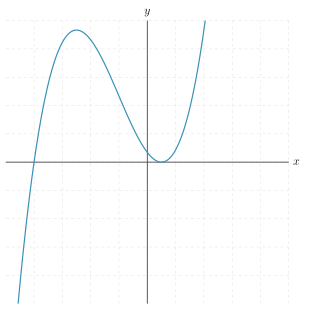
- Let \(f(x) = (x+2a)^3 -27 a^2 x\), where \(a\ge 0\). By sketching \(f(x)\), show that \(f(x)\ge 0\) for \(x \ge0\).
- Use part (i) to find the greatest value of \(xy^2\) in the region of the \(x\)-\(y\) plane given by \(x\ge0\), \(y\ge0\) and \(x+2y\le 3\,\). For what values of \(x\) and \(y\) is this greatest value achieved?
- Use part (i) to show that \((p+q+r)^3 \ge 27pqr\) for any non-negative numbers \(p\), \(q\) and \(r\). If \((p+q+r)^3 = 27pqr\), what relationship must \(p\), \(q\) and \(r\) satisfy?
Solution:
- Note that \(f(x) = (x+2a)^3 - 27a^2x\) so \(f'(x) = 3(x+2a)^2-27a^2 = 3x^2+12ax-15a^2 = (x-a)(3x+15a)\) so the turning points are at \(x = a, x = -5a\). But \(f(a) = 0\), so the curve just touches the \(x\)-axis. Note also that \(f(0) = 8a^3 \geq 0\) so:
- \(\,\) \begin{align*} && 0 &\leq (x+2y)^3 - 27y^2 x \\ &&& \leq 3^3 - 27 y^2 x \\ &&&= 27(1-y^2x) \\ \Rightarrow && xy^2 &\leq1 \end{align*} with equality when \(x = y = 1\)
- Notice that \begin{align*} && 0 &\leq (p+q+r)^3 - 27\left (\frac{q+r}{2}\right)^2 p \\ \Rightarrow && (p+q+r)^3 &\geq 27\left (\frac{q+r}{2}\right)^2 p \\ &&&\underbrace{\geq}_{AM-GM} 27\left (\sqrt{qr}\right)^2 p \\ &&&= 27pqr \end{align*} Equality can only hold if \(p = \frac{q+r}{2}\), but by symmetry we must also have \(q = \frac{r+p}{2}, r = \frac{p+q}{2}\) ie \(p = q = r\). And indeed equality does hold in this case.
2009 Paper 1 Q5
A right circular cone has base radius \(r\), height \(h\) and slant length \(\ell\). Its volume \(V\), and the area \(A\) of its curved surface, are given by \[ V= \tfrac13 \pi r^2 h \,, \ \ \ \ \ \ \ A = \pi r\ell\,. \]
- Given that \(A\) is fixed and \(r\) is chosen so that \(V\) is at its stationary value, show that \(A^2 = 3\pi^2r^4\) and that \(\ell =\sqrt3\,r\).
- Given, instead, that \(V\) is fixed and \(r\) is chosen so that \(A\) is at its stationary value, find \(h\) in terms of \(r\).
Solution:
- Given \(A\) is fixed, and \(h^2 + r^2 = \ell^2\), we can look at \begin{align*} && V^2 &= \frac19 \pi^2 r^4 h^2 \\ &&&= \frac19\pi^2r^4(\ell^2 - r^2) \\ &&&= \frac19\pi^2 r^4\left (\frac{A^2}{\pi^2r^2} - r^2 \right) \\ &&&= \frac{A^2r^2 - \pi^2r^6}{9} \end{align*} Differentiating wrt to \(r\) we find that \(2rA^2-6\pi^2 r^5 = 0\) or hence \(A^2 = 3\pi^2 r^4 \Rightarrow A = \sqrt{3}\pi r^2\). Therefore \(\sqrt{3}\pi r^2 = \pi r \ell \Rightarrow \ell = \sqrt{3}r\).
- Supposing \(V\) is fixed, then \begin{align*} && A^2 &= \pi^2 r^2\ell^2 \\ &&&= \pi^2 r^2 (h^2+r^2) \\ &&&= \pi^2 r^2 \left ( \frac{9V^2}{\pi^2r^4} + r^2 \right) \\ &&&= 9V^2r^{-2} + \pi^2r^4 \\ \end{align*} Differentiating wrt to \(r\) we find \(-18V^2r^{-3} + 4\pi^2 r^3 = 0\) so \(V^2 = \frac{2\pi^2}{9}r^6\) or \(V = \frac{\sqrt{2}\pi}{3}r^3\), from which it follows: \(\frac{\sqrt{2}\pi}{3}r^3 = \frac13\pi r^2 h \Rightarrow h = \sqrt{2}r\)
2001 Paper 1 Q10
A gun is sited on a horizontal plain and can fire shells in any direction and at any elevation at speed \(v\). The gun is a distance \(d\) from a straight railway line which crosses the plain, where \(v^2>gd\). The gunner aims to hit the line, choosing the direction and elevation so as to maximize the time of flight of the shell. Show that the time of flight, \(T\), of the shell satisfies \[ %\frac{2v}{g} \sin \left( \frac12 \arccos \frac{gd}{v^2}\right)\,. g^2 T^2 = 2 v^2 +2 \left(v^4 -g^2d^2\right)^{\frac12}\,. \] Extension: (Not in original paper) Find the time of flight if the gun is constrained so that the angle of elevation \(\alpha \) is not greater than \( 45^\circ\).
Solution: If we fire the gun at an angle to the track, as long as we can travel a horizontal distance \(\geq d\) we can hit the track. Suppose we am at an elevatation \(\alpha\), then \begin{align*} (\uparrow): && s &= ut + \frac12 at^2 \\ && 0 &= v\sin \alpha T - \frac12 g T^2 \\ \Rightarrow &&T &= \frac{2v\sin \alpha}{g}\\ \\ (\rightarrow): && s &= ut \\ && s &= v \cos \alpha T \\ &&&= v\sqrt{1-\sin^2 \alpha} T \\ &&&= vT\sqrt{1 - \frac{g^2T^2}{4v^2}}\\ &&&= \frac{T}{2}\sqrt{4v^2-g^2T^2}\\ \Rightarrow && d & \leq \frac{T}{2}\sqrt{4v^2-g^2T^2} \\ \Rightarrow && 4g^2d^2&\leq g^2T^2(4v^2-g^2T^2) \\ \Rightarrow && 0 &\leq -(g^2T^2)^2 + 4v^2 (g^2T^2)-4g^2d^2 \\ &&&=4v^4-4g^2d^2 -\left (g^2T^2-2v^2 \right)^2 \\ \Rightarrow && \left (g^2T^2-2v^2 \right)^2 & \leq 4v^4-4g^2d^2 \\ \Rightarrow && g^2T^2 &\leq 2v^2+2\sqrt{v^4-g^2d^2} \end{align*} Therefore the maximum value for \(g^2T^2\) is \(2v^2+2\sqrt{v^4-g^2d^2}\) Notice that we are hitting the track directly at \(d\). This is because to maximise the time of flight (for a fixed speed) we want to maximise the angle of elevation. Therefore we want the highest angle where we still hit the track (which is clearly the shortest distance). If we are constraint to \(\alpha \leq 45^\circ\) we know that \(T\) is maximised when \(\alpha = 45^\circ\) (and we will reach the track since the range \(\frac{v^2 \sin 2 \alpha}{g}\) is increasing). Therefore the maximum time is \(T = \frac{\sqrt{2}v}{g}\)