Problems
Filters
2 problems found
2018 Paper 1 Q10
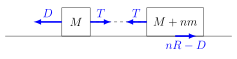
A train is made up of two engines, each of mass \(M\), and \(n\) carriages, each of mass \(m\). One of the engines is at the front of the train, and the other is coupled between the \(k\)th and \((k+1)\)th carriages. When the train is accelerating along a straight, horizontal track, the resistance to the motion of each carriage is \(R\) and the driving force on each engine is \(D\), where \(2D >nR\,\). The tension in the coupling between the engine at the front and the first carriage is \(T\).
- Show that \[ T = \frac{n(mD+MR)}{nm+2M}\,. \]
- Show that \(T\) is greater than the tension in any other coupling provided that \(k> \frac12n\,\).
- Show also that, if \(k> \frac12n\,\), then at least one of the couplings is in compression (that is, there is a negative tension in the coupling).
Solution:
- \(\,\)
\begin{align*} \text{N2}(\leftarrow, \text{first engine}): && D-T &= Ma \\ \text{N2}(\leftarrow, \text{rest of train}): && T-nR+D &= (M+nm)a \\ \Rightarrow && \frac{D-T}{M} &= \frac{T+D-nR}{M+nm} \\ \Rightarrow && T \left ( \frac{1}{M+nm}+\frac{1}{M} \right) &= \frac{D}{M} + \frac{nR-D}{M+nm} \\ \Rightarrow && T \left ( 2M+nm\right) &= DM +Dnm + nRM - DM \\ &&&= n(mD+MR) \\ \Rightarrow && T &= \frac{n(mD+MR)}{2M+nm} \end{align*}
- The greatest coupling must occur behind an engine, because each carriage behind an engine acts as a drag.
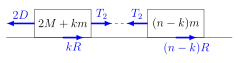
Therefore we need only consider the couple between the second engine and the rest of the carriages:
\begin{align*} \text{N2}(\leftarrow, \text{up to second engine}): && 2D - T_2 - kR &= (2M+km)a \\ \text{N2}(\leftarrow, \text{everything else}): && T_2 - (n-k)R &= (n-k)ma \\ \Rightarrow && \frac{2D-T_2-kR}{2M+km} &= \frac{T_2-(n-k)R}{(n-k)m} \\ \Rightarrow && T_2 \left (\frac{1}{(n-k)m} + \frac{1}{2M+km} \right) &= \frac{2D-kR}{2M+km} + \frac{R}{m} \\ \Rightarrow && T_2 \left (2M+ nm \right) &= (2D-kR)m(n-k) + R(2M+km)(n-k) \\ \Rightarrow && T_2 &= \frac{(n-k)\left (2Dm+2RM \right)}{2M+nm} \\ &&&= \frac{2(n-k)(mD + MR)}{2M+nm} \end{align*} Therefore \(T > T_2\) provided \(2(n-k) < n \Leftrightarrow k > \frac12n\)
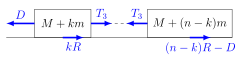
- If there is a coupling which is in negative tension, it must be between the two engines. In particular, if there is one, there must be one directly in front of the first engine.
\begin{align*} \text{N2}(\leftarrow, \text{before second engine}): && D - T_3 - kR &= (M+km)a \\ \text{N2}(\leftarrow, \text{everything else}): && T_3 +D- (n-k)R &= (M+(n-k)m)a \\ \Rightarrow && \frac{D-T_3-kR}{M+km} &= \frac{T_3+D-(n-k)R}{M+(n-k)m} \\ \Rightarrow && T_3 \left ( \frac{1}{M+(n-k)m} + \frac{1}{M+km} \right) &= \frac{D-(n-k)R}{M+(n-k)m}+\frac{kR-D}{M+km} \\ \Rightarrow && T_3 (2M+nm) &= (D-(n-k)R)(M+km)+(kR-D)(M+(n-k)m) \\ &&&= D(M+km-M-(n-k)m) + R(kM+k(n-k)m-(n-k)M-k(n-k)m) \\ &&&= D(n-2k)m+RM(2k-n)m \\ &&&= (n-2k)m(D-RM) \end{align*} Therefore \(T_3\) is negative if \(k > \frac12n\) so there are some connections in compression.
2009 Paper 3 Q10
A light spring is fixed at its lower end and its axis is vertical. When a certain particle \(P\) rests on the top of the spring, the compression is \(d\). When, instead, \(P\) is dropped onto the top of the spring from a height \(h\) above it, the compression at time \(t\) after \(P\) hits the top of the spring is \(x\). Obtain a second-order differential equation relating \(x\) and \(t\) for \(0\le t \le T\), where \(T\) is the time at which \(P\) first loses contact with the spring. Find the solution of this equation in the form \[ x= A + B\cos (\omega t) + C\sin(\omega t)\,, \] where the constants \(A\), \(B\), \(C\) and \(\omega\) are to be given in terms of \(d\), \(g\) and \(h\) as appropriate. Show that \[ T = \sqrt{d/g\;} \left (2 \pi - 2 \arctan \sqrt{2h/d\;}\;\right)\,. \]