Problems
Filters
2 problems found
2018 Paper 2 Q8
D: 1600.0
B: 1484.0
differential equation
first order
integrating factor
substitution
Bernoulli equation
curve sketching
comparison of solutions
- Use the substitution \(v= \sqrt y\) to solve the differential equation \[ \frac{\d y}{\d t} = \alpha y^{\frac12} - \beta y \ \ \ \ \ \ \ \ \ \ (y\ge0, \ \ t\ge0) \,, \] where \(\alpha\) and \(\beta\) are positive constants. Find the non-constant solution \(y_1(x)\) that satisfies \(y_1(0)=0\,\).
- Solve the differential equation \[ \frac{\d y}{\d t} = \alpha y^{\frac23} - \beta y \ \ \ \ \ \ \ \ \ \ (y\ge0, \ \ t\ge0) \,, \] where \(\alpha\) and \(\beta\) are positive constants. Find the non-constant solution \(y_2(x)\) that satisfies \(y_2(0)=0\,\).
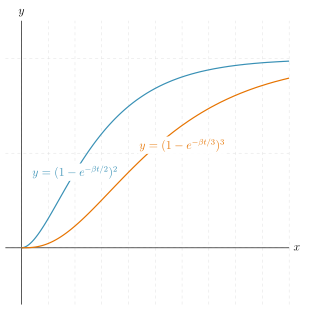
- In the case \(\alpha=\beta\), sketch \(y_1(x)\) and \(y_2(x)\) on the same axes, indicating clearly which is \(y_1(x)\) and which is \(y_2(x)\). You should explain how you determined the positions of the curves relative to each other.
Solution:
- Suppose \(v = \sqrt{y} \Rightarrow v^2 = y \Rightarrow 2v v' = y'\) so \begin{align*} && 2vv' &= \alpha v-\beta v^2 \\ \Rightarrow && 2v' &= \alpha - \beta v \\ \Rightarrow && v' + \frac{\beta}{2} v &= \frac{\alpha}{2} \\ \Rightarrow && \frac{\d}{\d t} \left (e^{\beta t/2} v \right) &= \frac{\alpha}{2} e^{\beta t/2} \\ \Rightarrow && e^{\beta t/2} v &=C+ \frac{\alpha}{\beta}e^{\beta t /2} \\ \Rightarrow && v &= Ce^{-\beta t/2} + \frac{\alpha}{\beta} \\ \Rightarrow && \sqrt{y} &= Ce^{-\beta t/2} + \frac{\alpha}{\beta} \\ y(0) = 0: && 0 &= C+\frac{\alpha}{\beta} \\ \Rightarrow && \sqrt{y} &= \frac{\alpha}{\beta} \left (1-e^{-\beta t/2} \right) \\ \Rightarrow && y &= \frac{ \alpha^2}{\beta^2} \left (1-e^{-\beta t/2} \right)^2 \end{align*}
- Try \(v = y^{1/3} \Rightarrow v^3 = y \Rightarrow 3v^2 v' = y'\) so \begin{align*} && y' &= \alpha v^2 - \beta y \\ \Rightarrow && 3v^2v' &= \alpha v^2 - \beta v^3 \\ \Rightarrow && v' +\frac{\beta}{3} v &= \frac{\alpha}{3} \\ \Rightarrow && (v e^{\beta t/3})' &= \frac{\alpha}{3}e^{\beta t/3} \\ \Rightarrow && v &= Ce^{-\beta t/3} + \frac{\alpha}{\beta} \\ v(0) = 0: && v &= \frac{\alpha}{\beta} \left (1 - e^{-\beta t/3} \right) \\ \Rightarrow && y &= \frac{\alpha^3}{\beta^3} \left (1 - e^{-\beta t/3} \right) ^3 \end{align*}
- \(y_1 = (1-e^{-\beta t/2})^2, y_2 = (1-e^{-\beta t/3})^3\)
By considering the differential equation, notice that \(0 < y_i < 1\) so \(y^{1/2} > y^{2/3}\) and therefore \(y_1' > y_2'\) and so \(y_1\) increases faster.
2004 Paper 2 Q8
D: 1600.0
B: 1483.3
differential equation
first order
separation of variables
curve sketching
inequality
substitution
trigonometric
comparison of solutions
Let \(x\) satisfy the differential equation $$ \frac {\d x}{\d t} = {\big( 1-x^n\big)\vphantom{\Big)}}^{\!1/n} $$ and the condition \(x=0\) when \(t=0 \,\).
- Solve the equation in the case \(n=1\) and sketch the graph of the solution for \(t > 0 \,\).
- Prove that \(1-x < (1-x^2)^{1/2} \) for \(0 < x < 1 \,\). Use this result to sketch the graph of the solution in the case \(n=2\) for \(0 < t < \frac12 \pi \,\), using the same axes as your previous sketch. By setting \(x=\sin y\,\), solve the equation in this case.
- Use the result (which you need not prove) \[ (1-x^2)^{1/2} < (1-x^3)^{1/3} \text{ \ \ for \ \ } 0 < x < 1 \;, \] to sketch, without solving the equation, the graph of the solution of the equation in the case \(n=3\) using the same axes as your previous sketches. Use your sketch to show that \(x=1\) at a value of \(t\) less than \(\frac12 \pi \,\).
Solution:
- \(\,\) \begin{align*}
&& \dot{x} &= (1-x) \\
\Rightarrow &&\int \frac{1}{1-x} \d x &= \int \d t \\
\Rightarrow && -\ln |1-x| &= t + C \\
t=0, x = 0: && -\ln 1 &= C \Rightarrow C = 0\\
\Rightarrow && -\ln|1-x| &= t \\
\Rightarrow && 1-x&= e^{-t} \\
\Rightarrow && x &= 1-e^{-t}
\end{align*}

- Notice that \((1-x^2)^{1/2} = (1-x)^{1/2}(1+x)^{1/2} > (1-x)^{1/2} > 1-x\)
\begin{align*} && \dot{x} &= \sqrt{1-x^2} \\ \Rightarrow && \int \frac{1}{\sqrt{1-x^2}} \d x &= t + C \\ x = \sin y, \d x = \cos y && \int \frac{\cos y}{\cos y} \d y &= t + C \\ \Rightarrow && y &= t + C \\ \Rightarrow && \sin^{-1} x &= t + C \\ t = 0, x = 0: && x &= \sin t \end{align*}

- \(\,\)
We know the gradient is steeper, so the solution must always be above \(\sin t\), which means it reaches \(1\) before \(\frac{\pi}{2}\)
