Problems

Filters
Clear Filters

1 problem found

2003 Paper 1 Q11
D: 1516.0 B: 1516.0

A smooth plane is inclined at an angle \(\alpha\) to the horizontal. \(A\) and \(B\) are two points a distance \(d\) apart on a line of greatest slope of the plane, with \(B\) higher than \(A\). A particle is projected up the plane from \(A\) towards \(B\) with initial speed \(u\), and simultaneously another particle is released from rest at \(B\,\). Show that they collide after a time \(\displaystyle {d /u}\,\). The coefficient of restitution between the two particles is \(e\) and both particles have mass \(m\,\). Show that the loss of kinetic energy in the collision is \(\frac14 {m u^2 \big( 1 - e^2 \big) }\,\).


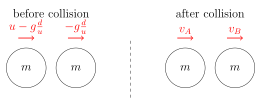
Solution: We can `ignore' the fact that they are both accelerating, because the acceleration is the same for both object so it will "cancel" out. Therefore the time taken is the same as if the object has to travel distance \(d\) at speed \(u\), ie \(d/u\). \begin{align*} && u_A &= u - g \frac{d}{u} \\ && u_B &= -g\frac{d}{u} \end{align*}
TikZ diagram
The speed of approach is \(u\), therefore the speed of separation is \(eu\), in particular \(v_B = v_A + eu\) \begin{align*} \text{COM}: && m\left (u-g\frac{d}{u} \right)+m\left (-g\frac{d}{u} \right) &= mv_A + m(v_A + eu) \\ \Rightarrow && 2v_A &= u - 2g\frac{d}{u}-eu \\ \Rightarrow && v_A &= \frac12 (1-e)u - \frac{gd}{u} \\ \Rightarrow && v_B &= \frac12 (1+e)u - \frac{gd}{u} \\ \\ && \text{initial k.e.} &= \frac12 m \left (u-g\frac{d}{u} \right)^2 + \frac12 m \left (-g\frac{d}{u} \right)^2 \\ &&&= \frac12m \left (u^2 -2gd + \frac{2g^2d^2}{u^2} \right) \\ && \text{final k.e.} &= \frac12 m \left ( \frac12 (1-e)u - \frac{gd}{u}\right)^2 + \frac12 m \left ( \frac12 (1+e)u - \frac{gd}{u}\right)^2 \\ &&&= \frac12 m \left (\frac14 \left ( (1-e)^2+(1+e)^2\right)u^2 - gd \left ((1-e)+(1+e) \right) +\frac{2g^2d^2}{u^2}\right) \\ &&&= \frac12 m \left (\frac12(1+e^2)u^2-2gd+ \frac{2g^2d^2}{u^2}\right) \\ \Rightarrow && \text{loss k.e.} &= \frac12m \left ( u^2 - \frac12(1+e^2)u^2\right) \\ &&&= \frac14mu^2(1-e^2) \end{align*}