Problems
Filters
2 problems found
2018 Paper 3 Q3
Show that the second-order differential equation \[ x^2y''+(1-2p) x\, y' + (p^2-q^2) \, y= \f(x) \,, \] where \(p\) and \(q\) are constants, can be written in the form \[ x^a \big(x^b (x^cy)'\big)' = \f(x) \,, \tag{\(*\)} \] where \(a\), \(b\) and \(c\) are constants.
- Use \((*)\) to derive the general solution of the equation \[ x^{2}y''+(1-2p)xy'+(p^2-q^{2})y=0 \] in the different cases that arise according to the values of \(p\) and \(q\).
- Use \((*)\) to derive the general solution of the equation \[ x^{2}y''+(1-2p)xy'+p^2y=x^{n} \] in the different cases that arise according to the values of \(p\) and \(n\).
Solution: Consider $x^a \big(x^b (x^cy)'\big)'$ then \begin{align*} x^a \big(x^b (x^cy)'\big)' &= x^a \big (bx^{b-1}(x^c y)'+x^b(x^cy)'' \big ) \\ &= x^a \big (bx^{b-1} (cx^{c-1}y + x^c y') + x^b(c(c-1)x^{c-2}y + 2cx^{c-1}y' + x^cy'') \\ &= x^{a+b+c}y'' + (2cx^{c-1+b+a}+bx^{c+b-1+a})y'+(c(b+c-1))x^{a+b+c-2} y \end{align*} So we need: \begin{align*} &&& \begin{cases} a+b+c &= 2 \\ 2c+b &= 1-2p \\ c(b+c-1) &= p^2-q^2 \end{cases} \\ \Rightarrow && c((1-2p)-2c+c-1) &=p^2-q^2 \\ \Rightarrow && c^2+2pc &= q^2-p^2 \end{align*}
2014 Paper 1 Q9
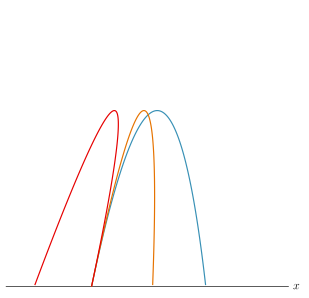
A particle of mass \(m\) is projected due east at speed \(U\) from a point on horizontal ground at an angle \(\theta\) above the horizontal, where \(0 < \theta < 90^\circ\). In addition to the gravitational force \(mg\), it experiences a horizontal force of magnitude \(mkg\), where \(k\) is a positive constant, acting due west in the plane of motion of the particle. Determine expressions in terms of \(U\), \(\theta\) and \(g\) for the time, \(T_H\), at which the particle reaches its greatest height and the time, \(T_L \), at which it lands. Let \(T = U\cos\theta /(kg)\). By considering the relative magnitudes of \(T_H\), \(T_L \) and \(T\), or otherwise, sketch the trajectory of the particle in the cases \(k\tan\theta<\frac12\), \(\frac12 < k\tan\theta<1\), and \(k\tan\theta>1\). What happens when \(k\tan\theta =1\)?
Solution: \begin{align*} && v_{\uparrow} &= U\sin \theta - g t \\ \Rightarrow && T_H &= \frac{U \sin \theta}{g} \\ \\ && s_{\uparrow} &= U \sin \theta t - \frac12 g t^2 \\ \Rightarrow && 0 &= U\sin \theta T_L - \frac12 g T_L^2 \\ && T_L &= \frac{2 U \sin \theta}{g} \end{align*} \(T = U\cos \theta / (kg)\) is the point when the particle's horizontal motion is reversed.