Problems
Filters
3 problems found
2018 Paper 1 Q6
Use the identity \[ 2 \sin P\,\sin Q = \cos(Q-P)-\cos(Q+P)\, \] to show that \[ 2\sin\theta \,\big (\sin\theta + \sin 3\theta + \cdots + \sin (2n-1)\theta\,\big ) = 1-\cos 2n\theta \,. \]
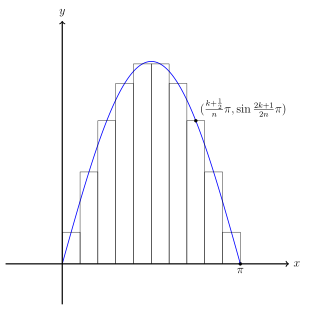
- Let \(A_n\) be the approximation to the area under the curve \(y=\sin x\) from \(x=0\) to \(x=\pi\), using \(n\) rectangular strips each of width \(\frac{{\displaystyle \pi}}{\displaystyle n}\), such that the midpoint of the top of each strip lies on the curve. Show that \[ A_n \sin \left( \frac{\pi}{2n} \right) = \frac \pi n\,. \]
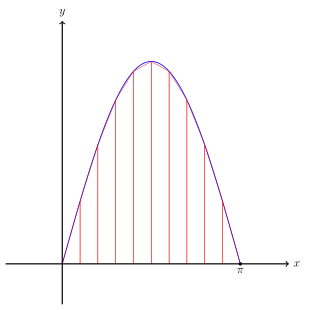
- Let \(B_n\) be the approximation to the area under the curve \(y=\sin x\) from \(x=0\) to \(x=\pi\,\), using the trapezium rule with \(n\) strips each of width \(\frac{\displaystyle \pi}{ \displaystyle n}\). Show that \[B_n \sin \left( \frac{\pi}{2n} \right) = \frac{\pi}{n} \cos \left( \frac{\pi}{2n} \right) . \]
- Show that \[ \frac{1}{2}(A_n + B_n) = B_{2n}\,, \] and that \[ A_n B_{2n} = A^2_{2n}\, . \]
Solution: \begin{align*} && 2\sin\theta \,\big (\sin\theta + \sin 3\theta + \cdots + \sin (2n-1)\theta\,\big ) &= 2\sin\theta\sin\theta + 2\sin\theta\sin 3\theta + \cdots + 2\sin\theta\sin (2n-1)\theta \\ &&&= \cos((1-1)\theta) - \cos((1+1)\theta)+\cos((3-1)\theta)-\cos((3+1)\theta) + \cdots + \cos (((2n-1)-1)\theta) -\cos(((2n-1)+1)\theta) \\ &&&= \cos 0 - \cos(2n\theta) \\ &&&= 1 - \cos 2n \theta \end{align*}
- \(\,\)
Therefore the area is: \begin{align*} A_n &= \frac{\pi}{n} \sin \left ( \frac{\pi}{2n} \right) + \frac{\pi}{n} \sin \left ( \frac{3\pi}{2n} \right) + \frac{\pi}{n} \sin \left ( \frac{5\pi}{2n} \right) + \cdots \frac{\pi}{n} \sin \left ( \frac{(2n-1)\pi}{2n} \right) \\ &= \frac{\pi}{n} \left( \frac{1-\cos \frac{2n \pi}{2n}}{2\sin \frac{\pi}{2n}} \right) \\ &= \frac{\pi}{n} \frac{1}{\sin \frac{\pi}{2n}} \end{align*} as required
- Therefore the area is: \begin{align*} && B_n &= \frac{\pi}{n} \frac{\sin(0)+\sin(\frac{\pi}{n})}{2}+\frac{\pi}{n} \frac{\sin(\frac{\pi}n)+\sin(\frac{2\pi}{n})}{2} + \cdots \frac{\pi}{n} \frac{\sin(\frac{(n-1)\pi}{n})+\sin(\frac{n\pi}{n})}{2} \\ &&&= \frac{\pi}{n} \left ( \sin \frac{\pi}{n} + \sin \frac{2\pi}{n} + \cdots+\sin \frac{(n-1)\pi}{n} \right) \\ \Rightarrow && 2\sin \left ( \frac{\pi}{2n} \right)B_n &= \frac{\pi}{2} \left (2\sin \left ( \frac{\pi}{2n} \right)\sin \frac{\pi}{n} + 2\sin \left ( \frac{\pi}{2n} \right)\sin \frac{2\pi}{n} + \cdots+2\sin \left ( \frac{\pi}{2n} \right)\sin \frac{(n-1)\pi}{n} \right) \\ &&&= \frac{\pi}2 \left ( \cos \frac{\pi}{2n} - \cos \frac{3\pi}{n} + \cos\frac{3\pi}{2n} - \cos \frac{5\pi}{2n} + \cos \frac{(2n-3)\pi}{2n} - \cos \frac{(2n-1)\pi}{2n} \right) \\ &&&= \frac{\pi}{n} \left ( \cos \frac{\pi}{2n} - \cos \left ( \pi - \frac{\pi}{2n} \right) \right) \\ &&&= 2 \frac{\pi}{n} \cos \frac{\pi}{2n} \\ \Rightarrow && \sin \left ( \frac{\pi}{2n} \right)B_n &= \frac{\pi}n \cos \frac{\pi}{2n} \end{align*} as required
- \begin{align*} \frac12(A_n+B_n) &= \frac12 \frac{\pi}{n} \frac{1}{\sin \frac{\pi}{2n}} \left ( 1 + \cos \frac{\pi}{2n} \right) \\ &= \frac{\pi}{n}\frac1{2 \sin \frac{\pi}{2n}} \left (2 \cos^2 \frac{\pi}{4n} \right) \\ &=\frac{\pi}{n} \frac{1}{4 \sin \frac{\pi}{4n} \cos \frac{\pi}{4n}} \left (2 \cos^2 \frac{\pi}{4n} \right) \\ &= \frac{\pi}{2n} \frac{\cos \frac{\pi}{4n}}{\sin \frac{\pi}{4n}} \\ &= B_{2n} \\ \\ A_nB_{2n} &= \frac{\pi}{n\sin \frac{\pi}{2n}} \cdot \frac{\pi}{2n} \frac{\cos \frac{\pi}{4n}}{\sin \frac{\pi}{4n}} \\ &= \frac{\pi^2}{(2n)^2} \frac{\cos \frac{\pi}{4n}}{\sin^2 \frac{\pi}{4n} \cos \frac{\pi}{4n}} \\ &= \left ( \frac{\pi}{2n} \frac{1}{\sin \frac{\pi}{4n}}\right)^2 \\ &= A_{2n}^2 \end{align*}
2009 Paper 2 Q2
The curve \(C\) has equation \[ y= a^{\sin (\pi \e^ x)}\,, \] where \(a>1\).
- Find the coordinates of the stationary points on \(C\).
- Use the approximations \(\e^t \approx 1+t\) and \(\sin t \approx t\) (both valid for small values of \(t\)) to show that \[ y\approx 1-\pi x \ln a \; \] for small values of \(x\).
- Sketch \(C\).
- By approximating \(C\) by means of straight lines joining consecutive stationary points, show that the area between \(C\) and the \(x\)-axis between the \(k\)th and \((k+1)\)th maxima is approximately \[ \Big( \frac {a^2+1}{2a} \Big) \ln \Big ( 1+ \big( k-\tfrac34)^{-1} \Big)\,. \]
Solution:
- \(\,\) \begin{align*} && y & = a^{\sin(\pi e^x)} \\ \Rightarrow && \frac{\d y}{\d x} &= a^{\sin(\pi e^x)} \cdot ( \ln a) \cdot (\cos (\pi e^x)) \cdot \pi e^x \\ \frac{\d y}{\d x} = 0: && 0 &= \cos(\pi e^x) \\ \Rightarrow && \pi e^x &= \left ( \frac{2n+1}{2} \right) \pi \\ \Rightarrow && x &= \ln \left ( \frac{2n+1}{2} \right) \\ && y &= a^{(-1)^n} \\ &&(x,y) &= \left (\ln \left ( \frac{2n+1}{2} \right), a^{(-1)^n} \right) \end{align*}
- \(\,\) \begin{align*} && y &= a^{\sin(\pi e^x)} \\ &&&= e^{\ln a \cdot \sin(\pi e^x)} \\ &&&\approx e^{\ln a \cdot \sin(\pi (1+x))} \\ &&&\approx e^{-\ln a \cdot \sin(\pi x)} \\ &&&\approx e^{-\ln a \cdot \pi x} \\ &&&\approx 1-( \pi\ln a) x \end{align*}
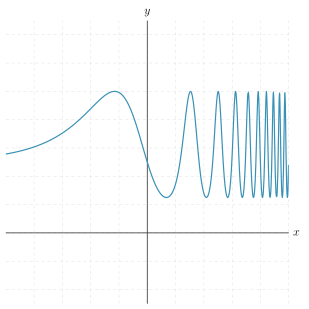
- The \(k\)th maxima is at \(\ln \left ( \frac{4(k-1)+1}{2}\right)\) and \(a\) ,and the \((k+1)\)th is at \(\ln \left ( \frac{4k+1}{2}\right)\). They have a minima between at \(\ln \left ( \frac{4k-3}{2}\right)\). \begin{align*} && \text{Area} &\approx \frac12 \left (\ln \left ( \frac{4k-1}{2}\right)- \ln \left ( \frac{4k-3}{2}\right)\right) \left ( a + \frac1a \right) + \frac12 \left ( \ln \left ( \frac{4k+1}{2}\right)-\ln \left ( \frac{4k-1}{2}\right)\right) \left ( a + \frac1a \right) \\ &&&= \frac{a^2+1}{2a} \ln \left (\frac{4k+1}{4k-3} \right) \\ &&&= \frac{a^2+1}{2a} \ln \left (1 + \frac{4}{4k-3} \right) \\ &&&= \frac{a^2+1}{2a} \ln \left (1 + \frac{1}{k-\tfrac34} \right) \\ &&&= \frac{a^2+1}{2a} \ln \left (1 + (k-\tfrac34)^{-1} \right) \\ \end{align*}
1989 Paper 1 Q2
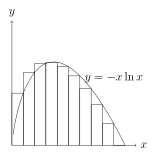
For \(x>0\) find \(\int x\ln x\,\mathrm{d}x\). By approximating the area corresponding to \(\int_{0}^{1}x\ln(1/x)\, \d x\) by \(n\) rectangles of equal width and with their top right-hand vertices on the curve \(y=x\ln(1/x)\), show that, as \(n\rightarrow\infty\), \[ \frac{1}{2}\left(1+\frac{1}{n}\right)\ln n-\frac{1}{n^{2}}\left[\ln\left(\frac{n!}{0!}\right)+\ln\left(\frac{n!}{1!}\right)+\ln\left(\frac{n!}{2!}\right)+\cdots+\ln\left(\frac{n!}{(n-1)!}\right)\right]\rightarrow\frac{1}{4}. \] {[}You may assume that \(x\ln x\rightarrow0\) as \(x\rightarrow0\).{]}
Solution: Integrating by parts we obtain: \begin{align*} \int x \ln x \, \d x &= [\frac12 x^2 \ln x] - \int \frac12x^2 \cdot \frac1x \d x \\ &= \frac12 x^2 \ln x - \frac14 x^2 + C \end{align*}