Problems
Filters
4 problems found
2016 Paper 2 Q8
Evaluate the integral \[ \hphantom{ \ \ \ \ \ \ \ \ \ (m> \tfrac12)\,.} \int_{m-\frac12} ^\infty \frac 1{x^2}\, \d x { \ \ \ \ \ \ \ \ \ (m > \tfrac12)\,.} \] Show by means of a sketch that \[ \sum_{r=m}^n \frac 1 {r^2} \approx \int_{m-\frac12}^{n+\frac12} \frac1 {x^2} \, \d x \,, \tag{\(*\)} \] where \(m\) and \(n\) are positive integers with \(m < n\).
- You are given that the infinite series \(\displaystyle \sum_{r=1}^\infty \frac 1 {r^2}\) converges to a value denoted by \(E\). Use \((*)\) to obtain the following approximations for \(E\): \[ E\approx 2\,; \ \ \ \ E\approx \frac53\,; \ \ \ \ E\approx \frac{33}{20} \,.\]
- Show that, when \(r\) is large, the error in approximating \(\dfrac 1{r^2}\) by \(\displaystyle \int_{r-\frac12}^{r+\frac12} \frac 1 {x^2} \, \d x\) is approximately \(\dfrac 1{4r^4}\,\). Given that \(E \approx 1.645\), show that \(\displaystyle \sum_{r=1}^\infty \frac1{r^4} \approx 1.08\, \).
Solution: \begin{align*} && \int_{m-\frac12}^\infty \frac{1}{x^2} \d x &= \lim_{K \to \infty} \left [ -x^{-1} \right]_{m-\frac12}^K \\ &&&= \frac{1}{m-\frac12} - \lim_{K \to \infty }\frac{1}K \\ &&&= \frac{1}{m-\frac12} \end{align*}

- \(\,\) \begin{align*} E &\approx \int_{1-\frac12}^\infty \frac1{x^2} \d x = \frac{1}{1-\frac12} = 2 \\ E &\approx 1 + \int_{2-\frac12}^\infty \frac1{x^2} \d x= 1 + \frac{1}{2 - \frac12} = \frac53 \\ E &\approx 1 +\frac14 + \int_{3-\frac12}^\infty \frac1{x^2} \d x= \frac54 + \frac{1}{3-\frac12} \\ &= \frac54+\frac{2}{5} = \frac{33}{20} \end{align*}
- The error is \begin{align*} && \epsilon &= \int_{r-\frac12}^{r+\frac12} \frac 1 {x^2} \, \d x - \frac1{r^2} \\ &&&= \frac{1}{r-\frac12} - \frac{1}{r + \frac12} - \frac1{r^2} \\ &&&= \frac{1}{r^2 - \frac14} - \frac1{r^2} \\ &&&= \frac{\frac14}{r^2(r^2-\frac14)} \\ &&&\approx \frac{1}{4r^4} \end{align*} Therefore \begin{align*} && \sum_{n=1}^\infty \frac1{r^4} &\approx 4 \left ( 1 +\frac14 + \int_{3-\frac12}^\infty \frac1{x^2} \d x-\sum_{r=1}^\infty \frac{1}{r^2} \right) + 1 + \frac{1}{2^4}\\ &&&= 4 \left ( \frac{33}{20}-1.645 \right) + 1 + \frac{1}{2^4} \\ &&&= 4 \left ( 1.65-1.645 \right) + 1 + \frac{1}{2^4} \\ &&&= 1.0825 \approx 1.08 \end{align*}
1999 Paper 3 Q3
Justify, by means of a sketch, the formula $$ \lim_{n\rightarrow\infty}\left\{{1\over n}\sum_{m=1}^n \f(1+m/n)\right\} = \int_1^2 \f(x)\,\d x \,. $$ Show that $$ \lim_{n\rightarrow\infty}\left\{{1\over n+1} + {1\over n+2} + \cdots + {1\over n+n}\right\} = \ln 2 \,. $$ Evaluate $$ \lim_{n\rightarrow\infty}\left\{{n\over n^2+1} + {n\over n^2+4} + \cdots + {n\over n^2+n^2}\right\}\,. $$
Solution:

1989 Paper 1 Q2
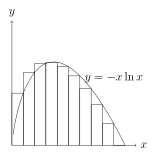
For \(x>0\) find \(\int x\ln x\,\mathrm{d}x\). By approximating the area corresponding to \(\int_{0}^{1}x\ln(1/x)\, \d x\) by \(n\) rectangles of equal width and with their top right-hand vertices on the curve \(y=x\ln(1/x)\), show that, as \(n\rightarrow\infty\), \[ \frac{1}{2}\left(1+\frac{1}{n}\right)\ln n-\frac{1}{n^{2}}\left[\ln\left(\frac{n!}{0!}\right)+\ln\left(\frac{n!}{1!}\right)+\ln\left(\frac{n!}{2!}\right)+\cdots+\ln\left(\frac{n!}{(n-1)!}\right)\right]\rightarrow\frac{1}{4}. \] {[}You may assume that \(x\ln x\rightarrow0\) as \(x\rightarrow0\).{]}
Solution: Integrating by parts we obtain: \begin{align*} \int x \ln x \, \d x &= [\frac12 x^2 \ln x] - \int \frac12x^2 \cdot \frac1x \d x \\ &= \frac12 x^2 \ln x - \frac14 x^2 + C \end{align*}
1989 Paper 3 Q10
- Prove that \[ \sum_{r=1}^{n}r(r+1)(r+2)(r+3)(r+4)=\tfrac{1}{6}n(n+1)(n+2)(n+3)(n+4)(n+5) \] and deduce that \[ \sum_{r=1}^{n}r^{5}<\tfrac{1}{6}n(n+1)(n+2)(n+3)(n+4)(n+5). \]
- Prove that, if \(n>1,\) \[ \sum_{r=0}^{n-1}r^{5}>\tfrac{1}{6}(n-5)(n-4)(n-3)(n-2)(n-1)n. \]
- Let \(\mathrm{f}\) be an increasing function. If the limits \[ \lim_{n\rightarrow\infty}\sum_{r=0}^{n-1}\frac{a}{n}\mathrm{f}\left(\frac{ra}{n}\right)\qquad\mbox{ and }\qquad\lim_{n\rightarrow\infty}\sum_{r=1}^{n}\frac{a}{n}\mathrm{f}\left(\frac{ra}{n}\right) \] both exist and are equal, the definite integral \({\displaystyle \int_{0}^{a}\mathrm{f}(x)\,\mathrm{d}x}\) is defined to be their common value. Using this definition, prove that \[ \int_{0}^{a}x^{5}\,\mathrm{d}x=\tfrac{1}{6}a^6. \]
Solution:
- Claim: \[ \sum_{r=1}^{n}r(r+1)(r+2)(r+3)(r+4)=\tfrac{1}{6}n(n+1)(n+2)(n+3)(n+4)(n+5) \] Proof: (By Induction) Base case: (n=1) \begin{align*} LHS &= 1 \cdot 2 \cdot 3 \cdot 4 \cdot 5 = 5! \\ RHS &= \frac16 1 \cdot 2 \cdot 3 \cdot 4 \cdot 5 \cdot 6 = 5! \end{align*} Therefore the base case is true. Inductive step: Suppose our statement is true for some \(n=k\), then consider \(n = k+1\) \begin{align*} \sum_{r=1}^{k+1} r(r+1)(r+2)(r+3)(r+4) &= \sum_{r=1}^{k} r(r+1)(r+2)(r+3)(r+4) + (k+1)(k+2)(k+3)(k+4)(k+5) \\ &\underbrace{=}_{\text{assumption}} \frac16 k(k+1)(k+2)(k+3)(k+4)(k+5) + (k+1)(k+2)(k+3)(k+4)(k+5) \\ &= (k+1)(k+2)(k+3)(k+4)(k+5) \l \frac{k}{6} +1\r \\ &= \frac16 (k+1)(k+2)(k+3)(k+4)(k+5)(k+6) \end{align*} Therefore our statement is true for \(n = k+1\). Therefore since our statement is true for \(n=1\) and if it is true for \(n=k\) then it is true for \(n = k+1\) by the principle of mathematical induction it is true for all \(n \geq 1\) Since \begin{align*} \sum_{r=1}^{n}r^5 &< \sum_{r=1}^{n}r(r+1)(r+2)(r+3)(r+4) \\ &= \frac16 n(n+1)(n+2)(n+3)(n+4)(n+5) \end{align*}
- \begin{align*}\sum_{r=0}^{n-1} r^5 &> \sum_{r=0}^{n-1} (r-4)(r-3)(r-2)(r-1)r \\ &= \sum_{r=0}^{n-5} r(r+1)(r+2)(r+3)(r+4) \\ &= \frac16 (n-5)(n-4)(n-3)(n-2)(n-1)n \end{align*}
- Let \(f(x) = x^5\) \begin{align*} S_{1,n} &= \sum_{r=0}^{n-1}\frac{a}{n}f\left(\frac{ra}{n}\right) \\ &= \sum_{r=0}^{n-1}\frac{a}{n}\left(\frac{ra}{n}\right)^5 \\ &=\frac{a^6}{n^6} \sum_{r=0}^{n-1}r^5\\ \end{align*} Therefore \(\frac{a^6}6 \frac{(n-5)(n-4)(n-3)(n-2)(n-1)n}{n^6} < S_{1,n} < \frac{a^6}6 \frac{(n-1)n(n+1)(n+2)(n+3)(n+4)}{n^6}\) and so \(\lim_{n\to\infty} S_{1,n} = \frac{a^6}{6}\). Similarly, \begin{align*} S_{2,n} &= \sum_{r=1}^{n}\frac{a}{n}f\left(\frac{ra}{n}\right) \\ &= \sum_{r=1}^{n}\frac{a}{n}\left(\frac{ra}{n}\right)^5 \\ &= \frac{a^6}{n^6} \sum_{r=1}^{n} r^5 \end{align*} Therefore \(\frac{a^6}6 \frac{(n-4)(n-3)(n-2)(n-1)n(n+1)}{n^6} < S_{2,n} < \frac{a^6}6 \frac{n(n+1)(n+2)(n+3)(n+4)(n+5)}{n^6}\) and so \(\lim_{n\to\infty} S_{2,n} = \frac{a^6}{6}\). Since both limits exist are are equal, we have \[ \int_{0}^{a}x^{5}\,\mathrm{d}x=\tfrac{1}{6}a^6. \]