Problems
Filters
5 problems found
2018 Paper 2 Q8
- Use the substitution \(v= \sqrt y\) to solve the differential equation \[ \frac{\d y}{\d t} = \alpha y^{\frac12} - \beta y \ \ \ \ \ \ \ \ \ \ (y\ge0, \ \ t\ge0) \,, \] where \(\alpha\) and \(\beta\) are positive constants. Find the non-constant solution \(y_1(x)\) that satisfies \(y_1(0)=0\,\).
- Solve the differential equation \[ \frac{\d y}{\d t} = \alpha y^{\frac23} - \beta y \ \ \ \ \ \ \ \ \ \ (y\ge0, \ \ t\ge0) \,, \] where \(\alpha\) and \(\beta\) are positive constants. Find the non-constant solution \(y_2(x)\) that satisfies \(y_2(0)=0\,\).
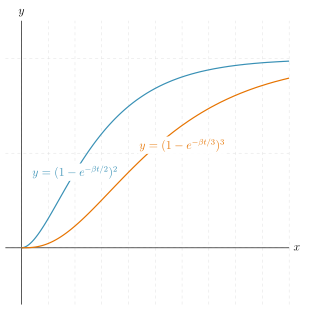
- In the case \(\alpha=\beta\), sketch \(y_1(x)\) and \(y_2(x)\) on the same axes, indicating clearly which is \(y_1(x)\) and which is \(y_2(x)\). You should explain how you determined the positions of the curves relative to each other.
Solution:
- Suppose \(v = \sqrt{y} \Rightarrow v^2 = y \Rightarrow 2v v' = y'\) so \begin{align*} && 2vv' &= \alpha v-\beta v^2 \\ \Rightarrow && 2v' &= \alpha - \beta v \\ \Rightarrow && v' + \frac{\beta}{2} v &= \frac{\alpha}{2} \\ \Rightarrow && \frac{\d}{\d t} \left (e^{\beta t/2} v \right) &= \frac{\alpha}{2} e^{\beta t/2} \\ \Rightarrow && e^{\beta t/2} v &=C+ \frac{\alpha}{\beta}e^{\beta t /2} \\ \Rightarrow && v &= Ce^{-\beta t/2} + \frac{\alpha}{\beta} \\ \Rightarrow && \sqrt{y} &= Ce^{-\beta t/2} + \frac{\alpha}{\beta} \\ y(0) = 0: && 0 &= C+\frac{\alpha}{\beta} \\ \Rightarrow && \sqrt{y} &= \frac{\alpha}{\beta} \left (1-e^{-\beta t/2} \right) \\ \Rightarrow && y &= \frac{ \alpha^2}{\beta^2} \left (1-e^{-\beta t/2} \right)^2 \end{align*}
- Try \(v = y^{1/3} \Rightarrow v^3 = y \Rightarrow 3v^2 v' = y'\) so \begin{align*} && y' &= \alpha v^2 - \beta y \\ \Rightarrow && 3v^2v' &= \alpha v^2 - \beta v^3 \\ \Rightarrow && v' +\frac{\beta}{3} v &= \frac{\alpha}{3} \\ \Rightarrow && (v e^{\beta t/3})' &= \frac{\alpha}{3}e^{\beta t/3} \\ \Rightarrow && v &= Ce^{-\beta t/3} + \frac{\alpha}{\beta} \\ v(0) = 0: && v &= \frac{\alpha}{\beta} \left (1 - e^{-\beta t/3} \right) \\ \Rightarrow && y &= \frac{\alpha^3}{\beta^3} \left (1 - e^{-\beta t/3} \right) ^3 \end{align*}
- \(y_1 = (1-e^{-\beta t/2})^2, y_2 = (1-e^{-\beta t/3})^3\)
By considering the differential equation, notice that \(0 < y_i < 1\) so \(y^{1/2} > y^{2/3}\) and therefore \(y_1' > y_2'\) and so \(y_1\) increases faster.
2008 Paper 2 Q7
- By writing \(y=u{(1+x^2)\vphantom{\dot A}}^{\frac12}\), where \(u\) is a function of \(x\), find the solution of the equation \[ \frac 1 y \frac{\d y} {\d x} = xy + \frac x {1+x^2} \] for which \(y=1\) when \(x=0\).
- Find the solution of the equation \[ \frac 1 y \frac{\d y} {\d x} = x^2y + \frac {x^2 } {1+x^3} \] for which \(y=1\) when \(x=0\).
- Give, without proof, a conjecture for the solution of the equation \[ \frac 1 y \frac{\d y} {\d x} = x^{n-1}y + \frac {x^{n-1} } {1+x^n} \] for which \(y=1\) when \(x=0\), where \(n\) is an integer greater than 1.
2004 Paper 3 Q8
Show that if \[ {\mathrm{d}y \over \mathrm{d} x}=\f(x)y + {\g(x) \over y} \] then the substitution \(u = y^2\) gives a linear differential equation for \(u(x)\,\). Hence or otherwise solve the differential equation \[ {\mathrm{d}y \over \mathrm{d} x}={y \over x} - {1 \over y}\;. \] Determine the solution curves of this equation which pass through \((1 \,, 1)\,\), \((2\, , 2)\) and \((4 \, , 4)\) and sketch graphs of all three curves on the same axes.
Solution: \begin{align*} && \frac{\d y}{\d x} &= f(x) y + \frac{g(x)}{y} \\ && y \frac{\d y}{\d x} &= f(x) y^2 + g(x) \\ u = y^2: && \frac12 \frac{\d u}{\d x} &= f(x) u + g(x) \end{align*} Which is a linear differential equation for \(u\). \begin{align*} && \frac12 u' &= \frac1x u -1 \\ \Rightarrow && u' - \frac2xu &= -1 \\ \Rightarrow && \frac{1}{x^2} u' - \frac{2}{x^3} u &= -\frac{1}{x^2} \\ \Rightarrow && (\frac{u}{x^2})' &= - \frac{1}{x^2} \\ \Rightarrow && \frac{u}{x^2} &= \frac1x + C \\ \Rightarrow && u &= Cx^2 + x \\ \Rightarrow && y^2 &= Cx^2 + x \end{align*} If \((1,1)\) is on the curve then \(1 = C + 1 \Rightarrow C = 0 \Rightarrow y^2 = x\). If \((2,2)\) is on the curve then \(4 = 4C + 2 \Rightarrow C = \frac12 \Rightarrow y^2 = x + \frac12 x^2\). If \((3,3)\) is on the curve then \(9 = 9C + 3 \Rightarrow C = \frac23 \Rightarrow y^2 = x + \frac23 x^2\)

1995 Paper 1 Q6
- In the differential equation \[ \frac{1}{y^{2}}\frac{\mathrm{d}y}{\mathrm{d}x}+\frac{1}{y}=\mathrm{e}^{2x} \] make the substitution \(u=1/y,\) and hence show that the general solution of the original equation is \[ y=\frac{1}{A\mathrm{e}^{x}-\mathrm{e}^{2x}}\,. \]
- Use a similar method to solve the equation \[ \frac{1}{y^{3}}\frac{\mathrm{d}y}{\mathrm{d}x}+\frac{1}{y^{2}}=\mathrm{e}^{2x}. \]
Solution:
- \(,\) \begin{align*} u = 1/y, \frac{\d u}{\d x} = -1/y^2 y': && -\frac{\d u}{\d x} + u &= e^{2x} \\ \Rightarrow && \frac{\d}{\d x} \left (e^{-x}u \right) = -e^{x} \\ \Rightarrow && e^{-x}u &= -e^x+C \\ \Rightarrow && u &= Ce^x-e^{2x} \\ \Rightarrow && y &= \frac{1}{Ce^x-e^{2x}} \end{align*}
- \(\,\) \begin{align*} u = 1/y^2, u' = -2/y^3 y': && -2u'+u &= e^{2x} \\ \Rightarrow && \frac{\d}{\d x} \left (e^{-1/2x}u\right) &= -\frac12e^{\frac32x} \\ \Rightarrow && e^{-\frac12x}u &= -\frac13e^{\frac32x}+C \\ \Rightarrow && u &= -\frac13e^{2x}+Ce^{\frac12x} \\ \Rightarrow && y &= \left ( \frac{1}{Ce^{\frac12x}-\frac13e^{2x}}\right)^{\frac12} \end{align*}
1993 Paper 2 Q3
- Solve the differential equation \[ \frac{\mathrm{d}y}{\mathrm{d}x}-y-3y^{2}=-2 \] by making the substitution \(y=-\dfrac{1}{3u}\dfrac{\mathrm{d}u}{\mathrm{d}x}.\)
- Solve the differential equation \[ x^{2}\frac{\mathrm{d}y}{\mathrm{d}x}+xy+x^{2}y^{2}=1 \] by making the substitution \[ y=\frac{1}{x}+\frac{1}{v}, \] where \(v\) is a function of \(x\).