Problems
Filters
13 problems found
2015 Paper 1 Q1
- Sketch the curve \(y = \e^x (2x^2 -5x+ 2)\,.\) Hence determine how many real values of \(x\) satisfy the equation \(\e^x (2x^2 -5x+ 2)= k\) in the different cases that arise according to the value of \(k\). {\em You may assume that \(x^n \e^x\to 0\) as \(x\to-\infty\) for any integer \(n\).}
- Sketch the curve \(\displaystyle y = \e^{x^2} (2x^4 -5x^2+ 2)\,\).
Solution:
- \(y = e^x(2x^2-5x+2) = e^x(2x-1)(x-2)\), we also have \(y' = e^x(2x^2-5x+2 + 4x-5) = e^x(2x^2-x-3) = e^x(2x-3)(x+1)\)
\(y(-1) = \frac{9}{e}\), \(y(\frac32) = -e^{3/2}\)
If \(k < -e^{3/2}\) there are no solutions. If \(k = -e^{3/2}\) there is a unique solution. If \(-e^{3/2} < k \leq 0\) there are two solutions. If \(0 < k < \frac{9}{e}\) there are three solutions. Otherwise there is a unique solution.


2015 Paper 1 Q2
- Show that \(\cos 15^\circ = \dfrac{\sqrt3 +1}{2\sqrt2}\) and find a similar expression for \(\sin 15^\circ\).
- Show that \(\cos \alpha\) is a root of the equation \[ 4x^3-3 x -\cos 3\alpha =0\,, \] and find the other two roots in terms of \(\cos\alpha\) and \(\sin\alpha\).
- Use parts (i) and (ii) to solve the equation \(y^3-3y -\sqrt2 =0\,\), giving your answers in surd form.
Solution:
- \begin{align*} \cos 15^{\circ} &= \cos (45^{\circ} - 30^{\circ}) \\ &= \cos 45^{\circ} \cos 30^{\circ} + \sin 45^{\circ} \sin 30^{\circ} \\ &= \frac{1}{\sqrt{2}}\frac{\sqrt{3}}{2} + \frac{1}{\sqrt{2}}\frac{1}{2} \\ &= \frac{\sqrt{3}+1}{2\sqrt{2}} \\ \\ \sin15^{\circ} &= \sin(45^{\circ} - 30^{\circ}) \\ &= \sin45^{\circ} \cos 30^{\circ} - \cos 45^{\circ} \sin 30^{\circ} \\ &= \frac{1}{\sqrt{2}}\frac{\sqrt{3}}{2} - \frac{1}{\sqrt{2}}\frac{1}{2} \\ &= \frac{\sqrt{3}-1}{2\sqrt{2}} \\ \end{align*}
- \begin{align*} \cos 3 \alpha &= \cos 2\alpha \cos \alpha - \sin2\alpha \sin \alpha \\ &= (2\cos^2 \alpha -1)\cos \alpha - 2 \cos \alpha \sin^2 \alpha \\ &= 2\cos^3 \alpha - \cos \alpha - 2\cos \alpha (1-\cos^2 \alpha) \\ &= 4\cos^2 \alpha - 3\cos \alpha \end{align*} Therefore if \(x = \cos \alpha\) then \(4x^3 - 3x-\cos3\alpha = 0\). \begin{align*} 0 &= 4x^3 - 3x-\cos3\alpha \\ &= 4x^3 - 3x - 4\cos^3\alpha+ 3\cos \alpha \\ &= 4(x-\cos\alpha)(x^2+x\cos\alpha+\cos^2\alpha)-3(x-\cos\alpha)\\ &= (x - \cos \alpha)(4x^2+4x\cos\alpha+4\cos^2\alpha-3) \end{align*} Therefore the other roots will be solutions to the second quadratic which are: \begin{align*} \frac{-4\cos \alpha \pm \sqrt{16\cos^2\alpha - 16(4\cos^2\alpha-3)}}{8} &= \frac{-\cos \alpha \pm \sqrt{3(1-\cos^2\alpha)}}{2} \\ &= \frac{-\cos \alpha \pm \sqrt{3} \sin \alpha}{2} \end{align*}
- Suppose \(y^3-3y-\sqrt{2} = 0\) then \(4\l \frac{y}{2} \r ^3-3(\frac{y}{2}) -\frac{\sqrt{2}}{2} = 0\) or alternatively, if \(x = \frac{y}{2}\), \(4x^3-3x-\cos 45^{\circ} = 0\). Therefore \(x = \cos 15^{\circ}, \frac{-\cos 15^{\circ} \pm \sqrt{3} \sin 15^{\circ}}{2}\) Therefore \(y =2\cos 15^{\circ}, -\cos 15^{\circ} \pm \sqrt{3} \sin 15^{\circ}\) or \(y = \frac{\sqrt{6}+\sqrt{2}}{2}\), \begin{align*} y &= -\frac{\sqrt{3}+1}{2\sqrt{2}} \pm \frac{3-\sqrt{3}}{2\sqrt{2}} \\ &= \frac{-4}{2\sqrt{2}}, \frac{-2\sqrt{3}}{2\sqrt{2}} \\ &= -\sqrt{2}, -\frac{\sqrt{6}-\sqrt{2}}{2} \end{align*}
2015 Paper 1 Q3
A prison consists of a square courtyard of side \(b\) bounded by a perimeter wall and a square building of side \(a\) placed centrally within the courtyard. The sides of the building are parallel to the perimeter walls. Guards can stand either at the middle of a perimeter wall or in a corner of the courtyard. If the guards wish to see as great a length of the perimeter wall as possible, determine which of these positions is preferable. You should consider separately the cases \(b<3a\) and \(b>3a\,\).
Solution:
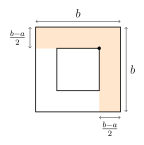
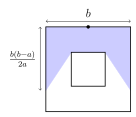
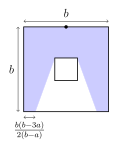
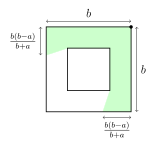
2015 Paper 1 Q4
The midpoint of a rod of length \(2b\) slides on the curve \(y =\frac14 x^2\), \(x\ge0\), in such a way that the rod is always tangent, at its midpoint, to the curve. Show that the curve traced out by one end of the rod can be written in the form \begin{align*} x& = 2 \tan\theta - b \cos\theta \\ y& = \tan^2\theta - b \sin\theta \end{align*} for some suitably chosen angle \(\theta\) which satisfies \(0\le \theta < \frac12\pi\,\). When one end of the rod is at a point \(A\) on the \(y\)-axis, the midpoint is at point \(P\) and \(\theta = \alpha\). Let \(R\) be the region bounded by the following:
- the curve \(y=\frac14x^2\) between the origin and \(P\);
- the \(y\)-axis between \(A\) and the origin;
- the half-rod \(AP\).
Solution: At the point \((2t, t^2)\) the gradient is \(t\). Suppose \(\tan \theta = t\), then the point \(b\) away in each direction is \(\binom{2t}{t^2} \pm b \binom{\cos \theta}{\sin \theta}\), ie one end can be written in the form \((x,y) = (2\tan \theta - b \cos \theta, \tan^2 \theta - b \sin \theta)\). Notice we must have \(2\tan \alpha- b \cos \alpha= 0 \Rightarrow b = 2 \frac{\sin \alpha}{\cos ^2 \alpha}\), therefore the coordinates are \((2 \tan \alpha - 2 \tan \alpha, \tan^2 \alpha - 2\tan^2 \alpha) = (0, -\tan^2 \alpha)\) and \((4 \tan \alpha, 3\tan^2 \alpha)\)
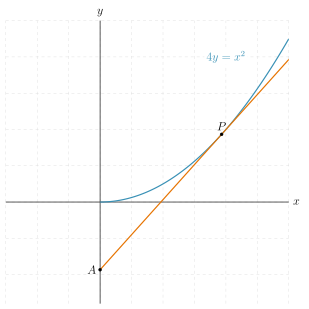
2015 Paper 1 Q5
- The function \(\f\) is defined, for \(x>0\), by \[ \f(x) =\int_{1}^3 (t-1)^{x-1} \, \d t \,. \] By evaluating the integral, sketch the curve \(y=\f(x)\).
- The function \(\g\) is defined, for \(-\infty < x < \infty\), by \[ \g(x)= \int_{-1}^1 \frac 1 {\sqrt{1-2xt +x^2} \ }\, \d t \,.\] By evaluating the integral, sketch the curve \(y=\g(x)\).
Solution:
- \(\,\)
\begin{align*}
&& f(x) &= \int_1^3 (t-1)^{x-1} \d t \\
&&&= \left [ \frac1x(t-1)^{x} \right]_1^3 \\
&&&= \frac{2^x}{x}
\end{align*}

- \(\,\)
\begin{align*}
&& g(x) &= \int_{-1}^1 \frac{1}{\sqrt{1-2xt+x^2}} \d t \\
&&&= \left [ -\frac{1}{x}(1 +x^2 - 2xt)^{\frac12} \right]_{-1}^1 \\
&&&= \frac1x \left ( \sqrt{1+x^2+2x}-\sqrt{1+x^2-2x}\right) \\
&&&= \frac1x \left ( |1+x|-|1-x| \right)
\end{align*}

2015 Paper 1 Q6
The vertices of a plane quadrilateral are labelled \(A\), \(B\), \(A'\) and \(B'\), in clockwise order. A point \(O\) lies in the same plane and within the quadrilateral. The angles \(AOB\) and \(A'OB'\) are right angles, and \(OA=OB\) and \(OA'=OB'\). Use position vectors relative to \(O\) to show that the midpoints of \(AB\), \(BA'\), \(A'B'\) and \(B'A\) are the vertices of a square. Given that the lengths of \(OA\) and \(OA'\) are fixed (and the conditions of the first paragraph still hold), find the value of angle \(BOA'\) for which the area of the square is greatest.
Solution: Let \(O\) be the origin, and let \(\mathbf{a}, \mathbf{b}, \mathbf{a}', \mathbf{b}'\) be the four points. The conditions give us \begin{align*} && \mathbf{a} \cdot \mathbf{b} &= 0 \\ && |\mathbf{a}| &= |\mathbf{b}| \\ && \mathbf{a}' \cdot \mathbf{b}' &= 0 \\ && |\mathbf{a}'| &= |\mathbf{b}'| \\ \end{align*} So \begin{align*} \text{midpoint }AB \text{ to midpoint } BA' &= (\tfrac12(\mathbf{a}+\mathbf{b}) - \tfrac12(\mathbf{b}+\mathbf{a}'))\cdot (\tfrac12(\mathbf{a}+\mathbf{b}) - \tfrac12(\mathbf{b}+\mathbf{a}')) \\ &= \frac12(\mathbf{a}-\mathbf{a}')\cdot \frac12(\mathbf{a} - \mathbf{a}') \\ \text{midpoint }BA' \text{ to midpoint } A'B' &= (\tfrac12(\mathbf{b}+\mathbf{a}') - \tfrac12(\mathbf{a}'+\mathbf{b}')) \cdot (\tfrac12(\mathbf{b}+\mathbf{a}') - \tfrac12(\mathbf{a}'+\mathbf{b}'))\\ &= \frac12(\mathbf{b}-\mathbf{b}')\cdot \frac12(\mathbf{b} - \mathbf{b}') \\ &= \frac14 (|\mathbf{b}|^2 + |\mathbf{b}'|^2 - 2\mathbf{b}\cdot\mathbf{b}')\\ &= \frac14(|\mathbf{a}|^2 + |\mathbf{a}'|^2 - 2\mathbf{b}\cdot\mathbf{b}') \\ \text{midpoint }A'B' \text{ to midpoint } B'A &= (\tfrac12(\mathbf{a}'+\mathbf{b}') - \tfrac12(\mathbf{b}'+\mathbf{a})) \cdot (\tfrac12(\mathbf{a}'+\mathbf{b}') - \tfrac12(\mathbf{b}'+\mathbf{a}))\\ &= \frac12(\mathbf{a}'-\mathbf{a})\cdot \frac12(\mathbf{a}' - \mathbf{a}) \\ \text{midpoint }B'A \text{ to midpoint } AB &= (\tfrac12(\mathbf{b}'+\mathbf{a}) - \tfrac12(\mathbf{a}+\mathbf{b})) \cdot (\tfrac12(\mathbf{b}'+\mathbf{a}) - \tfrac12(\mathbf{a}+\mathbf{b}))\\ &= \frac12(\mathbf{b}'-\mathbf{b})\cdot \frac12(\mathbf{b}' - \mathbf{b}) \\ \end{align*} So it's sufficient to prove \(\mathbf{a}\cdot \mathbf{a}' = \mathbf{b}\cdot \mathbf{b}'\) but this is clear from looking at a diagram for 1 second. Given the length of the square is what it is, we want to minimise \(\mathbf{b}\cdot \mathbf{b}'\) which is when they are vertically opposite each other, ie \(\angle BOA' = 90^\circ\)
2015 Paper 1 Q7
Let \[ \f(x) = 3ax^2 - 6x^3\, \] and, for each real number \(a\), let \({\rm M}(a)\) be the greatest value of \(\f(x)\) in the interval \(-\frac13 \le x \le 1\). Determine \({\rm M} (a)\) for \(a\ge0\). [The formula for \({\rm M} (a)\) is different in different ranges of \(a\); you will need to identify three ranges.]
Solution: \(f'(x) = 6ax-18x^2\), therefore \(f\) has turning points at \(0\) and \(\frac{a}3\) (ie decreasing for \(x \leq 0\) and \(x \geq \frac{a}{3}\) and increasing otherwise). Therefore possible maxima are \(f(-\tfrac13), f(\frac{a}{3}), f(1)\) where we consider \(\frac{a}{3}\) if \(a \leq 3\) and \(1\) otherwise. \(f(-\frac13) = \frac{a}{3} + \frac{2}{9} = \frac{3a+2}{9}\) \(f(\frac{a}{3}) = \frac{a^3}{3} - \frac{2a^3}{9} = \frac{a^3}{9}\) \(f(1) = 3(a-2)\) Comparing \(\frac{a^3}{9}\) to \(\frac{3a+2}{9}\) we have a double root at \(a = -1\) and a single root at \(a = 2\), therefore \(\frac{a^3}9\) is larger if \(a \geq 2\) Comparing \(3(a-2)\) to \(\frac{3a+2}9\) we have a cross-over at \(a = \frac{7}3\). Therefore we have: \begin{align*} M(a) &= \begin{cases} \frac{3a+2}{9} & 0 \leq a \leq 2 \\ \frac{a^3}{9} & 2 \leq a \leq 3 \\ 3(a-2) & 3 \leq a \end{cases} \end{align*}
2015 Paper 1 Q8
Show that:
- \(1+2+3+ \cdots + n = \frac12 n(n+1)\);
- if \(N\) is a positive integer, \(m\) is a non-negative integer and \(k\) is a positive odd integer, then \((N-m)^k +m^k\) is divisible by \(N\).
Solution:
- \(\,\) \begin{align*} && S & = 1 +\quad 2\quad \;\;+ \quad 3 \quad+ \cdots + \quad n \\ && S &= n + (n-1) + (n-2) + \cdots + 1 \\ && 2S &= (n+1) + (n+1) + \cdots + (n+1) \\ \Rightarrow && S &= \frac12n(n+1) \end{align*}
- \(\,\) \begin{align*} && (N-m)^{k} + m^k&= \sum_{i=0}^k \binom{k}{i} N^{k-i} (-m)^{i} + m^k \\ &&&= N\sum_{i=0}^{k-1} \binom{k}{i}N^{k-i-1}(-m)^i -m^k+m^k \\ &&&= N\sum_{i=0}^{k-1} \binom{k}{i}N^{k-i-1}(-m)^i \end{align*} which is clearly divisible by \(N\).
2015 Paper 1 Q9
A short-barrelled machine gun stands on horizontal ground. The gun fires bullets, from ground level, at speed \(u\) continuously from \(t=0\) to \(t= \dfrac{\pi}{ 6\lambda}\), where \(\lambda\) is a positive constant, but does not fire outside this time period. During this time period, the angle of elevation \(\alpha\) of the barrel decreases from \(\frac13\pi\) to \(\frac16\pi\) and is given at time \(t\) by \[ \alpha =\tfrac13 \pi - \lambda t\,. \] Let \(k = \dfrac{g}{2\lambda u}\). Show that, in the case \(\frac12 \le k \le \frac12 \sqrt3\), the last bullet to hit the ground does so\\[2pt] at a distance \[ \frac{ 2 k u^2 \sqrt{1-k^2}}{g} \] from the gun. What is the corresponding result if \(k<\frac12\)?
Solution: The bullet fired at time \(t\) will hit the ground at time \(t+\frac{2u \sin (\frac13\pi - \lambda t)}{g}\). To find the last time a bullet hits the ground, we can differentiate, noting that \begin{align*} && T(t) &= t + \frac{2u \sin \alpha}{g} \\ \Rightarrow && T'(t) &= 1 - \frac{2u\lambda}{g} \cos \alpha \\ && T''(t) &= \frac{2u \lambda^2}{g} \sin \alpha > 0 \end{align*} If \(k = \frac{g}{2\lambda u} \in [\frac12, \frac12\sqrt{3}]\) then notice that this turning point is always achieved, and will be a maximum. It will be when \(\cos \alpha = k, \sin \alpha = \sqrt{1-k^2}\). The distance will be \(u \cos \alpha \cdot \frac{2 u \sin \alpha}{g} = \frac{2ku^2\sqrt{1-k^2}}{g}\). If \(k < \frac12\) then the last bullet to hit the ground will be the last bullet fired, ie \(\frac{2u^2 \sin \frac16\pi \cos \frac16\pi}{g} = \frac{u^2 \sin \frac13 \pi}{g} = \frac{\sqrt{3}u^2}{2g}\)
2015 Paper 1 Q10
A bus has the shape of a cuboid of length \(a\) and height \(h\). It is travelling northwards on a journey of fixed distance at constant speed \(u\) (chosen by the driver). The maximum speed of the bus is \(w\). Rain is falling from the southerly direction at speed \(v\) in straight lines inclined to the horizontal at angle \(\theta\), where \(0<\theta<\frac12\pi\). By considering first the case \(u=0\), show that for \(u>0\) the total amount of rain that hits the roof and the back or front of the bus in unit time is proportional to \[ h\big \vert v\cos\theta - u \big\vert + av\sin\theta \,. \] Show that, in order to encounter as little rain as possible on the journey, the driver should choose \( u=w\) if either \(w< v\cos\theta\) or \( a\sin\theta > h\cos\theta\). How should the speed be chosen if \(w>v\cos\theta\) and \( a\sin\theta < h\cos\theta\)? Comment on the case \( a\sin\theta = h\cos\theta\). How should the driver choose \(u\) on the return journey?
2015 Paper 1 Q11
Two long circular cylinders of equal radius lie in equilibrium on an inclined plane, in \mbox{contact} with one another and with their axes horizontal. The weights of the upper and lower \mbox{cylinders} are \(W_1\) and \(W_2\), respectively, where \(W_1>W_2\)\,. The coefficients of friction \mbox{between} the \mbox{inclined} plane and the upper and lower cylinders are \(\mu_1\) and \(\mu_2\), respectively, and the \mbox{coefficient} of friction \mbox{between} the two cylinders is \(\mu\). The angle of inclination of the plane is~\(\alpha\) (which is positive).
- Let \(F\) be the magnitude of the frictional force between the two cylinders, and let \(F_1\) and \(F_2\) be the magnitudes of the frictional forces between the upper cylinder and the plane, and the lower cylinder and the plane, respectively. Show that \(F=F_1=F_2\,\).
- Show that \[ \mu \ge \dfrac{W_1+W_2}{W_1-W_2} \,,\] and that \[ \tan\alpha \le \frac{ 2 \mu_1 W_1}{(1+\mu_1)(W_1+ W_2)}\,. \]
2015 Paper 1 Q12
The number \(X\) of casualties arriving at a hospital each day follows a Poisson distribution with mean 8; that is, \[ \P(X=n) = \frac{ \e^{-8}8^n}{n!}\,, \ \ \ \ n=0, \ 1, \ 2, \ \ldots \ . \] Casualties require surgery with probability \(\frac14\). The number of casualties arriving on any given day is independent of the number arriving on any other day and the casualties require surgery independently of one another.
- What is the probability that, on a day when exactly \(n\) casualties arrive, exactly \(r\) of them require surgery?
- Prove (algebraically) that the number requiring surgery each day also follows a Poisson distribution, and state its mean.
- Given that in a particular randomly chosen week a total of 12 casualties require surgery on Monday and Tuesday, what is the probability that 8 casualties require surgery on Monday? You should give your answer as a fraction in its lowest terms.
Solution:
- \(\mathbb{P}(r \text{ need surgery}|n \text{ casualties}) = \binom{n}{r} \left ( \frac14\right)^r \left ( \frac34\right)^{n-r}\)
- \(\,\) \begin{align*} && \mathbb{P}(r \text{ need surgery}) &= \sum_{n=r}^{\infty} \mathbb{P}(r \text{ need surgery} |n \text{ casualties}) \mathbb{P}(n \text{ casualties}) \\ &&&= \sum_{n=r}^{\infty} \binom{n}{r}\left ( \frac14\right)^r \left ( \frac34\right)^{n-r} \frac{e^{-8} 8^n}{n!} \\ &&&= \sum_{n=r}^{\infty} \frac{n!}{(n-r)!r!}\left ( \frac14\right)^r \left ( \frac34\right)^{n-r} \frac{e^{-8} 8^n}{n!} \\ &&&= \frac{e^{-8}8^r}{r!}\left ( \frac14\right)^r \sum_{n=r}^{\infty} \frac{8^{n-r}}{(n-r)} \left ( \frac34\right)^{n-r} \\ &&&= \frac{e^{-8}8^r}{r!}\left ( \frac14\right)^r \sum_{n=r}^{\infty} \frac{6^{n-r}}{(n-r)} \\ &&&= \frac{e^{-8}2^r}{r!} e^6 \\ &&&= \frac{e^{-2}2^r}{r!} \end{align*} Therefore the number requiring surgery is \(Po(2)\) with mean \(2\).
- \(\,\) \begin{align*} && \mathbb{P}(X_1 = 8| X_1 + X_2 =12) &= \frac{\mathbb{P}(X_1 = 8,X_2 =4)} {\mathbb{P}(X_1+X_2 = 12)}\\ &&&= \frac{\frac{e^{-2}2^8}{8!} \cdot \frac{e^{-2}2^4}{4!}}{\frac{e^{-4}4^{12}}{12!}} \\ &&&= \frac{12!}{8!4!} \frac{1}{2^{12}} \\ &&&= \binom{12}4 \left ( \frac12 \right)^4\left ( \frac12 \right)^8 \\ &&&= \frac{495}{4096} \end{align*}
2015 Paper 1 Q13
A fair die with faces numbered \(1, \ldots, 6\) is thrown repeatedly. The events \(A\), \(B\), \(C\), \(D\) and \(E\) are defined as follows. \begin{align*} A: && \text{the first 6 arises on the \(n\)th throw.}\\ B: && \text{at least one 5 arises before the first 6.} \\ C: && \text{at least one 4 arises before the first 6.}\\ D: && \text{exactly one 5 arises before the first 6.}\\ E: && \text{exactly one 4 arises before the first 6.} \end{align*} Evaluate the following probabilities:
- \(\P(A)\)
- \(\P(B)\)
- \(\P(B\cap C)\)
- \(\P(D)\)
- \(\P(D\cup E)\)
Solution:
- \(\,\) \begin{align*} \mathbb{P}(A) &= \mathbb{P}(\text{the first 6 arises on the \(n\)th throw.}) \\ &= \mathbb{P}(\text{\(n-1\) not 6s, followed by a 6.})\\ &= \left ( \frac56\right)^{n-1} \cdot \frac16 = \frac{5^{n-1}}{6^n} \end{align*}
- There is nothing special about \(5\) or \(6\), so which comes first is \(50:50\), therefore this probability is \(\frac12\)
- There is nothing special about \(4\), \(5\) or \(6\) so this is the probability that \(6\) appears last out of these three numbers, hence \(\frac13\)
- \(\,\) \begin{align*} \mathbb{P}(D) &= \mathbb{P}(\text{exactly one 5 arises before the first 6.}) \\ &=\sum_{n=2}^{\infty} \mathbb{P}(\text{exactly one 5 arises before the first 6 which appears on the \(n\)th roll.}) \\ &= \sum_{n=2}^{\infty} \binom{n-1}{1} \left ( \frac46 \right)^{n-2} \frac16 \cdot \frac16 \\ &= \frac1{36} \sum_{n=2}^{\infty} (n-1) \left ( \frac23 \right)^{n-2} \\ &= \frac1{36} \sum_{n=1}^{\infty} n \left ( \frac23 \right)^{n-1} \\ &= \frac1{36} \frac{1}{\left ( 1- \frac23 \right)^2} = \frac14 \end{align*}
- \(\,\) \begin{align*} \mathbb{P}(D \cup E) &= \mathbb{P}(D) + \mathbb{P}(E) - \mathbb{P}(D \cap E) \\ &= \frac12 - \mathbb{P}(D \cap E) \\ &=\frac12 - \sum_{n=3}^{\infty} \mathbb{P}(\text{exactly one 5 and one 4 arises before the first 6 which appears on the \(n\)th roll.}) \\ &=\frac12 - \sum_{n=3}^{\infty} 2\binom{n-1}{2} \left ( \frac36 \right)^{n-3}\cdot \frac16 \cdot \frac16 \cdot \frac16 \\ &=\frac12 - \frac2{6^3}\sum_{n=3}^{\infty} \frac{(n-1)(n-2)}{2} \left ( \frac12 \right)^{n-3} \\ &=\frac12 - \frac2{6^3}\frac{1}{(1-\tfrac12)^3}\\ &= \frac12 - \frac{2}{27} \\ &= \frac{23}{54} \end{align*}