Problems
Filters
39 problems found
2017 Paper 1 Q1
- Use the substitution \(u= x\sin x +\cos x\) to find \[ \int \frac{x }{x\tan x +1 } \, \d x \,. \] Find by means of a similar substitution, or otherwise, \[ \int \frac{x }{x\cot x -1 } \, \d x \,. \]
- Use a substitution to find \[ \int \frac{x\sec^2 x \, \tan x}{x\sec^2 x -\tan x} \,\d x \, \] and \[ \int \frac{x\sin x \cos x}{(x-\sin x \cos x)^2} \, \d x \,. \]
Solution:
- \(\,\) \begin{align*} && I &= \int \frac{x}{x \tan x + 1} \d x \\ &&&= \int \frac{x \cos x}{x \sin x + \cos x} \d x \\ u = x \sin x + \cos x , \d u = x \cos x \d x: &&&= \int \frac{\d u}{u} \\ &&&= \ln u + C \\ &&&= \ln (x \sin x + \cos x) + C \\ \\ && J &= \int \frac{x}{x \cot x - 1} \d x \\ &&&= \int \frac{x \sin x }{x \cos x - \sin x} \d x \\ u = x \cos x - \sin x, \d u = x \sin x \d x: &&&= \int \frac{1}{u} \d u \\ &&&= \ln u + K \\ &&&= \ln (x \cos x -\sin x) + K \end{align*}
- \(\,\) \begin{align*} && I &= \int \frac{x \sec^2 x \tan x}{x \sec^2 x - \tan x} \d x \\ u = x\sec^2 x-\tan x, \d u = 2x \sec^2 x \tan x&&&= \frac12 \int \frac{1}{u} \d u \\ &&&= \frac12 \ln (x \sec^2 x - \tan x) + C \\ \\ && J &= \int \frac{x \sin x \cos x}{(x - \sin x \cos x)^2} \d x \\ u = x \sec^2 x -\tan x, \d u=2x \frac{\sin x}{\cos^3 x} &&&= \int \frac{x \sin x \cos x}{\cos^4x(x\sec^2 x -\tan x)^2} \d x \\ &&&= \frac12 \int \frac{1}{u^2} \d u \\ &&&= -\frac12u^{-1} + K \\ &&&= \frac{1}{2(\tan x - x \sec^2 x)} + K \end{align*}
2017 Paper 1 Q2
- The inequality \(\dfrac 1 t \le 1\) holds for \(t\ge1\). By integrating both sides of this inequality over the interval \(1\le t \le x\), show that \[ \ln x \le x-1 \tag{\(*\)} \] for \(x \ge 1\). Show similarly that \((*)\) also holds for \(0 < x \le 1\).
- Starting from the inequality \(\dfrac{1}{t^2} \le \dfrac1 t \) for \(t \ge 1\), show that \[ \ln x \ge 1-\frac{1}{x} \tag{\(**\)} \] for \(x > 0\).
- Show, by integrating (\(*\)) and (\(**\)), that \[ \frac{2}{ y+1} \le \frac{\ln y}{ y-1} \le \frac{ y+1}{2 y} \] for \( y > 0\) and \( y\ne1\).
Solution:
- \(\,\) \begin{align*} (x \geq 1): && \int_1^x \frac{1}{t} \d t &\leq \int_1^x 1 \d t \\ \Rightarrow && \ln x - \ln 1 &\leq x - 1 \\ \Rightarrow && \ln x & \leq x - 1 \\ \\ (0 < x \leq 1):&& \int_x^1 1\d t &\leq \int_x^1 \frac{1}{t} \d t \\ \Rightarrow&& 1- x &\leq \ln 1 - \ln x \\ \Rightarrow&& \ln x &\leq x - 1 \end{align*}
- \(\,\) \begin{align*} (x \geq 1): && \int_1^x \frac{1}{t^2} \d t &\leq \int_1^x \frac{1}{t} \d t \\ \Rightarrow && -\frac1x+1 &\leq \ln x - \ln 1 \\ \Rightarrow && 1 - \frac1x &\leq \ln x \\ \\ (0 < x \leq 1): && \int_x^1 \frac{1}{t} \d t &\leq \int_x^1 \frac{1}{t^2} \d t \\ \Rightarrow && \ln 1 - \ln x & \leq -1 + \frac{1}{x} \\ \Rightarrow && 1 - \frac1x &\leq \ln x \\ \end{align*}
- \(\,\) \begin{align*} (1 < y): && \int_1^y \left (1 - \frac1{x} \right)\d x &\leq \int_1^y \ln x \d x \\ \Rightarrow && \left [x - \ln x \right]_1^y & \leq \left [ x \ln x - x\right]_1^y \\ \Rightarrow && y - \ln y - 1 &\leq y \ln y - y +1 \\ \Rightarrow && 2y-2 & \leq (y+1) \ln y \\ \Rightarrow && \frac{2}{y+1} & \leq \frac{\ln y}{y-1} \\ (0 < y < 1): && \int_y^1 \left (1 - \frac1{x} \right)\d x &\leq \int_y^1 \ln x \d x \\ \Rightarrow && \left [x - \ln x \right]_y^1 & \leq \left [ x \ln x - x\right]_y^1 \\ \Rightarrow && 1 - (y - \ln y) &\leq -1-(y \ln y-y) \\ \Rightarrow && 2-2y &\leq -(y+1)\ln y \\ \Rightarrow && \frac{2}{y+1} &\leq \frac{-\ln y}{1-y} \tag{\(1-y > 0\)} \\ \Rightarrow && \frac{2}{y+1} &\leq \frac{\ln y}{y-1} \\ \\ (1 < y): && \int_1^y \ln x \d x &\leq \int_1^y (x-1) \d x \\ \Rightarrow && \left [x \ln x -x \right]_1^y &\leq \left[ \frac12 x^2 - x \right]_1^y\\ \Rightarrow && y \ln y - y +1 &\leq \frac12y^2 - y+\frac12 \\ \Rightarrow && y \ln y &\leq \frac12 \left (y^2-1 \right) \\ \Rightarrow && \frac{\ln y}{y-1} &\leq \frac{y+1}{2y} \\ \\ (0 < y < 1) && \int_y^1 \ln x \d x &\leq \int_y^1 (x-1) \d x \\ \Rightarrow && \left [x \ln x -x \right]_y^1&\leq \left[ \frac12 x^2 - x \right]_y^1\\ \Rightarrow && -1-(y \ln y - y +1) &\leq-\frac12 - \left ( \frac12y^2 - y\right)\\ \Rightarrow && \frac12 \left (y^2-1 \right) &\leq y \ln y \\ \Rightarrow && \frac{\ln y}{y-1} & \leq \frac{y+1}{2y} \tag{\(y-1 < 0\)} \end{align*}
2017 Paper 1 Q3
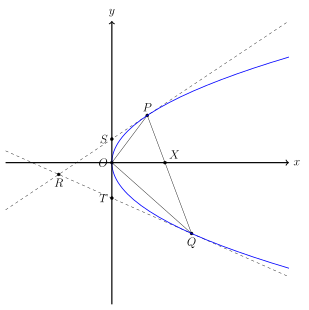
The points \(P(ap^2, 2ap)\) and \(Q(aq^2, 2aq)\), where \(p>0\) and \(q<0\), lie on the curve \(C\) with equation $$y^2= 4ax\,,$$ where \(a>0\,\). Show that the equation of the tangent to \(C\) at \(P\) is $$y= \frac 1 p \, x +ap\,.$$ The tangents to the curve at \(P\) and at \(Q \) meet at \(R\). These tangents meet the \(y\)-axis at \(S\) and \(T\) respectively, and \(O\) is the origin. Prove that the area of triangle \(OPQ\) is twice the area of triangle \(RST\).
Solution: \begin{align*} && 2yy' &= 4a \\ \Rightarrow && y' &= \frac{2a}{y} = \frac{2a}{2ap} = \frac1p \\ \Rightarrow && \frac{y-2ap}{x-ap^2} &= \frac1p \\ \Rightarrow && y &= \frac1p x +ap \end{align*} The other tangent will be \(y = \frac1qx+aq\) \begin{align*} &&& \begin{cases} py-x &= ap^2 \\ qy - x &= aq^2 \end{cases} \\ \Rightarrow && y(p-q) &= a(p^2-q^2) \\ \Rightarrow && y &= a(p+q) \\ && x &= apq \end{align*} Therefore \(R(apq, a(p+q)), S(0, ap), T(0, aq)\).
2017 Paper 1 Q4
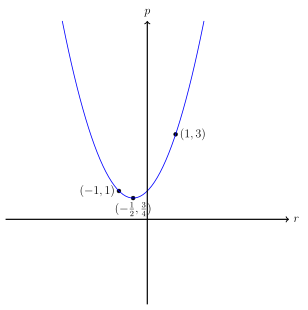
- Let \(r\) be a real number with \(\vert r \vert<1\) and let \[ S = \sum_{n=0}^\infty r^n\,. \] You may assume without proof that \(S = \displaystyle \frac{1}{1-r}\, \). Let \(p= 1 + r +r^2\). Sketch the graph of the function \(1+r+r^2\) and deduce that \(\frac{3}{4} \le p < 3\,\). Show that, if \(1 < p < 3\), then the value of \( p\) determines \(r\), and hence \(S\), uniquely. Show also that, if \(\frac{3}{4} < p < 1\), then there are two possible values of \(S\) and these values satisfy the equation \((3-p)S^2-3S+1=0\).
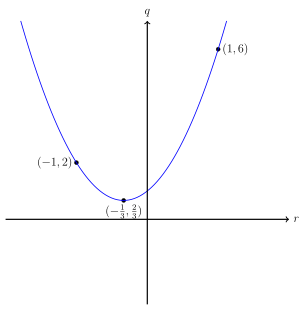
- Let \(r\) be a real number with \(\vert r \vert<1\) and let \[ T =\sum_{n=1}^\infty nr^{n-1}\,. \] You may assume without proof that \(T = \displaystyle \dfrac{1}{(1-r)^2}\,.\) Let \( q= 1+2r+3r^2\). Find the set of values of \( q\) that determine \(T\) uniquely. Find the set of values of \(q\) for which \(T\) has two possible values. Find also a quadratic equation, with coefficients depending on \( q\), that is satisfied by these two values.
Solution:
- \(\,\)
Notice that \(1+r+r^2\) ranges from \(\frac34\) to \(3\) over \((-1,1)\) therefore \(\frac34 \leq p < 3\) attaining its minimum but not its maximum. If \(p > 1\) we know we must be on the right branch and hence we can determine \(r\) and \(S\) uniquely. If \(\frac34 < p < 1\) then we must have two possible values for \(r\), satisfying \(r_i^2 + r+1 = p\) and so our two possible values for \(S_i = \frac{1}{1-r_i}\) or \(r_i = 1-\frac{1}{S_i}\) and so \begin{align*} && p &= \left ( 1 - \frac{1}{S} \right)^2 + 1 - \frac1S + 1 \\ \Rightarrow && pS^2 &= (S-1)^2 + S^2-S + S^2 \\ \Rightarrow && 0 &= (3-p)S^2 -3S + 1 \end{align*}
- \(\,\)
So \(\frac23 \leq q < 6\) and \(r\) and hence \(T\) is uniquely determined if \(2 \leq q < 6\). if \(\frac23
2017 Paper 1 Q5
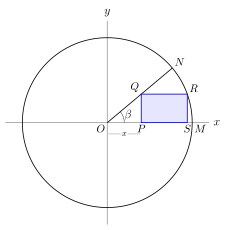
A circle of radius \(a\) is centred at the origin \(O\). A rectangle \(PQRS\) lies in the minor sector \(OMN\) of this circle where \(M\) is \((a,0)\) and \(N\) is \((a \cos \beta, a \sin \beta)\), and \(\beta\) is a constant with \(0 < \beta < \frac{\pi}{2}\,\). Vertex \(P\) lies on the positive \(x\)-axis at \((x,0)\); vertex \(Q\) lies on \(ON\); vertex \(R\) lies on the arc of the circle between \(M\) and \(N\); and vertex \(S\) lies on the positive \(x\)-axis at \((s,0)\). Show that the area \(A\) of the rectangle can be written in the form \[ A= x(s-x)\tan\beta \,. \] Obtain an expression for \(s\) in terms of \(a\), \(x\) and \(\beta\), and use it to show that \[ \frac{\d A}{\d x} = (s-2x) \tan \beta - \frac {x^2} s \tan^3\beta \,. \] Deduce that the greatest possible area of rectangle \(PQRS\) occurs when \(s= x(1+\sec\beta)\) and show that this greatest area is \(\tfrac12 a^2 \tan \frac12 \beta\,\). Show also that this greatest area occurs when \(\angle ROS = \frac12\beta\,\).
Solution:
2017 Paper 1 Q6
In this question, you may assume that, if a continuous function takes both positive and negative values in an interval, then it takes the value \(0\) at some point in that interval.
- The function \(\f\) is continuous and \(\f(x)\) is non-zero for some value of \(x\) in the interval \(0\le x \le 1\). Prove by contradiction, or otherwise, that if \[ \int_0^1 \f(x) \d x = 0\,, \] then \(\f(x)\) takes both positive and negative values in the interval \(0\le x\le 1\).
- The function \(\g\) is continuous and \[ \int_0^1 \g(x) \, \d x = 1\,, \quad \int_0^1 x\g(x) \, \d x = \alpha\, , \quad \int_0^1 x^2\g(x) \, \d x = \alpha^2\,. \tag{\(*\)} \] Show, by considering \[ \int_0^1 (x - \alpha)^2 \g(x) \, \d x \,, \] that \(\g(x)=0\) for some value of \(x\) in the interval \(0\le x\le 1\). Find a function of the form \(\g(x) = a+bx\) that satisfies the conditions \((*)\) and verify that \(\g(x)=0\) for some value of \(x\) in the interval \(0\le x \le 1\).
- The function \(\h\) has a continuous derivative \(\h'\) and \[ \h(0) = 0\,, \quad \h(1) = 1\,, \quad \int_0^1 \h(x) \, \d x = \beta\,, \quad \int_0^1 x \h(x) \, \d x = \tfrac{1}{2}\beta (2 - \beta) \,. \] Use the result in part (ii) to show that \(\h^\prime(x)=0\) for some value of \(x\) in the interval \(0\le x\le 1\).
Solution:
- Claim: If \(f(x)\) non-zero for some \(x \in [0,1]\) and \(\int_0^1 f(x) \d x =0\) then \(f\) takes both positive and negative values in the interval \([0,1]\). Proof: Suppose not, then WLOG suppose \(f(x) > 0\) for some \(x \in [0,1]\). Then notice (since \(f\) is continuous) that there is some interval where \(f(x) > 0\) around the \(x\) we have already shown exists. But then \(\int_{\text{interval}} f(x) \d x > 0\) and since \(f(x) \geq 0\) everywhere \(\int_0^1 f(x) \d x > 0\), which is a contradiction.
- \(\,\) \begin{align*} && \int_0^1 (x - \alpha)^2 g(x) \d x &= \int_0^1 x^2g(x) \d x - 2 \alpha \int_0^1 x g(x) \d x + \alpha^2 \int_0^1 g(x) \d x \\ &&&= \alpha^2 - 2\alpha \cdot \alpha + \alpha^2 \cdot 1 \\ &&&= 0 \end{align*} Therefore \(g(x)(x-\alpha)^2\) is a continuous function which is either exactly \(0\) (in which case we've already found our \(0\)) or it is a continuous function which is both positive somewhere and has \(0\) integral, and therefore by part (i) must take both positive and negative values (and therefore takes \(0\) in between those points by continuity). \begin{align*} &&1 &= \int_0^1 a+bx \d x \\ &&&= a + \frac12 b \\ && \alpha &= \int_0^1 ax + bx^2 \d x \\ &&&= \frac12 a + \frac13 b \\ && \alpha^2 &= \int_0^1 ax^2 + bx^3 \d x\\ &&&= \frac13 a + \frac14 b \\ \Rightarrow && \frac1{36}(3a+2b)^2 &= \frac1{12}(4a+3b) \\ \Rightarrow && \frac1{36}(3a+2(2-2a))^2 &= \frac1{12}(4a+3(2-2a)) \\ \Rightarrow && (4-a)^2 &= 3(6-2a) \\ \Rightarrow && 16-8a+a^2 &= 18-6a \\ \Rightarrow && a^2-2a-2 &= 0 \\ \Rightarrow && (a-1)^2 - 3 &= 0 \\ \Rightarrow && a &= \pm \sqrt{3}+1 \\ && b &= \mp 2\sqrt{3} \end{align*} So say \(a = \sqrt{3}+1, b = -2\sqrt{3}\) This has a root at \(-\frac{a}{b} = \frac{1+\sqrt{3}}{2\sqrt{3}} = \frac{\sqrt{3}+3}{6} < 1\) so we have met our condition.
- Consider \(h'\), we must have \begin{align*} && \int_0^1 h'(x)\d x &= h(1)-h(0) =1\\ && \int_0^1 xh'(x) \d x &= \left [x h(x) \right]_0^1 - \int_0^1 h(x) \d x \\ &&&= 1 - \beta \\ && \int_0^1 x^2 h'(x) \d x &= \left [ x^2h(x) \right]_0^1 - \int_0^1 2xh(x) \d x \\ &&&= 1 - 2\tfrac12 \beta(2-\beta) \\ &&&= (1-\beta)^2 \end{align*} Therefore \(h'\) satisfies the conditions with \(\alpha = 1-\beta\), so \(h'\) must have a root in our interval.
2017 Paper 1 Q7
The triangle \(ABC\) has side lengths \(\left| BC \right| = a\), \(\left| CA \right| = b\) and \(\left| AB \right| = c\). Equilateral triangles \(BXC\), \(CYA\) and \(AZB\) are erected on the sides of the triangle \(ABC\), with \(X\) on the other side of \(BC\) from \(A\), and similarly for \(Y\) and \(Z\). Points \(L\), \(M\) and \(N\) are the centres of rotational symmetry of triangles \(BXC\), \(CY\!A\) and \(AZB\) respectively.
- Show that \(| CM| = \dfrac {\ b} {\sqrt3} \,\) and write down the corresponding expression for \(| CL|\).
- Use the cosine rule to show that \[ 6 \left| LM \right|^2 = a^2+b^2+c^2 + 4\sqrt3 \, \Delta \,, \] where \(\Delta\) is the area of triangle \(ABC\). Deduce that \(LMN\) is an equilateral triangle. Show further that the areas of triangles \(LMN\) and \(ABC\) are equal if and only if \[ a^2+b^2 +c^2 = 4\sqrt3 \, \Delta \,. \]
- Show that the conditions \[ (a -b)^2 = -2ab \big( 1 -\cos(C-60^\circ)\big) \,\] and \[ a^2+b^2 +c^2 = 4\sqrt3 \, \Delta \] are equivalent. Deduce that the areas of triangles \(LMN\) and \(ABC\) are equal if and only if \(ABC\) is equilateral.
Solution:
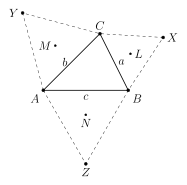
- Consider the equilateral triangle \(CYA\), notice that \(YM\) is a vertical line of symmetry, and \(\angle ACM = 30^\circ\) therefore \(\frac{AC/2}{CM} = \cos 30^\circ \Rightarrow |CM| = \frac{b}{2} \cdot \frac{2}{\sqrt{3}} = \frac{b}{\sqrt{3}}\). Similarly \(|CL| = \frac{a}{\sqrt{3}}\)
- \(\,\) \begin{align*} && |LM|^2 &= |CM|^2 + |CL|^2 - 2 \cdot |CM| \cdot |CL| \cdot \cos \angle MCL \\ &&&= \frac{b^2}{3} + \frac{a^2}{3} - 2 \frac{ab}{3} \cos \left (\angle CMA + \angle CAB + \angle BCL \right) \\ &&&= \frac13 \left (b^2 + a^2 - 2ab \cos \left ( \frac{\pi}{3} + \angle CAB \right) \right) \\ &&&= \frac13 \left (b^2 + a^2 - ab \cos \left ( \angle CAB \right) + \sqrt{3}ab \sin \angle CAB \right) \\ &&&= \frac13 \left (b^2 + a^2 - ab \cos \angle CAB + 2\sqrt{3} \Delta\right) \\ &&&= \frac13 \left (b^2 + a^2 - ab \left (\frac{a^2+b^2-c^2}{2ab} \right) + 2\sqrt{3} \Delta\right) \\ &&&= \frac13 \left ( \frac12(a^2+b^2+c^2) + 2\sqrt{3}\Delta \right) \\ \Rightarrow && 6|LM|^2 &= a^2 + b^2 + c^2 + 4\sqrt{3} \Delta \end{align*} However, nothing in our reasoning here was special about \(LM\), therefore \(LN\) and \(MN\) also equal this value, and we find that the triangle is equilateral. The area of equilateral triangle [LMN] is \(\frac{\sqrt{3}}4 |LM|^2\), ie \begin{align*} &&& \text{areas are equal} \\ \Leftrightarrow && \Delta &= \frac{\sqrt{3}}4 |LM|^2 \\ &&&= \frac{\sqrt{3}}4 \frac{a^2+b^2+c^2+4\sqrt{3}\Delta}{6} \\ &&&= \frac{\sqrt{3}}{24} (a^2+b^2+c^2) + \frac12 \Delta \\ \Leftrightarrow && \Delta &= \frac{\sqrt{3}}{12}(a^2+b^2+c^2)\\ \Leftrightarrow && 4\sqrt{3}\Delta &=a^2+b^2+c^2\\ \end{align*}
- \(\,\) \begin{align*} && (a-b)^2 &= -2ab(1 - \cos(C - 60^{\circ})) \\ \Leftrightarrow && a^2+b^2 - 2ab &=-2ab + 2ab \cos(C - 60^{\circ}) \\ \Leftrightarrow && a^2+b^2 &= ab \cos C+\sqrt{3}ab\sin C \\ \Leftrightarrow && a^2+b^2 &= ab \frac{a^2+b^2-c^2}{2ab} + 2\sqrt{3} \Delta \\ \Leftrightarrow && a^2+b^2+c^2 &= 4\sqrt{3}\Delta \end{align*} Since the LHS is non-positive, and the RHS is positive, the only way they can be equal is if they are both \(0\), ie \(a=b\) and \(C = 60^{\circ}\) ie \(ABC\) is equilateral.
2017 Paper 1 Q8
Two sequences are defined by \(a_1 = 1\) and \(b_1 = 2\) and, for \(n \ge 1\), \begin{equation*} \begin{split} a_{n+1} & = a_n+ 2b_n \,, \\ b_{n+1} & = 2a_n + 5b_n \,. \end{split} \end{equation*} Prove by induction that, for all \(n \ge 1\), \[ a_n^2+2a_nb_n - b_n^2 = 1 \,. \tag{\(*\)}\]
- Let \(c_n = \dfrac{a_n}{b_n}\). Show that \(b_n \ge 2 \times 5^{n-1}\) and use \((*)\) to show that \[ c_n \to \sqrt 2 -1 \text{ as } n\to\infty\,. \]
- Show also that \(c_n > \sqrt2 -1\) and hence that \(\dfrac2 {c_n+1} < \sqrt2 < c_n+1\). Deduce that \(\dfrac{140}{99}< \sqrt{2} < \dfrac{99}{70 }\,\).
Solution: Claim \(a_n^2+2a_nb_n - b_n^2 = 1\) for all \(n \geq 1\) Proof: (By induction) Base case: (\(n = 1\)). When \(n = 1\) we have \(a_1^2 + 2a_1 b_1-b_1^2 = 1^2+2\cdot1\cdot2-2^2 = 1\) as required. (Inductive step). Now we assume our result is true for some \(n =k\), ie \(a_k^2+2a_kb_k - b_k^2 = 1\), now consider \(n = k+1\) \begin{align*} && a_{k+1}^2+2a_{k+1}b_{k+1} - b_{k+1}^2 &= (a_k+2b_k)^2+2(a_k+2b_k)(2a_k+5b_k) - (2a_k+5b_k)^2 \\ &&&= a_k^2+4a_kb_k+4b_k^2 +4a_k^2+18a_kb_k+20b_k^2 - 4a_k^2-20a_kb_k-25b_k^2 \\ &&&= (1+4-4)a_k^2+(4+18-20)a_kb_k +(4+20-25)b_k^2 \\ &&&= a_k^2+2a_kb_k -b_k^2 = 1 \end{align*} Therefore since our statement is true for \(n = 1\) and when it is true for \(n=k\) it is true for \(n=k+1\) by the POMI it is true for \(n \geq 1\)
- Notice that \(b_{n+1} \geq 5 b_n\) and therefore \(b_n \geq 5^{n-1} b_1 = 2\cdot 5^{n-1}\), so \begin{align*} && 1 &= a_n^2+2a_nb_n - b_n^2\\ \Rightarrow && \frac1{b_n^2} &= c_n^2 + 2c_n - 1 \\ \to && 0 &= c_n^2 + 2c_n - 1 \quad \text{ as } n\to \infty \\ \end{align*} This has roots \(c = -1 \pm \sqrt{2}\), and since \(c_n > 0\) it must tend to the positive value, ie \(c_n \to \sqrt{2}-1\)
- Notice that \(c_n^2 + 2c_n - 1 > 0\) so either \(c_n > \sqrt{2}-1\) or \(c_n < -1-\sqrt{2}\), but again, since \(c_n > 0\) we must have \(c_n > \sqrt{2}-1\). Therefore \(\sqrt{2} < c_n + 1\) and \(1+c_n > \sqrt{2} \Rightarrow \frac{1}{1+c_n} < \frac{\sqrt{2}}2 \Rightarrow \frac{2}{1+c_n} < \sqrt{2}\) \begin{array}{c|c|c} n & a_n & b_n \\ \hline 1 & 1 & 2 \\ 2 & 5 & 12 \\ 3 & 29 & 70 \end{array} Therefore \(c_3 = \frac{29}{70}\) and so \(\frac{2}{1 + \frac{29}{70}} = \frac{140}{99} < \sqrt{2} < \frac{29}{70} + 1 = \frac{99}{70}\)
2017 Paper 1 Q9
A particle is projected at speed \(u\) from a point \(O\) on a horizontal plane. It passes through a fixed point \(P\) which is at a horizontal distance \(d\) from \(O\) and at a height \(d \tan \beta\) above the plane, where \(d>0\) and \(\beta \) is an acute angle. The angle of projection \(\alpha\) is chosen so that \(u\) is as small as possible.
- Show that \(u^2 = gd \tan \alpha\) and \(2\alpha = \beta + 90^\circ\,\).
- At what angle to the horizontal is the particle travelling when it passes through \(P\)? Express your answer in terms of \(\alpha\) in its simplest form.
Solution:
- \(\,\) \begin{align*} && d &= u \cos \alpha t \\ && d \tan \beta &= u \sin \alpha t - \frac12 gt^2 \\ && &= d\tan \alpha - \frac1{2u^2} g d^2 \sec^2 \alpha \\ \Rightarrow && u^2 &= \frac{gd \sec^2 \alpha}{2(\tan \alpha + \tan \beta)} \\ &&&= \frac{gd t^2}{2(t+\tan \beta)} \\ && \frac{\d}{\d t} \left (u^2 \right) &= \frac{2gdt\cdot 2(t+\tan \beta) - gdt^2 \cdot 2}{4(t+\tan \beta)^2} \\ &&&= \frac{2gdt(2t-t+2\tan \beta)}{4(t+\tan \beta)^2} \\ &&&= \frac{gdt(t+2\tan \beta)}{2(t+\tan \beta)^2} \\ \end{align*} So either \(t = 0\) or \(t = -2 \tan \beta\) \begin{align*} && u^2 &= \frac{gd\cdot 4 \tan^2 \beta}{2(-2\tan \beta + \tan \beta)} \\ &&&= \frac{2gd \tan \beta}{-1} \\ &&&= gd (-2\tan \beta) \\ &&&= gd \tan \alpha \end{align*} \begin{align*} && d \tan \beta &= d \tan \alpha - \frac12 \frac{gd^2}{gd \tan \alpha \cdot \cos^2 \alpha } \\ \Rightarrow && \tan \beta&= \tan \alpha - \frac{1}{2\sin \alpha \cos \alpha} \\ &&&= \frac{2 \sin^2 \alpha - 1}{2 \sin \alpha \cos \alpha} \\ &&&= \frac{-\cos 2 \alpha}{\sin 2 \alpha} \\ &&&= -\cot 2 \alpha \\ &&&= \tan (2\alpha - 90^\circ) \\ \Rightarrow && \beta &= 2\alpha - 90^\circ \\ \Rightarrow && 2\alpha &= \beta + 90^\circ \end{align*}
- Suppose the angle to the horizontal is \(\theta\), then \(\tan \theta = \frac{v_y}{v_x}\) so \begin{align*} && \tan \theta &= \frac{u \sin \alpha - gt}{u \cos \alpha} \\ &&&= \frac{u \sin \alpha - \frac12 g \frac{d}{u \cos \alpha}}{u \cos \alpha} \\ &&&= \frac{u^2\sin \alpha \cos \alpha - gd}{u^2 \cos^2 \alpha} \\ &&&= \frac{gd \tan \alpha \sin \alpha \cos \alpha- gd}{ gd \tan \alpha \cdot \cos^2 \alpha} \\ &&&= \frac{\tan \alpha \sin \alpha \cos \alpha - 1}{ \sin \alpha \cos \alpha} \\ &&&= \frac{\sin^2 \alpha - 1}{\sin \alpha \cos \alpha} \\ &&&= -\frac{\cos \alpha}{\sin \alpha}\\ &&&= - \cot \alpha = \tan (\alpha - 90^\circ)\\ \Rightarrow && \theta &= \alpha - 90^\circ \end{align*}
2017 Paper 1 Q10
Particles \(P_1\), \(P_2\), \(\ldots\) are at rest on the \(x\)-axis, and the \(x\)-coordinate of \(P_n\) is \(n\). The mass of \(P_n\) is \(\lambda^nm\). Particle \(P\), of mass \(m\), is projected from the origin at speed \(u\) towards \(P_1\). A series of collisions takes place, and the coefficient of restitution at each collision is \(e\), where \(0 < e <1\). The speed of \(P_n\) immediately after its first collision is \(u_n\) and the speed of \(P_n\) immediately after its second collision is \(v_n\). No external forces act on the particles.
- Show that \(u_1=\dfrac{1+e}{1+\lambda}\, u\) and find expressions for \(u_n\) and \(v_n\) in terms of \(e\), \(\lambda\), \(u\) and \(n\).
- Show that, if \(e > \lambda\), then each particle (except \(P\)) is involved in exactly two collisions.
- Describe what happens if \(e=\lambda\) and show that, in this case, the fraction of the initial kinetic energy lost approaches \(e\) as the number of collisions increases.
- Describe what happens if \(\lambda e=1\). What fraction of the initial kinetic energy is \mbox{eventually} lost in this case?
Solution:
- \begin{align*} \text{COM}: && mu &= mv + \lambda m u_1 \\ \Rightarrow && u &= v + \lambda u_1 \tag{1} \\ \text{NEL}: && e &= \frac{u_1-v}{u} \\ \Rightarrow && eu &= u_1 - v \tag{2} \\ (1)+(2) && (1+e)u &= (1+\lambda) u_1 \\ \Rightarrow && u_1 &= \frac{1+e}{1+\lambda}u \\ && v &= u_1 - eu \\ &&&= \frac{1+e - (1+\lambda)e}{1+\lambda} u \\ &&&= \frac{1-\lambda e}{1+\lambda}u \end{align*} Note that subsequent (first (and second)) are the same as these, therefore: \begin{align*} u_n &= \left ( \frac{1+e}{1+\lambda} \right)^n u \\ v_n &= \frac{1-\lambda e}{1+\lambda } u_n \\ &= \frac{1-\lambda e}{1+\lambda } \left ( \frac{1+e}{1+\lambda} \right)^n u \end{align*}

- If \(e > \lambda\) then \((1-\lambda e) > 1-e^2 > 0\) and \begin{align*} \frac{v_{n+1}}{v_n} &= \frac{1+e}{1+\lambda} > 1 \end{align*} So the particles are moving away from each other - hence no more collisions.
- If \(e = \lambda\) then \(u_n = u\) and \(v_n = (1-\lambda)u\) so all the particles end up moving at the same speed. \begin{align*} \text{initial k.e.} &= \frac12 m u^2 \\ \text{final k.e.} &= \frac12 m((1-e)u)^2 + \sum_{n = 1}^{\infty} \frac12 \lambda^n m ((1-e)u)^2 \\ &= \frac12mu^2(1-e)^2 \left ( \sum_{n=0}^{\infty} e^n \right) \tag{\(e = \lambda\)} \\ &= \frac12 mu^2(1-e)^2 \frac{1}{1-e} \\ &= \frac12m u^2 (1-e) \\ \text{change in k.e.} &= \frac12 m u^2 - \frac12m u^2 (1-e) \\ &= e\frac12m u^2 \end{align*} Ie the total energy lost approaches a fraction of \(e\).
- If \(\lambda e = 1\), after the second collision the particle will be stationary. ie \begin{align*} \text{initial k.e.} &= \frac12 m u^2 \\ \text{k.e. after }n\text{ collisions} &= \frac12 \lambda^n m \left (\left ( \frac{1+e}{1+\lambda} \right)^n u \right)^2\\ &= \frac12 \lambda^n m \left ( \frac{1+\frac1{\lambda}}{1+\lambda} \right)^{2n} u&2\\ &= \frac12 \lambda^n m \left ( \frac{1+\frac1{\lambda}}{1+\lambda} \right)^{2n} u\\ &= \frac12 \lambda^n m \left ( \frac{1}{\lambda} \right)^{2n} u\\ &= \frac12 m \lambda^{-n} u\\ &\to 0 \end{align*} Eventually we lose all the kinetic energy.
2017 Paper 1 Q11
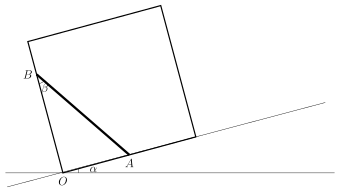
A plane makes an acute angle \(\alpha\) with the horizontal. A box in the shape of a cube is fixed onto the plane in such a way that four of its edges are horizontal and two of its sides are vertical. A uniform rod of length \(2L\) and weight \(W\) rests with its lower end at \(A\) on the bottom of the box and its upper end at \(B\) on a side of the box, as shown in the diagram below. The vertical plane containing the rod is parallel to the vertical sides of the box and cuts the lowest edge of the box at \(O\). The rod makes an acute angle~\(\beta\) with the side of the box at \(B\). The coefficients of friction between the rod and the box at the two points of contact are both \(\tan \gamma\), where \(0 < \gamma < \frac12\pi\). %The frictional force on the rod at \(A\) acts toward \(O\), %and the frictional force on the rod at~\(B\) %acts away from \(O\). The rod is in limiting equilibrium, with the end at \(A\) on the point of slipping in the direction away from \(O\) and the end at \(B\) on the point of slipping towards \(O\). Given that \(\alpha < \beta\), show that \(\beta = \alpha + 2\gamma\). [\(Hint\): You may find it helpful to take moments about the midpoint of the rod.]
Solution:

2017 Paper 1 Q12
In a lottery, each of the \(N\) participants pays \(\pounds c\) to the organiser and picks a number from \(1\) to \(N\). The organiser picks at random the winning number from \(1\) to \(N\) and all those participants who picked this number receive an equal share of the prize, \(\pounds J\).
- The participants pick their numbers independently and with equal probability. Obtain an expression for the probability that no participant picks the winning number, and hence determine the organiser's expected profit. Use the approximation \[ \left( 1 - \frac{a}{N} \right)^N \approx \e^{-a} \tag{\(*\)} \] to show that if \(2Nc = J\) then the organiser will expect to make a loss. Note: \(\e > 2\).
- Instead of the numbers being equally popular, a fraction \(\gamma\) of the numbers are popular and the rest are unpopular. For each participant, the probability of picking any given popular number is \(\dfrac{a}{N}\) and the probability of picking any given unpopular number is \(\dfrac{b}{N}\,\). Find a relationship between \(a\), \(b\) and \(\gamma\). Show that, using the approximation \((*)\), the organiser's expected profit can be expressed in the form \[ A\e^{-a} + B\e^{-b} +C \,, \] where \(A\), \(B\) and \(C\) can be written in terms of \(J\), \(c\), \(N\) and \(\gamma\). In the case \(\gamma = \frac18\) and \(a=9b\), find \(a\) and \(b\). Show that, if \(2Nc = J\), then the organiser will expect to make a profit. Note: \(\e < 3\).
Solution:
- The probability no-one picks the winning number is \(\left ( 1 - \frac{1}{N}\right)^N \approx \frac1e\). \begin{align*} && \mathbb{E}(\text{profit}) &= Nc - (1-e^{-1})J \\ &&& < Nc -(1- \tfrac12 )J \\ &&& < Nc - \frac12 J \\ &&&= \frac{2Nc-J}{2} \end{align*} Therefore if \(J = 2Nc\) the expected profit is negative.
- \(\,\) \begin{align*} && 1 &= \sum_{\text{all numbers}} \mathbb{P}(\text{pick }i) \\ &&&= \sum_{\text{popular numbers}} \mathbb{P}(\text{pick }i)+\sum_{\text{unpopular numbers}} \mathbb{P}(\text{pick }i) \\ &&&=\gamma N \frac{a}{N} + (1-\gamma)N \frac{b}{N} \\ &&&= \gamma a + (1-\gamma)b \end{align*} \begin{align*} && \mathbb{P}(\text{no-one picks winning number}) &= \mathbb{P}(\text{no-one picks winning number} | \text{winning number is popular})\mathbb{P})(\text{winning number is popular}) + \\ &&&\quad + \mathbb{P}(\text{no-one picks} | \text{unpopular})\mathbb{P}(\text{unpopular}) \\ &&&= \left (1 - \frac{a}{N} \right)^N \gamma + \left (1 - \frac{b}{N} \right)^N (1-\gamma) \\ &&&\approx \gamma e^{-a} + (1-\gamma)e^{-b} \\ \\ && \mathbb{E}(\text{profit}) &= Nc - (1-\gamma e^{-a} - (1-\gamma)e^{-b})J \\ &&&= Nc-J+J\gamma e^{-a} +J(1-\gamma)e^{-b} \end{align*} If \(\gamma = \frac18\) and \(a=9b\), then \(1=\frac18 a + \frac78b = 2b \Rightarrow b = \frac12, a = \frac92\) and \begin{align*} && \mathbb{E}(\text{profit}) &= Nc-J +J\tfrac18e^{-9/2}+J\tfrac78e^{-1/2} \\ &&&= Nc-J+\tfrac18Je^{-1/2}(e^{-4}+7) \end{align*} If we can show \(e^{-1/2}\frac{e^{-4}+7}{8} > \frac12\) we'd be done, so \begin{align*} && e^{-1/2}\frac{e^{-4}+7}{8} &> \frac12 \\ \Leftrightarrow && e^{-4}+7 &>4e^{1/2} \\ \Leftrightarrow && 49+14e^{-4}+e^{-8} &>16e \\ \end{align*} But clearly the LHS \(>49\) and the RHS \(<48\) so we're done
2017 Paper 1 Q13
I have a sliced loaf which initially contains \(n\) slices of bread. Each time I finish setting a STEP question, I make myself a snack: either toast, using one slice of bread; or a sandwich, using two slices of bread. I make toast with probability \(p\) and I make a sandwich with probability \(q\), where \(p+q=1\), unless there is only one slice left in which case I must, of course, make toast. Let \(s_r\) (\(1 \le r \le n\)) be the probability that the \(r\)th slice of bread is the second of two slices used to make a sandwich and let \(t_r\) (\(1 \le r \le n\)) be the probability that the \(r\)th slice of bread is used to make toast. What is the value of \(s_1\)? Explain why the following equations hold: \begin{align*} \phantom{\hspace{2cm} (2\le r \le n-1)} t_r &= (s_{r-1}+ t_{r-1})\,p \hspace{2cm} (2\le r \le n-1)\,; \\ \phantom{\hspace{1.53cm} (2\le r \le n) } s_r &= 1- (s_{r-1} + t_{r-1}) \hspace{1.53cm} ( 2\le r \le n )\,. \end{align*} Hence, or otherwise, show that \(s_{r} = q(1-s_{r-1})\) for \(2\le r\le n-1\). Show further that \[ \phantom{\hspace{2.7cm} (1\le r\le n)\,,} s_r = \frac{q+(-q)^r}{1+q} \hspace{2.7cm} (1\le r\le n-1)\,, \, \hspace{0.14cm} \] and find the corresponding expression for \(t_r\). Find also expressions for \(s_n\) and \(t_n\) in terms of \(q\).
Solution: The \(1\)st slice of bread can only be the first slice in a sandwich or a slice of toast. Therefore \(s_1 = 0\) \begin{align*} && t_r &= \underbrace{s_{r-1}}_{r-1\text{th is the end of a sandwich}} \cdot \underbrace{p}_{\text{and we make toast}} + \underbrace{t_{r-1}}_{r-1\text{th is toast}} \cdot \underbrace{p}_{\text{and we make toast}} \\ &&&= (s_{r-1}+t_{r-1})p \\ \\ && s_r &= 1-\mathbb{P}(\text{previous slice is not the first of a sandwich}) \\ &&&= 1-(s_{r-1} + t_{r-1}) \\ \\ \Rightarrow && s_r &= 1 - \frac{t_r}{p} \\ \Rightarrow && t_r &= p - ps_r \\ \Rightarrow && s_r &= 1 - s_{r-1} - (p-ps_{r-1}) \\ &&&= 1 -p -(1-p)s_{r-1} \\ &&&= q(1-s_{r-1}) \end{align*} Therefore since \(s_r + qs_{r-1} = q\) we should look for a solution of the form \(s_r = A(-q)^r + B\). The particular solution will have \((1+q)B = q \Rightarrow B = \frac{q}{1+q}\), the initial condition will have \(s_1 = \frac{q}{1+q} +A(-q) = 0 \Rightarrow q = \frac{1}{1+q}\), so we must have \begin{align*} && s_r &= \frac{q+(-q)^r}{1+q}\\ \Rightarrow && t_r &= p(1-s_r) \\ &&&= p \frac{1+q-q-(-q)^r}{1+q} \\ &&&= \frac{(1-q)(1-(-q)^r)}{1+q} \\ && s_n &= 1-\frac{q+(-q)^{n-1}}{1+q} - \frac{p(1-(-q)^{n-1})}{1+q} \\ &&&= 1-\frac{1+(1-p)(-q)^{n-1}}{1+q}\\ &&&= 1-\frac{1-(-q)^n}{1+q}\\ &&&= \frac{q+(-q)^n}{1+q}\\ && t_n &=1-s_n \\ &&&=\frac{1-(-q)^n}{1+q} \end{align*}
2017 Paper 2 Q1
Note: In this question you may use without proof the result \( \dfrac{\d \ }{\d x}\big(\!\arctan x \big) = \dfrac 1 {1+x^2}\,\). Let \[ I_n = \int_0^1 x^n \arctan x \, \d x \;, \] where \(n=0\), 1, 2, 3, \(\ldots\) .
- Show that, for \(n\ge0\,\), \[ (n+1) I_n = \frac \pi 4 - \int _0^1 \frac {x^{n+1}}{1+x^2} \, \d x \, \] and evaluate \(I_0\).
- Find an expression, in terms of \(n\), for \((n+3)I_{n+2}+(n+1)I_{n}\,\). Use this result to evaluate \(I_4\).
- Prove by induction that, for \(n\ge1\), \[ (4n+1) I_{4n} =A - \frac12 \sum_{r=1}^{2n} (-1)^r \frac 1 {r} \,, \] where \(A\) is a constant to be determined.
Solution:
- \(\,\) \begin{align*} && I_n &= \int_0^1 x^n \arctan x \d x \\ &&&= \left [ \frac{x^{n+1}}{n+1} \arctan x\right]_0^1 - \int_0^1 \frac{x^{n+1}}{n+1} \frac{1}{1+x^2} \d x \\ &&&= \frac{1}{n+1} \frac{\pi}{4} - \frac{1}{n+1} \int_0^1 \frac{x^{n+1}}{1+x^2}\d x \\ \Rightarrow && (n+1)I_n &= \frac{\pi}{4} - \int_0^1 \frac{x^{n+1}}{1+x^2}\d x \\ && I_0 &= \frac{\pi}{4} - \int_0^1 \frac{x}{1+x^2} \d x \\ &&&= \frac{\pi}{4} - \left [\frac12 \ln(1+x^2) \right]_0^1 \\ &&&= \frac{\pi}{4} - \frac12 \ln 2 \end{align*}
- \(\,\) \begin{align*} && (n+3)I_{n+2} + (n+1)I_n &=\left ( \frac{\pi}{4} - \int_0^1 \frac{x^{n+3}}{1+x^2} \d x \right)+ \left (\frac{\pi}{4} - \int_0^1 \frac{x^{n+1}}{1+x^2} \d x \right) \\ &&&=\frac{\pi}{2}+ \int_0^1 \frac{x^{n+1}+x^{n+3}}{1+x^2} \d x \\ &&&=\frac{\pi}{2}+ \int_0^1 x^{n+1} \d x \\ &&&= \frac{\pi}{2} + \frac{1}{n+2} \\ && 3I_2 + I_0 &= \frac{\pi}{2} + \frac{1}{2} \\ \Rightarrow && 3I_2 &=\frac{\pi}{4} + \frac12 \ln 2 + \frac12 \\ && 5I_4 + 3I_2 &= \frac{\pi}{2} + \frac14 \\ \Rightarrow && 5I_4 &= \frac{\pi}{2} + \frac14 - \left ( \frac{\pi}{4} + \frac12 \ln 2 + \frac12\right) \\ &&&= \frac{\pi}4-\frac12 \ln 2-\frac14 \\ \Rightarrow && I_4 &= \frac15 \left (\frac{\pi}4-\frac12 \ln 2-\frac14 \right) \\ &&&= \frac1{20} \left (\pi - 2\ln 2 -1 \right) \end{align*}
- Claim: \[ (4n+1) I_{4n} =\frac{\pi}4-\frac12 \ln 2 - \frac12 \sum_{r=1}^{2n} (-1)^r \frac 1 {r} \,, \] Proof: Base case we have just shown above Assume true for \(n = k\), consider \(n = k+1\), then \begin{align*} && (4(k+1)+1) I_{4(k+1)} &= \frac{\pi}{2} + \frac{1}{4(k+1)} - (4k+3)I_{4k+2} \\ &&&= \frac{\pi}{2} + \frac{1}{4(k+1)} - \left (\frac{\pi}{2} + \frac{1}{2(2k+1)} - (4k+1)I_{4k} \right)\\ &&&= (4k+1)I_{4k} - \frac12 \left ( \frac{1}{2k+2} - \frac{1}{2k+1}\right) \\ &&&= \frac{\pi}4-\frac12 \ln 2 - \frac12 \sum_{r=1}^{2k} (-1)^r \frac 1 {r} - \frac12 \left ( \frac{1}{2k+2} - \frac{1}{2k+1}\right)\\ &&&= \frac{\pi}4-\frac12 \ln 2 - \frac12 \sum_{r=1}^{2(k+1)} (-1)^r \frac 1 {r} \\ \end{align*} as required.
2017 Paper 2 Q2
The sequence of numbers \(x_0\), \(x_1\), \(x_2\), \(\ldots\) satisfies \[ x_{n+1} = \frac{ax_n-1}{x_n+b} \,. \] (You may assume that \(a\), \(b\) and \(x_0\) are such that \(x_n+b\ne0\,\).) Find an expression for \(x_{n+2}\) in terms of \(a\), \(b\) and \(x_n\).
- Show that \(a+b=0\) is a necessary condition for the sequence to be periodic with period 2. Note: The sequence is said to be periodic with period \(k\) if \(x_{n+k} = x_n\) for all \(n\), and there is no integer \(m\) with \(0 < m < k\) such that \(x_{n+m} = x_n\) for all \(n\).
- Find necessary and sufficient conditions for the sequence to have period 4.
Solution: \begin{align*} x_{n+2} &= \frac{ax_{n+1}-1}{x_{n+1}+b} \\ &= \frac{a \frac{ax_n - 1}{x_n+b}-1}{\frac{ax_n - 1}{x_n+b}+b} \\ &= \frac{a(ax_n-1)-(x_n+b)}{ax_n-1+b(x_n+b)} \\ &= \frac{(a^2-1)x_n-(a+b)}{(a+b)x_n+b^2-1} \end{align*}
- If \(x_{n+2} = x_n\) then \begin{align*} && x_n &= \frac{(a^2-1)x_n-(a+b)}{(a+b)x_n+b^2-1} \\ \Rightarrow && 0 &=(a+b)x_n^2+(b^2-a^2)x_n+(a+b) \\ &&&= (a+b)(x_n^2+(a-b)x_n + 1) \end{align*} If \(x_{n+1} = x_n\) then \(x_n^2+(a-b)x_n + 1\) and since our sequence has period \(2\) rather than \(1\) it must be the case this is non-zero. Therefore \(a+b =0\).
- \begin{align*} x_{n+4} &= \frac{(a^2-1)x_{n+2}-(a+b)}{(a+b)x_{n+2}+b^2-1} \\ &= \frac{(a^2-1)\frac{(a^2-1)x_{n}-(a+b)}{(a+b)x_{n}+b^2-1} -(a+b)}{(a+b)\frac{(a^2-1)x_{n}-(a+b)}{(a+b)x_{n}+b^2-1} +b^2-1} \\ &= \frac{((a^2-1)^2-(a+b)^2)x_n -(a^2+b^2-2)(a+b)}{(a^2+b^2-2)(a+b)x_n + (b^2-1)^2-(a+b)^2} \end{align*} If \(x_{n+4} = x_n\) then \begin{align*} x_n &=\frac{((a^2-1)^2-(a+b)^2)x_n -(a^2+b^2-2)(a+b)}{(a^2+b^2-2)(a+b)x_n + (b^2-1)^2-(a+b)^2} \\ 0 &= (a^2+b^2-2)(a+b)x_n^2 + \l (b^2-1)^2-(a^2-1)^2 \r x_n+(a^2+b^2-2)(a+b) \\ &= (a^2+b^2-2)(a+b)x_n^2+(b^2-a^2)(a^2+b^2-2)x_n + (a^2+b^2-2)(a+b) \\ &= (a^2+b^2-2)(a+b)(x_n^2+(b-a)x_n + 1) \end{align*} Since we do not want \(x_n\) to be periodic with period \(1\) we must have the quadratic in \(x_n\) \(\neq 0\). If \(a+b = 0\) then \(x_n\) is periodic with period \(2\) since \(x_{n+2} = \frac{(a^2-1)x_n}{((-a)^2-1)} = x_n\). Therefore it is necessary that \(a^2+b^2-2 = 0\). If \(a^2+b^2-2= 0\) then \begin{align*} x_{n+4} &= \frac{((a^2-1)^2-(a+b)^2)x_n}{(b^2-1)^2-(a+b)^2} \\ &=\frac{((a^2-1)^2-(a+b)^2)x_n}{((2-a^2)-1)^2-(a+b)^2} \\ &=\frac{((a^2-1)^2-(a+b)^2)x_n}{((1-a^2)^2-(a+b)^2} \\ &= x_n \end{align*} Therefore it is sufficient too. So our conditions are \(a+b \neq 0, \, \, x_n^2+(a-b)x_n + 1 \neq 0\) and \(a^2+b^2-2 = 0\)