Problems
Filters
39 problems found
2011 Paper 1 Q1
- Show that the gradient of the curve \(\; \dfrac a x + \dfrac by =1\), where \(b\ne0\), is \(\; -\dfrac{ay^2}{bx^2}\,\). The point \((p,q)\) lies on both the straight line \(ax+by=1\) and the curve \(\dfrac a x + \dfrac by =1\,\), where \(ab\ne0\). Given that, at this point, the line and the curve have the same gradient, show that \( p=\pm q\,\). Show further that either \((a-b)^2 =1\,\) or \((a+b)^2 =1\,\).
- Show that if the straight line \(ax+by=1\), where \(ab\ne0\), is a normal to the curve \(\dfrac a x - \dfrac by =1\), then \(a^2-b^2 = \frac12\,\).
Solution:
- \(\,\) \begin{align*} && 1 &= \frac{a}{x} + \frac{b}{y} \\ \frac{\d}{\d x}: && 0 &= -\frac{a}{x^2} - \frac{b}{y^2} \frac{\d y}{\d x} \\ \Rightarrow && \frac{\d y}{\d x} &= -\frac{ay^2}{bx^2} \\ \\ (p,q): && -\frac{aq^2}{bp^2} &= -\frac{a}{b} \\ \Rightarrow && p^2 &= q^2 \\ \Rightarrow && p &= \pm q \\ \\ \Rightarrow && ap \pm b p &= 1 \\ \Rightarrow && (a\pm b)p &= 1 \\ \Rightarrow && \frac{a}{p} \pm \frac{b}{p} &= 1 \\ \Rightarrow && (a \pm b)\frac{1}{p} &= 1 \\ \Rightarrow && (a \pm b)^2 &= 1 \end{align*}
- \(\,\) \begin{align*} && 1 &= \frac{a}{x} - \frac{b}{y} \\ \Rightarrow && \frac{\d y}{\d x} &= \frac{ay^2}{bx^2} \\ \Rightarrow && \frac{aq^2}{bp^2} &= \frac{b}{a} \\ \Rightarrow && aq &= \pm bp \\ \Rightarrow && 1 &= \frac{a}{p} - \frac{b}{q} \\ &&&= \frac{aq-bp}{pq} \\ \Rightarrow && aq &= -bp \\ \Rightarrow && 1 &= \frac{2aq}{pq} \\ \Rightarrow && p &= 2a \\ \Rightarrow && q &= -2b \\ \Rightarrow && 1 &= 2a^2-2b^2 \\ \Rightarrow && \frac12 &= a^2-b^2 \end{align*}
2011 Paper 1 Q2
The number \(E\) is defined by $\displaystyle E= \int_0^1 \frac{\e^x}{1+x} \, \d x\,.$ Show that \[ \int_0^1 \frac{x \e^x}{1+x} \, \d x = \e -1 -E\, ,\] and evaluate \(\ds \int_0^1 \frac{x^2\e^x}{1+x} \, \d x\) in terms of \(\e\) and \(E\). Evaluate also, in terms of \(E\) and \(\rm e\) as appropriate:
- \[ \int_0^1 \frac{\e^{\frac{1-x}{1+x}}}{1+x}\, \d x\,\]
- \[ \int_1^{\sqrt2} \frac {\e^{x^2}}x \, \d x \, \]
Solution: \begin{align*} \int_0^1 \frac{x \e^x}{1+x} \, \d x &= \int_0^1 \frac{(x+1-1) \e^x}{1+x} \, \d x \\ &= \int_0^1 \left ( e^x -\frac{\e^x}{1+x} \right )\, \d x \\ &= \e-1-E \end{align*} \begin{align*} \int_0^1 \frac{x^2 \e^x}{1+x} \, \d x &= \int_0^1 \frac{(x^2+x-x) \e^x}{1+x} \, \d x \\ &= \int_0^1 \left ( xe^x -\frac{x\e^x}{1+x} \right )\, \d x \\ &= \left [xe^{x} \right]_0^1 - \int_0^1 e^x \, \d x -(\e-1-E) \\ &= \e-(\e-1)-(\e -1 -E) \\ &= 2-\e + E \end{align*}
- Since \(\displaystyle u = \frac{1-x}{1+x},\frac{\d u}{\d x} = \frac{-(1+x)-(1-x)}{(1+x)^2}\), \begin{align*} && \int_0^1 \frac{\e^{\frac{1-x}{1+x}}}{1+x}\, \d x &= \int_{u=1}^{u=0} \frac{e^u}{1+x} \cdot \frac{(1+x)^2}{-2} \d u \\ &&&= \int_0^1 \frac{(1+x) e^u}{2} \d u \\ &&&= \int_0^1 \frac{\left ( 1 + \frac{1-u}{1+u} \right) e^u}{2}\, \d u \\ &&&= \frac12 \int_0^1 \left (e^u + \frac{e^{u}}{1+u} - \frac{ue^u}{1+u} \right) \, \d u \\ &&&= \frac12 \left( \e-1 + E - (\e - 1 - E) \right) \\ &&&= E \end{align*}
- Since \(\displaystyle u = x^2-1, \d u = 2x \d x\)\begin{align*} \int_1^{\sqrt2} \frac {\e^{x^2}}x \, \d x &= \int_{u=0}^{u=1} \frac{e^{u+1}}{x} \frac{1}{2x} \d u \\ &= \int_0^1 \frac{e^{u+1}}{2(u+1)} \d u \\ &= \frac{\e}{2} E \\ &= \frac{E\e}{2} \end{align*}
2011 Paper 1 Q3
Prove the identity \[ 4\sin\theta \sin(\tfrac13\pi-\theta) \sin (\tfrac13\pi+\theta)= \sin 3\theta\, . \tag{\(*\)}\]
- By differentiating \((*)\), or otherwise, show that \[ \cot \tfrac19\pi - \cot \tfrac29\pi + \cot \tfrac49\pi = \sqrt3\,. \]
- By setting \(\theta = \frac16\pi-\phi\) in \((*)\), or otherwise, obtain a similar identity for \(\cos3\theta\) and deduce that \[ \cot \theta \cot (\tfrac13\pi-\theta) \cot (\tfrac13\pi+\theta) =\cot3\theta\,. \] Show that \[ \cosec \tfrac19\pi -\cosec \tfrac59\pi +\cosec \tfrac79\pi = 2\sqrt3\,. \]
Solution: \begin{align*} && LHS &= 4\sin\theta \sin(\tfrac13\pi-\theta) \sin (\tfrac13\pi+\theta) \\ &&&= 4 \sin \theta \left (\tfrac{\sqrt{3}}{2}\cos \theta - \tfrac12 \sin \theta \right)\left (\tfrac{\sqrt{3}}{2}\cos \theta + \tfrac12 \sin \theta \right) \\ &&&= 4 \sin \theta \left (\tfrac{3}{4}\cos^2 \theta - \tfrac14 \sin^2 \theta \right) \\ &&&= 3\sin \theta - 4\sin^3 \theta \\ &&&= \cos 3 \theta = RHS \end{align*}
- \(\,\) \begin{align*} && 3 \cos 3 \theta &= \sin 3 \theta \left (\cot \theta - \cot (\tfrac13\pi - \theta) + \cot (\tfrac13\pi + \theta) \right) \\ \Rightarrow && 3 \cot 3\theta &= \cot \theta - \cot (\tfrac13\pi - \theta) + \cot (\tfrac13\pi + \theta) \\ \theta = \tfrac{\pi}{9}: && 3\cot \frac{\pi}{3} &= \cot \tfrac{\pi}{9} - \cot \tfrac{2}{9}\pi + \cot \tfrac49 \pi \\ \Rightarrow && \sqrt{3} &= \cot \tfrac{\pi}{9} - \cot \tfrac{2}{9}\pi + \cot \tfrac49 \pi \end{align*}
- \(\,\) \begin{align*} \theta = \tfrac16\pi - \phi && \sin(\tfrac12\pi - 3\phi) &= 4\sin(\tfrac16\pi - \phi)\sin(\phi+\tfrac16\pi)\sin(\tfrac12\pi - \phi) \\ \Rightarrow && \cos 3\phi &= 4\cos(\phi - \tfrac13\pi)\cos(\tfrac13\pi - \phi)\cos\phi \\ \Rightarrow && \cot 3\theta &= \cot \theta\cot(\phi - \tfrac13\pi)\cot(\tfrac13\pi - \phi) \tag{dividing by (\(*\))} \\ \\ \frac{\d}{\d \theta}:&& -\csc^2 3\phi &= \cot3\phi \left (-\csc^2 \phi\tan \phi+\csc^2 (\tfrac13\pi - \phi) \tan (\tfrac13\pi - \phi) -\csc^2(\phi - \tfrac13\pi)\tan (\phi - \tfrac13\pi) \right) \\ \Rightarrow && \csc^23\phi\tan3\phi & = 2( \csc2\phi- \csc(\tfrac{2}{3}\pi - 2\phi)+\csc(\phi - \tfrac23\pi)) \\ \phi = \frac{1}{18}\pi: && 4\sqrt{3} &= 2(\csc \tfrac{1}{9}\pi - \csc \tfrac59\pi + \csc \tfrac79 \pi) \\ \end{align*} and the result follows.
2011 Paper 1 Q4
The distinct points \(P\) and \(Q\), with coordinates \((ap^2,2ap)\) and \((aq^2,2aq)\) respectively, lie on the curve \(y^2=4ax\). The tangents to the curve at \(P\) and \(Q\) meet at the point \(T\). Show that \(T\) has coordinates \(\big(apq, a(p+q)\big)\). You may assume that \(p\ne0\) and \(q\ne0\). The point \(F\) has coordinates \((a,0)\) and \(\phi\) is the angle \(TFP\). Show that \[ \cos\phi = \frac{pq+1}{\sqrt{(p^2+1)(q^2+1)}\ } \] and deduce that the line \(FT\) bisects the angle \(PFQ\).
Solution: The tangent at \((at^2, 2at)\) can be found \begin{align*} && \frac{\d y}{\d x} &= \frac{\dot{y}}{\dot{x}} \\ &&&= \frac{2a}{2at} = \frac1t \\ \Rightarrow && \frac{y-2at}{x-at^2} &= \frac1t \\ \Rightarrow && ty -x &= at^2 \\ \\ PT: && py - x &= ap^2 \\ QT: && qy - x &= aq^2 \\ \Rightarrow && (p-q)y &= a(p^2-q^2) \\ \Rightarrow && y &= a(p+q) \\ && x &= aq(p+q) - aq^2 \\ &&&= apq \end{align*} By the cosine rule: \begin{align*} && TP^2 &= FT^2 + FP^2 - 2 \cdot FT \cdot FP \cdot \cos \phi \\ && (apq - ap^2)^2 + (a(p+q)-2ap)^2 &= (a-apq)^2+(a(p+q))^2 + \\ &&&\quad + (a-ap^2) + (2ap)^2 - 2 \cdot FT \cdot FP \cdot \cos \phi \\ \Rightarrow && a^2p^2(q-p)^2 + a^2(q-p)^2 &= a^2(1-pq)^2+a^2(p+q)^2 + \\ &&&\quad + a^2(1-p^2)^2+4a^2p^2 - 2 \cdot FT \cdot FP \cdot \cos \phi \\ && a^2(p^2+1)(q-p)^2 &= a^2(1+p^2)(1+q^2) + a^2(1+p^2)^2 + \\ &&&\quad - 2 \cdot a^2(1+p^2)\sqrt{(1+p^2)(1+q^2)} \cos \phi \\ \Rightarrow && \cos \phi &= \frac{a^2(1+p^2)(2+q^2+p^2-(q-p)^2)}{2 a^2 (1+p^2)\sqrt{(1+p^2)(1+q^2)}} \\ &&&= \frac{1+pq}{\sqrt{(1+p^2)(1+q^2)}} \end{align*} As required. Notice that by symmetry, \(\cos \angle TFQ = \frac{1+qp}{\sqrt{(1+q^2)(1+p^2)}} = \cos \phi\). Therefore they have the same angle and \(FT\) bisects \(PFQ\)
2011 Paper 1 Q5
Given that \(0 < k < 1\), show with the help of a sketch that the equation \[ \sin x = k x \tag{\(*\)}\] has a unique solution in the range \(0 < x < \pi\). Let \[ I= \int_0^\pi \big\vert \sin x -kx\big\vert \, \d x\,. \] Show that \[ I= \frac{\pi^2 \sin\alpha }{2\alpha} -2\cos\alpha - \alpha \sin\alpha\,, \] where \(\alpha\) is the unique solution of \((*)\). Show that \(I\), regarded as a function of \(\alpha\), has a unique stationary value and that this stationary value is a minimum. Deduce that the smallest value of \(I\) is \[ -2 \cos \frac{\pi}{\sqrt2}\, .\]
Solution:
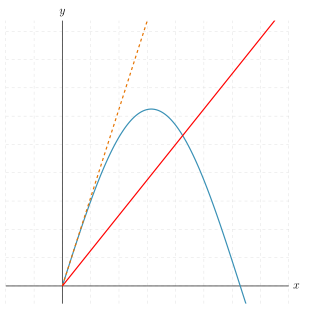
2011 Paper 1 Q6
Use the binomial expansion to show that the coefficient of \(x^r\) in the expansion of \((1-x)^{-3}\) is \(\frac12 (r+1)(r+2)\,\).
- Show that the coefficient of \(x^r\) in the expansion of \[ \frac{1-x+2x^2}{(1-x)^3} \] is \(r^2+1\) and hence find the sum of the series \[ 1+\frac22+\frac54+\frac{10}8+\frac{17}{16}+\frac{26}{32}+\frac{37}{64} +\frac{50}{128}+ \cdots \,. \]
- Find the sum of the series \[ 1+2+\frac94+2+\frac{25}{16}+\frac{9}{8}+\frac{49}{64} + \cdots \,. \]
Solution: Notice that the coefficient of \(x^r\) is \((-1)^r\frac{(-3) \cdot (-3-1) \cdots (-3-r+1)}{r!} = (-1)^r \frac{(-1)(-2)(-3)(-4) \cdots (-(r+2))}{(-1)(-2)r!} = (-1)^r(-1)^{r+2}\frac{(r+2)!}{2r!} = \frac{(r+2)(r+1)}2\).
- The coefficient of \(x^r\) is \begin{align*} && c_r &=\frac{(r+1)(r+2)}{2} - \frac{(r-1+1)(r-1+2)}{2} + 2 \frac{((r-2+1)(r-2+2)}{2} \\ &&&= \frac{r^2+3r+2}{r} - \frac{r^2+r}{2} + \frac{2r^2-2r}{2}\\ &&&= \frac{2r^2+2}{2} = r^2+1 \end{align*} \begin{align*} && S & = 1+\frac22+\frac54+\frac{10}8+\frac{17}{16}+\frac{26}{32}+\frac{37}{64} +\frac{50}{128}+ \cdots \\ &&&= \sum_{r=0}^{\infty} \frac{r^2+1}{2^r} \\ &&&= \frac{1-\tfrac12+2 \cdot \tfrac14}{(1-\tfrac12)^3} \\ &&&= 8 \end{align*}
- \(\,\) \begin{align*} && S &= 1+2+\frac94+2+\frac{25}{16}+\frac{9}{8}+\frac{49}{64} + \cdots \\ &&&= \sum_{r=0}^{\infty} \frac{(r+1)^2}{2^r} \\ &&&= 2 \sum_{r=0}^{\infty} \frac{(r+1)^2}{2^{r+1}} \\ &&&= 2 \sum_{r=1}^{\infty} \frac{r^2}{2^{r}} \\ &&&= 2 \left (\sum_{r=0}^{\infty} \frac{r^2+1}{2^{r}} - \sum_{r=0}^{\infty} \frac{1}{2^{r}} \right) \\ &&&= 2 (8 - 1) = 14 \end{align*}
2011 Paper 1 Q7
In this question, you may assume that \(\ln (1+x) \approx x -\frac12 x^2\) when \(\vert x \vert \) is small. The height of the water in a tank at time \(t\) is \(h\). The initial height of the water is \(H\) and water flows into the tank at a constant rate. The cross-sectional area of the tank is constant.
- Suppose that water leaks out at a rate proportional to the height of the water in the tank, and that when the height reaches \(\alpha^2 H\), where \(\alpha\) is a constant greater than 1, the height remains constant. Show that \[ \frac {\d h}{\d t } = k( \alpha^2 H -h)\,, \] for some positive constant \(k\). Deduce that the time \(T\) taken for the water to reach height \(\alpha H\) is given by \[ kT = \ln \left(1+\frac1\alpha\right)\,, \] and that \(kT\approx \alpha^{-1}\) for large values of \(\alpha\).
- Suppose that the rate at which water leaks out of the tank is proportional to \(\sqrt h\) (instead of \(h\)), and that when the height reaches \(\alpha^2 H\), where \(\alpha\) is a constant greater than 1, the height remains constant. Show that the time \(T'\) taken for the water to reach height \(\alpha H\) is given by \[ cT'=2\sqrt H \left( 1 - \sqrt\alpha +\alpha \ln \left(1+\frac1 {\sqrt\alpha} \right)\right)\, \] for some positive constant \(c\), and that \(cT'\approx \sqrt H\) for large values of \(\alpha\).
Solution:
- \begin{align*} \frac{\d h}{\d t} &= \underbrace{c}_{\text{flow in}} - \underbrace{kh}_{\text{flow out}} \end{align*}. We also know that when \(h = \alpha^2 H\), \(\frac{\d h}{\d t} = 0\), ie \(c - k \alpha^2 H = 0\) therefore: \[ \frac{\d h}{\d t} = k(\alpha^2 H - h) \] \begin{align*} && \frac{\d h}{\d t} &= k(\alpha^2 H - h) \\ && \int \frac{1}{\alpha^2 H - h} \d h &= \int k \d t \\ && - \ln |\alpha^2H -h| &= kt + C \\ t = 0, h = H: && -\ln |(1-\alpha^2 )H| &= C \\ \Rightarrow && kt &= \ln \left | \frac{(\alpha^2-1)H}{h-\alpha^2 H }\right | \\ && kT &= \ln \frac{(\alpha^2-1)H}{\alpha H - \alpha^2 H} \\ &&&= \ln \frac{1+\alpha}{\alpha} \\ &&&= \ln \left (1 + \frac1{\alpha} \right) \\ &&&\approx \frac1{\alpha} - \frac12 \frac1{\alpha^2}\\ &&&\approx \alpha^{-1} \end{align*}
- \begin{align*} && \frac{\d h}{\d t} &=c(\alpha \sqrt{H} - \sqrt{h}) \\ \Leftrightarrow && c \int_0^{T'} \d t&= \int_{H}^{\alpha H} \frac{1}{\alpha \sqrt{H}-\sqrt{h}} \d h \\ u = \sqrt{h/H}: && cT' &= \int_1^{\sqrt{\alpha}} \frac{1}{\alpha \sqrt{H} - \sqrt{H}u} 2\sqrt{H}u \d u \\ &&&= 2\sqrt{H}\int_1^{\sqrt{\alpha}} \frac{u}{\alpha - u} \d u \\ &&&= 2\sqrt{H}\int_1^{\sqrt{\alpha}} \frac{u - \alpha + \alpha}{\alpha - u} \d u \\ &&&= 2\sqrt{H}\left [-u - \alpha \ln |\alpha - u| \right]_1^{\sqrt{\alpha}} \\ &&&= 2\sqrt{H}\left ( -\sqrt{\alpha} + 1- \alpha \ln (\alpha - \sqrt{\alpha}) + \alpha \ln |\alpha - 1| \right) \\ &&&= 2\sqrt{H}\left (1-\sqrt{\alpha} + \alpha \ln \left ( \frac{\alpha-1}{\alpha - \sqrt{\alpha}} \right)\right)\\ &&&= 2\sqrt{H}\left (1-\sqrt{\alpha} + \alpha \ln \left ( \frac{\sqrt{\alpha}^2-1}{\sqrt{\alpha}(\sqrt{\alpha}-1)} \right)\right)\\ &&&= 2\sqrt{H}\left (1-\sqrt{\alpha} + \alpha \ln \left ( \frac{\sqrt{\alpha}+1}{\sqrt{\alpha}} \right)\right)\\ &&&= \boxed{2\sqrt{H}\left (1-\sqrt{\alpha} + \alpha \ln \left ( 1+\frac{1}{\sqrt{\alpha}} \right)\right)}\\ &&&\approx2\sqrt{H}\left (1-\sqrt{\alpha} + \alpha \left ( \frac{1}{\sqrt{\alpha}}-\frac12 \frac{1}{\alpha} \right)\right) \\ &&&=2\sqrt{H} \left ( 1 - \frac12 \right) \\ &&&= \sqrt{H} \end{align*} as required.
2011 Paper 1 Q8
- The numbers \(m\) and \(n\) satisfy
\[
m^3=n^3+n^2+1\,.
\tag{\(*\)}
\]
- Show that \(m > n\). Show also that \(m < n+1\) if and only if \(2n^2+3n > 0\,\). Deduce that \(n < m < n+1\) unless \(-\frac32 \le n \le 0\,\).
- Hence show that the only solutions of \((*)\) for which both \(m\) and \(n\) are integers are \((m,n) = (1,0)\) and \((m,n)= (1,-1)\).
- Find all integer solutions of the equation \[ p^3=q^3+2q^2-1\,. \]
2011 Paper 1 Q9
A particle is projected at an angle \(\theta\) above the horizontal from a point on a horizontal plane. The particle just passes over two walls that are at horizontal distances \(d_1\) and \(d_2\) from the point of projection and are of heights \(d_2\) and \(d_1\), respectively. Show that \[ \tan\theta = \frac{d_1^2+d_\subone d_\subtwo +d_2^2}{d_\subone d_\subtwo}\,. \] Find (and simplify) an expression in terms of \(d_1\) and \(d_2\) only for the range of the particle.
2011 Paper 1 Q10
A particle, \(A\), is dropped from a point \(P\) which is at a height \(h\) above a horizontal plane. A~second particle, \(B\), is dropped from \(P\) and first collides with \(A\) after \(A\) has bounced on the plane and before \(A\) reaches \(P\) again. The bounce and the collision are both perfectly elastic. Explain why the speeds of \(A\) and \(B\) immediately before the first collision are the same. The masses of \(A\) and \(B\) are \(M\) and \(m\), respectively, where \(M>3m\), and the speed of the particles immediately before the first collision is \(u\). Show that both particles move upwards after their first collision and that the maximum height of \(B\) above the plane after the first collision and before the second collision is \[ h+ \frac{4M(M-m)u^2}{(M+m)^2g}\,. \]
2011 Paper 1 Q11
A thin non-uniform bar \(AB\) of length \(7d\) has centre of mass at a point \(G\), where \(AG=3d\). A light inextensible string has one end attached to \(A\) and the other end attached to \(B\). The string is hung over a smooth peg \(P\) and the bar hangs freely in equilibrium with \(B\) lower than~\(A\). Show that \[ 3\sin\alpha = 4\sin\beta\,, \] where \(\alpha\) and \(\beta\) are the angles \(PAB\) and \(PBA\), respectively. Given that \(\cos\beta=\frac45\) and that \(\alpha\) is acute, find in terms of \(d\) the length of the string and show that the angle of inclination of the bar to the horizontal is \(\arctan \frac17\,\).
2011 Paper 1 Q12
I am selling raffle tickets for \(\pounds1\) per ticket. In the queue for tickets, there are \(m\) people each with a single \(\pounds1\) coin and \(n\) people each with a single \(\pounds2\) coin. Each person in the queue wants to buy a single raffle ticket and each arrangement of people in the queue is equally likely to occur. Initially, I have no coins and a large supply of tickets. I stop selling tickets if I cannot give the required change.
- In the case \(n=1\) and \(m\ge1\), find the probability that I am able to sell one ticket to each person in the queue.
- By considering the first three people in the queue, show that the probability that I am able to sell one ticket to each person in the queue in the case \(n=2\) and \(m\ge2\) is \(\dfrac{m-1}{m+1}\,\).
- Show that the probability that I am able to sell one ticket to each person in the queue in the case \(n=3\) and \(m\ge3\) is \(\dfrac{m-2}{m+1}\,\).
Solution:
- The only way you wont be able to sell to them is if they are first, ie \(\frac1{m+1}\)
- If \(n=2\), the the only way you fail to sell to them is if one comes first or they both appear before two people with pound coins, ie \(2\) or \(122\). These have probabilities \(\frac{2}{m+2}\) and \(\frac{m}{m+2} \cdot \frac{2}{m+1} \frac{1}{m} = \frac{2}{(m+1)(m+2)}\). Therefore the total probability you don't sell all the tickets is \(\frac{2}{m+2}\left ( 1 + \frac{1}{m+1} \right) = \frac{2}{m+2} \frac{m+2}{m+1} = \frac{2}{m+1}\). Therefore the probability you do sell all the tickets is \(1 - \frac{2}{m+1} = \frac{m-1}{m+1}\)
- The only ways to fail when \(n=3\) are: \(2\), \(122\), or if all three \(2\)s appear before three \(1\)s. this can happen in \(11222\), \(12122\) These happen with probability: \begin{align*} 2: && \frac{3}{m+3} \\ 122: && \frac{m}{m+3} \cdot \frac{3}{m+2} \cdot \frac{2}{m+1} \\ 11222: && \frac{m(m-1) 6}{(m+3)(m+2)(m+1)m(m-1)} \\ 12122: && \frac{m(m-1) 6}{(m+3)(m+2)(m+1)m(m-1)} \\ \end{align*} Therefore the total probability is: \begin{align*} P &= \frac{1}{(m+3)(m+2)(m+1)} \left (3(m+2)(m+1)+6m + 12 \right) \\ &= \frac{1}{(m+3)(m+2)(m+1)} \left (3(m+1)(m+2) \right) \\ &= \frac{3}{m+1} \end{align*} and the result follows
2011 Paper 1 Q13
In this question, you may use without proof the following result: \[ \int \sqrt{4-x^2}\, \d x = 2 \arcsin (\tfrac12 x ) + \tfrac 12 x \sqrt{4-x^2} +c\,. \] A random variable \(X\) has probability density function \(\f\) given by \[ \f(x) = \begin{cases} 2k & -a\le x <0 \\[3mm] k\sqrt{4-x^2} & \phantom{-} 0\le x \le 2 \\[3mm] 0 & \phantom{-}\text{otherwise}, \end{cases} \] where \(k\) and \(a\) are positive constants.
- Find, in terms of \(a\), the mean of \(X\).
- Let \(d\) be the value of \(X\) such that \(\P(X> d)=\frac1 {10}\,\). Show that \(d < 0\) if \(2a> 9\pi\) and find an expression for \(d\) in terms of \(a\) in this case.
- Given that \(d=\sqrt 2\), find \(a\).
Solution: First notice that \begin{align*} && 1 &= \int_{-a}^2 f(x) \d x \\ &&&= 2ka + k\pi \\ \Rightarrow && k &= (\pi + 2a)^{-1} \end{align*}
- \(\,\) \begin{align*} && \E[X] &= \int_{-a}^2 x f(x) \d x\\ &&&= \int_{-a}^0 2kx \d x + k\int_0^{2} x\sqrt{4-x^2} \d x\\ &&&= \left [kx^2 \right]_{-a}^0 +k \left [-\frac13(4-x^2)^{\frac32} \right]_0^2 \\ &&&= -ka^2 + \frac83k \\ &&&= \frac{\frac83-a^2}{\pi + 2a} \end{align*}
- Consider \(\mathbb{P}(X < 0)\) then \(d < 0 \Leftrightarrow \mathbb{P}(X < 0) > \frac{9}{10}\) \begin{align*} && \frac{9}{10} &< \mathbb{P}(X < 0) \\ &&&= \int_{-a}^0 2k \d x \\ &&&= \frac{2a}{\pi+2a} \\ \Leftrightarrow && 9\pi &< 2a \\ \\ && \frac{9}{10} &= \int_{-a}^d 2k \d x \\ &&&= \frac{2(d+a)}{\pi + 2a} \\ \Rightarrow && 9\pi &= 2a + 20d \\ \Rightarrow && d &= \frac{2a-9\pi}{20} \end{align*}
- Suppose \(d=\sqrt 2\) then \begin{align*} && \frac1{10} &= \int_{\sqrt{2}}^2 f(x) \d x \\ &&&= \int_{\sqrt{2}}^2 k\sqrt{4-x^2} \d x \\ &&&= k\left [ 2 \sin^{-1} \tfrac12 x + \tfrac12 x \sqrt{4-x^2}\right]_{\sqrt{2}}^2 \\ &&&= k\left (\pi -\frac{\pi}{2} - 1 \right) \\ \Rightarrow && \pi + 2a &= 5\pi - 10 \\ \Rightarrow && a &= 2\pi-5 \end{align*}
2011 Paper 2 Q1
- Sketch the curve \(y=\sqrt{1-x} + \sqrt{3+x}\;\). Use your sketch to show that only one real value of \(x\) satisfies \[ \sqrt{1-x} + \sqrt{3+x} = x+1\,, \] and give this value.
- Determine graphically the number of real values of \(x\) that satisfy \[ 2\sqrt{1-x} = \sqrt{3+x} + \sqrt{3-x}\;. \] Solve this equation.
Solution:
- Clearly the only solution is \(x = 1\)

- There is clearly only one solution, with \(x \approx -2\) \begin{align*} && 4(1-x) &= 6+2\sqrt{9-x^2} \\ && -2x-1 &=\sqrt{9-x^2} \\ \Rightarrow && 4x^2+4x+1 &= 9-x^2 \\ \Rightarrow && 0 &= 5x^2+4x-8 \\ &&x&= \frac{-2\pm 2\sqrt{11}}{5} \\ \Rightarrow && x &= -\left ( \frac{2+2\sqrt{11}}{5} \right) \end{align*}

2011 Paper 2 Q2
Write down the cubes of the integers \(1, 2, \ldots , 10\). The positive integers \(x\), \(y\) and \(z\), where \(x < y\), satisfy \[ x^3+y^3 = kz^3\,, \tag{\(*\)} \] where \(k\) is a given positive integer.
- In the case \(x+y =k\), show that \[ z^3 = k^2 -3kx+3x^2\,. \] Deduce that \((4z^3 - k^2)/3\) is a perfect square and that \(\frac14 {k^2} \le z^3 < k^2\,\). Use these results to find a solution of \((*)\) when \(k=20\).
- By considering the case \(x+y = z^2\), find two solutions of \((*)\) when \(k=19\).
Solution: \begin{array}{c|c} n & n^3 \\ \hline 1 & 1 \\ 2 & 8 \\ 3 & 27 \\ 4 & 64 \\ 5 & 125 \\ 6 & 216 \\ 7 & 343 \\ 8 & 512 \\ 9 & 729 \\ 10 & 1000 \\ \end{array}
- \(\,\) \begin{align*} && x^3 + y^3 &= kz^3 \\ \Rightarrow &&k(x^2-xy+y^2)&=kz^3 \\ \Rightarrow && z^3 &= (x+y)^2-3xy \\ &&&= k^2-3x(k-x) \\ &&&= k^2-3xk+3x^2 \\ \\ \Rightarrow && \frac{4z^3-k^2}{3} &= \frac{4(k^2-3xk+3x^2)-k^2}{3} \\ &&&= \frac{3k^2-12xk+12x^2}{3} \\ &&&= k^2-4xk+4x^2 \\ &&&= (k-2x)^2 \end{align*} Therefore \(\frac{4z^3-k^2}{3}\) is a perfect square and so \(4z^3 \geq k^2 \Rightarrow z^3 \geq \frac14k^2\). Clearly \(kz^3 < x^3+3x^2y+3xy^2+y^3 = k^3 \Rightarrow z^3 < k^2\), therefore \(\frac14 k^2 \leq z^3 < k^2\) Therefore if \(k = 20\), \(100 \leq z^3 < 400 \Rightarrow z \in \{ 5, 6,7\}\). Mod \(3\) it is clear that \(4z^3-k^2\) is not divisible by \(3\) for \(z = 5,6\) therefore \(z = 7\) \begin{align*} && 343 &= 3x^2-60x+400 \\ \Rightarrow && 0 &= 3x^2-60x+57 \\ \Rightarrow && 0 &= x^2-20x+19 \\ \Rightarrow && x &= 1,19 \end{align*} Therefore a solution is \(1^3 + 19^3 = 20 \cdot 7^3\)
- When \(x+y = z^2\) we must have \begin{align*} && x^3 + y^3 &= kz^3 \\ \Rightarrow &&(x^2-xy+y^2)&=kz \\ \Rightarrow && kz &= (x+y)^2-3xy \\ &&&= z^4-3x(z^2-x)\\ &&&= z^4-3xz^2+3x^2 \\ \Rightarrow && 0 &= 3x^2-3z^2x+z^4-kz \\ \\ \Rightarrow && 0 &\leq \Delta = 9z^4-12(z^4-kz) \\ &&&=12kz-3z^4 \\ \Rightarrow && z^3 &\leq 4k \end{align*} If \(k = 19\) this means \(z \leq 4\) \begin{array}{c|c|c|c} z & 19z^3 & x & y \\ \hline 1 & 19 & - & - \\ 2 & 152 & 3 & 5 \\ 3 & 513 & 1 & 8 \end{array} So two solutions are \(1^3+8^3 = 19 \cdot 3^3\) and \(3^3+5^3=19 \cdot 2^3\)