Problems
Filters
39 problems found
2009 Paper 1 Q1
A {\em proper factor} of an integer \(N\) is a positive integer, not \(1\) or \(N\), that divides \(N\).
- Show that \(3^2\times 5^3\) has exactly \(10\) proper factors. Determine how many other integers of the form \(3^m\times5^n\) (where \(m\) and \(n\) are integers) have exactly 10 proper factors.
- Let \(N\) be the smallest positive integer that has exactly \(426\) proper factors. Determine \(N\), giving your answer in terms of its prime factors.
Solution:
- All factors of \(3^2 \times 5^3\) have factors of the form \(3^k \times 5^l\) where \(0 \leq k \leq 2\) and \(0 \leq l \leq 3\) therefore there are \(3\) possible values for \(k\) and \(4\) possible values for \(l\), which gives \(3 \times 4 = 12\) factors, which includes \(2\) factors we aren't counting, so \(10\) proper factors. By the same argument \(3^m \times 5^n\) has \((m+1) \times (n+1) - 2\) proper factors, so we want \((m+1) \times (n+1) = 12\), so we could have \begin{array}{cccc} \text{factor} & m+1 & n + 1 & m & n \\ 12 = 12 \times 1 & 12 & 1 & 11 & 0 \\ 12 = 6 \times 2 & 6& 2 & 5 & 1 \\ 12 = 4 \times 3 & 4& 3 & 3 & 2 \\ 12 = 3 \times 4 & 3& 4 & 2 & 3 \\ 12 = 2 \times 6 & 2& 6 & 1 & 5 \\ 12 = 1 \times 12 & 1& 12 & 0 & 11 \\ \end{array} So we could have \(3^{11}, 3^{5} \times 5^1 3^3 \times 5^2, 3^2 \times 5^3, 3^1 \times 5^5, 5^{11}\)
- Suppose \(N\) has \(426\) proper factors, then it has \(428 = 2^2 \times 107\) factors, so it will either factor as \(p^{427}\) or \(p_1^{106} p_2^{3}\) or \(p_1^{106} p_2 p_3\). Clearly the first will be very large, and we should have \(p_1 < p_2 < p_3\), so lets consider \(2^{106}\) with either \(3^3 = 27\) or \(3 \times = 15 < 27\). Therefore we should take \(2^{106} \times 3 \times 5\)
2009 Paper 1 Q2
A curve has the equation \[ y^3 = x^3 +a^3+b^3\,, \] where \(a\) and \(b\) are positive constants. Show that the tangent to the curve at the point \((-a,b)\) is \[ b^2y-a^2x = a^3+b^3\,. \] In the case \(a=1\) and \(b=2\), show that the \(x\)-coordinates of the points where the tangent meets the curve satisfy \[ 7x^3 -3x^2 -27x-17 =0\,. \] Hence find positive integers \(p\), \(q\), \(r\) and \(s\) such that \[ p^3 = q^3 +r^3 +s^3\,. \]
Solution: \begin{align*} && y^3 &= x^3 + a^3 + b^3 \\ \Rightarrow && 3y^2 \frac{\d y}{\d x} &= 3x^2 \\ \Rightarrow && \frac{\d y}{\d x} &= \frac{x^2}{y^2} \end{align*} Therefore the tangent at the point \((-a,b)\) has gradient \(\frac{a^2}{b^2}\), ie \begin{align*} && \frac{y-b}{x+a} &= \frac{a^2}{b^2} \\ \Rightarrow && b^2y - b^3 &= a^2 x + a^3 \\ \Rightarrow && b^2 y-a^2 x &= a^3 + b^3 \end{align*} Notice that tangent will be, \(4y-x = 9\) so substituting this we obtain: \begin{align*} && \left (\frac{9+x}{4} \right)^3 &= x^3 + 9 \\ \Rightarrow && 9^3 + 3 \cdot 9^2 x + 3 \cdot 9x^2 + x^3 &= 64x^3 + 64 \cdot 9 \\ \Rightarrow && 9 \cdot (9^2 - 8^2) + 9 \cdot (3 \cdot 9) + 9 \cdot 3x^2 -9 \cdot 7x^3 &= 0 \\ \Rightarrow && 7x^3-3x^2-27x-17 &= 0 \\ \Rightarrow && (x+1)^2(7x-17) &= 0 \tag{repeated root since tangent} \end{align*} So we have another point on the curve \(y^3 = x^3 + 2^3 + 1^3\), namely \((\frac{17}7, \frac{17+9 \cdot 7}{28}) = (\frac{17}7, \frac{20}{7})\), so \begin{align*} 20^3 &= 17^3 + 14^3 + 7^3 \end{align*}
2009 Paper 1 Q3
- By considering the equation \(x^2+x-a=0\,\), show that the equation \(x={(a-x)\vphantom M}^{\frac12}\) has one real solution when \(a\ge0\) and no real solutions when \(a<0\,\). Find the number of distinct real solutions of the equation \[ x={\big((1+a)x-a\big)}^{\!\frac13} \] in the cases that arise according to the value of \(a\).
- Find the number of distinct real solutions of the equation \[ x={(b+x)\vphantom M}^{\frac12} \] in the cases that arise according to the value of \(b\,\).
Solution:
- \(\,\) \begin{align*} && x &= (a-x)^{\frac12} \\ \Rightarrow && x^2 &= a - x \\ \Rightarrow && 0 &= x^2 + x - a \end{align*} This has a roots if \(\Delta = 1 + 4a \geq 0 \Rightarrow a \geq -\frac14\). These roots also need to be positive (since \(x \geq 0\)). Since \(f(0) = -a\) we have one positive root if \(a \geq 0\). If \(a \leq 0\) then since the roots are symmetric about \(x = -\frac12\), both roots are negative and there are no positive roots. Therefore we have on real solution if \(a \geq 0\) and non otherwise. \begin{align*} && x & = \left ( (1+a)x - a \right)^{\frac13} \\ \Leftrightarrow && x^ 3 &= (1+a)x - a \\ \Leftrightarrow && 0 &= x^3- (1+a)x + a \\ \Leftrightarrow && 0 &= (x-1)(x^2+x-a) \\ \end{align*} Since every solution to the first equation is a solution to the second, we have \(x = 1\) always works, and there is an additional two solutions if \(a > -\frac14\) and a single extra solution if \(a = -\frac14\). We can also repeat solutions if \(1\) is a root of \(x^2+x -a\), ie when \(a = 2\) Therefore: One solution if \(a < -\frac14\) Two solutions if \(a = -\frac14, 2\) Three solutions if \(a > -\frac14, a \neq 2\)
- \(\,\) \begin{align*} && x &= (b+x)^{\frac12} \\ \Rightarrow && x^2 &= b + x \\ \Rightarrow && 0 &= x^2 - x - b \end{align*} This has a positive root if \(\frac14 - \frac12 - b \leq 0 \rightarrow b \geq \frac14\). It has two positive roots if \(b \geq 0\). Therefore two solutions if \(b > \frac14\) and one solution if \(b = \frac14\)
2009 Paper 1 Q4
The sides of a triangle have lengths \(p-q\), \(p\) and \(p+q\), where \(p>q> 0\,\). The largest and smallest angles of the triangle are \(\alpha\) and \(\beta\), respectively. Show by means of the cosine rule that \[ 4(1-\cos\alpha)(1-\cos\beta) = \cos\alpha + \cos\beta \,. \] In the case \(\alpha = 2\beta\), show that \(\cos\beta=\frac34\) and hence find the ratio of the lengths of the sides of the triangle.
Solution: The largest angle will be opposite the side with length \(p+q\). Similarly the smallest angle will be opposite the side with length \(p-q\). The cosine rule tells us that: \begin{align*} && (p+q)^2 &= p^2 + (p-q)^2 - 2p(p-q) \cos \alpha \\ && 0 &= p(p-4q-2(p-q)\cos \alpha)\\ && 0 &= p(1-2\cos \alpha) + q(2\cos \alpha - 4)\\ \Rightarrow && \frac{p}{q} & = \frac{4-2 \cos \alpha}{1-2 \cos \alpha} \\ && (p-q)^2 &= p^2 + (p+q)^2 - 2p(p+q) \cos \beta \\ && 0 &= p(p+4q-2(p+q) \cos \beta) \\ && 0 &= p(1-2\cos \beta)+q(4-2\cos \beta) \\ \Rightarrow && \frac{p}{q} &= \frac{2\cos \beta - 4}{1-2\cos \beta} \\ \Rightarrow && \frac{4-2 \cos \alpha}{1-2 \cos \alpha} &= \frac{2\cos \beta - 4}{1-2\cos \beta} \\ \Rightarrow && (2-\cos \alpha)(1-2\cos \beta) &= (\cos \beta - 2)(1 - 2 \cos \alpha) \\ \Rightarrow && 2 - \cos \alpha -4\cos \beta+2\cos \alpha \cos \beta &= \cos \beta - 2-2\cos \alpha \cos \beta + 4 \cos \alpha \\ \Rightarrow && 4-4\cos \alpha - 4\cos \beta+4\cos \alpha\cos \beta &= \cos \alpha + \cos \beta \\ \Rightarrow && 4(1-\cos \alpha)(1-\cos \beta) &= \cos \alpha + \cos \beta \end{align*} If \(\alpha = 2 \beta\), and let \(c = \cos \beta\) \begin{align*} && 4 (1- \cos 2 \beta)(1-\cos \beta) &= \cos 2 \beta + \cos \beta \\ \Rightarrow && 4(1-(2c^2-1))(1-c) &= 2c^2-1+c\\ \Rightarrow && 8(1+c)(1-c)^2 &= (2c-1)(c+1) \\ \Rightarrow && 0 &= (c+1)(8(1-c)^2-(2c-1)) \\ &&&= (c+1)(8c^2-18c+9) \\ &&&= (c+1)(4c-3)(2c-3) \\ \end{align*} Therefore \(c = -1, \frac32, \frac34\). Clearly \(\cos \beta \neq -1, \frac32\), since they are not valid angles in a triangle (or valid values of \(\cos \beta\)). \(\frac{p}{q} = \frac{2 \cdot \frac34-4 }{1 - 2\cdot \frac34} = \frac{3-8}{2-3} = 5\) so \(4:5:6\)
2009 Paper 1 Q5
A right circular cone has base radius \(r\), height \(h\) and slant length \(\ell\). Its volume \(V\), and the area \(A\) of its curved surface, are given by \[ V= \tfrac13 \pi r^2 h \,, \ \ \ \ \ \ \ A = \pi r\ell\,. \]
- Given that \(A\) is fixed and \(r\) is chosen so that \(V\) is at its stationary value, show that \(A^2 = 3\pi^2r^4\) and that \(\ell =\sqrt3\,r\).
- Given, instead, that \(V\) is fixed and \(r\) is chosen so that \(A\) is at its stationary value, find \(h\) in terms of \(r\).
Solution:
- Given \(A\) is fixed, and \(h^2 + r^2 = \ell^2\), we can look at \begin{align*} && V^2 &= \frac19 \pi^2 r^4 h^2 \\ &&&= \frac19\pi^2r^4(\ell^2 - r^2) \\ &&&= \frac19\pi^2 r^4\left (\frac{A^2}{\pi^2r^2} - r^2 \right) \\ &&&= \frac{A^2r^2 - \pi^2r^6}{9} \end{align*} Differentiating wrt to \(r\) we find that \(2rA^2-6\pi^2 r^5 = 0\) or hence \(A^2 = 3\pi^2 r^4 \Rightarrow A = \sqrt{3}\pi r^2\). Therefore \(\sqrt{3}\pi r^2 = \pi r \ell \Rightarrow \ell = \sqrt{3}r\).
- Supposing \(V\) is fixed, then \begin{align*} && A^2 &= \pi^2 r^2\ell^2 \\ &&&= \pi^2 r^2 (h^2+r^2) \\ &&&= \pi^2 r^2 \left ( \frac{9V^2}{\pi^2r^4} + r^2 \right) \\ &&&= 9V^2r^{-2} + \pi^2r^4 \\ \end{align*} Differentiating wrt to \(r\) we find \(-18V^2r^{-3} + 4\pi^2 r^3 = 0\) so \(V^2 = \frac{2\pi^2}{9}r^6\) or \(V = \frac{\sqrt{2}\pi}{3}r^3\), from which it follows: \(\frac{\sqrt{2}\pi}{3}r^3 = \frac13\pi r^2 h \Rightarrow h = \sqrt{2}r\)
2009 Paper 1 Q6
- Show that, for \(m>0\,\), \[ \int_{1/m}^m \frac{x^2}{x+1} \, \d x = \frac{(m-1)^3(m+1)}{2m^2}+ \ln m\,. \]
- Show by means of a substitution that \[ \int_{1/m}^m \frac1 {x^n(x+1)}\,\d x = \int_{1/m}^m \frac {u^{n-1}}{u+1}\,\d u \,. \]
- Evaluate:
- \(\bf (a)\) \(\displaystyle \int_{1/2}^2 \frac {x^5+3}{x^3(x+1)}\,\d x \;;\)
- \(\bf (b)\) \(\displaystyle \int_1^2 \frac{x^5+x^3 +1}{x^3(x+1)}\, \d x\;. \)
Solution:
- \(\,\) \begin{align*} && \int_{1/m}^m \frac{x^2}{x+1} \d x &= \int_{1/m}^m \left ( x- 1 + \frac{1}{x+1} \right) \d x \\ &&&= \left [ \frac{x^2}{2} - x + \ln (x+1) \right]_{1/m}^m \\ &&&= \left ( m^2/2 - m + \ln(m+1) \right)- \left ( \frac{1}{2m^2} - \frac{1}{m} + \ln\left(\frac1m+1\right) \right) \\ &&&= \frac{m^4-2m^3-1+2m}{2m^2} + \ln (m+1) - \ln(m+1) + \ln m \\ &&&= \frac{(m-1)^3(m+1)}{2m^2} + \ln m \end{align*}
- \(\,\) \begin{align*} u = \frac{1}x, \d x = -\frac{1}{u^2} \d u:&& \int_{1/m}^m \frac1 {x^n(x+1)}\,\d x &= \int_{u=m}^{u=1/m} \frac{1}{u^{-n}(u^{-1}+1)} \frac{-1}{u^2} \d u \\ &&&= \int_{1/m}^m \frac{u^{n-1}}{u+1} \d u \end{align*}
- \(\bf (a)\) \(\,\) \begin{align*} && I &= \int_{1/2}^2 \frac {x^5+3}{x^3(x+1)}\,\d x \\ &&&= \int_{1/2}^2 \left ( \frac{x^2}{x+1} + \frac{3}{x^3(x+1)} \right) \d x \\ &&&= \int_{1/2}^2 \frac{x^2}{x+1} \d x + 3 \int_{1/2}^2 \frac{x^2}{x+1} \d x \\ &&&= 4 \left ( \frac{(2-1)^3(2+1)}{2 \cdot 2^2} + \ln 2 \right) \\ &&&= \frac32+4 \ln 2 \end{align*}
- \(\bf (b)\) \(\,\) \begin{align*} && J &= \int_1^2 \frac{x^5+x^3 +1}{x^3(x+1)}\, \d x \\ && K &= \int_1^2 \frac{x^5 +1}{x^3(x+1)}\, \d x\\ u = 1/x, \d x = -1/u^2 \d u: &&&= \int_{u=1}^{u=1/2} \frac{u^{-5}+1}{u^{-3}(u^{-1}+1)} \frac{-1}{u^2} \d u \\ &&&= \int_{1/2}^1 \frac{1 + u^5}{u^3(u+1)} \d u \\ \Rightarrow && K &= \frac12 \int_{1/2}^2 \frac{x^5+1}{x^3(x+1)} \d x \\ &&&= \frac{(2-1)^3(2+1)}{2 \cdot 2^2} + \ln 2 \\ &&&= \frac38 + \ln 2 \\ && L &= \int_1^2 \frac{x^3}{x^3(x+1)} \d x \\ &&&= \ln (3) - \ln 2 \\ \Rightarrow && J &= \frac38 + \ln 3 \end{align*}
2009 Paper 1 Q7
Show that, for any integer \(m\), \[ \int_0^{2\pi} \e^x \cos mx \, \d x = \frac {1}{m^2+1}\big(\e^{2\pi}-1\big)\,. \]
- Expand \(\cos(A+B) +\cos(A-B)\). Hence show that \[\displaystyle \int_0^{2\pi} \e^x \cos x \cos 6x \, \d x\, = \tfrac{19}{650}\big( \e^{2\pi}-1\big)\,. \]
- Evaluate $\displaystyle \int_0^{2\pi} \e^x \sin 2x \sin 4x \cos x \, \d x\,$.
Solution: \begin{align*} && I &= \int_0^{2 \pi} e^{x} \cos m x \d x \\ &&&= \left [e^x \cos m x \right]_0^{2 \pi}-\int_0^{2 \pi} e^x m (-\sin mx) \d x\\ &&&= e^{2\pi}-1 + m\int_0^{2\pi}e^x \sin m x \d x \\ &&&= e^{2\pi}-1 + m\left [e^x \sin m x \right]_0^{2\pi} - m \int_0^{2\pi} e^x m \cos x \d x \\ &&&= e^{2\pi}-1+0 - m^2 I\\ \Rightarrow && (m^2+1)I &= e^{2\pi}-1 \\ \Rightarrow && I &= \frac{1}{m^2+1} (e^{2\pi}-1) \end{align*}
- \(\,\) \begin{align*} && \cos(A+B) + \cos(A-B) &= \cos A\cos B - \sin A \sin B + \cos A \cos B + \sin A \sin B \\ &&&= 2 \cos A \cos B \end{align*} Therefore \begin{align*} && I &= \int_0^{2\pi} e^x \cos x \cos 6x \d x \\ &&&= \int_0^{2\pi} e^x \frac12\left (\cos 7x + \cos 5x \right) \d x\\ &&&= \left ( \frac{1}{2(1+7^2)} + \frac1{2(1+5^2)}\right)(e^{2\pi}-1) \\ &&&= \left (\frac{1}{100}+\frac{1}{52} \right) (e^{2\pi}-1) \\ &&&= \frac{19}{650}(e^{2\pi}-1) \end{align*}
- \(\,\) \begin{align*} && I &= \int_0^{2\pi} e^x \sin 2x \sin 4x \cos x \d x\\ &&&= \int_0^{2\pi} e^x \tfrac12(\cos2x-\cos 6x) \cos x \d x\\ &&&= \frac12 \int_0^{2\pi} e^x \left (\cos 2x \cos x -\cos 6x \cos x \right) \d x \\ &&&= \frac14 \int_0^{2\pi} e^x \left (\cos 3x + \cos x-\cos 7x-\cos 5x \right) \d x \\ &&&= \frac14 \left (\frac{1}{1+3^2}+\frac{1}{1+1^2}-\frac{1}{1+7^2} - \frac{1}{1+5^2} \right)(e^{2\pi}-1) \\ &&&= \frac14 \left (\frac{1}{10}+\frac{1}{2}-\frac{1}{50} - \frac{1}{26} \right)(e^{2\pi}-1) \\ &&&= \frac{44}{325}(e^{2\pi}-1) \end{align*}
2009 Paper 1 Q8
- The equation of the circle \(C\) is \[ (x-2t)^2 +(y-t)^2 =t^2, \] where \(t\) is a positive number. Show that \(C\) touches the line \(y=0\,\). Let \(\alpha\) be the acute angle between the \(x\)-axis and the line joining the origin to the centre of \(C\). Show that \(\tan2\alpha=\frac43\) and deduce that \(C\) touches the line \(3y=4x\,\).
- Find the equation of the incircle of the triangle formed by the lines \(y=0\), \(3y=4x\) and \(4y+3x=15\,\). Note: The incircle of a triangle is the circle, lying totally inside the triangle, that touches all three sides.
Solution:
- This is a circle centre \((2t,t)\) with radius \(t\). Therefore it is exactly \(t\) away from the line \(y = 0\) so just touches that line. Not that \(\tan \alpha = \frac{t}{2t} = \frac12\) so \(\tan 2\alpha = \frac{2\tan \alpha}{1-\tan^2\alpha} = \frac{1}{1-\frac14} = \frac43\). Therefore the line \(y = \frac43x\) or \(3y = 4x\) is tangent to \(C\).
- Note that \(3y=4x\) and \(4y+3x=15\) are perpendicular, so this is a right-angled triangle with incenter \((2t,t)\) for some \(t\) and hypotenuse \(15\) We can find the third coordinate when \(3y-4x = 0\) and \(4y+3x = 15\) meet, ie \((\frac{9}{5}, \frac{12}5)\) The incentre lies on the bisector of the right angle at this point, which is the line through \((\frac{9}{5}, \frac{12}5)\) and \((\frac{15}{2}, 0)\), so \begin{align*} && \frac{2t-\frac{12}{5}}{t - \frac{9}{5}} &= \frac{-\frac{12}{5}}{\frac{15}2-\frac95} \\ \Rightarrow && \frac{10t-12}{5t-9} &= \frac{-24}{57} = -\frac{8}{19} \\ \Rightarrow && 190t - 12 \cdot 19 &= -40t + 72 \\ \Rightarrow && t &= 2 \end{align*} Therefore the center is \((4, 2)\) and the equation is \((x-4)^2+(y-2)^2=2^2\)
2009 Paper 1 Q9
Two particles \(P\) and \(Q\) are projected simultaneously from points \(O\) and \(D\), respectively, where~\(D\) is a distance \(d\) directly above \(O\). The initial speed of \(P\) is \(V\) and its angle of projection {\em above} the horizontal is \(\alpha\). The initial speed of \(Q\) is \(kV\), where \(k>1\), and its angle of projection {\em below} the horizontal is \(\beta\). The particles collide at time \(T\) after projection. Show that \(\cos\alpha = k\cos\beta\) and that \(T\) satisfies the equation \[ (k^2-1)V^2T^2 +2dVT\sin\alpha -d^2 =0\,. \] Given that the particles collide when \(P\) reaches its maximum height, find an expression for~\(\sin^2\alpha\) in terms of \(g\), \(d\), \(k\) and \(V\), and deduce that \[ gd\le (1+k)V^2\,. \]
2009 Paper 1 Q10
A triangular wedge is fixed to a horizontal surface. The base angles of the wedge are \(\alpha\) and \(\frac\pi 2-\alpha\). Two particles, of masses \(M\) and \(m\), lie on different faces of the wedge, and are connected by a light inextensible string which passes over a smooth pulley at the apex of the wedge, as shown in the diagram. The contacts between the particles and the wedge are smooth.
- Show that if \(\tan \alpha> \dfrac m M \) the particle of mass \(M\) will slide down the face of the wedge.
- Given that \(\tan \alpha = \dfrac{2m}M\), show that the magnitude of the acceleration of the particles is \[ \frac{g\sin\alpha}{\tan\alpha +2} \] and that this is maximised at \(4m^3=M^3\,\).
2009 Paper 1 Q11
Two particles move on a smooth horizontal table and collide. The masses of the particles are \(m\) and \(M\). Their velocities before the collision are \(u{\bf i}\) and \(v{\bf i}\,\), respectively, where \(\bf i\) is a unit vector and \(u>v\). Their velocities after the collision are \(p{\bf i}\) and \(q{\bf i}\,\), respectively. The coefficient of restitution between the two particles is \(e\), where \(e<1\).
- Show that the loss of kinetic energy due to the collision is \[ \tfrac12 m (u-p)(u-v)(1-e)\,, \] and deduce that \(u\ge p\).
- Given that each particle loses the same (non-zero) amount of kinetic energy in the collision, show that \[ u+v+p+q=0\,, \] and that, if \(m\ne M\), \[ e= \frac{(M+3m)u + (3M+m)v}{(M-m)(u-v)}\,. \]
Solution:
- \begin{align*} \text{COM}: && mu + Mv &= mp + Mq \\ \Rightarrow && m(u-p) &= M(q-v) \\ \text{NEL}: && q-p &= e(u-v) \\ && q +ev &= p+eu \\ && \Delta \text{ k.e.} &= \frac12 m u^2 + \frac12 M v^2 -\frac12 m p^2 - \frac12 M q^2 \\ &&&= \frac12m (u^2 - p^2)+\frac12M(v^2-q^2) \\ &&&= \frac12m (u^2 - p^2)+\frac12M(v-q)(v+q) \\ &&&= \frac12m(u^2-p^2) - \frac12 m(u-p)(v+q) \\ &&&= \frac12 m(u-p) \left ( u+p-v-q\right) \\ &&&= \frac12 m(u-p) \left (u-v+(p-q)\right) \\ &&&= \frac12 m(u-p) \left (u-v-e(u-v)\right) \\ &&&= \frac12m(u-p)(u-v)(1-e) \end{align*} Since the loss in energy is positive, and \(m\), \(u-v\) and \(1-e\) are all positive, so is \(u-p\), ie \(u \geq p\)
- \begin{align*} && \frac12 m u^2 - \frac12mp^2 &= \frac12Mv^2 - \frac12Mq^2 \\ && \frac12 m(u-p)(u+p) &= \frac12 M (v-q)(v+q) \\ && \frac12 m (u-p)(u+p) &= -\frac12 m(u-p)(v+q) \\ \Rightarrow && u+p+v+q &= 0 \end{align*} \begin{align*} && p+q &= -(u+v)\\ &&mp+Mq &= mu+Mv \\ \Rightarrow && (M-m)q &= mu+Mv+mu+mv\\ \Rightarrow && q &= \frac{(M+m)v+2mu}{M-m} \\ \Rightarrow && (m-M)p &= mu+Mv+Mu+Mv \\ \Rightarrow && p &= -\frac{(M+m)u+2Mv}{M-m} \\ \\ && e &= \frac{q-p}{u-v} \\ &&&= \frac{(M+m)v+2mu+(M+m)u+2Mv}{(u-v)(M-m)} \\ &&&= \frac{(3M+m)v+(3m+M)u}{(u-v)(M-m)} \end{align*}
2009 Paper 1 Q12
Prove that, for any real numbers \(x\) and \(y\), \(x^2+y^2\ge2xy\,\).
- Carol has two bags of sweets. The first bag contains \(a\) red sweets and \(b\) blue sweets, whereas the second bag contains \(b\) red sweets and \(a\) blue sweets, where \(a\) and \(b\) are positive integers. Carol shakes the bags and picks one sweet from each bag without looking. Prove that the probability that the sweets are of the same colour cannot exceed the probability that they are of different colours.
- Simon has three bags of sweets. The first bag contains \(a\) red sweets, \(b\) white sweets and \(c\) yellow sweets, where \(a\), \(b\) and \(c\) are positive integers. The second bag contains \(b\) red sweets, \(c\) white sweets and \(a\) yellow sweets. The third bag contains \(c\) red sweets, \(a\) white sweets and \(b\) yellow sweets. Simon shakes the bags and picks one sweet from each bag without looking. Show that the probability that exactly two of the sweets are of the same colour is \[ \frac {3(a^2b+b^2c+c^2a+ab^2 + bc^2 +ca^2)}{(a+b+c)^3}\,, \] and find the probability that the sweets are all of the same colour. Deduce that the probability that exactly two of the sweets are of the same colour is at least 6 times the probability that the sweets are all of the same colour.
2009 Paper 1 Q13
I seat \(n\) boys and \(3\) girls in a line at random, so that each order of the \(n+3\) children is as likely to occur as any other. Let \(K\) be the maximum number of consecutive girls in the line so, for example, \(K=1\) if there is at least one boy between each pair of girls.
- Find \(\P(K=3)\).
- Show that \[\P(K=1)= \frac{n(n-1)}{(n+2)(n+3)}\,. \]
- Find \(\E(K)\).
Solution:
- If all the girls are say together there are \(n+1\) ways to place the block of 3 girls. There are \(\binom{n+3}{3}\) ways to choose where to place the girls in total, therefore: \begin{align*} && \mathbb{P}(K =3) &= \frac{n+1}{\binom{n+3}3} \\ &&&= \frac{6(n+1)}{(n+3)(n+2)(n+1)} \\ &&&= \frac{6}{(n+3)(n+2)} \end{align*}
- If \(K= 1\) then all of the girls are separated. We can place three girls and two boys separating them, then we are allocating \(N-2\) boys to \(4\) gaps, ie \(\binom{N-2+3}{3} = \binom{N+1}{3}\). \begin{align*} && \mathbb{P}(K=3) &= \frac{\binom{n+1}{3}}{\binom{n+3}{3}} \\ &&&= \frac{(n+1)n(n-1)}{(n+3)(n+2)(n+1)} \\ &&&= \frac{n(n-1)}{(n+3)(n+2)} \end{align*}
- \(\,\) \begin{align*} \mathbb{E}(K) &= \sum_{k=1}^3 k \mathbb{P}(K=k) \\ &= \frac{6}{(n+3)(n+2)} + 2 \left (1 - \frac{6}{(n+3)(n+2)} - \frac{n(n-1)}{(n+3)(n+2)} \right) + 3\frac{n(n-1)}{(n+3)(n+2)} \\ &= 2+\frac{6-12+n(n-1)}{(n+3)(n+2)} \\ &= 2 + \frac{n^2-n-6}{(n+2)(n+3)}\\ &= 2 + \frac{(n-3)(n+2)}{(n+2)(n+3)} \\ &= 2 + \frac{n-3}{n+3} \\ &= \frac{2n}{n+3} \end{align*}
2009 Paper 2 Q1
Two curves have equations \(\; x^4+y^4=u\;\) and \(\; xy = v\;\), where \(u\) and \(v\) are positive constants. State the equations of the lines of symmetry of each curve. The curves intersect at the distinct points \(A\), \(B\), \(C\) and \(D\) (taken anticlockwise from \(A\)). The coordinates of \(A\) are \((\alpha,\beta)\), where \(\alpha > \beta > 0\). Write down, in terms of \(\alpha\) and \(\beta\), the coordinates of \(B\), \(C\) and \(D\). Show that the quadrilateral \(ABCD\) is a rectangle and find its area in terms of \(u\) and \(v\) only. Verify that, for the case \(u=81\) and \(v=4\), the area is \(14\).
Solution: The curve \(x^4 + y^4 = u\) has lines of symmetry:
- \(y = 0\)
- \(x = 0\)
- \(y = x\)
- \(y = -x\)
- \(y = x\)
- \(y = -x\)

2009 Paper 2 Q2
The curve \(C\) has equation \[ y= a^{\sin (\pi \e^ x)}\,, \] where \(a>1\).
- Find the coordinates of the stationary points on \(C\).
- Use the approximations \(\e^t \approx 1+t\) and \(\sin t \approx t\) (both valid for small values of \(t\)) to show that \[ y\approx 1-\pi x \ln a \; \] for small values of \(x\).
- Sketch \(C\).
- By approximating \(C\) by means of straight lines joining consecutive stationary points, show that the area between \(C\) and the \(x\)-axis between the \(k\)th and \((k+1)\)th maxima is approximately \[ \Big( \frac {a^2+1}{2a} \Big) \ln \Big ( 1+ \big( k-\tfrac34)^{-1} \Big)\,. \]
Solution:
- \(\,\) \begin{align*} && y & = a^{\sin(\pi e^x)} \\ \Rightarrow && \frac{\d y}{\d x} &= a^{\sin(\pi e^x)} \cdot ( \ln a) \cdot (\cos (\pi e^x)) \cdot \pi e^x \\ \frac{\d y}{\d x} = 0: && 0 &= \cos(\pi e^x) \\ \Rightarrow && \pi e^x &= \left ( \frac{2n+1}{2} \right) \pi \\ \Rightarrow && x &= \ln \left ( \frac{2n+1}{2} \right) \\ && y &= a^{(-1)^n} \\ &&(x,y) &= \left (\ln \left ( \frac{2n+1}{2} \right), a^{(-1)^n} \right) \end{align*}
- \(\,\) \begin{align*} && y &= a^{\sin(\pi e^x)} \\ &&&= e^{\ln a \cdot \sin(\pi e^x)} \\ &&&\approx e^{\ln a \cdot \sin(\pi (1+x))} \\ &&&\approx e^{-\ln a \cdot \sin(\pi x)} \\ &&&\approx e^{-\ln a \cdot \pi x} \\ &&&\approx 1-( \pi\ln a) x \end{align*}
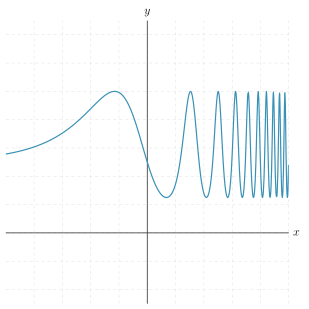
- The \(k\)th maxima is at \(\ln \left ( \frac{4(k-1)+1}{2}\right)\) and \(a\) ,and the \((k+1)\)th is at \(\ln \left ( \frac{4k+1}{2}\right)\). They have a minima between at \(\ln \left ( \frac{4k-3}{2}\right)\). \begin{align*} && \text{Area} &\approx \frac12 \left (\ln \left ( \frac{4k-1}{2}\right)- \ln \left ( \frac{4k-3}{2}\right)\right) \left ( a + \frac1a \right) + \frac12 \left ( \ln \left ( \frac{4k+1}{2}\right)-\ln \left ( \frac{4k-1}{2}\right)\right) \left ( a + \frac1a \right) \\ &&&= \frac{a^2+1}{2a} \ln \left (\frac{4k+1}{4k-3} \right) \\ &&&= \frac{a^2+1}{2a} \ln \left (1 + \frac{4}{4k-3} \right) \\ &&&= \frac{a^2+1}{2a} \ln \left (1 + \frac{1}{k-\tfrac34} \right) \\ &&&= \frac{a^2+1}{2a} \ln \left (1 + (k-\tfrac34)^{-1} \right) \\ \end{align*}