Problems
Filters
42 problems found
2004 Paper 1 Q1
- Express \(\left(3+2\sqrt{5} \, \right)^3\) in the form \(a+b\sqrt{5}\) where \(a\) and \(b\) are integers.
- Find the positive integers \(c\) and \(d\) such that \(\sqrt[3]{99-70\sqrt{2}\;}\) = \(c - d\sqrt{2} \,\).
- Find the two real solutions of \(x^6 - 198 x^3 + 1 = 0 \,\).
Solution:
- \begin{align*} (3+2\sqrt{5})^3 &= 3^3 + 3 \cdot 3^2 \cdot 2\sqrt{5} + 3 \cdot 3 \cdot (2 \sqrt{5})^2 + (2\sqrt{5})^3 \\ &= 27 + 180 + (54+40)\sqrt{5} \\ &= 207 + 94\sqrt{5} \end{align*}
- \begin{align*} && (c-d\sqrt{2})^3 &= c^3+6cd -(3c^2d+2d^3)\sqrt{2} \\ \Rightarrow && 99 &= c(c^2+6d^2) \\ && 70 &= d(3c^2+2d^2) \\ \Rightarrow && c & \mid 99, d \mid 70 \\ && c &= 3, d = 2 \end{align*}
- \begin{align*} && 0 &= x^6 - 198x^3 + 1 \\ \Rightarrow && 0 &= (x^3-99)^2+1-99^2 \\ \Rightarrow && x^3 &= 99 \pm \sqrt{99^2-1} \\ &&&= 99 \pm 10 \sqrt{98} \\ &&&= 99 \pm 70 \sqrt{2} \\ \Rightarrow && x &= 3 \pm 2 \sqrt{2} \end{align*}
2004 Paper 1 Q2
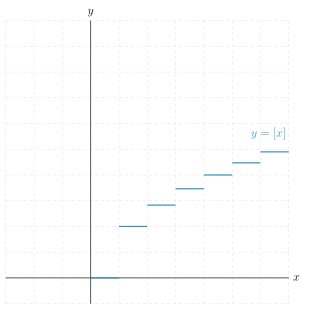
The square bracket notation \(\boldsymbol{[} x\boldsymbol{]}\) means the greatest integer less than or equal to \(x\,\). For example, \(\boldsymbol{[}\pi\boldsymbol{]} = 3\,\), \(\boldsymbol{[}\sqrt{24}\,\boldsymbol{]} = 4\,\) and \(\boldsymbol{[}5\boldsymbol{]}=5\,\).
- Sketch the graph of \(y = \sqrt{\boldsymbol{[}x\boldsymbol{]}}\) and show that \[ \displaystyle \int^a_0 \sqrt{\boldsymbol{[}x\boldsymbol{]}} \; \mathrm{d}x = \sum^{a-1}_{r=0} \sqrt{r} \] when \(a\) is a positive integer.
- Show that $\displaystyle \int^{a}_0 2_{\vphantom{A}}^{\pmb{\boldsymbol {[} } x \pmb{ \boldsymbol{]}} }\; \mathrm{d}x = 2^{a}-1\( when \)a\( is a positive integer.
- Determine an expression for \)\displaystyle \int^{a}_0 2_{\vphantom{\dot A}}^{\pmb{\boldsymbol{[} }x \pmb{ \boldsymbol{]}} } \; \mathrm{d}x\( when \)a$ is positive but not an integer.
Solution:
- \(\,\) \begin{align*} && \int_0^a \sqrt{\boldsymbol{[}x\boldsymbol{]}} \d x &= \sum_{r=0}^{a-1} \int_{x=r}^{x=r+1} \sqrt{\boldsymbol{[}x\boldsymbol{]}} \d x \\ &&&= \sum_{r=0}^{a-1} \int_r^{r+1} \sqrt{r} \d x \\ &&&= \sum_{r=0}^{a-1} \sqrt{r} \\ \end{align*}
- \(\,\) \begin{align*} && \int^{a}_0 2^{\boldsymbol {[} x \boldsymbol{]}} \d x &= \sum_{r=0}^{a-1} \int_{x=r}^{x=r+1} 2^{\boldsymbol {[} x \boldsymbol{]}} \d x \\ &&&= \sum_{r=0}^{a-1} \int_{x=r}^{x=r+1} 2^{r} \d x \\ &&&= \sum_{r=0}^{a-1} 2^{r}\\ &&&= 2^{a}-1 \end{align*}
- \(\,\) \begin{align*} && \int^{a}_0 2^{\boldsymbol {[} x \boldsymbol{]}} \d x &= \int_0^{\boldsymbol {[} a \boldsymbol{]}} 2^{\boldsymbol {[} x \boldsymbol{]}} \d x + \int_{\boldsymbol {[} a \boldsymbol{]}}^a 2^{\boldsymbol {[} x \boldsymbol{]}} \d x \\ &&&= 2^{ \boldsymbol {[} a \boldsymbol{]}}-1 + (a-\boldsymbol {[} a \boldsymbol{]})2^{\boldsymbol {[} a \boldsymbol{]}} \\ &&&= (a-\boldsymbol {[} a \boldsymbol{]}+1)2^{\boldsymbol {[} a \boldsymbol{]}} -1 \end{align*}
2004 Paper 1 Q3
- Show that \(x-3\) is a factor of \begin{equation} x^3-5x^2+2x^2y+xy^2-8xy-3y^2+6x+6y \;. \tag{\(*\)} \end{equation} Express (\( * \)) in the form \((x-3)(x+ay+b)(x+cy+d)\) where \(a\), \(b\), \(c\) and \(d\) are integers to be determined.
- Factorise \(6y^3-y^2-21y+2x^2+12x-4xy+x^2y-5xy^2+10\) into three linear factors.
Solution:
- Let \(f(x,y) = x^3-5x^2+2x^2y+xy^2-8xy-3y^2+6x+6y\), then \begin{align*} f(3,y) &= 27 - 5 \cdot 9 +18y + 3y^2-24y-3y^2+18 + 6y \\ &= 0 \end{align*}, therefore \(x-3\) is a factor of \(f(x,y)\). \begin{align*} f(x,y) &= x^3-5x^2+6x+y(2x^2-8x+6) + y^2(x-3) \\ &= (x-3)(x^2-2x)+y(x-3)(2x-2)+y^2(x-3) \\ &= (x-3)(x^2-2x+2y(x-1)+y^2) \\ &= (x-3)(x+y)(x+y-2) \end{align*}
- Let \(g(x,y) = 6y^3-y^2-21y+2x^2+12x-4xy+x^2y-5xy^2+10\), notice that \(g(x,-2) = 0\), so \(y+2\) is a factor, \begin{align*} g(x,y) &= 6y^3-y^2-21y+2x^2+12x-4xy+x^2y-5xy^2+10 \\ &= x^2(2+y) + x(12-4y-5y^2) + 6y^3-y^2-21y+10 \\ &= x^2(y+2) + x(y+2)(6-5y) + (y+2)(6y^2-13y+5) \\ &= (y+2)(x^2+(6-5y)x+(6y^2-13y+5)) \\ &= (y+2)(x-2y +1)(x-3y+5) \end{align*}
2004 Paper 1 Q4
Differentiate \(\sec {t}\) with respect to \(t\).
- Use the substitution \(x=\sec t\) to show that $\displaystyle \int^2_{\sqrt 2} \frac{1}{ x^3\sqrt {x^2-1} } \; \mathrm{d}x =\frac{\sqrt 3 - 2}{8} + \frac {\pi}{24} \;.$
- Determine $\displaystyle \int \frac{1} {( x+2) \sqrt {(x+1)(x+3)} } \; \mathrm{d}x \;$.
- Determine $\displaystyle \int \frac {1} {(x+2) \sqrt {x^2+4x-5} } \; \mathrm{d}x \;$.
Solution: \[\frac{\d}{\d t} \left ( \sec t \right) = \frac{\sin t }{\cos^2 t} = \sec t \tan t \]
- \(\,\) \begin{align*} && I_1 &= \int_{\sqrt{2}}^2 \frac{1}{x^3 \sqrt{x^2-1}} \\ x = \sec t, \d x = \sec t \tan t:&&&= \int_{t=\pi/4}^{t=\pi/3} \frac{1}{\sec^3 t \tan t} \sec t \tan t \d t \\ &&&= \int_{t=\pi/4}^{t=\pi/3} \cos^2 t \d t \\ &&&= \int_{t=\pi/4}^{t=\pi/3} \frac{1+\cos 2t}{2} \d t \\ &&&= \frac12 \frac{\pi}{12} + \frac12 \left (\sin \frac{\pi}{3} - \sin \frac{\pi}{4} \right) \\ &&&= \frac{\pi}{24} + \frac{\sqrt{3}-2}{8} \\ \end{align*}
- \(\,\) \begin{align*} && I_2 &= \int \frac{1}{(x+2)\sqrt{(x+1)(x+3)}} \d x \\ &&&= \int \frac{1}{(x+2)\sqrt{(x+2)^2-1}} \d x \\ &&&= \int \frac{1}{u\sqrt{u^2-1}} \d u \\ &&&= \sec^{-1} u + C \\ &&&= \sec^{1} (x+2) + C \end{align*}
- \(\,\) \begin{align*} && I_3 &= \int \frac{1}{(x+2)\sqrt{(x+2)^2 - 9}} \d x \\ &&&= \int\frac{1}{9(\frac{x+2}{3})\sqrt{(\frac{x+2}3)^2 - 1}} \d x \\ u = \frac{x+2}{3}, 3\d u =\d x &&&= \frac19 \int \frac{1}{u\sqrt{u^2-1}} 3 \d u \\ &&&= \frac13 \sec^{-1} u + C \\ &&&= \frac13 \sec^{-1} \frac{x+2}{3} + C \end{align*}
2004 Paper 1 Q5
The positive integers can be split into five distinct arithmetic progressions, as shown: \begin{align*} A&: \ \ 1, \ 6, \ 11, \ 16, \ ... \\ B&: \ \ 2, \ 7, \ 12, \ 17, \ ...\\ C&: \ \ 3, \ 8, \ 13, \ 18, \ ... \\ D&: \ \ 4, \ 9, \ 14, \ 19, \ ... \\ E&: \ \ 5, 10, \ 15, \ 20, \ ... \end{align*} Write down an expression for the value of the general term in each of the five progressions. Hence prove that the sum of any term in \(B\) and any term in \(C\) is a term in \(E\). Prove also that the square of every term in \(B\) is a term in \(D\). State and prove a similar claim about the square of every term in \(C\).
- Prove that there are no positive integers \(x\) and \(y\) such that \[ x^2+5y=243\,723 \,. \]
- Prove also that there are no positive integers \(x\) and \(y\) such that \[ x^4+2y^4=26\,081\,974 \,. \]
2004 Paper 1 Q6
The three points \(A\), \(B\) and \(C\) have coordinates \(\l p_1 \, , \; q_1 \r\), \(\l p_2 \, , \; q_2 \r\) and \(\l p_3 \, , \; q_3 \r\,\), respectively. Find the point of intersection of the line joining \(A\) to the midpoint of \(BC\), and the line joining~\(B\) to the midpoint of \(AC\). Verify that this point lies on the line joining \(C\) to the midpoint of~\(AB\). The point \(H\) has coordinates \(\l p_1 + p_2 + p_3 \, , \; q_1 + q_2 + q_3 \r\,\). Show that if the line \(AH\) intersects the line \(BC\) at right angles, then \(p_2^2 + q_2^2 = p_3^2 + q_3^2\,\), and write down a similar result if the line \(BH\) intersects the line \(AC\) at right angles. Deduce that if \(AH\) is perpendicular to \(BC\) and also \(BH\) is perpendicular to \(AC\), then \(CH\) is perpendicular to \(AB\).
2004 Paper 1 Q7
- The function \(\f(x)\) is defined for \(\vert x \vert < \frac15\) by \[ \f(x) = \sum_{n=0}^\infty a_n x^n\;, \] where \(a_0=2\), \(a_1=7\) and \(a_n =7a_{n-1} - 10a_{n-2}\) for \(n\ge{2}\,\). Simplify \(\f(x) - 7x\f(x) + 10x^2\f(x)\,\), and hence show that \(\displaystyle\f(x) = {1\over 1-2x} + {1 \over 1-5x} \;\). Hence show that \(a_n=2^n + 5^n\,\).
- The function \(\g(x)\) is defined for \(\vert x \vert < \frac13\) by \[ \g(x) = \sum_{n=0}^\infty b_n x^n \;, \] where \(b_0=5\,\), \(b_1 =10 \,\), \(b_2=40\,\), \(b_3=100\) and \(b_n = pb_{n-1} + qb_{n-2}\) for \(n\ge{2}\,\). Obtain an expression for \(\g(x)\) as the sum of two algebraic fractions and determine \(b_n\) in terms of \(n\).
Solution:
- \begin{align*} && f(x) -7xf(x)+10x^2f(x) &= \sum_{n=0}^\infty a_n x^n - 7x \sum_{n=0}^{\infty} a_n x^n + 10x^2 \sum_{n=0}^{\infty} a_nx^n \\ &&&= \sum_{n=2}^\infty (a_n-7a_{n-1}+10a_{n-2})x^n + a_0+a_1x-7a_0x \\ &&&= 0 + 2-7x \\ \\ \Rightarrow && f(x) &= \frac{2-7x}{1-7x+10x^2} \\ &&&= \frac{2-7x}{(1-5x)(1-2x)} \\ &&&= \frac{1}{1-2x} + \frac{1}{1-5x} \\ &&&= \sum_{n=0}^{\infty} (2^n + 5^n)x^n \end{align*} Therefore \(a_n = 2^n +5^n\)
- \(\,\) \begin{align*} && 40 &= 10p + 5 q \\ && 100 &= 40p+10q \\ && 10 &= 4p + q \\ \Rightarrow && (p,q) &= (1,6) \\ \\ && g(x) -xg(x)-6x^2g(x) &= 5+5x \\ \Rightarrow && g(x) &= \frac{5+5x}{1-x-6x^2} \\ &&&= \frac{5+5x}{(1-3x)(1+2x)} \\ &&&= \frac{4}{1-3x} + \frac{1}{1+2x} \\ &&&= \sum_{n=0}^{\infty} (4 \cdot 3^n + (-2)^n)x^n \\ \Rightarrow && b_n &= 4 \cdot 3^n + (-2)^n \end{align*}
2004 Paper 1 Q8
A sequence \(t_0\), \(t_1\), \(t_2\), \(...\) is said to be strictly increasing if \(t_{n+1} > t_n\) for all \(n\ge{0}\,\).
- The terms of the sequence \(x_0\,\), \(x_1\,\), \(x_2\,\), \(\ldots\) satisfy $$ \ds x_{n+1}=\frac{x_n^2 +6}{5} $$ for \(n\ge{0}\,\). Prove that if \(x_0 > 3\) then the sequence is strictly increasing.
- The terms of the sequence \(y_0\,\), \(y_1\,\), \(y_2\,\), \(\ldots\) satisfy $$ \ds y_{n+1}= 5-\frac 6 {y_n} $$ for \(n\ge{0}\,\). Prove that if \(2 < y_0 < 3\) then the sequence is strictly increasing but that \(y_n<3\) for all \(n\,\).
Solution:
- Suppose \(x_n> 3\) then \begin{align*} && x_{n+1} &= \frac{x_n^2+9-3}{5} \\ &&& \geq \frac{2\sqrt{x_n^2 \cdot 9} - 3}{5} \\ &&&= \frac{6x_n -3}{5} = x_n + \frac{x_n-3}{5} \\ &&&> x_n > 3 \end{align*} Therefore if \(x_i > 3 \Rightarrow x_{i+1} > x_i\) and \(x_{i+1} > 3\) so by induction \(x_n\) strictly increasing for all \(n\).
- Suppose \(2 < y_n < 3\) then \begin{align*} && y_{n+1} &= 5 - \frac6{y_n} \\ &&&< 5 - \frac63 = 3 \\ \\ && y_{n+1} &= 5 - \frac4{y_n} - \frac{2}{y_n} \\ \\ &&&= y_n + 5 - \frac{2}{y_n} - \left ( y_n + \frac4{y_n} \right) \\ &&&\geq y_n + 5 - \frac{2}{y_n} - 2\sqrt{y_n \frac{4}{y_n}} \\ &&&= y_n + 1 - \frac{2}{y_n} \\ &&&> y_n \end{align*} Therefore if \(y_n \in (2,3)\) we have \(y_{n+1} \in ( y_n, 3)\) and so \(y_n\) is strictly increasing and bounded.
2004 Paper 1 Q9
A particle is projected over level ground with a speed \(u\) at an angle \(\theta\) above the horizontal. Derive an expression for the greatest height of the particle in terms of \(u\), \(\theta\) and \(g\). A particle is projected from the floor of a horizontal tunnel of height \({9\over 10}d\). Point \(P\) is \({1\over 2}d\) metres vertically and \(d\) metres horizontally along the tunnel from the point of projection. The particle passes through point \(P\) and lands inside the tunnel without hitting the roof. Show that \[ \arctan \textstyle {3 \over 5} < \theta < \arctan \, 3 \;. \]
Solution: \begin{align*} && v^2 &= u^2 + 2as \\ (\uparrow): && 0 &= (u \sin \theta)^2 - 2gh \\ \Rightarrow && h &= \frac{u^2 \sin^2 \theta}{2g} \end{align*} To avoid hitting the ceiling \begin{align*} && \frac9{10}d &>\frac{u^2 \sin^2 \theta}{2g} \\ \Rightarrow && \frac{gd}{u^2}&>\frac{5\sin^2 \theta}{9} \\ \end{align*} In order to pass through \(P\) we need \begin{align*} && d &= u \cos \theta t \\ && \frac12 d &= u \sin \theta t - \frac12 g t^2 \\ \Rightarrow && \frac12 &= \tan \theta - \frac12 \frac{g d}{u^2} \sec^2 \theta \\ &&&<\tan \theta - \frac12 \frac{5 \sin^2 \theta}{9\cos^2 \theta} \\ \Rightarrow && 0 & >5 \tan^2 \theta -18\tan \theta +9 \\ &&&= (5\tan \theta - 3)(\tan \theta - 3) \\ \\ \Rightarrow && \tan \theta &\in \left ( \frac35, 3\right) \\ && \theta &= \left (\arctan \tfrac35, \arctan 3 \right) \end{align*}
2004 Paper 1 Q10
A particle is travelling in a straight line. It accelerates from its initial velocity \(u\) to velocity \(v\), where \(v > \vert u \vert > 0\,\), travelling a distance \(d_1\) with uniform acceleration of magnitude \(3a\,\). It then comes to rest after travelling a further distance \(d_2\,\) with uniform deceleration of magnitude \(a\,\). Show that
- if \(u>0\) then \(3d_1 < d_2\,\);
- if \(u<0\) then \(d_2 < 3d_1 < 2d_2\,\).
2004 Paper 1 Q11
Two uniform ladders \(AB\) and \(BC\) of equal length are hinged smoothly at \(B\). The weight of \(AB\) is \(W\) and the weight of \(BC\) is \(4W \). The ladders stand on rough horizontal ground with \(\angle ABC=60^\circ\,\). The coefficient of friction between each ladder and the ground is \(\mu\). A decorator of weight \(7W\) begins to climb the ladder \(AB\) slowly. When she has climbed up \(\frac13\) of the ladder, one of the ladders slips. Which ladder slips, and what is the value of \(\mu\)?
Solution:

2004 Paper 1 Q12
In a certain factory, microchips are made by two machines. Machine A makes a proportion \(\lambda\) of the chips, where \(0 < \lambda < 1\), and machine B makes the rest. A proportion \(p\) of the chips made by machine A are perfect, and a proportion \(q\) of those made by machine B are perfect, where \(0 < p < 1\) and \(0 < q < 1\). The chips are sorted into two groups: group 1 contains those that are perfect and group 2 contains those that are imperfect. In a large random sample taken from group 1, it is found that \(\frac 2 5\) were made by machine A. Show that \(\lambda\) can estimated as \[ {2q \over 3p + 2q}\;. \] Subsequently, it is discovered that the sorting process is faulty: there is a probability of \(\frac 14\) that a perfect chip is assigned to group 2 and a probability of \(\frac 14\) that an imperfect chip is assigned to group 1. Taking into account this additional information, obtain a new estimate of \(\lambda\,\).
Solution: \begin{align*} && \frac25 &= \frac{\lambda p}{\lambda p + (1-\lambda) q} \\ \Rightarrow && 2(1-\lambda)q &= 3\lambda p \\ \Rightarrow && \lambda(3p+2q) &= 2q \\ \Rightarrow && \lambda &= \frac{2q}{3p+2q} \end{align*} \begin{align*} && \frac25 &= \frac{\lambda (p + \frac14(1-p))}{\lambda (p + \frac14(1-p))+(1-\lambda) (q + \frac14(1-q))} \\ &&&= \frac{\lambda(\frac34p + \frac14)}{\lambda(\frac34p + \frac14)+(1-\lambda)(\frac34q + \frac14)} \\ \Rightarrow && \lambda &= \frac{2(\frac34q+\frac14)}{3(\frac34p + \frac14)+2(\frac34q+\frac14)} \\ &&&= \frac{\frac32q + \frac12}{\frac94p + \frac32q + \frac54} \\ &&&= \frac{6q+2}{9p+6q+5} \end{align*}
2004 Paper 1 Q13
- Three real numbers are drawn independently from the continuous rectangular distribution on \([ 0, 1 ]\,\). The random variable \(X\) is the maximum of the three numbers. Show that the probability that \(X \le 0.8\) is \(0.512\,\), and calculate the expectation of \(X\).
- \(N\) real numbers are drawn independently from a continuous rectangular distribution on \([ 0, a ]\,\). The random variable \(X\) is the maximum of the \(N\) numbers. A hypothesis test with a significance level of 5\% is carried out using the value, \(x\), of \(X \). The null hypothesis is that \(a=1\) and the alternative hypothesis is that \(a<1 \,\). The form of the test is such that \(H_0\) is rejected if \(x < c\,\), for some chosen number \(c\,\). Using the approximation \(2^{10} \approx 10^3\,\), determine the smallest integer value of \(N\) such that if \(x \le 0.8\) the null hypothesis will be rejected. With this value of \(N\), write down the probability that the null hypothesis is rejected if \(a = 0.8\,\), and find the probability that the null hypothesis is rejected if \(a = 0.9\,\).
Solution: \begin{align*} \P(X \leq 0.8) &= \P(X_1 \leq 0.8,X_2 \leq 0.8,X_3 \leq 0.8) \\ &= 0.8^3 \\ &= 0.512 \end{align*} \begin{align*} && \P(X < c) &= c^3 \\ \Rightarrow && f_X(x) &= 3x^2 \\ \Rightarrow && \E[X] &= \int_0^1 x \cdot (3x^2) \, dx \\ && &= \left [ \frac{3}{4}x^4 \right]_0^1 \\ &&&= \frac{3}{4} \end{align*} \(X\) is distributed the maximum of \(N\) numbers on \([0,a]\). \begin{align*} H_0 : & x= 1 \\ H_1 : & x < 1 \end{align*} \begin{align*} &&\P(X < c) &= c^N \\ &&&= \frac1{20} \\ \Rightarrow && N &= -\frac{\log(20)}{\log(c)} \end{align*} where \(c = 0.8\), we have \begin{align*} N &= \frac{\log(20)}{\log(5/4)} \\ &= \frac{\log(5)+\log(4)}{\log(5)-\log(4)} \\ &= \frac{ \frac{\log(5)}{\log(4)}+1}{\frac{\log(5)}{\log(4)} - 1} \end{align*} \begin{align*} && 2^{10} &\approx 10^{3} \\ && 10\log(2) &\approx 3 (\log(5) + \log(2)) \\ && 7\log(2) &\approx 3 \log(5) \\ && \frac{\log(5)}{2\log(2)} &\approx \frac{7}{6} \end{align*} \begin{align*} &= \frac{ \frac{\log(5)}{\log(4)}+1}{\frac{\log(5)}{\log(4)} - 1} &= \frac{\frac{7}{6} + 1}{\frac{7}{6} -1} \\ &= 13 \end{align*} Since \(2^{10} > 10^3\) then \(N=14\) is the value we seek. \(\P(X < 0.8 | a= 0.8) = 1\) \(\P(X < 0.8 | a= 0.9, N=14) = \frac{8^{14}}{9^{14}}\)
2004 Paper 1 Q14
Three pirates are sharing out the contents of a treasure chest containing \(n\) gold coins and \(2\) lead coins. The first pirate takes out coins one at a time until he takes out one of the lead coins. The second pirate then takes out coins one at a time until she draws the second lead coin. The third pirate takes out all the gold coins remaining in the chest. Find:
- the probability that the first pirate will have some gold coins;
- the probability that the second pirate will have some gold coins;
- the probability that all three pirates will have some gold coins.
Solution:
- The first pirate will have some gold coins as long as the very first coin drawn is a gold coin, ie \(\frac{n}{n+2}\).
- The probability the second pirate will have some gold coins is the probability the two lead coins are separate. There are \((n+2)!\) ways to arrange the coins, and there are \((n+1)! \cdot 2\) ways to arrange the coins where they are together, therefore the probability is: \[ 1 - \frac{2(n+1)!}{(n+2)!} = 1 - \frac{2}{n+2} = \frac{n}{n+2} \]
- For all three pirates to have some gold coins we need the lead coins to be separate and not first or last. If we line up all \(n\) gold coins, there are \(n-1\) gaps between them we could place the \(2\) lead coins in, therefore \(\binom{n-1}{2}\) ways to place the lead coins with the restriction. Without the restriction there are \(\binom{n+2}{2}\) ways to choose where to put the coins, therefore \begin{align*} && P &= \frac{\binom{n-1}{2}}{\binom{n+2}{2}} \\ &&&= \frac{(n-1)(n-2)}{(n+2)(n+1)} \end{align*} [Notice this is clearly \(0\) if there are only \(1\) or \(2\) gold coins]
2004 Paper 2 Q1
Find all real values of \(x\) that satisfy:
- \( \ds \sqrt{3x^2+1} + \sqrt{x} -2x-1=0 \;;\)
- \( \ds \sqrt{3x^2+1} - 2\sqrt{x} +x-1=0 \;;\)
- \( \ds \sqrt{3x^2+1} - 2\sqrt{x} -x+1=0 \;.\)
Solution:
- \(\,\) \begin{align*} && 0 &= \sqrt{3x^2+1} + \sqrt{x} -2x-1 \\ \Rightarrow && 2x+1 &= \sqrt{3x^2+1} + \sqrt{x} \\ \Rightarrow && 4x^2+4x+1 &= 3x^2+1+x+2\sqrt{x(3x^2+1)} \\ \Rightarrow && x^2+3x &= 2\sqrt{x(3x^2+1)} \\ \Rightarrow && x^2(x^2+6x+9) &= 4x(3x^2+1) \\ \Rightarrow && 0 &= x^4-6x^3+9x^2-4x \\ &&&= x(x-4)(x-1)^2 \end{align*} So clearly we have \(x = 0, x = 1, x = 4\). \(x = 0\) works, \(x = 1\) works, \(x = 4\) works.
- \(\,\) \begin{align*} && 0 &= \sqrt{3x^2+1} - 2\sqrt{x} +x-1 \\ \Rightarrow && 1-x &= \sqrt{3x^2+1}-2\sqrt{x} \\ \Rightarrow && x^2-2x+1 &= 3x^2+1+4x-4\sqrt{x(3x^2+1)} \\ \Rightarrow && x^2+3x &= 2\sqrt{x(3x^2+1)} \\ \Rightarrow && 0 &= x(x-4)(x-1)^2 \end{align*} Again we must check \(x = 0, x = 1, x = 4\). \(x = 0,1\) work, but \(x = 4\) is not a solution.
- \(\,\) \begin{align*} && 0 &= \sqrt{3x^2+1} - 2\sqrt{x} -x+1 \\ \Rightarrow && x-1 &= \sqrt{3x^2+1} - 2\sqrt{x} \\ \Rightarrow && x^2-2x+1 &= 3x^2+1+4x-4\sqrt{x(3x^2+1)} \\ \Rightarrow && x^2+3x &= 2\sqrt{x(3x^2+1)}\\ \Rightarrow && 0 &= x(x-4)(x-1)^2 \end{align*} So again, we need to check \(x = 0, 1, 4\). \(x = 0, 4\) work, but \(x = 1\) fails.