Problems
Filters
42 problems found
1997 Paper 1 Q1
Show that you can make up 10 pence in eleven ways using 10p, 5p, 2p and 1p coins. In how many ways can you make up 20 pence using 20p, 10p, 5p, 2p and 1p coins? You are reminded that no credit will be given for unexplained answers.
Solution: Writing out the possibilities in order of the largest coin used (and then second largest and so-on): \begin{align*} && 10 &= 10 \\ &&&= 5 + 5 \\ &&&= 5 + 2 + 2 + 1 \\ &&&= 5 + 2 + 1 + 1 + 1 \\ &&&= 5 + 1 + 1 + 1 + 1 + 1\\ &&&= 2 + 2 + 2 + 2 + 2 = 5 \cdot 2\\ &&&= 4 \cdot 2 + 2 \cdot 1 \\ &&&= 3 \cdot 2 + 4 \cdot 1\\ &&&= 2 \cdot 2 + 6\cdot 1\\ &&&= 1 \cdot 2 + 8\cdot 1 \\ &&&= 10 \cdot 1 \end{align*} For 20p, we have \begin{align*} && 20 &= 20 \\ &&&= 10 + \text{all 11 ways} \\ &&&= 4\cdot 5 \\ &&&= 3\cdot 5 +\text{3 ways} \\ &&&= 2\cdot5 + \text{6 ways} \\ &&&= 1\cdot 5 + \text{8 ways} \\ &&&= k\cdot 2 + (20-2k)\cdot 1 \quad \text{11 ways} \end{align*} ie 41 ways
1997 Paper 1 Q2
- If \[{\mathrm f}(x)=\tan^{-1}x+\tan^{-1}\left(\frac{1-x}{1+x}\right),\] find \({\mathrm f}'(x)\). Hence, or otherwise, find a simple expression for \({\mathrm f}(x)\).
- Suppose that \(y\) is a function of \(x\) with \(0 < y < (\pi/2)^{1/2}\) and \[x=y\sin y^{2}\] for \(0 < x < (\pi/2)^{1/2}\). Show that (for this range of \(x\)) \[\frac{{\mathrm d}y}{{\mathrm d}x}= \frac{y}{x+2y^2\sqrt{y^{2}-x^{2}}}.\]
Solution:
- \begin{align*} && f(x)&=\tan^{-1}x+\tan^{-1}\left(\frac{1-x}{1+x}\right) \\ \Rightarrow && f'(x) &= \frac{1}{1+x^2} + \frac{1}{1+\l \frac{1-x}{1+x} \r^2} \cdot \l \frac{-2}{(1+x)^2}\r \\ &&&= \frac1{1+x^2}- \frac{2}{(1+x)^2+(1-x)^2} \\ &&&= \frac1{1+x^2} - \frac{2}{2+2x^2} \\ &&&= 0 \end{align*} Therefore $f(x) = \begin{cases} c_1 & \text{if } x < -1 \\ c_2 & \text{if } x > -1 \end{cases}$ \(f(0) = \tan^{-1} 0 + \tan^{-1} 1 = \frac{\pi}{4}\) \(\lim_{x \to \infty} f(x) = -\frac{\pi}{2} + \tan^{-1} -1 = -\frac{3\pi}{4}\) therefore $f(x) = \begin{cases} -\frac{3\pi}{4}& \text{if } x < -1 \\ \frac{\pi}{4} & \text{if } x > -1 \end{cases}$
- \begin{align*} && x &= y \sin y^2 \\ \Rightarrow && \frac{\d x}{\d y} &= \sin y^2 + 2y^2 \cos y^2 \\ \Rightarrow && \frac{\d y}{\d x} &= \frac{1}{\sin y^2+2y^2 \cos y^2} \\ &&&=\frac{1}{\frac{x}{y}+2y^2 \sqrt{1-\sin^2y^2}} \\ &&&= \frac{y}{x + 2y^3 \sqrt{1-\frac{x^2}{y^2}}} \\ &&&= \frac{y}{x+2y^2 \sqrt{y^2-x^2}} \end{align*}
1997 Paper 1 Q3
Let \(a_{1}=3\), \(a_{n+1}=a_{n}^{3}\) for \(n\geqslant 1\). (Thus \(a_{2}=3^{3}\), \(a_{3}=(3^{3})^{3}\) and so on.)
- What digit appears in the unit place of \(a_{7}\)?
- Show that \(a_{7}\geqslant 10^{100}\).
- What is \(\dfrac{a_{7}+1}{2a_{7}}\) correct to two places of decimals? Justify your answer.
Solution:
- Notice that \(a_n = 3^{3^{n-1}}\) in particular, \(a_7 = 3^{3^6}\). Using Fermat's little theorem, we can see that \(3^4 \equiv 1 \pmod{5}\) and so we need to figure out \(3^6 \pmod{4}\), which is clearly \(1\). Therefore \(3^{3^6} \equiv 3^{4k+1} \equiv 3 \pmod{5}\). Therefore the units digit is \(3\).
- Notice that \(3^5 > 100\) and \(3^3 > 10\). Therefore \begin{align*} a_7 &= 3^{3^6} \\ &= (3^3)^{3^5} \\ &> 10^{3^5} \\ &> 10^{100} \end{align*}
- \begin{align*} \frac{a_7+1}{2a_7} &= \frac12 + \frac1{2a_7} \\ &= 0.5 + 0.\underbrace{000\cdots}_{\text{at least }99\text{ zeros}} \\ &= 0.50 \end{align*} Since \(a_7 > 10^{100}, \, \frac{1}{2a_7} < 10^{-100}\)
1997 Paper 1 Q4
Find all the solutions of the equation \[|x+1|-|x|+3|x-1|-2|x-2|=x+2.\]
Solution: Case 1: \(x \leq -1\) \begin{align*} && -1-x+x-3(x-1)+2(x-2) &= x + 2 \\ \Leftrightarrow && -x-2 &= x + 2 \\ \Leftrightarrow && x = -2 \end{align*} Case \(-1 < x \leq 0\): \begin{align*} && x+1+x-3(x-1)+2(x-2) &= x + 2 \\ \Leftrightarrow && x&= x + 2 \\ \end{align*} No solutions Case \(0 < x \leq 1\): \begin{align*} && x+1-x-3(x-1)+2(x-2) &= x + 2 \\ \Leftrightarrow && -x&= x + 2 \\ \end{align*} No solutions Case \(1 < x \leq 2\): \begin{align*} && x+1-x+3(x-1)+2(x-2) &= x + 2 \\ \Leftrightarrow && 5x-6&= x + 2 \\ \Leftrightarrow && x = 2 \end{align*} Case \(2 < x\): \begin{align*} && x+1-x+3(x-1)-2(x-2) &= x + 2 \\ \Leftrightarrow && x+2&= x + 2 \\ \end{align*} Therefore the solutions are \(x \in \{-2\} \cup [2, \infty)\)
1997 Paper 1 Q5
Four rigid rods \(AB\), \(BC\), \(CD\) and \(DA\) are freely jointed together to form a quadrilateral in the plane. Show that if \(P\), \(Q\), \(R\), \(S\) are the mid-points of the sides \(AB\), \(BC\), \(CD\), \(DA\), respectively, then \[|AB|^{2}+|CD|^{2}+2|PR|^{2}=|AD|^{2}+|BC|^{2}+2|QS|^{2}.\] Deduce that \(|PR|^{2}-|QS|^{2}\) remains constant however the vertices move. (Here \(|PR|\) denotes the length of \(PR\).)
1997 Paper 1 Q6
Find constants \(a_{0}\), \(a_{1}\), \(a_{2}\), \(a_{3}\), \(a_{4}\), \(a_{5}\), \(a_{6}\) and \(b\) such that \[x^{4}(1-x)^{4}=(a_{6}x^{6}+a_{5}x^{5}+a_{4}x^{4}+a_{3}x^{3}+ a_{2}x^{2}+a_{1}x+a_{0})(x^{2}+1)+b.\] Hence, or otherwise, prove that \[\int_{0}^{1}\frac{x^{4}(1-x)^{4}}{1+x^{2}}{\rm d}x =\frac{22}{7}-\pi.\] Evaluate \(\displaystyle{\int_{0}^{1}x^{4}(1-x)^{4}{\rm d}x}\) and deduce that \[\frac{22}{7}>\pi>\frac{22}{7}-\frac{1}{630}.\]
Solution: Plugging in \(x = i\) we obtain \((1-i)^4 = (-2i)^2 = -4 \Rightarrow b = -4\). \begin{align*} x^4(1-x)^4 &= x^4(1-4x+6x^2-4x^3+x^4) \\ &= x^8-4x^7+6x^6-4x^5+x^4 \\ &= x^6(x^2+1) - x^6 -4x^7+6x^6-4x^5+x^4 \\ &= x^6(x^2+1) -4x^5(x^2+1)+4x^5 +5x^6-4x^5+x^4 \\ &= (x^6-4x^5)(x^2+1) +5x^4(x^2+1)-5x^4+x^4 \\ &= (x^6-4x^5+5x^4)(x^2+1) -4x^2(x^2+1)+4x^2 \\ &= (x^6-4x^5+5x^4-4x^2)(x^2+1) +4(x^2+1)-4 \\ &= (x^6-4x^5+5x^4-4x^2+4)(x^2+1) -4 \\ \end{align*} So \begin{align*} \int_0^1 \frac{x^4(1-x)^4}{1+x^2} \d x &= \int_0^1 (x^6-4x^5+5x^4-4x^2+4) - \frac{4}{1+x^2} \d x \\ &= \frac17 - \frac46+1-\frac43+4 - \pi \\ &= \frac{22}7 - \pi \end{align*} \begin{align*} \int_0^1 x^4(1-x)^4 \d x &= B(5,5) \\ &= \frac{4!4!}{9!} \\ &= \frac1{630} \end{align*} Therefore since \(0 < \frac{x^4(1-x)^4}{1+x^2} < x^4(1-x)^4\) we must have that \begin{align*} && 0 &< \frac{22}7 - \pi \\ \Rightarrow && \pi & < \frac{22}{7} \\ && \frac{22}{7} - \pi &< \frac1{630} \\ \Rightarrow && \frac{22}{7} - \frac1{630} &< \pi \end{align*} which is what we wanted.
1997 Paper 1 Q7
Find constants \(a_{1}\), \(a_{2}\), \(u_{1}\) and \(u_{2}\) such that, whenever \({\mathrm P}\) is a cubic polynomial, \[\int_{-1}^{1}{\mathrm P}(t)\,{\mathrm d}t =a_{1}{\mathrm P}(u_{1})+a_{2}{\mathrm P}(u_{2}).\]
Solution: Since this is true for all cubic polynomials, it must be true in particular for \(1, x, x^2, x^3\), therefore: \begin{align*} \int_{-1}^{1} 1 {\mathrm d}t &=a_{1}+a_{2} &=2\\ \int_{-1}^{1} x {\mathrm d}t &=a_{1}u_1+a_{2}u_2 &= 0 \\ \int_{-1}^{1} x^2 {\mathrm d}t &=a_{1}u_1^2+a_{2}u_2^2 &= \frac23\\ \int_{-1}^{1} x^3 {\mathrm d}t &=a_{1}u_1^3+a_{2}u_2^3 &= 0\\ \end{align*} \begin{align*} && \begin{cases} a_{1}+a_{2} &=2 \\ a_{1}u_1+a_{2}u_2 &= 0 \\ a_{1}u_1^2+a_{2}u_2^2 &= \frac23\\ a_{1}u_1^3+a_{2}u_2^3 &= 0\\ \end{cases} \\ \Rightarrow && \begin{cases} a_{1}(u_1^2 - \frac13) + a_{2}(u_2^2 - \frac13) &= 0 \\ a_{1}u_1(u_1^2 - \frac13) + a_{2}u_2(u_2^2 - \frac13) &= 0 \end{cases} \\ \Rightarrow && \begin{cases} u_i = \pm \frac1{\sqrt{3}} \\ a_i = 1\end{cases} \end{align*} Therefore we have: \[\int_{-1}^{1}{\mathrm P}(t)\,{\mathrm d}t ={\mathrm P} \l \frac1{\sqrt{3}} \r+{\mathrm P}\l -\frac1{\sqrt{3}} \r \] [Note: this question is actually asking about Gauss-Legendre polynomials, and could be done directly by appealing to standard results]
1997 Paper 1 Q8
By considering the maximum of \(\ln x-x\ln a\), or otherwise, show that the equation \(x=a^{x}\) has no real roots if \(a > e^{1/e}\). How many real roots does the equation have if \(0 < a < 1\)? Justify your answer.
Solution: \begin{align*} && y &= \ln x - x \ln a \\ \Rightarrow && y' &= \frac1x - \ln a \\ && y'' &= -\frac{1}{x^2} \end{align*} Therefore the maximum is when \(x = \frac{1}{\ln a}\) and \(y_{max} = -\ln \ln a - 1\). If \(y_{max} < 0\) then \(y \neq 0\). But that's equivalent to \(a > e^{1/e}\). \begin{align*} && 0 &> -\ln \ln a - 1 \\ \Leftrightarrow && 1 &> - \ln \ln a \\ \Leftrightarrow && \ln \ln a &>-1 \\ \Leftrightarrow && \ln a &> e^{-1} \\ \Leftrightarrow && a & > e^{1/e} \end{align*} If \(0 < a < 1\) then, when \(x\) is small, \(\ln x - x \ln a\) is large and negative. When \(x\) is large and positive \(\ln x\) is positive and \(-x \ln a\) is positive. We also notice there is no turning point. Hence exactly one solution
1997 Paper 1 Q9
A single stream of cars, each of width \(a\) and exactly in line, is passing along a straight road of breadth \(b\) with speed \(V\). The distance between the successive cars is \(c\).
1997 Paper 1 Q10
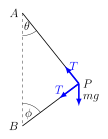
The point \(A\) is vertically above the point \(B\). A light inextensible string, with a smooth ring \(P\) of mass \(m\) threaded onto it, has its ends attached at \(A\) and \(B\). The plane \(APB\) rotates about \(AB\) with constant angular velocity \(\omega\) so that \(P\) describes a horizontal circle of radius \(r\) and the string is taut. The angle \(BAP\) has value \(\theta\) and the angle \(ABP\) has value \(\phi\). Show that \[\tan\frac{\phi-\theta}{2}=\frac{g}{r\omega^{2}}.\] Find the tension in the string in terms of \(m\), \(g\), \(r\), \(\omega\) and \(\sin\frac{1}{2}(\theta+\phi)\). Deduce from your results that if \(r\omega^2\) is small compared with \(g\), then the tension is approximately \(\frac{mg}{2}\)
Solution: None \begin{multicols}{2}
1997 Paper 1 Q11
A particle of unit mass is projected vertically upwards in a medium whose resistance is \(k\) times the square of the velocity of the particle. If the initial velocity is \(u\), prove that the velocity \(v\) after rising through a distance \(s\) satisfies \begin{equation*} v^{2}=u^{2}\e^{-2ks}+\frac{g}{k}(\e^{-2ks}-1). \tag{*} \end{equation*} Find an expression for the maximum height of the particle above he point of projection. Does equation \((*)\) still hold on the downward path? Justify your answer.
Solution: \begin{align*} \text{N2}(\uparrow): && 1 \cdot v\frac{\d v}{\d s} &= -g - kv^2 \\ \Rightarrow && \int \frac{v}{g+kv^2} \d v &= \int -1 \d s \\ \Rightarrow && \frac{1}{2k}\ln(g+kv^2) &= -s + C \\ s =0, v = u: && \frac{1}{2k} \ln(g+ku^2) &= C \\ \Rightarrow && s &= \frac{1}{2k} \ln \frac{g+ku^2}{g+kv^2} \\ \Rightarrow && e^{-2ks} &= \frac{g+kv^2}{g+ku^2} \\ \Rightarrow && v^2 &= u^2e^{-2ks} + \frac{g}{k}(e^{-2ks}-1) \end{align*} The maximum height will be when \(v = 0\), ie \(\displaystyle s = \frac{1}{2k}\ln\left(1 + \frac{k}{g}u^2 \right)\). On the downward path the resistance will be going upwards, ie \begin{align*} \text{N2}(\uparrow): && 1 \cdot v\frac{\d v}{\d s} &= -g + kv^2 \end{align*} but our solution is solving a different differential equation, therefore unless \(k=0\) the equation will be different.
1997 Paper 1 Q12
An experiment produces a random number \(T\) uniformly distributed on \([0,1]\). Let \(X\) be the larger root of the equation \[x^{2}+2x+T=0.\] What is the probability that \(X>-1/3\)? Find \(\mathbb{E}(X)\) and show that \(\mathrm{Var}(X)=1/18\). The experiment is repeated independently 800 times generating the larger roots \(X_{1}, X_{2}, \dots, X_{800}\). If \[Y=X_{1}+X_{2}+\dots+X_{800}.\] find an approximate value for \(K\) such that \[\mathrm{P}(Y\leqslant K)=0.08.\]
Solution: \((x+1)^2+T-1 = 0\) so the larger root is \(-1 + \sqrt{1-T}\) \begin{align*} && \mathbb{P}(X > -1/3) &= \mathbb{P}(-1 + \sqrt{1-T} > -1/3) \\ &&&= \mathbb{P}(\sqrt{1-T} > 2/3)\\ &&&= \mathbb{P}(1-T > 4/9)\\ &&&= \mathbb{P}\left (T < \frac59 \right) = \frac59 \end{align*} Similarly, for \(t \in [-1,0]\) \begin{align*} && \mathbb{P}(X \leq t) &= \mathbb{P}(-1 + \sqrt{1-T} \leq t) \\ &&&= \mathbb{P}(\sqrt{1-T} \leq t+1)\\ &&&= \mathbb{P}(1-T \leq (t+1)^2)\\ &&&= \mathbb{P}\left (T \geq 1-(t+1)^2\right) = (t+1)^2 \\ \Rightarrow && f_X(t) &= 2(t+1) \\ \Rightarrow && \E[X] &= \int_{-1}^0 x \cdot f_X(x) \d x \\ &&&= \int_{-1}^0 x2(x+1) \d x \\ &&&= \left [\frac23x^3+x^2 \right]_{-1}^0 \\ &&&= -\frac13 \\ && \E[X^2] &= \int_{-1}^0 x^2 \cdot f_X(x) \d x \\ &&&= \int_{-1}^0 2x^2(x+1) \d x \\ &&&= \left [ \frac12 x^4 + \frac23x^3\right]_{-1}^0 \\ &&&= \frac16 \\ \Rightarrow && \var[X] &= \E[X^2] - \left (\E[X] \right)^2 \\ &&&= \frac16 - \frac19 = \frac1{18} \end{align*} Notice that by the central limit theorem \(\frac{Y}{800} \approx N( -\tfrac13, \frac{1}{18 \cdot 800})\). Also notice that \(\Phi^{-1}(0.08) \approx -1.4 \approx -\sqrt{2}\) Therefore we are looking for roughly \(800 \cdot (-\frac13 -\frac{1}{\sqrt{18 \cdot 800}} \sqrt{2})) = -267-9 = -276\)
1997 Paper 1 Q13
Mr Blond returns to his flat to find it in complete darkness. He knows that this means that one of four assassins Mr 1, Mr 2, Mr 3 or Mr 4 has set a trap for him. His trained instinct tells him that the probability that Mr \(i\) has set the trap is \(i/10\). His knowledge of their habits tells him that Mr \(i\) uses a deadly trained silent anaconda with probability \((i+1)/10\), a bomb with probability \(i/10\) and a vicious attack canary with probability \((9-2i)/10\) \([i=1,2,3,4]\). He now listens carefully and, hearing no singing, concludes correctly that no canary is involved. If he switches on the light and the trap is a bomb he has probability \(1/2\) of being killed but if the trap is an anaconda he has probability \(2/3\) of survival. If he does not switch on the light and the trap is a bomb he is certain to survive but, if the trap is an anaconda, he has a probability \(1/2\) of being killed. His professional pride means that he must enter the flat. Advise Mr Blond, giving reasons for your advice.
Solution: \begin{array}{c|c|c|c} & A & B & C \\ \hline 1 & \frac{1}{10} \cdot \frac{2}{10} & \frac{1}{10} \cdot \frac{1}{10} & \frac{1}{10} \cdot \frac{7}{10} \\ 2 & \frac{2}{10} \cdot \frac{3}{10} &\frac{2}{10} \cdot \frac{2}{10} &\frac{2}{10} \cdot \frac{5}{10} \\ 3 & \frac{3}{10} \cdot \frac{4}{10} &\frac{3}{10} \cdot \frac{3}{10} &\frac{3}{10} \cdot \frac{3}{10} \\ 4 & \frac{4}{10} \cdot \frac{5}{10} &\frac{4}{10} \cdot \frac{4}{10} &\frac{4}{10} \cdot \frac{1}{10} \\ \hline & \frac{2+6+12+20}{100} & \frac{1 + 4 + 9 + 16}{100} & \frac{7 + 10 + 9 + 4}{100} \end{array} Therefore \(\mathbb{P}(A) = \frac{4}{10}, \mathbb{P}(B) = \frac{3}{10}, \mathbb{P}(C) = \frac{3}{10}\), in particular, \begin{align*} \mathbb{P}(A | \text{not }C) &= \frac{4}{7} \\ \mathbb{P}(B | \text{not }C) &= \frac{3}{7} \\ \end{align*} If he switches the light on, his probability of survival is \(\frac47 \cdot \frac23 + \frac37 \cdot \frac12 = \frac{25}{42}\), if he doesn't his probability is \(\frac12 \cdot \frac47 +\frac37= \frac{5}{7} = \frac{30}{42}\) therefore he shouldn't switch the light on.
1997 Paper 1 Q14
The maximum height \(X\) of flood water each year on a certain river is a random variable with density function \begin{equation*} {\mathrm f}(x)= \begin{cases} \exp(-x)&\text{if \(x\geqslant 0\),}\\ 0&\text{otherwise}. \end{cases} \end{equation*} It costs \(y\) megadollars each year to prepare for flood water of height \(y\) or less. If \(X\leqslant y\) no further costs are incurred but if \(X\geqslant y\) the cost of flood damage is \(r+s(X-y)\) megadollars where \(r,s>0\). The total cost \(T\) megadollars is thus given by \begin{equation*} T= \begin{cases} y&\text{if \(X\leqslant y\)},\\ y+r+s(X-y)&\text{if \(X>y\)}. \end{cases} \end{equation*} Show that we can minimise the expected total cost by taking \[y=\ln(r+s).\]
1997 Paper 2 Q1
Find the sum of those numbers between 1000 and 6000 every one of whose digits is one of the numbers \(0,\,2,\,5\) or \(7\), giving your answer as a product of primes.
Solution: The first digit is \(2\) or \(5\), all the other digits can be any value from \(0,2,5,7\). Therefore we have \begin{align*} S &= 2000 \cdot 4^3+5000 \cdot 4^3 + (200+500+700) \cdot 2 \cdot 4^2 + (20+50+70) \cdot 2 \cdot 4^2 + (2+5+7) \cdot 2 \cdot 4^2 \\ &= 7 \cdot 4^3 \cdot 2^3 \cdot 5^3 + 14 \cdot 2 \cdot 4^2 \cdot 111 \\ &= 2^{9} \cdot5^3 \cdot 7 + 2^{6} \cdot 3 \cdot 7 \cdot 37 \\ &= 2^6 \cdot 7 \cdot (1000+111) \\ &= 2^6 \cdot 7 \cdot 11 \cdot 101 \end{align*} Alternatively, consider adding the first and last terms, and second and second and last terms, etc we obtain \(7777\). There are \(2 \cdot 4^3\) terms so \(7777 \cdot 4^3 = 2^6 \cdot 7 \cdot 11 \cdot 101\)