Problems
Filters
16 problems found
1989 Paper 3 Q1
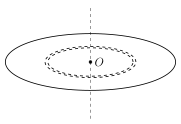
Prove that the area of the zone of the surface of a sphere between two parallel planes cutting the sphere is given by \[ 2\pi\times(\mbox{radius of sphere})\times(\mbox{perpendicular distance between the planes}). \] A tangent from the origin \(O\) to the curve with cartesian equation \[ (x-c)^{2}+y^{2}=a^{2}, \] where \(a\) and \(c\) are positive constants with \(c>a,\) touches the curve at \(P\). The \(x\)-axis cuts the curve at \(Q\) and \(R\), the points lying in the order \(OQR\) on the axis. The line \(OP\) and the arc \(PR\) are rotated through \(2\pi\) radians about the line \(OQR\) to form a surface. Find the area of this surface.
Solution:


1989 Paper 3 Q2
The points \(A,B\) and \(C\) lie on the surface of the ground, which is an inclined plane. The point \(B\) is 100m due north of \(A,\) and \(C\) is 60m due east of \(B\). The vertical displacements from \(A\) to \(B,\) and from \(B\) to \(C\), are each 5m downwards. A plane coal seam lies below the surface and is to be located by making vertical bore-holes at \(A,B\) and \(C\). The bore-holes strike the coal seam at 95m, 45m and 76m below \(A,B\) and \(C\) respectively. Show that the coal seam is inclined at \(\cos^{-1}(\frac{4}{5})\) to the horizontal. The coal seam comes to the surface along a line. Find the bearing of this line.
Solution: Set up a coordinate system so that \(x\) is E-W, \(y\) is N-S and \(z\) is the vertical direction. Also assume \(B\) is the origin, then, \(A = \begin{pmatrix} 0 \\ -100 \\ 5\end{pmatrix}, B = \begin{pmatrix} 0 \\ 0 \\ 0\end{pmatrix}, C= \begin{pmatrix} 60 \\ 0\\ -5\end{pmatrix},\). The coal seam has points: \(\begin{pmatrix} 0 \\ -100 \\ -90\end{pmatrix}, \begin{pmatrix} 0 \\ 0 \\ -45\end{pmatrix}, \begin{pmatrix} 60 \\ 0\\ -81\end{pmatrix},\) Therefore we can find the normal to the coal seam: \begin{align*} \mathbf{n} &= \left (\begin{pmatrix} 0 \\ -100 \\ -90\end{pmatrix} - \begin{pmatrix} 0 \\ 0 \\ -45\end{pmatrix}\right ) \times \left ( \begin{pmatrix} 60 \\ 0\\ -81\end{pmatrix} - \begin{pmatrix} 0 \\ 0 \\ -45\end{pmatrix}\right ) \\ &= \begin{pmatrix} 0 \\ - 100 \\ -45\end{pmatrix} \times \begin{pmatrix} 60 \\ 0 \\ -36\end{pmatrix} \\ &= \begin{pmatrix} 3600 \\ -60 \cdot 45 \\ 60 \cdot 100 \end{pmatrix} \\ &= 300\begin{pmatrix} 12 \\ -9 \\ 20\end{pmatrix} \end{align*} To measure the incline \(\theta\) to the horizontal we can take a dot with \(\hat{\mathbf{k}}\), to see: \begin{align*} \cos \theta &= \frac{20}{\sqrt{12^2+(-9)^2+20^2} \sqrt{1^2+0^2+0^2}} \\ &= \frac{20}{25} \\ &= \frac{4}{5} \end{align*} Therefore the angle is \(\cos^{-1} \tfrac 45\) The equation of the seam is \(12x - 9y + 20z = -900\). The equation of the surface is \(5x + 3y + 60z = 0\) We can compute the direction of the overlap again with a cross product: \begin{align*} \mathbf{d} &= \begin{pmatrix} 12 \\ -9 \\ 20\end{pmatrix} \times \begin{pmatrix} 5 \\ 3 \\ 60\end{pmatrix} \\ &= \begin{pmatrix} -600 \\ -620 \\ 81 \end{pmatrix} \end{align*} To get the bearing of this vector we just need to look at the \(x\) and \(y\) components, so it will be \(\tan^{-1} \frac{600}{620} = \tan^{-1} \frac{30}{31}\)
1989 Paper 3 Q3
The matrix \(\mathbf{M}\) is given by \[ \mathbf{M}=\begin{pmatrix}\cos(2\pi/m) & -\sin(2\pi/m)\\ \sin(2\pi/m) & \cos(2\pi/m) \end{pmatrix}, \] where \(m\) is an integer greater than \(1.\) Prove that \[ \mathbf{M}^{m-1}+\mathbf{M}^{m-2}+\cdots+\mathbf{M}^{2}+\mathbf{M}+\mathbf{I}=\mathbf{O}, \] where $\mathbf{I}=\begin{pmatrix}1 & 0\\ 0 & 1 \end{pmatrix}\( and \)\mathbf{O}=\begin{pmatrix}0 & 0\\ 0 & 0 \end{pmatrix}.$ The sequence \(\mathbf{X}_{0},\mathbf{X}_{1},\mathbf{X}_{2},\ldots\) is defined by \[ \mathbf{X}_{k+1}=\mathbf{PX}_{k}+\mathbf{Q}, \] where \(\mathbf{P,Q}\) and \(\mathbf{X}_{0}\) are given \(2\times2\) matrices. Suggest a suitable expression for \(\mathbf{X}_{k}\) in terms of \(\mathbf{P},\) \(\mathbf{Q}\) and \(\mathbf{X}_{0},\) and justify it by induction. The binary operation \(*\) is defined as follows: \[ \mathbf{X}_{i}*\mathbf{X}_{j}\mbox{ is the result of substituting \ensuremath{\mathbf{X}_{j}}for \ensuremath{\mathbf{X}_{0}}in the expression for \ensuremath{\mathbf{X}_{i}}. } \] Show that if \(\mathbf{P=M},\) the set \(\{\mathbf{X}_{1},\mathbf{X}_{2},\mathbf{X}_{3},\ldots\}\) forms a finite group under the operation \(*\).
Solution: \(\mathbf{M}^m = \mathbf{I}\), we also have \(\mathrm{det}(\mathbf{M - I}) = \cos^2(2\pi/m) - 2\cos(2\pi/m) + 1 + \sin^2(2\pi/m) = 2(1-\cos(2\pi/m))\) therefore \(\mathbf{M-I}\) is invertible. Therefore since \(\mathbf{(M-I)(M^{m-1} + M^{m-1} + \cdots + M^2 + M + I)= M^m-I = 0}\) we can cancel the \(\mathbf{M-I}\) to obtain the desired result. \(\mathbf{X_0 = X_0}\) \(\mathbf{X_1 = PX_0+Q}\) \(\mathbf{X_2 = P(PX_0+Q)+Q = P^2X_0 + PQ + Q}\) Claim: \(\mathbf{X_k = P^k X_0 + (P^{k-1} + P^{k-2} + \cdots + I)Q}\) Proof: (By induction on \(k\)). Base case \(k = 0\) is true. Assume it's true for some \(k = l\), then consider \(k = l+1\) \(\mathbf{X_{l+1} = PX_l + Q = P( P^l X_0 + (P^{l-1} + P^{l-2} + \cdots + I)Q) + Q = P^{l+1}X_0 + (P^l + P^{l-1} + \cdots + P)Q + Q = P^{l+1}X_0 + (P^l + P^{l-1} + \cdots + P + I)Q}\) Suppose \(\mathbf{P} = \mathbf{M}\), then consider the set \(\{\mathbf{X_1, X_2}, \ldots\}\) with the operation \(*\) as defined. \(\mathbf{X_i * X_j} = M^{i}(X_j) + (M^{i-1} + M^{i-2} + \cdots + M + I)Q = M^{i}(M^jX_0 + (M^{j-1} + M^{j-2} + \cdots + M + I)Q) + (M^{i-1} + M^{i-2} + \cdots + M + I)Q = M^{i+j}X_0 + (M^{i+j-1}+\cdots + M + I)Q = X_{i+j}\) Since \(X_m = X_0\) we can check all the requirements of the group, but this is going to be isomorphic to the cyclic group with \(m\) elements.
1989 Paper 3 Q4
Sketch the curve whose cartesian equation is \[ y=\frac{2x(x^{2}-5)}{x^{2}-4}, \] and give the equations of the asymptotes and of the tangent to the curve at the origin. Hence, or otherwise, determine (giving reasons) the number of real roots of the following equations:
- \(4x^{2}(x^{2}-5)=(5x-2)(x^{2}-4)\);
- \(4x^{2}(x^{2}-5)^{2}=(x^{2}-4)^{2}(x^{2}+1)\);
- \(4z^{2}(z-5)^{2}=(z-4)^{2}(z+1)\).
Solution:

- \begin{align*} && 4x^{2}(x^{2}-5)&=(5x-2)(x^{2}-4) \\ && \frac{2x(x^2-5)}{x^2-4} &= \frac{5x-2}{2x} = \frac52 -\frac1x \end{align*} Therefore it will have two roots as the hyperbola will intersect our graph in two places. (In the upper left and lower right quadrants).
- \begin{align*}
&& 4x^{2}(x^{2}-5)^{2}&=(x^{2}-4)^{2}(x^{2}+1) \\
&& \frac{2x(x^2-5)}{x^2-4} &= \frac{(x^2-4)(x^2+1)}{2x}
\end{align*}
No solutions \begin{align*} && 4z^{2}(z-5)^{2}&=(z-4)^{2}(z+1) \\ && \frac{2z(z^2-5)}{z^2-4} &= \frac{(z+5)(z-4)(z+1)}{(z-5)(z+4)} \end{align*}
 5 solutions
1989 Paper 3 Q5
Given that \(y=\cosh(n\cosh^{-1}x),\) for \(x\geqslant1,\) prove that \[ y=\frac{(x+\sqrt{x^{2}-1})^{n}+(x-\sqrt{x^{2}-1})^{n}}{2}. \] Explain why, when \(n=2k+1\) and \(k\in\mathbb{Z}^{+},\) \(y\) can also be expressed as the polynomial \[ a_{0}x+a_{1}x^{3}+a_{2}x^{5}+\cdots+a_{k}x^{2k+1}. \] Find \(a_{0},\) and show that
- \(a_{1}=(-1)^{k-1}2k(k+1)(2k+1)/3\);
- \(a_{2}=(-1)^{k}2(k-1)k(k+2)(2k+1)/15.\)
Solution: Recall, \(\cosh^{-1} x = \ln (x + \sqrt{x^2-1})\) \begin{align*} \cosh(n \cosh^{-1} x) &= \frac12 \left ( \exp(n \cosh^{-1} x) + \exp(-n\cosh^{-1}x) \right) \\ &= \frac12 \left ((x + \sqrt{x^2-1})^n + (x + \sqrt{x^2-1})^{-n} \right) \\ &= \frac12 \left ((x + \sqrt{x^2-1})^n + (x - \sqrt{x^2-1})^{n} \right) \\ \end{align*} When \(n = 2k+1\) \begin{align*} \cosh(n \cosh^{-1} x)&= \frac12 \left ((x + \sqrt{x^2-1})^n + (x - \sqrt{x^2-1})^{n} \right) \\ &= \frac12 \left (\sum_{i=0}^{2k+1}\binom{2k+1}{i}x^{2k+1-i}\left ( (\sqrt{x^2-1}^{i} + (-\sqrt{x^2-1})^{i} \right) \right) \\ &=\sum_{i=0}^{k} \binom{2k+1}{2i}x^{2k+1-2i}(x^2-1)^i \\ &=\sum_{i=0}^{k} \binom{2k+1}{2i}x^{2(k-i)+1}(x^2-1)^i \\ \end{align*} Which is clearly a polynomial with only odd degree terms. \begin{align*} a_0 &= \frac{\d y}{\d x} \vert_{x=0} \\ &= \sum_{i=0}^k\binom{2k+1}{2i} \left ( (2(k-i)+1)x^{2(k-i)}(x^2-1)^i + 2i\cdot x^{2(k-i)+2}(x^2-1) \right) \\ &= \binom{2k+1}{2k} (-1)^{k} \\ &= (-1)^k(2k+1) \end{align*}
- \begin{align*} a_1 &= \binom{2k+1}{2k}\binom{k}{1}(-1)^{k-1}+\binom{2k+1}{2(k-1)}(-1)^{k-1} \\ &=(-1)^{k-1}\cdot ( (2k+1)k + \frac{(2k+1)\cdot 2k \cdot (2k-1)}{3!}) \\ &= (-1)^{k-1}(2k+1)k\frac{3 + 2k-1}{3} \\ &= (-1)^{k-1}2(2k+1)k (k+1) \end{align*}
- \begin{align*} a_2 &= \binom{2k+1}{2k} \binom{k}{2}(-1)^{k-2} + \binom{2k+1}{2(k-1)} \binom{k-1}{1} (-1)^{k-2}+\binom{2k+1}{2(k-2)} (-1)^{k-2} \\ &= \binom{2k+1}{1} \binom{k}{2}(-1)^{k-2} + \binom{2k+1}{3} \binom{k-1}{1} (-1)^{k-2}+\binom{2k+1}{5} (-1)^{k-2} \\ &= (-1)^{k} \left (\binom{2k+1}{1} \frac{k(k-1)}{2} + \binom{2k+1}{3}(k-1)+\binom{2k+1}{5} \right) \\ &= (-1)^{k} \left ( \frac{(2k+1)k(k-1)}{2} + \frac{(2k+1)k(2k-1)}{3} + \frac{(2k+1)k(2k-1)(k-1)(2k-3)}{5\cdot2\cdot3} \right) \\ &= (-1)^k (2k+1)k\frac{1}{30} \left ( 15(k-1) + 10(2k-1)+(2k-1)(k-1)(2k-3) \right) \end{align*}
1989 Paper 3 Q6
Show that, for a given constant \(\gamma\) \((\sin\gamma\neq0)\) and with suitable choice of the constants \(A\) and \(B\), the line with cartesian equation \(lx+my=1\) has polar equations \[ \frac{1}{r}=A\cos\theta+B\cos(\theta-\gamma). \] The distinct points \(P\) and \(Q\) on the conic with polar equations \[ \frac{a}{r}=1+e\cos\theta \] correspond to \(\theta=\gamma-\delta\) and \(\theta=\gamma+\delta\) respectively, and \(\cos\delta\neq0.\) Obtain the polar equation of the chord \(PQ.\) Hence, or otherwise, obtain the equation of the tangent at the point where \(\theta=\gamma.\) The tangents at \(L\) and \(M\) to a conic with focus \(S\) meet at \(T.\) Show that \(ST\) bisects the angle \(LSM\) and find the position of the intersection of \(ST\) and \(LM\) in terms of your chosen parameters for \(L\) and \(M.\)
Solution: \begin{align*} && \frac1{r} &= A \cos \theta + B \cos (\theta - \gamma) \\ &&&= A \cos \theta + B \cos \theta \cos \gamma + B \sin \theta \sin \gamma \\ &&&= (A+B \cos \gamma) \cos \theta + B \sin \gamma \sin \theta \\ \Longleftrightarrow && 1 &= (A+B \cos \gamma) x + B \sin \gamma y \end{align*} So if we choose \(B = \frac{m}{\sin \gamma}\) and \(A = l-m \cot \gamma\) we have the desired result. \begin{align*} && \frac{1 + e \cos (\gamma -\delta)}a &= A \cos (\gamma - \delta) + B \cos (\gamma - \delta - \gamma) \\ &&&= A \cos(\gamma-\delta) +B \cos \delta\\ && \frac{1 + e \cos (\gamma +\delta)}{a} &= A \cos (\gamma + \delta) + B \cos (\gamma + \delta - \gamma) \\ &&&= A \cos(\gamma + \delta) + B \cos \delta\\ \Rightarrow && \frac1{r} &= \frac{e}{a} \cos \theta + \frac{1}{a \cos \delta} \cos (\theta - \gamma) \\ \lim{\delta \to 0} &&\frac1{r} &= \frac{e}{a} \cos \theta+ \frac{1}{a} \cos (\theta - \gamma) \end{align*} Suppose we have have points \(L\) and \(M\) with \(\theta = \gamma_L, \gamma_M\) then our tangents are: \begin{align*} && \frac{a}{r} &= \cos \theta + \cos (\theta - \gamma_L) \\ && \frac{a}{r} &= \cos \theta + \cos (\theta - \gamma_M) \\ \Rightarrow && 0 &= \cos (\theta - \gamma_L) -\cos(\theta - \gamma_M) \\ &&&= - 2 \sin \frac{(\theta - \gamma_L)+(\theta - \gamma_M)}{2} \sin \frac{(\theta - \gamma_L)-(\theta - \gamma_M)}{2} \\ &&&= -2 \sin \left ( \theta - \frac{\gamma_L+\gamma_M}2 \right) \sin \left ( \frac{\gamma_M - \gamma_L}{2}\right) \\ \Rightarrow && \theta &= \frac{\gamma_L+\gamma_M}{2} \end{align*} Therefore clearly \(ST\) bisects \(LSM\). The line \(LM\) can be seen as the chord from the points \(\frac{\gamma_L+\gamma_M}{2} \pm \frac{\gamma_L-\gamma_M}{2}\), so the line is: \begin{align*} && \frac{a}{r} &= e \cos \theta + \frac{1}{\cos \left ( \frac{\gamma_L-\gamma_M}{2}\right)} \cos \left (\theta - \frac{\gamma_L+\gamma_M}{2} \right) \end{align*} and we want the point on the line where \(\theta =\frac{\gamma_L+\gamma_M}{2}\) so \begin{align*} && \frac{a}{r} &= e \cos \left ( \frac{\gamma_L+\gamma_M}{2} \right) + \frac{1}{\cos \left ( \frac{\gamma_L-\gamma_M}{2}\right)} \\ \Rightarrow && r &= \frac{a}{e \cos \left ( \frac{\gamma_L+\gamma_M}{2} \right) + \frac{1}{\cos \left ( \frac{\gamma_L-\gamma_M}{2}\right)}} \end{align*}
1989 Paper 3 Q7
The linear transformation \(\mathrm{T}\) is a shear which transforms a point \(P\) to the point \(P'\) defined by
- \(\overrightarrow{PP'}\) makes an acute angle \(\alpha\) (anticlockwise) with the \(x\)-axis,
- \(\angle POP'\) is clockwise (i.e. the rotation from \(OP\) to \(OP'\) clockwise is less than \(\pi),\)
- \(PP'=k\times PN,\) where \(PN\) is the perpendicular onto the line \(y=x\tan\alpha,\) where \(k\) is a given non-zero constant.
Solution:

1989 Paper 3 Q8
Given that \[ \frac{\mathrm{d}x}{\mathrm{d}t}=4(x-y)\qquad\mbox{ and }\qquad\frac{\mathrm{d}y}{\mathrm{d}t}=x-12(\mathrm{e}^{2t}+\mathrm{e}^{-2t}), \] obtain a differential equation for \(x\) which does not contain \(y\). Hence, or otherwise, find \(x\) and \(y\) in terms of \(t\) given that \(x=y=0\) when \(t=0\).
Solution: \begin{align*} && \frac{\d x}{\d t} &= 4(x-y) \\ && \frac{\d y}{\d t} &= x - 12(e^{2t}+e^{-2t}) \\ \Rightarrow && \frac{\d^2 x}{\d t^2} &= 4 \frac{\d x}{\d t}-4\frac{\d y}{\d t} \\ &&&= 4 \frac{\d x}{\d t}-4 \left ( x - 12(e^{2t}+e^{-2t}) \right) \\ \Rightarrow && \frac{\d^2 x}{\d t^2} - 4 \frac{\d x}{\d t}+4x &= 48 (e^{2t}+e^{-2t}) \end{align*} This differential equation has characteristic polynomial \(\lambda^2 - 4\lambda + 4 = (\lambda-2)^2\). Therefore we should expect a general solution of \((At+B)e^{2t}\). For particular integrals we should try \(ke^{-2t}\) and \(Ct^2 e^{2t}\). For the former, we have: \begin{align*} && 48 &= 4k+8k+k \\ \Rightarrow && k &= \frac{48}{13} \end{align*} For the latter we have: \begin{align*} &&4Ct^2e^{2t} -4C(2te^{2t}+2t^2e^{2t})+2C((1+2t)e^{2t}+2t^2e^{2t}) &= 48e^{2t} \\ \Rightarrow && 2C &= 48 \\ \Rightarrow && C &= 24 \end{align*} Therefore the solution should be: \begin{align*} x = (At+B)e^{2t} + \frac{48}{13}e^{-2t} + 24t^2 e^{2t} \\ x(0) = B + \frac{48}{13} \\ x'(0) = 2B+A-\frac{96}{13} \\ x =\frac{48}{13}((4t-1)e^{2t}+e^{-2t})+24t^2e^{2t} \\ y = x - \frac{1}{4} \frac{\d x}{\d t} \end{align*}
1989 Paper 3 Q9
Obtain the sum to infinity of each of the following series.
- \(1{\displaystyle +\frac{2}{2}+\frac{3}{2^{2}}+\frac{4}{2^{3}}+\cdots+\frac{r}{2^{r-1}}+\cdots;}\)
- \(1{\displaystyle +\frac{1}{2}\times\frac{1}{2}+\frac{1}{3}\times\frac{1}{2^{2}}+\cdots+\frac{1}{r}\times\frac{1}{2^{r-1}}+\cdots;}\)
- \({\displaystyle \dfrac{1\times3}{2!}\times\frac{1}{3}+\frac{1\times3\times5}{3!}\frac{1}{3^{2}}+\cdots+\frac{1\times3\times\cdots\times(2k-1)}{k!}\times\frac{1}{3^{k-1}}+\cdots.}\)
Solution:
- \begin{align*} && \frac1{1-x} &= \sum_{r=0}^{\infty} x^r \\ \underbrace{\Rightarrow}_{\frac{\d}{\d x}} && \frac{1}{(1-x)^2} &= \sum_{r=0}^\infty rx^{r-1} \\ \underbrace{\Rightarrow}_{x = \frac12} && 4 &= \sum_{r=0}^{\infty} \frac{r}{2^{r-1}} \end{align*}
- \begin{align*} && \frac1{1-x} &= \sum_{r=1}^{\infty} x^{r-1} \\ \underbrace{\Rightarrow}_{\int} && -\ln (1-x) &= \sum_{r=1}^{\infty} \frac1{r} x^r \\ \underbrace{\Rightarrow}_{x = \frac12} && \ln 2 &= \sum_{r=1}^{\infty} \frac1{r } \times \frac{1}{ 2^{r}} \\ \Rightarrow && 2 \ln 2 &= \sum_{r=1}^{\infty} \frac1{r } \times \frac{1}{ 2^{r-1}} \\ \end{align*}
- \begin{align*} && (1-x)^{-1/2} &= 1 + \frac{(-\tfrac12)}{1!} (-x) +\frac{(-\tfrac12)(-\tfrac32)}{2!}(-x)^2 + \cdots \\ &&&= \sum_{r=0}^{\infty} \frac{1 \cdot 3 \cdot 5 \cdots \cdot (2r-1)}{2^rr!} x^r \\ \underbrace{\Rightarrow}_{x = \frac23} && \sqrt{3} &= \sum_{r=0}^{\infty} \frac{1 \cdot 3 \cdot 5 \cdots \cdot (2r-1)}{r!} \frac1{3^r} \\ &&&= 1 + \frac{1}{1!} \frac23 + \frac13 \sum_{r=2}^{\infty} \frac{1 \cdot 3 \cdot 5 \cdots \cdot (2r-1)}{r!} \frac1{3^{r-1}} \\ \Rightarrow && 3\sqrt{3}-5 &= \sum_{r=2}^{\infty} \frac{1 \cdot 3 \cdot 5 \cdots \cdot (2r-1)}{r!} \frac1{3^{r-1}} \\ \end{align*}
1989 Paper 3 Q10
- Prove that \[ \sum_{r=1}^{n}r(r+1)(r+2)(r+3)(r+4)=\tfrac{1}{6}n(n+1)(n+2)(n+3)(n+4)(n+5) \] and deduce that \[ \sum_{r=1}^{n}r^{5}<\tfrac{1}{6}n(n+1)(n+2)(n+3)(n+4)(n+5). \]
- Prove that, if \(n>1,\) \[ \sum_{r=0}^{n-1}r^{5}>\tfrac{1}{6}(n-5)(n-4)(n-3)(n-2)(n-1)n. \]
- Let \(\mathrm{f}\) be an increasing function. If the limits \[ \lim_{n\rightarrow\infty}\sum_{r=0}^{n-1}\frac{a}{n}\mathrm{f}\left(\frac{ra}{n}\right)\qquad\mbox{ and }\qquad\lim_{n\rightarrow\infty}\sum_{r=1}^{n}\frac{a}{n}\mathrm{f}\left(\frac{ra}{n}\right) \] both exist and are equal, the definite integral \({\displaystyle \int_{0}^{a}\mathrm{f}(x)\,\mathrm{d}x}\) is defined to be their common value. Using this definition, prove that \[ \int_{0}^{a}x^{5}\,\mathrm{d}x=\tfrac{1}{6}a^6. \]
Solution:
- Claim: \[ \sum_{r=1}^{n}r(r+1)(r+2)(r+3)(r+4)=\tfrac{1}{6}n(n+1)(n+2)(n+3)(n+4)(n+5) \] Proof: (By Induction) Base case: (n=1) \begin{align*} LHS &= 1 \cdot 2 \cdot 3 \cdot 4 \cdot 5 = 5! \\ RHS &= \frac16 1 \cdot 2 \cdot 3 \cdot 4 \cdot 5 \cdot 6 = 5! \end{align*} Therefore the base case is true. Inductive step: Suppose our statement is true for some \(n=k\), then consider \(n = k+1\) \begin{align*} \sum_{r=1}^{k+1} r(r+1)(r+2)(r+3)(r+4) &= \sum_{r=1}^{k} r(r+1)(r+2)(r+3)(r+4) + (k+1)(k+2)(k+3)(k+4)(k+5) \\ &\underbrace{=}_{\text{assumption}} \frac16 k(k+1)(k+2)(k+3)(k+4)(k+5) + (k+1)(k+2)(k+3)(k+4)(k+5) \\ &= (k+1)(k+2)(k+3)(k+4)(k+5) \l \frac{k}{6} +1\r \\ &= \frac16 (k+1)(k+2)(k+3)(k+4)(k+5)(k+6) \end{align*} Therefore our statement is true for \(n = k+1\). Therefore since our statement is true for \(n=1\) and if it is true for \(n=k\) then it is true for \(n = k+1\) by the principle of mathematical induction it is true for all \(n \geq 1\) Since \begin{align*} \sum_{r=1}^{n}r^5 &< \sum_{r=1}^{n}r(r+1)(r+2)(r+3)(r+4) \\ &= \frac16 n(n+1)(n+2)(n+3)(n+4)(n+5) \end{align*}
- \begin{align*}\sum_{r=0}^{n-1} r^5 &> \sum_{r=0}^{n-1} (r-4)(r-3)(r-2)(r-1)r \\ &= \sum_{r=0}^{n-5} r(r+1)(r+2)(r+3)(r+4) \\ &= \frac16 (n-5)(n-4)(n-3)(n-2)(n-1)n \end{align*}
- Let \(f(x) = x^5\) \begin{align*} S_{1,n} &= \sum_{r=0}^{n-1}\frac{a}{n}f\left(\frac{ra}{n}\right) \\ &= \sum_{r=0}^{n-1}\frac{a}{n}\left(\frac{ra}{n}\right)^5 \\ &=\frac{a^6}{n^6} \sum_{r=0}^{n-1}r^5\\ \end{align*} Therefore \(\frac{a^6}6 \frac{(n-5)(n-4)(n-3)(n-2)(n-1)n}{n^6} < S_{1,n} < \frac{a^6}6 \frac{(n-1)n(n+1)(n+2)(n+3)(n+4)}{n^6}\) and so \(\lim_{n\to\infty} S_{1,n} = \frac{a^6}{6}\). Similarly, \begin{align*} S_{2,n} &= \sum_{r=1}^{n}\frac{a}{n}f\left(\frac{ra}{n}\right) \\ &= \sum_{r=1}^{n}\frac{a}{n}\left(\frac{ra}{n}\right)^5 \\ &= \frac{a^6}{n^6} \sum_{r=1}^{n} r^5 \end{align*} Therefore \(\frac{a^6}6 \frac{(n-4)(n-3)(n-2)(n-1)n(n+1)}{n^6} < S_{2,n} < \frac{a^6}6 \frac{n(n+1)(n+2)(n+3)(n+4)(n+5)}{n^6}\) and so \(\lim_{n\to\infty} S_{2,n} = \frac{a^6}{6}\). Since both limits exist are are equal, we have \[ \int_{0}^{a}x^{5}\,\mathrm{d}x=\tfrac{1}{6}a^6. \]
1989 Paper 3 Q11
A smooth uniform sphere, with centre \(A\), radius \(2a\) and mass \(3m,\) is suspended from a fixed point \(O\) by means of a light inextensible string, of length \(3a,\) attached to its surface at \(C\). A second smooth unifom sphere, with centre \(B,\) radius \(3a\) and mass \(25m,\) is held with its surface touching \(O\) and with \(OB\) horizontal. The second sphere is released from rest, falls and strikes the first sphere. The coefficient of restitution between the spheres is \(3/4.\) Find the speed \(U\) of \(A\) immediately after the impact in terms of the speed \(V\) of \(B\) immediately before impact. The same system is now set up with a light rigid rod replacing the string and rigidly attached to the sphere so that \(OCA\) is a straight line. The rod can turn freely about \(O\). The sphere with centre \(B\) is dropped as before. Show that the speed of \(A\) immediately after impact is \(125U/127.\)
1989 Paper 3 Q12
A smooth horizontal plane rotates with constant angular velocity \(\Omega\) about a fixed vertical axis through a fixed point \(O\) of the plane. The point \(A\) is fixed in the plane and \(OA=a.\) A particle \(P\) lies on the plane and is joined to \(A\) by a light rod of length \(b(>a)\) freely pivoted at \(A\). Initially \(OAP\) is a straight line and \(P\) is moving with speed \((a+2\sqrt{ab})\Omega\) perpendicular to \(OP\) in the same sense as \(\Omega.\) At time \(t,\) \(AP\) makes an angle \(\phi\) with \(OA\) produced. Obtain an expression for the component of the acceleration of \(P\) perpendicular to \(AP\) in terms of \(\dfrac{\mathrm{d}^{2}\phi}{\mathrm{d}t^{2}},\phi,a,b\) and \(\Omega.\) Hence find \(\dfrac{\mathrm{d}\phi}{\mathrm{d}t}\), in terms of \(\phi,a,b\) and \(\Omega,\) and show that \(P\) never crosses \(OA.\)
Solution: Set up coordinate axes so that at time \(t\) \(OA\) is the \(x\)-axis, and all rotations are counter-clockwise. Then if \(OA = \mathbf{a}\), \(AP = \mathbf{x}\) and \(OP = \mathbf{p}\) we have: \begin{align*} \mathbf{a} &= \binom{a}{0} \\ \dot{\mathbf{a}} &= \binom{0}{-a \Omega} \\ \ddot{\mathbf{a}} &= \binom{-a \Omega^2}{0} \\ \\ \mathbf{x} &= \binom{b \cos \phi }{b \sin \phi } \\ \dot{\mathbf{x}} &= b \dot{\phi} \binom{-\sin \phi}{\cos \phi} \\ \ddot{\mathbf{x}} &= \binom{-b \ddot{\phi} \sin \phi-b \dot{\phi}^2 \cos \phi }{b \ddot{\phi} \cos \phi-b \dot{\phi}^2 \sin \phi} \\ \\ \ddot{\mathbf{p}} &= \binom{-a \Omega^2 +-b \ddot{\phi} \sin \phi-b \dot{\phi}^2 \cos \phi }{b \ddot{\phi} \cos \phi-b \dot{\phi}^2 \sin \phi} \end{align*} We can take a dot product with \(\mathbf{n} = \binom{-\sin \phi}{\cos \phi}\) to obtain the component perpendicular to \(AP\), which is: \begin{align*} && \binom{-\sin \phi}{\cos \phi} \cdot \ddot{x} &= a \Omega^2 \sin \phi + b \ddot{\phi} \end{align*} Noticing that this component must be \(0\) (since the only force acting on \(P\) is the rod), this must be equal to zero. \begin{align*} && 0 &= a \Omega^2 \sin \phi + b \ddot{\phi} \\ \Rightarrow && 0 &= a \Omega^2 \dot{\phi} \sin \phi + b\dot{\phi} \ddot{\phi} \\ \Rightarrow && C &= -a \Omega^2 \cos \phi + \tfrac12 b \dot{\phi}^2 \end{align*} Noticing that the initial conditions are \(\phi = 0\) and \(\dot{\phi} = 2\sqrt{\frac{a}{b}} \Omega\), so \begin{align*} && C &= -a \Omega^2+ \tfrac12 b \left ( 2\sqrt{\frac{a}{b}} \Omega \right)^2 \\ &&&= -a \Omega^2 + 2a \Omega^2 \\ &&&= a \Omega^2\\ \Rightarrow && \dot{\phi} &=\sqrt{\frac{2}{b} \left ( a \Omega^2 + a \Omega^2 \cos \phi \right)} \\ &&&= \Omega \sqrt{\frac{2a}{b}} \sqrt{1+ \cos \phi} \\ &&& = \Omega \sqrt{\frac{2a}{b}}\sqrt{2} \cos \tfrac{\phi}{2} \\ \Rightarrow && \int \sec \tfrac{\phi}{2} \d \phi &= 2 \Omega \sqrt{\frac{a}{b}}t \\ \Rightarrow && \tfrac12 \ln | \sec \tfrac{\phi}{2}+\tan \tfrac{\phi}{2} | &= 2 \Omega \sqrt{\frac{a}{b}}t + C \\ t = 0, \phi = 0: && C = 0 \\ \Rightarrow && \sec \tfrac{\phi}{2}+\tan \tfrac{\phi}{2} &= e^{4 \Omega \sqrt{\frac{a}{b}}t} \end{align*} Since when \(t > 0\) this is positive and larger than \(1\) we cannot have \(\phi = 0\) and since it remains below infinite \(\phi\) cannot reach \(\pi\). Therefore it cannot cross \(OA\)
1989 Paper 3 Q13
The points \(A,B,C,D\) and \(E\) lie on a thin smooth horizontal table and are equally spaced on a circle with centre \(O\) and radius \(a\). At each of these points there is a small smooth hole in the table. Five elastic strings are threaded through the holes, one end of each beging attached at \(O\) under the table and the other end of each being attached to a particle \(P\) of mass \(m\) on top of the table. Each of the string has natural length \(a\) and modulus of elasticity \(\lambda.\) If \(P\) is displaced from \(O\) to any point \(F\) on the table and released from rest, show that \(P\) moves with simple harmonic motion of period \(T\), where \[ T=2\pi\sqrt{\frac{am}{5\lambda}}. \] The string \(PAO\) is replaced by one of natural length \(a\) and modulus \(k\lambda.\) \(P\) is displaced along \(OA\) from its equilibrium position and released. Show that \(P\) still moves in a straight line with simple harmonic motion, and, given that the period is \(T/2,\) find \(k\).
Solution:

1989 Paper 3 Q14
- A solid circular disc has radius \(a\) and mass \(m.\) The density is proportional to the distance from the centre \(O\). Show that the moment of inertia about an axis through \(C\) perpendicular to the plane of the disc is \(\frac{3}{5}ma^{2}.\)
- A light inelastic string has one end fixed at \(A\). It passes under and supports a smooth pulley \(B\) of mass \(m.\) It then passes over a rough pulley \(C\) which is a disc of the type described in (i), free to turn about its axis which is fixed and horizontal. The string carries a particle \(D\) of mass \(M\) at its other end. The sections of the string which are not in contact with the pulleys are vertical. The system is released from rest and moves under gravity for \(t\) seconds. At the end of this interval the pulley \(B\) is suddenly stopped. Given that \(m<2M\), find the resulting impulse on \(D\) in terms of \(m,M,g\) and \(t\). {[}You may assume that the string is long enough for there to be no collisions between the elements of the system, and that the pulley \(C\) is rough enough to prevent slipping throughout.{]}
Solution:
- \begin{align*} m &= \int_0^a \underbrace{(\rho r)}_{\text{mass per area}} \underbrace{\pi r^2}_{\text{area}} \d r \\ &= \rho \pi \frac{a^3}{3} \\ \\ I &= \sum m r^2 \\ &= \sum (\rho r) \pi r^2 \cdot r^2 \\ &\to \int_0^a \rho \pi r^4 \\ &= \frac15 \rho \pi a^5 \\ &= \frac35 m a^2 \end{align*}
- \begin{align*} \text{N2}(\downarrow, D): && Mg -T_C &= Mf \\ \overset{\curvearrowright}{C} && (T_C - T_B)a &= I \frac{f}{a} \\ &&&= \frac35 m a f \\ \text{N2}(\uparrow, B): && 2T_B-mg &= \frac12 m f \\ \\ \Rightarrow && Mg-T_B &= \left (M + \frac35 m \right)f \\ \Rightarrow && Mg - \frac12 mg &= \left (M + \frac35 m + \frac14 m \right)f \\ \Rightarrow && f &= \frac{(M-\frac12 m)g}{M + \frac{17}{20} m} \\ &&&= \frac{(2M-m)g}{2M +\frac{17}{10}m} \end{align*} Therefore the speed after a time \(t\) is \(\displaystyle \frac{(2M-m)g}{2M +\frac{17}{10}m} t\) and the impulse will be the change in momentum, ie \(\displaystyle \frac{(2M-m)g}{2M +\frac{17}{10}m} Mt\)

1989 Paper 3 Q15
The continuous random variable \(X\) is uniformly distributed over the interval \([-c,c].\) Write down expressions for the probabilities that:
- \(n\) independently selected values of \(X\) are all greater than \(k\),
- \(n\) independently selected values of \(X\) are all less than \(k\),
Solution:
- \begin{align*} \mathbb{P}(n\text{ independent values of }X > k) &= \prod_{i=1}^n \mathbb{P}(X > k) \\ &= \left ( \frac{c-k}{2c}\right)^n \end{align*}
- \begin{align*} \mathbb{P}(n\text{ independent values of }X < k) &= \prod_{i=1}^n \mathbb{P}(X < k) \\ &= \left ( \frac{k+c}{2c}\right)^n \end{align*}