Problems
Filters
13 problems found
2010 Paper 2 Q1
Let \(P\) be a given point on a given curve \(C\). The \textit{osculating circle} to \(C\) at \(P\) is defined to be the circle that satisfies the following two conditions at \(P\): it touches \(C\); and the rate of change of its gradient is equal to the rate of change of the gradient of \(C\). Find the centre and radius of the osculating circle to the curve \(y=1-x+\tan x\) at the point on the curve with \(x\)-coordinate \(\frac14 \pi\).
Solution: The condition is that we match the first and second derivative (as well as passing through the point in question, which is \((\frac{\pi}{4}, 2 - \frac{\pi}{4})\) The gradient is \(y' = -1 + \sec^2 x\), so the value is \(1\). The second derivative is \(y'' = 2 \sec^2 x \tan x\), which is \(4\) If we have a circle, radius \(r\), so \((x-a)^2 + (y-b)^2 = r^2\) then \(2(x-a) + 2(y-b) \frac{\d y}{\d x} = 0\) and \(2 + 2 \left ( \frac{\d y}{\d x} \right)^2 + 2(y-b) \frac{\d^2y}{\d x^2} = 0\). Therefore we must have \(1+1+(2-\frac{\pi}{4}-b)4 = 0 \Rightarrow b =\frac52-\frac{\pi}{4}\) We know that the centre lies on the line \(y = 2-x\), so we must have \(a = \frac{\pi}{4}-\frac12\) and so the centre is \(( \frac{\pi}{4} - \frac12,\frac52 - \frac{\pi}{4})\) and the radius is \(\sqrt{\frac14 + \frac14} = \frac{\sqrt{2}}{2}\)
2010 Paper 2 Q2
Prove that \[ \cos 3x = 4 \cos^3 x - 3 \cos x \,. \] Find and prove a similar result for \(\sin 3x\) in terms of \(\sin x\).
- Let \[ {\rm I}(\alpha) = \int_0^\alpha \big(7\sin x - 8 \sin^3 x\big) \d x\,. \] Show that \[ {\rm I}(\alpha) = -\tfrac 8 3 c^3 + c +\tfrac5 3\,, \] where \(c = \cos \alpha\). Write down one value of \(c\) for which \({\rm I}(\alpha) =0\).
- Useless Eustace believes that \[ \int \sin^n x \, \d x =\dfrac {\sin^{n+1}x}{n+1}\, \] for \(n=1, \ 2, \ 3, \ldots\, \). Show that Eustace would obtain the correct value of \({\rm I}(\beta)\,\), where \(\cos \beta= -\frac16\). Find all values of \(\alpha\) for which he would obtain the correct value of \({\rm I}(\alpha)\).
Solution: \begin{align*} \cos 3x &\equiv \cos (2x + x) \\ &\equiv \cos 2x \cos x - \sin 2x \sin x \\ &\equiv (2\cos^2 x - 1) \cos x - 2 \sin x \cos x \sin x \\ &\equiv 2 \cos^3 x - \cos x - 2\cos x (\sin^2 x) \\ &\equiv 2 \cos^3 x - \cos x - 2\cos x (1- \cos^2 x) \\ &\equiv 4\cos^3 x - 3\cos x \end{align*} Similarly, \begin{align*} \sin 3x &\equiv \sin (2x + x) \\ &\equiv \sin 2x \cos x + \cos 2x \sin x \\ &\equiv 2 \sin x \cos x \cos x + (1-2\sin^2 x) \sin x \\ &\equiv 2 \sin x (1-\sin^2 x) + \sin x - 2 \sin^3 x \\ &\equiv 3 \sin x -4 \sin ^3 x \end{align*}
- \begin{align*} I(\alpha) &= \int_0^{\alpha} (7 \sin x - 8 \sin^3 x) \d x \\ &= \int_0^{\alpha} (7 \sin x - (6\sin x-2 \sin 3x) ) \d x \\ &= \int_0^{\alpha} (\sin x +2 \sin 3x ) \d x \\ &= -\cos \alpha - \frac23 \cos 3\alpha +1+\frac23 \\ &= -c - \frac23 (4c^3-3c) + \frac53 \\ &= -\frac83 c^3 +c + \frac53 \end{align*} as required. When \(c = -1\) this value is \(0\). Eustace will obtain the value \(\frac{7}{2} \sin^2 \beta - 2 \sin^4 \beta = \frac72 (1-\cos^2 \beta) - 2(1-\cos^2 \beta)^2 = \frac32 + \frac12\cos^2 \beta -2\cos^4 \beta\) So if \(\cos \beta = -\frac16\) he will obtain \(\frac32 + \frac{1}{2\cdot36} - \frac{2}{6^4}\) and he should obtain \(\frac{8}{3} \frac{1}{6^3} - \frac{1}{6} + \frac{5}{3}\) which are equal. We want to find all roots of: \begin{align*} && \frac32 + \frac12 c^2 - 2c^4 &= -\frac83 c^3+ c + \frac53 \\ \Rightarrow && 0 &=2c^4-\frac83c^3-\frac12 c^2+c +\frac{1}{6} \\ &&&= 12c^4-16c^3-3c^2+6c+1\\ &&&= (6c+1)(2c^3-3c^2+1) \\ &&&= (6c+1)(2c+1)(c-1)^2 \end{align*} Therefore \(\cos \alpha = - \frac16, -\frac12, 1\) will give the correct answers.
2010 Paper 2 Q3
The first four terms of a sequence are given by \(F_0=0\), \(F_1=1\), \(F_2=1\) and \(F_3=2\). The general term is given by \[ F_n= a\lambda^n+b\mu^n\,, \tag{\(*\)} \] where \(a\), \(b\), \(\lambda\) and \(\mu\) are independent of \(n\), and \(a\) is positive.
- Show that \(\lambda^2 +\lambda\mu+ \mu^2 = 2\), and find the values of \(\lambda\), \(\mu\), \(a\) and \(b\).
- Use \((*)\) to evaluate \(F_6\).
- Evaluate \(\displaystyle \sum_{n=0}^\infty \frac{F_n}{2^{n+1}}\,.\)
Solution:
- \(\,\) \begin{align*} && 0 &= a+b \tag{1}\\ && 1 &= a\lambda -a\mu \tag{2} \\ && 1 &= a\lambda^2 -a\mu^2 \tag{3} \\ && 2 &= a\lambda^3 - a\mu^3 \tag{4} \\ (4) \div (2): && 2 & = \lambda^2+\lambda \mu + \mu^2 \\ (3) \div (2): && 1 &= \lambda + \mu \\ \Rightarrow && 2 &= \lambda^2 + \lambda(1-\lambda) + (1-\lambda)^2 \\ &&&= \lambda^2-\lambda+1\\ \Rightarrow && \lambda, \mu &= \frac{1 \pm \sqrt{5}}{2} \\ \Rightarrow && a &= \frac{1}{\lambda - \mu} = \frac{1}{\sqrt{5}} \\ \Rightarrow && b &= -\frac{1}{\sqrt{5}} \end{align*} (NB: This is Binet's formula)
- \(\,\) \begin{align*} F_6 &= \frac{1}{\sqrt{5}} \left ( \left ( \frac{1 +\sqrt{5}}{2} \right)^6- \left ( \frac{1 -\sqrt{5}}{2} \right)^6 \right) \\ &= \frac{1}{2^6 \sqrt{5}} \left ( (1+\sqrt{5})^6-(1-\sqrt{5})^6 \right) \\ &= \frac{1}{2^5 \cdot \sqrt{5}} \left (6 \sqrt{5} +\binom{6}{3} (\sqrt{5})^3+\binom{6}{5}(\sqrt{5})^5 \right)\\ &= \frac{1}{2^5} \left (6 +20\cdot 5+6\cdot 5^2 \right)\\ &= \frac{1}{2^5} 256 = 2^3 = 8 \end{align*} (way more painful than just computing it by adding terms!)
- \(\,\) \begin{align*} && \sum_{n=0}^{\infty} \frac{F_n}{2^{n+1}} &= \sum_{n=0}^{\infty} \frac{a\lambda^n + b\mu^n}{2^{n+1}} \\ &&&= \frac12 \left ( \frac{a}{1-\frac{\lambda}2} + \frac{b}{1-\frac{\mu}2} \right) \\ &&&= \frac12 \left ( \frac{2a}{2-\lambda} + \frac{2b}{2-\mu}\right) \\ &&&= \frac{2a}{4-2\lambda} + \frac{2b}{4-2\mu}\\ &&&= \frac{2a}{4-(1+\sqrt{5})} - \frac{2a}{4-(1-\sqrt{5})} \\ &&&= \frac{2}{3\sqrt{5}-5} - \frac{2}{3\sqrt{5}+5} \\ &&&= \frac{6\sqrt{5}+10-6\sqrt{5}+10}{45-25} \\ &&&= 1 \end{align*}
2010 Paper 2 Q4
- Let \[ I=\int_0^a \frac {\f(x)}{\f(x)+\f(a-x)} \, \d x\,. \] Use a substitution to show that \[ I = \int_0^a \frac {\f(a-x)}{\f(x)+\f(a-x)} \, \d x\, \] and hence evaluate \(I\) in terms of \(a\). Use this result to evaluate the integrals \[ \int_0^1 \frac{\ln (x+1)}{\ln (2+x-x^2)}\, \d x \ \ \ \ \ \ \text{ and }\ \ \ \ \ \int_0^{\frac\pi 2} \frac{\sin x } {\sin(x+\frac \pi 4 )} \, \d x \,. \]
- Evaluate \[ \int_{\frac12}^2 \frac {\sin x}{x \big(\sin x + \sin \frac 1 x\big)} \, \d x\,. \]
Solution:
- \(\,\) \begin{align*} && I &= \int_0^a \frac{f(x)}{f(x)+f(a-x)} \d x \\ u =a-x, \d u = - \d x: &&& \int_{u=a}^{u=0} \frac{f(a-u)}{f(a-u)+f(u)} (-1) \d u \\ &&&= \int_0^a \frac{f(a-u)}{f(u)+f(a-u)} \d u \\ &&&= \int_0^a \frac{f(a-x)}{f(x)+f(a-x)} \d x \\ \Rightarrow && 2 I &= \int_0^a \left ( \frac{f(x)}{f(x)+f(a-x)} + \frac{f(a-x)}{f(x)+f(a-x)} \right) \d x \\ &&&= \int_0^a 1 \d x \\ &&&= a \\ \Rightarrow && I &= \frac{a}{2} \end{align*} \begin{align*} && J &= \int_0^1 \frac{\ln (x+1)}{\ln (2+x-x^2)}\, \d x \\ &&&= \int_0^1 \frac{\ln (x+1)}{\ln((x+1)(2-x))} \d x \\ &&&= \int_0^1 \frac{\ln (x+1)}{\ln(x+1) + \ln ((1-x)+1)} \d x \\ &&&= \frac{1}{2} \tag{\(f(x) = \ln (x+1)\)} \\ \\ && K &= \int_0^{\frac\pi 2} \frac{\sin x } {\sin(x+\frac \pi 4 )} \, \d x \\ &&&= \int_0^{\frac{\pi}{2}} \frac{\sin x }{\sin x \cos \frac{\pi}{4} + \cos x \sin \frac{\pi}{4}} \\ &&&= \sqrt{2} \int_0^{\frac{\pi}{2}} \frac{\sin x }{\sin x + \sin (\frac{\pi}{2}-x)} \d x\\ &&&= \frac{\pi}{2\sqrt{2}} \end{align*}
- \(\,\) \begin{align*} &&I &= \int_{\frac12}^2 \frac{\sin x }{x(\sin x + \sin \frac1x)} \d x \\ u = 1/x, \d u = -1/x^2 \d x : &&&= \int_{u = 2}^{u=\frac12} \frac{\sin \frac1u}{\frac{1}{u}(\sin \frac1u + \sin u)} (-\frac{1}{u^2} ) \d u \\ &&&= \int_{\frac12}^2 \frac{\sin \frac1u}{u (\sin u + \sin \frac1u)} \d u \\ \Rightarrow && 2I &= \int_{\frac12}^2 \left ( \frac{\sin x }{x(\sin x + \sin \frac1x)} + \frac{\sin \frac1x }{x(\sin x + \sin \frac1x)}\right) \d x \\ &&&= \int_{\frac12}^2 \frac{1}{x} \d x\\ &&&= 2\ln2 \\ \Rightarrow && I &= \ln 2 \end{align*}
2010 Paper 2 Q5
The points \(A\) and \(B\) have position vectors \(\bf i +j+k\) and \(5{\bf i} - {\bf j} -{\bf k}\), respectively, relative to the origin \(O\). Find \(\cos2\alpha\), where \(2\alpha\) is the angle \(\angle AOB\).
- The line \(L _1\) has equation \({\bf r} =\lambda(m{\bf i}+n {\bf j} + p{\bf k})\). Given that \(L _1\) is inclined equally to \(OA\) and to \(OB\), determine a relationship between \(m\), \(n\) and~\(p\). Find also values of \(m\), \(n\) and~\(p\) for which \(L _1\) is the angle bisector of \(\angle AOB\).
- The line \(L _2\) has equation \({\bf r} =\mu(u{\bf i}+v {\bf j} + w{\bf k})\). Given that \( L _2\) is inclined at an angle \(\alpha\) to \(OA\), where \(2\alpha = \angle AOB\), determine a relationship between \(u\), \(v\) and \(w\). Hence describe the surface with Cartesian equation \(x^2+y^2+z^2 =2(yz+zx+xy)\).
2010 Paper 2 Q6
Each edge of the tetrahedron \(ABCD\) has unit length. The face \(ABC\) is horizontal, and \(P\) is the point in \(ABC\) that is vertically below \(D\).
- Find the length of \(PD\).
- Show that the cosine of the angle between adjacent faces of the tetrahedron is \(1/3\).
- Find the radius of the largest sphere that can fit inside the tetrahedron.
Solution:
- \(D\) must be above the centre (of any kind) of the equilateral triangle \(ABC\). Therefore it is a distance \(\frac23 \frac{\sqrt{3}}2 = \frac{\sqrt{3}}3\) from \(A\). \(D\) is \(1\) from \(A\), therefore by Pythagoras \(PD = \sqrt{1-\frac13} = \sqrt{\frac23}\)
- We can place \(D\) at \(\langle 0,0,\sqrt{\frac23}\rangle\) and \(A'\) (the midpoint of \(BC\)) at \(\langle-\frac{\sqrt{3}}{6},0,0 \rangle\) and we find: \begin{align*} && \cos \theta &= \frac{(\mathbf{a}'-\mathbf{d})\cdot \mathbf{a}'}{|\mathbf{a}'-\mathbf{d}|| \mathbf{a}'|} \\ &&&= \frac{|\mathbf{a}'|}{|\mathbf{a}'-\mathbf{d}|} \\ &&&= \frac{\frac{\sqrt{3}}{6}}{\sqrt{\frac23+\frac{3}{36}}} = \frac13 \end{align*}
- We have And therefore we must have \(\tan \frac{\cos^{-1} \frac13}{2} = \frac{r}{\frac{\sqrt{3}}{6}}\) therefore \begin{align*} && r &= \frac{\sqrt{3}}{6} \tan \left (\frac{\cos^{-1} \frac13}{2} \right) \\ &&&= \frac{\sqrt{3}}6 \sqrt{\frac{1-\cos(\cos^{-1}\frac13)}{1+\cos(\cos^{-1}\frac13)}} \\ &&&= \frac{\sqrt{3}}6 \sqrt{\frac{\frac23}{\frac43}} \\ &&&= \frac{\sqrt{6}}{12} \end{align*}

2010 Paper 2 Q7
- By considering the positions of its turning points, show that the curve with equation \[ y=x^3-3qx-q(1+q)\,, \] where \(q>0\) and \(q\ne1\), crosses the \(x\)-axis once only.
- Given that \(x\) satisfies the cubic equation \[ x^3-3qx-q(1+q)=0\,, \] and that \[ x=u+q/u\,, \] obtain a quadratic equation satisfied by \(u^3\). Hence find the real root of the cubic equation in the case \(q>0\), \(q\ne1\).
- The quadratic equation \[ t^2 -pt +q =0\, \] has roots \(\alpha \) and \(\beta\). Show that \[ \alpha^3+\beta^3 = p^3 -3qp\,. \] It is given that one of these roots is the square of the other. By considering the expression \((\alpha^2 -\beta)(\beta^2-\alpha)\), find a relationship between \(p\) and \(q\). Given further that \(q>0\), \(q\ne1\) and \(p\) is real, determine the value of \(p\) in terms of \(q\).
2010 Paper 2 Q8
The curves \(C_1\) and \(C_2\) are defined by \[ y= \e^{-x} \quad (x>0) \quad \text{ and } \quad y= \e^{-x}\sin x \quad (x>0), \] respectively. Sketch roughly \(C_1\) and \(C_2\) on the same diagram. Let \(x_n\) denote the \(x\)-coordinate of the \(n\)th point of contact between the two curves, where \(0 < x_1 < x_2 < \cdots\), and let \(A_n\) denote the area of the region enclosed by the two curves between \(x_n\) and \(x_{n+1}\). Show that \[ A_n = \tfrac12(\e^{2\pi}-1) \e^{-(4n+1)\pi/2} \] and hence find \(\displaystyle \sum_{n=1}^\infty A_n\).
Solution:
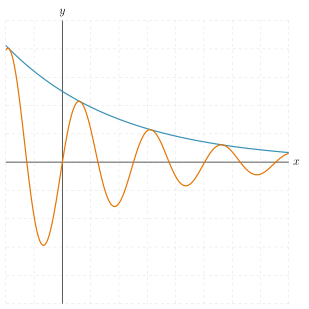
2010 Paper 2 Q9
Two points \(A\) and \(B\) lie on horizontal ground. A particle \(P_1\) is projected from \(A\) towards \(B\) at an acute angle of elevation \(\alpha\) and simultaneously a particle \(P_2\) is projected from \(B\) towards \(A\) at an acute angle of elevation \(\beta\). Given that the two particles collide in the air a horizontal distance \(b\) from \(B\), and that the collision occurs after \(P_1\) has attained its maximum height \(h\), show that \[ 2h \cot\beta < b < 4h \cot\beta \hphantom{\,,} \] and \[ 2h \cot\alpha < a < 4h \cot\alpha \,, \] where \(a\) is the horizontal distance from \(A\) to the point of collision.
2010 Paper 2 Q10
- In an experiment, a particle \(A\) of mass \(m\) is at rest on a smooth horizontal table. A particle \(B\) of mass \(bm\), where \(b >1\), is projected along the table directly towards \(A\) with speed \(u\). The collision is perfectly elastic. Find an expression for the speed of \(A\) after the collision in terms of \(b\) and \(u\), and show that, irrespective of the relative masses of the particles, \(A\) cannot be made to move at twice the initial speed of \(B\).
- In a second experiment, a particle \(B_1\) is projected along the table directly towards \(A\) with speed \(u\). This time, particles \(B_2\), \(B_3\), \(\ldots\,\), \(B_n\) are at rest in order on the line between \(B_1\) and \(A\). The mass of \(B_i\) (\(i=1\), \(2\), \(\ldots\,\), \(n\)) is \(\lambda^{n+1-i}m\), where \(\lambda>1\). All collisions are perfectly elastic. Show that, by choosing \(n\) sufficiently large, there is no upper limit on the speed at which \(A\) can be made to move. In the case \(\lambda=4\), determine the least value of \(n\) for which \(A\) moves at more than \(20u\). You may use the approximation \(\log_{10}2 \approx 0.30103\).
Solution:
- Since the collision is perfectly elastic, the speed of approach and separation are equal, ie \(v_B = v_A - u\) \begin{align*} \text{COM}: && bmu &= bm(v_A - u) + mv_A \\ \Rightarrow && (b+1)v_A &= 2bu \\ \Rightarrow && v_A &= \frac{2b}{b+1} u \end{align*} Since \(0 < \frac{b}{b+1} < 1\), the largest \(0 < v_A < 2u\)

- After the first collision with each \(B_i\) we will have \(\displaystyle v_{i+1} = \frac{2\lambda}{\lambda + 1}v_i\), ie \(\displaystyle v_{i+1} = \left (\frac{2\lambda}{\lambda + 1} \right)^i u\) and so \(\displaystyle v_A = \left (\frac{2\lambda}{\lambda + 1} \right)^n u\) which can be arbitrarily large. Suppose \(\lambda = 4\), then \begin{align*} && 20u &< v_A \\ &&&= \left (\frac{8}{5} \right)^n u \\ \Rightarrow && \log_{10} 20 < n \log_{10}(16/10) \\ && \log_{10} 2 + 1 < n 4\log_{10} 2 - n \\ \Rightarrow && n &> \frac{ \log_{10} 2 + 1}{ 4\log_{10} 2 - 1} \\ &&&\approx \frac{0.30103+1}{4 \times 0.30103 -1}\\ &&&= \frac{1.30103}{0.20412} \\ &&&>6 \end{align*} So \(n =7\) is the smallest possible
2010 Paper 2 Q11
A uniform rod \(AB\) of length \(4L \) and weight \(W\) is inclined at an angle \(\theta\) to the horizontal. Its lower end \(A\) rests on a fixed support and the rod is held in equilibrium by a string attached to the rod at a point \(C\) which is \(3L \) from \(A\). The reaction of the support on the rod acts in a direction \(\alpha\) to \(AC\) and the string is inclined at an angle \(\beta\) to \(CA\). Show that \[ \cot\alpha = 3\tan \theta + 2 \cot \beta\,. \] Given that \(\theta =30^\circ\) and \(\beta = 45^\circ\), show that \(\alpha= 15^\circ\).
2010 Paper 2 Q12
The continuous random variable \(X\) has probability density function \(\f(x)\), where \[ \f(x) = \begin{cases} a & \text {for } 0\le x < k \\ b & \text{for } k \le x \le 1\\ 0 & \text{otherwise}, \end{cases} \] where \(a > b > 0\) and \(0 < k < 1\). Show that \(a > 1\) and \(b < 1\).
- Show that \[ \E(X) = \frac{1-2b+ab}{2(a-b)}\,. \]
- Show that the median, \(M\), of \(X\) is given by \(\displaystyle M=\frac 1 {2a}\) if \(a+b\ge 2ab\) and obtain an expression for the median if \(a+b\le 2ab\).
- Show that \(M < \E(X)\,\).
Solution: \begin{align*} && 1 &= \int_0^1 f(x) \d x \\ &&&= ak + b(1-k) \\ &&&= b + (a-b)k \\ \Rightarrow && k &= \frac{1-b}{a-b} \\ \Rightarrow && b & < 1 \tag{\(0 < k, \,a > b\)} \\ && k &> 1 \\ \Rightarrow && a-b & > 1-b \\ \Rightarrow && a > 1 \end{align*}
- \(\,\) \begin{align*} && \E[X] &= \int_0^1 x \cdot f(x) \d x \\ &&&= \int_0^k ax \d x + \int_k^1 b x \d x \\ &&&= a \frac{k^2}{2} + b \frac{1-k^2}{2} \\ &&&= \frac12b + (a-b) \frac{(1-b)^2}{2(a-b)^2} \\ &&&= \frac{(1-b)^2+b(a-b)}{2(a-b)} \\ &&&= \frac{1-2b+ab}{2(a-b)} \end{align*}
- \(\,\) The median \(M\) satisfies \[\frac12 = \int_0^M f(x) \d x \] If \(ka = \frac{a-ab}{a-b} \leq \frac12 \Leftrightarrow 2a-2ab \leq a-b \Leftrightarrow a+b \leq 2ab\) then \(M > k\) otherwise \(M < k\). In the latter case: \begin{align*} && \frac12 &= Ma \\ \Rightarrow && M &= \frac{1}{2M} \end{align*} In the former case \begin{align*} && \frac12 &= ka + (M-k)b \\ &&&= k(a-b) + Mb \\ &&&= 1-b + M b \\ \Rightarrow && M &= 1-\frac1{2b} \end{align*}
2010 Paper 2 Q13
Rosalind wants to join the Stepney Chess Club. In order to be accepted, she must play a challenge match consisting of several games against Pardeep (the Club champion) and Quentin (the Club secretary), in which she must win at least one game against each of Pardeep and Quentin. From past experience, she knows that the probability of her winning a single game against Pardeep is \(p\) and the probability of her winning a single game against Quentin is \(q\), where \(0 < p < q < 1\).
- The challenge match consists of three games. Before the match begins, Rosalind must choose either to play Pardeep twice and Quentin once or to play Quentin twice and Pardeep once. Show that she should choose to play Pardeep twice.
- In order to ease the entry requirements, it is decided instead that the challenge match will consist of four games. Now, before the match begins, Rosalind must choose whether to play Pardeep three times and Quentin once (strategy 1), or to play Pardeep twice and Quentin twice (strategy 2) or to play Pardeep once and Quentin three times (strategy 3). Show that, if \(q-p > \frac 12\), Rosalind should choose strategy 1. If \(q-p<\frac12\), give examples of values of \(p\) and \(q\) to show that strategy 2 can be better or worse than strategy 1.
Solution:
- If she plays \(P\) twice her probability is \(q(p^2+2p(1-p)) = qp(2-p)\). If she plays \(Q\) twice her probability is \(pq(2-q)\). Since \(p < q\) she should play \(P\) twice.
- Under strategy 1, her probability is \(q(p^3+3p^2(1-p)+3p(1-p)^2) = qp(p^2+3p-3p^2+3-6p+3p^2) = qp(3-3p+p^2)\) Under strategy 2 her probability is \((p^2+2p(1-p))(q^2+2q(1-q)) = pq(2-p)(2-q)\). Under strategy 3 her probability is \(qp(3-3q+q^2)\) \begin{align*} && q - p &> \frac12 \\ \Rightarrow && (2-p)(2-q) & < (2-p)(\frac32 - p) \\ &&&= 3 - \frac72p + p^2 \\ &&&< 3- 3p + p^2 \end{align*} Therefore Strategy 1 dominates if \(q-p > \frac12\). If \(p = \frac14, q = \frac12\) then \((2-p)(2-q) =\frac74 \cdot \frac32 = \frac{21}{8}\) and \(3-3p + p^2 = 3 - \frac34 + \frac1{16} = \frac{48-12+1}{16} = \frac{37}{16} < \frac{42}{16}\) so strategy 2 dominates. Notice that strategy 1 always dominates strategy 3 since \(f(x) = 3-3x+x^2\) is decreasing for \(x < 1.5\). If \(p = \frac14, q = \frac12\) then \((2-p)(2-q) =\frac74 \cdot \frac32 = \frac{21}{8}\) and \(3-3p + p^2 = 3 - \frac34 + \frac1{16} = \frac{48-12+1}{16} = \frac{37}{16} < \frac{42}{16}\) so strategy 2 dominates. For strategy 1 to dominate, we need \(3-3p+p^2 > (2-q)(2-p)\) or \(\frac{3-3p+p^2}{2-p} > 2-q\). When \(p = \frac12\) this is \(\frac{3-\frac32 + \frac14}{2 - \frac12} = \frac{\frac{7}{4}}{\frac{3}{2}} = \frac76 = 2-\frac{5}{6}\) so take any value of \(q\) larger than \(\frac56\).