Problems
Filters
16 problems found
1988 Paper 2 Q1
The function \(\mathrm{f}\) is defined, for \(x\neq1\) and \(x\neq2\) by \[ \mathrm{f}(x)=\frac{1}{\left(x-1\right)\left(x-2\right)} \] Show that for \(\left|x\right|<1\) \[ \mathrm{f}(x)=\sum_{n=0}^{\infty}x^{n}-\frac{1}{2}\sum_{n=0}^{\infty}\left(\frac{x}{2}\right)^{n} \] and that for \(1<\left|x\right|<2\) \[ \mathrm{f}(x)=-\sum_{n=1}^{\infty}x^{-n}-\frac{1}{2}\sum_{n=0}^{\infty}\left(\frac{x}{2}\right)^{n} \] Find an expression for \(\mbox{f}(x)\) which is valid for \(\left|x\right|>2\).
Solution: \begin{align*} && \f(x) &= \frac1{(x-1)(x-2)} \\ &&&=\frac{1}{x-2} -\frac{1}{x-1} \\ \end{align*} Therefore, for \(|x| < 1\) \begin{align*} && \f(x) &=\frac{1}{x-2} -\frac{1}{x-1} \\ &&&= -\frac12 \frac{1}{1-\frac{x}{2}} + \frac{1}{1-x} \\ &&&= \sum_{n=0}^{\infty} x^n - \frac12 \sum_{n=0}^\infty \l \frac{x}2 \r^2 \end{align*} where both geometric series converge since \(|x| < 1\) and \(|\frac{x}{2}| < 1\) When \(1 < |x|< 2 \Rightarrow |\frac{1}{x}| < 1\), we must have: \begin{align*} && \f(x) &=\frac{1}{x-2} -\frac{1}{x-1} \\ &&&= -\frac12 \frac{1}{1-\frac{x}{2}} + \frac1{x}\frac{1}{1-\frac{1}{x}} \\ &&&= - \frac12 \sum_{n=0}^\infty \l \frac{x}2 \r^2 - \frac{1}{x} \sum_{n=0}^{\infty} x^{-n} \\ &&&= - \frac12 \sum_{n=0}^\infty \l \frac{x}2 \r^2 - \sum_{n=1}^{\infty} x^{-n} \\ \end{align*} Finally, when \(|x| > 2\), ie \(|\frac{2}{x}| < 1\) we have \begin{align*} && \f(x) &=\frac{1}{x-2} -\frac{1}{x-1} \\ &&& =\frac1{x} \frac{1}{1-\frac{2}{x}} - \frac{1}{x}\frac{1}{1-\frac{1}{x}} \\ &&&= \frac1{x} \sum_{n=0}^{\infty} \l \frac{2}{x} \r^n - \sum_{n=1}^{\infty}x^{-n} \\ &&&= \sum_{n=1}^{\infty} 2^{n-1} x^{-n} - \sum_{n=1}^{\infty}x^{-n} \\ \end{align*}
1988 Paper 2 Q2
The numbers \(x,y\) and \(z\) are non-zero, and satisfy \[ 2a-3y=\frac{\left(z-x\right)^{2}}{y}\quad\mbox{ and }\quad2a-3z=\frac{\left(x-y\right)^{2}}{z}, \] for some number \(a\). If \(y\neq z\), prove that \[ x+y+z=a, \] and that \[ 2a-3x=\frac{\left(y-z\right)^{2}}{x}. \] Determine whether this last equation holds only if \(y\neq z\).
Solution: \begin{align*} && \begin{cases} 2a-3y=\frac{\left(z-x\right)^{2}}{y} \\ 2a-3z=\frac{\left(x-y\right)^{2}}{z} \end{cases} \\ \Rightarrow && \begin{cases} 2ay-3y^2=\left(z-x\right)^{2} \\ 2az-3z^2=\left(x-y\right)^{2} \end{cases} \\ \Rightarrow && 2a(y-z)-3(y+z)(y-z) &= (z-x+x-y)(z-x-x+y) \\ \Rightarrow && (y-z)(2a-3y-3z) &= (z-y)(z-2x+y) \\ \Rightarrow && 2a-3y-3z &= 2x-y-z \tag{\(y \neq z\)} \\ \Rightarrow && a &= x+y+z \\ \end{align*} This is is our first result. \begin{align*} && 2a-3y-3z &= 2x-y-z \\ \Rightarrow && 2a-3y-3x &= 3z-y-x \\ \Rightarrow && (y-x)2a-3(y-x)(y+x) &= (y-x)(2z-x-y) \\ \Rightarrow && 2a(y-x)-3(y^2-x^2) &= (z-y)^2-(x-z)^2 \\ \Rightarrow && 2ax - 3x^2 &= (y-z)^2 \\ \Rightarrow && 2a - 3x &= \frac{(y-z)^2}{x} \end{align*} Suppose \(x = \frac23 a, y = z = \frac16 a\) then all equations are satisfied, but \(y = z\).
1988 Paper 2 Q3
The quadratic equation \(x^{2}+bx+c=0\), where \(b\) and \(c\) are real, has the properly that if \(k\) is a (possibly complex) root, then \(k^{-1}\) is a root. Determine carefully the restriction that this property places on \(b\) and \(c\). If, in addition to this property, the equation has the further property that if \(k\) is a root, then \(1-k\) is a root, find \(b\) and \(c\). Show that \[ x^{3}-\tfrac{3}{2}x^{2}-\tfrac{3}{2}x+1=0 \] is the only cubic equation of the form \(x^{3}+px^{2}+qx+r=0\), where \(p,q\) and \(r\) are real, which has both the above properties.
Solution: Suppose \(k\) is a root of our quadratic. There are two possibilities, if \(k^{-1} = k\) then we must have \(k^2 = 1\) so either \(\pm 1\) is a root or we must have \((x-k)(x-k^{-1}) = x^2+bx+c\). In the first case we can have: \begin{align*} x^2+bx +c = (x-1)^2 &\Rightarrow b = -2, c = 1 \\ x^2+bx +c = (x+1)^2 &\Rightarrow b = 2, c = 1 \\ x^2+bx +c = (x-1)(x+1) &\Rightarrow b = 0, c = 1 \\ \end{align*} In the other cases, \(c = 1\) and \(b = k^{-1}+k\). Therefore we must have \(c = 1\) and \(b\) can take any values. The statement "if \(k\) is a root then \(1-k\) is a root" implies these two roots are different, so we must have \(1-k = k^{-1} \Rightarrow k-k^2 = 1 \Rightarrow k^2-k+1 = 0\) so \(b = -1, c = 1\). Suppose \(x^3+px^2+qx+r = 0\) has the first property, then for any root \(k\) we must have: \(k^3 + pk^2 + qk + r = 0\) and \(1 + pk^{-1} + qk^{-2} + rk^{-3} = 0\) therefore \(x^3+px^2+qx+r\) and \(rx^3+qx^2+px+1 = 0\) must have identical roots (since \(x = \pm\) either wont work here since they imply having the roots \(1, 0\) or \(-1, 2, \frac12\) which is exactly our equation. Therefore \(r = 1, p = q\). Suppose \(x^3 + px^2 + px+1 = 0\) has the property that if \(k\) is a root \(1-k\) is a root, therefore: \begin{align*} 0 &= (1-k)^3+p(1-k)^2 + p(1-k) + 1 \\ &= 1 -3k+3k^2-k^3+p-2kp+pk^2+p-pk+1 \\ &= -k^3+(3+p)k^2+(-3-3p)k+(2+2p) \end{align*} Since these roots must be the same as the original roots, we must have \(3+p = -p, -3-3p = -p, 2+2p = -1 \Rightarrow p = -\frac32\)
1988 Paper 2 Q4
The complex number \(w\) is such that \(w^{2}-2w\) is real.
- Sketch the locus of \(w\) in the Argand diagram.
- If \(w^{2}=x+\mathrm{i}y,\) describe fully and sketch the locus of points \((x,y)\) in the \(x\)-\(y\) plane.
Solution:
- Suppose \(w = u+ vi\) then \(w^2 - 2w = u^2-v^2-2u+(2uv-2v)i\) so to be purely real we must have \(2uv-2v = 2v(u-1) = 0\) ie either \(v = 0\) or \(u = 1\). Therefore the locus is the real axis and the line \(1 + ti\):

- If \(w^2 = x+yi\) then we must have \(x = u^2-v^2\) and \(y = 2uv\), so either \(v = 0, y = 0, x = u^2-2u \geq -1\) or \(u = 1, x = 1-v^2, y = 2v\) which is a parabola:


1988 Paper 2 Q5
By considering the imaginary part of the equation \(z^{7}=1,\) or otherwise, find all the roots of the equation \[ t^{6}-21t^{4}+35t^{2}-7=0. \] You should justify each step carefully. Hence, or otherwise, prove that \[ \tan\frac{2\pi}{7}\tan\frac{4\pi}{7}\tan\frac{6\pi}{7}=\sqrt{7}. \] Find the corresponding result for \[ \tan\frac{2\pi}{n}\tan\frac{4\pi}{n}\cdots\tan\frac{(n-1)\pi}{n} \] in the two cases \(n=9\) and \(n=11.\)
Solution: Suppose \(z^7 = 1\), then we can write \(z = \cos \theta + i \sin \theta\) and we must have that: \begin{align*} 0 &= \textrm{Im}((\cos \theta + i \sin \theta)^7) \\ &= \binom{7}{6}\cos^6 \theta \sin \theta - \binom{7}{4} \cos^4 \theta \sin^3 \theta + \binom{7}{2} \cos^2 \theta \sin^5 \theta - \sin^7 \theta \\ &= 7 \cos^6 \sin \theta - 35 \cos^4 \theta \sin ^3 \theta + 21 \cos^2 \theta \sin^5 \theta - \sin^7 \theta \\ &= -\cos^7 \theta \l \tan^7 \theta - 21 \tan^5 \theta + 35 \tan^3 \theta - 7 \tan \theta\r \\ &= \cos^7 \theta \cdot t (t^7-21t^4+35t^2-7) \end{align*} Where \(t = \tan \theta\). So if \(z\) is a root of \(z^7 = 1\) and \(\cos \theta \neq 0, \tan \theta \neq 0\) then \(t\) is a root of the equation. Thererefore the roots are: \(\tan \frac{2\pi k}{7}\) where \(k = 1, 2, \ldots 6\). Noting that \(\tan \frac{\pi}7 = -\tan \frac{6\pi}{7}, \tan \frac{3\pi}{7} = -\tan \frac{4 \pi}{7}, \tan \frac{5\pi}{7} = -\tan \frac{2 \pi}{7}\) we can conclude that: \begin{align*} && 7 &= \prod_{k=1}^k \tan \frac{k \pi}{6} \\ &&&= \l \tan\frac{2\pi}{7}\tan\frac{4\pi}{7}\tan\frac{6\pi}{7} \r^2 \\ \Rightarrow&& \pm \sqrt{7} &= \tan\frac{2\pi}{7}\tan\frac{4\pi}{7}\tan\frac{6\pi}{7} \end{align*} However, we know that \(\tan \frac{2\pi}{7}\) is positive, \(\tan \frac{4\pi}{7},\tan \frac{6\pi}{7}\) are negative, therefore the result must be positive, ie \(+\sqrt{7}\) Using a similar method, we notice that: \begin{align*} 0 &= \textrm{Im} \l (\cos \theta + i \sin \theta)^n \r \\ &= \cos^n \theta \cdot t (t^{n-1} + \cdots - \binom{n}{n-1}) \end{align*} Therefore \(\prod_{k=0}^{n-1} \tan \frac{k \pi}{n} = n\) and since \(\tan \frac{(2k+1) \pi}{n} = \tan \frac{(n-2k-1)\pi}{n}\) is a map of all the odd numbers to the even numbers (and vice versa) when \(n\) is odd. We also know that the terms less where \(\tan \theta\) has \(\theta < \frac{\pi}{2}\) are positive, and the others even, we can determine the signs: \begin{align*} \tan \frac{2 \pi}{9} \tan \frac{4 \pi}{9} \tan \frac{6 \pi}{9} \tan \frac{8 \pi}{9} & = 3 \\ \tan \frac{2 \pi}{11} \tan \frac{4 \pi}{11} \tan \frac{6 \pi}{11} \tan \frac{8 \pi}{11} \tan \frac{10 \pi}{11} &= -\sqrt{11} \end{align*}
1988 Paper 2 Q6
Show that the following functions are positive when \(x\) is positive:
- [ \(x-\tanh x\)
- \(x\sinh x-2\cosh x+2\)
- \(2x\cosh2x-3\sinh2x+4x\).
Solution:
- Notice that \(f(x) = x - \tanh x\) has \(f'(x) = 1-\textrm{sech}^2 x = \tanh^2 x > 0\) so \(f(x)\) is strictly increasing on \((0, \infty)\) and \(f(0) = 0\) therefore \(f(x)\) is positive for all \(x\) positive
- Let \(f(x) = x\sinh x-2\cosh x+2\) then \(f'(x) = \sinh x +x \cosh x - 2 \sinh x = x \cosh x -\sinh x = \cosh x ( x - \tanh x) > 0\) by the first part. \(f(0) = 0\) so \(f(x)\) is positive for all \(x\) positive.
- Let \(f(x) = 2x\cosh2x-3\sinh2x+4x\) then \begin{align*} f'(x) &= 2\cosh 2x +4x\sinh 2x - 6 \cosh 2x + 4 \\ &= 4( x\sinh 2x-\cosh 2x +1) \\ &= 4(x2\cosh x \sinh x -2\cosh^2x ) \\ &= 8 \cosh^2 x (x - \tanh x) \end{align*} Which is always positive when \(x\) > 0, \(f(0) = 0\) so \(f(x) > 0\) for all positive \(x\).
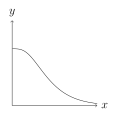
1988 Paper 2 Q7
The integral \(I\) is defined by \[ I=\int_{1}^{2}\frac{(2-2x+x^{2})^{k}}{x^{k+1}}\,\mathrm{d}x \] where \(k\) is a constant. Show that \[ I=\int_{0}^{1}\frac{(1+x^{2})^{k}}{(1+x)^{k+1}}\,\mathrm{d}x=\int_{0}^{\frac{1}{4}\pi}\frac{\mathrm{d}\theta}{\left[\sqrt{2}\cos\theta\cos\left(\frac{1}{4}\pi-\theta\right)\right]^{k+1}}=2\int_{0}^{\frac{1}{8}\pi}\frac{\mathrm{d}\theta}{\left[\sqrt{2}\cos\theta\cos\left(\frac{1}{4}\pi-\theta\right)\right]^{k+1}}. \] Hence show that \[ I=2\int_{0}^{\sqrt{2}-1}\frac{(1+x^{2})^{k}}{(1+x)^{k+1}}\,\mathrm{d}x \] Deduce that \[ \int_{1}^{\sqrt{2}}\left(\frac{2-2x^{2}+x^{4}}{x^{2}}\right)^{k}\frac{1}{x}\,\mathrm{d}x=\int_{1}^{\sqrt{2}}\left(\frac{2-2x+x^{2}}{x}\right)^{k}\frac{1}{x}\,\mathrm{d}x \]
Solution: \begin{align*} I &=\int_{1}^{2}\frac{(2-2x+x^{2})^{k}}{x^{k+1}}\,\mathrm{d}x \\ u = x-1 &, \quad \d u = \d x \\ &= \int_{u = 0}^{u=1} \frac{(u^2+1)^k}{(u+1)^{k+1}} \d u \\ &= \boxed{\int_0^1 \frac{(1+x^2)^k}{(1+x)^{k+1}} \d x} \\ x = \tan \theta &, \quad \d x = \sec^2 \theta \d \theta \\ &= \int_{\theta = 0}^{\theta = \pi/4} \frac{\sec^{2k+2} \theta }{(1 + \tan \theta)^{k+1}} \d \theta \\ &= \int_0^{\pi/4} \frac{\d \theta}{\cos^{2k+2} \theta (\frac{\sin \theta + \cos \theta}{\cos \theta})^{k+1}} \\ &= \int_0^{\pi/4} \frac{\d \theta}{\cos^{k+1} \theta ({\sin \theta + \cos \theta})^{k+1}} \\ &= \int_0^{\pi/4} \frac{\d \theta}{\cos^{k+1} \theta (\sqrt{2} \cos (\frac{\pi}{4} - \theta))^{k+1}} \\ I &= \boxed{ \int_0^{\pi/4} \frac{\d \theta}{(\sqrt{2}\cos \theta \cos (\frac{\pi}{4} - \theta))^{k+1}}} \\ \end{align*} Since \(f(\theta) = \cos \theta \cos (\frac{\pi}{4} - \theta)\) is symmetric about \(\frac{\pi}{8}\) this integral is twice the integral to \(\frac{\pi}{8}\). \(\tan 2 \theta = \frac{2\tan \theta}{1 - \tan^2 \theta} \Rightarrow 1 = \frac{2 \tan \frac{\pi}{8}}{1 - \tan^2 \frac{\pi}{8}} \Rightarrow \tan \frac{\pi}{8} = \sqrt{2}-1\). Therefore, using the same substitution we must have: \[ I=2\int_{0}^{\sqrt{2}-1}\frac{(1+x^{2})^{k}}{(1+x)^{k+1}}\,\mathrm{d}x \] Let \(u = x^2\), then \(\d u = 2 x\d x\) \begin{align*} \int_{1}^{\sqrt{2}}\left(\frac{2-2x^{2}+x^{4}}{x^{2}}\right)^{k}\frac{1}{x}\,\mathrm{d}x &= \int_{u = 1}^{u = 2} \l \frac{2-2u+u^2}{u}\r^k \frac{1}{2u} \d u \\ &= \frac12 I \\ &= \int_{0}^{\sqrt{2}-1}\frac{(1+x^{2})^{k}}{(1+x)^{k+1}}\,\mathrm{d}x \\ u = 1+x & \quad \d u = \d x \\ &= \int_1^{\sqrt{2}} \frac{(1+(u-1)^2)^k}{u^{k+1}} \d u \\ &= \int_{1}^{\sqrt{2}}\left(\frac{2-2u+u^{2}}{u}\right)^{k}\frac{1}{u}\,\mathrm{d}x \\ &= \int_{1}^{\sqrt{2}}\left(\frac{2-2x+x^{2}}{x}\right)^{k}\frac{1}{x}\,\mathrm{d}x \end{align*}
1988 Paper 2 Q8
In a crude model of population dynamics of a community of aardvarks and buffaloes, it is assumed that, if the numbers of aardvarks and buffaloes in any year are \(A\) and \(B\) respectively, then the numbers in the following year at \(\frac{1}{4}A+\frac{3}{4}B\) and \(\frac{3}{2}B-\frac{1}{2}A\) respectively. It does not matter if the model predicts fractions of animals, but a non-positive number of buffaloes means that the species has become extinct, and the model ceases to apply. Using matrices or otherwise, show that the ratio of the number of aardvarks to the number of buffaloes can remain the same each year, provided it takes one of two possible values. Let these two possible values be \(x\) and \(y\), and let the numbers of aardvarks and buffaloes in a given year be \(a\) and \(b\) respectively. By writing the vector \((a,b)\) as a linear combination of the vectors \((x,1)\) and \((y,1),\) or otherwise, show how the numbers of aardvarks and buffaloes in subsequent years may be found. On a sketch of the \(a\)-\(b\) plane, mark the regions which correspond to the following situations
- an equilibrium population is reached as time \(t\rightarrow\infty\);
- buffaloes become extinct after a finite time;
- buffaloes approach extinction as \(t\rightarrow\infty.\)
Solution: If the population in a given year is \(\mathbf{v} = \begin{pmatrix}A \\ B \end{pmatrix}\) then the population the next year is \(\mathbf{Mv}\) where \(\mathbf{M} = \begin{pmatrix} \frac14 & \frac34 \\ -\frac12 &\frac32 \end{pmatrix}\) The ratio is the same if \(\mathbf{Mv} = \lambda \mathbf{v}\) ie if \(\mathbf{v}\) is an eigenvector of \(\mathbf{M}\). The eigenvalues will be \(1\) and \(\frac38\) (by inspection) so we should be able to solve for the eigenvectors: \(\lambda = 1\) we have \(\frac14A + \frac34B = A \Rightarrow A = B\) a ratio of \(1\). \(\lambda = \frac38\) we have \(\frac14A + \frac34B = \frac38A \Rightarrow \frac34B = \frac18A \Rightarrow A = 6B\) a ratio of \(6\). If we write \(\begin{pmatrix} a \\ b \end{pmatrix}\) as \(x_1 \begin{pmatrix} 1 \\ 1 \end{pmatrix} + x_6 \begin{pmatrix} 6 \\ 1 \end{pmatrix}\) we find that after \(n\) years, we have: \(x_1 \begin{pmatrix} 1 \\ 1 \end{pmatrix} + \l \frac38 \r^n x_6 \begin{pmatrix} 6 \\ 1 \end{pmatrix}\) for the populations. Therefore if \(x_1\) is \(< 0\) then in finite time we will end up with one population being 0. If \(x_1 > 0\) are positive we tend to a finite population and if \(x_1 = 0\) then over time the population will tend to \(0\) at infinity. In our diagram these areas correspond to (red) - die out in finite time, (green) population stable and the thick black line where the population goes extinct as \(t \to \infty\)

1988 Paper 2 Q9
Give a careful argument to show that, if \(G_{1}\) and \(G_{2}\) are subgroups of a finite group \(G\) such that every element of \(G\) is either in \(G_{1}\) or in \(G_{2},\) then either \(G_{1}=G\) or \(G_{2}=G\). Give an example of a group \(H\) which has three subgroups \(H_{1},H_{2}\) and \(H_{3}\) such that every element of \(H\) is either in \(H_{1},H_{2}\) or \(H_{3}\) and \(H_{1}\neq H,H_{2}\neq H,H_{3}\neq H\).
Solution: Suppose \(|G_1|, |G_2| < |G|\) for sake of contraction. Then by Lagrange's theorem \(|G_1| \mid |G|\) and \(|G_2| \mid |G|\), so \(|G_1|, |G_2| \leq \frac{|G|}{2}\). But \(|G_1 \cup G_2| = |G_1| + |G_2| - |G_1 \cap G_2|\). \(|G_1 \cup G_2| = |G|\) by assumption, and \(e \in G_1 \cap G_2\), so \(|G_1 \cap G_2| \geq 1\). Therefore \(|G| = |G_1| + |G_2| - |G_1 \cap G_2| \leq \frac{|G|}{2} + \frac{|G|}{2} - 1 = |G| - 1 < |G|\), contradiction! Let \(H = K_4 = \{e, a, b, c\}\) with \(a^2 = b^2 = c^2 = e\). then \(H = \{e, a\} \cup \{e, b\} \cup \{e, c\}\) with all subgroups distinct
1988 Paper 2 Q10
The surface \(S\) in 3-dimensional space is described by the equation \[ \mathbf{a}\cdot\mathbf{r}+ar=a^{2}, \] where \(\mathbf{r}\) is the position vector with respect to the origin \(O\), \(\mathbf{a}(\neq\mathbf{0})\) is the position vector of a fixed point, \(r=\left|\mathbf{r}\right|\) and \(a=\left|\mathbf{a}\right|.\) Show, with the aid of a diagram, that \(S\) is the locus of points which are equidistant from the origin \(O\) and the plane \(\mathbf{r}\cdot\mathbf{a}=a^{2}.\) The point \(P\), with position vector \(\mathbf{p},\) lies in \(S\), and the line joining \(P\) to \(O\) meets \(S\) again at \(Q\). Find the position vector of \(Q\). The line through \(O\) orthogonal to \(\mathbf{p}\) and \(\mathbf{a}\) meets \(S\) at \(T\) and \(T'\). Show that the position vectors of \(T\) and \(T'\) are \[ \pm\frac{1}{\sqrt{2ap-a^{2}}}\mathbf{a}\times\mathbf{p}, \] where \(p=\left|\mathbf{p}\right|.\) Show that the area of the triangle \(PQT\) is \[ \frac{ap^{2}}{2p-a}. \]
Solution: The plane is the same as the plane \((\mathbf{r} - \mathbf{a}) \cdot \mathbf{a} = 0\), ie the plane through \(\mathbf{a}\) whose normal is parallel to \(\mathbf{a}\) The distance from \(\mathbf{r}\) to the plane therefore is \(\lambda\) where \(\mathbf{r}+\lambda \frac{1}{a}\mathbf{a}\) must be on the plane, ie \((\mathbf{r}+\frac{\lambda}{a} \mathbf{a} - \mathbf{a})\cdot \mathbf{a} = 0 \Rightarrow \lambda = \frac{a^2-\mathbf{a} \cdot \mathbf{r}}{a}\) But if \(\mathbf{a} \cdot \mathbf{r} = a^2 - ar\) then \(\lambda = r\), ie the distance to the plane is the same as the distance to the origin. \(\mathbf{q} = k \mathbf{p}\) and so \(\mathbf{a} \cdot k \mathbf{p} + a |k|p = a^2\) if \(k > 0\) we will find \(k = 1\) the position vector we already know about, therefore suppose \(k < 0\) so: \begin{align*} && \mathbf{a} \cdot k \mathbf{p} - ka p &= a^2 \\ \Rightarrow && k(a^2-ap)-kap &= a^2 \\ \Rightarrow && k(a^2-2ap) &= a^2 \\ \Rightarrow && k &= \frac{a^2}{a^2-2ap} \end{align*} Therefore \(\mathbf{q} = \frac{a^2}{a^2-2ap} \mathbf{p}\) The line through \(O\) orthogonal to \(\mathbf{p}\) and \(\mathbf{a}\) will be parallel to \(\mathbf{a} \times \mathbf{p}\). Therefore we should consider points of the from \(s \mathbf{a} \times \mathbf{p}\) on the surface \(S\). \begin{align*} && s\mathbf{a} \cdot ( \mathbf{a} \times \mathbf{p}) + sa^2p |\sin \theta| &= a^2 \end{align*} The angle between \(\cos \theta = \frac{\mathbf{a} \cdot \mathbf{p}}{ap} = \frac{a^2-ap}{ap} \Rightarrow |\sin \theta| = \sqrt{1-\frac{(a-p)^2}{p^2}} = \frac{1}{p} \sqrt{2ap-a^2}\) Therefore \(sa^2 \sqrt{2ap-a^2} = a^2 \Rightarrow s = \frac{1}{\sqrt{2ap-a^2}}\) and so the points are as required. Noting that \(|\mathbf{p} \times \mathbf{t}| = |\frac{1}{p \sin \theta}\mathbf{p} \times (\mathbf{p} \times \mathbf{a}) | = |\frac{1}{p \sin \theta}p^2a \sin \theta | = pa\) The area of triangle \(PQT\) is : \begin{align*} \frac12 | (\mathbf{p} - \mathbf{t}) \times (\mathbf{q} - \mathbf{t}) | &= \frac12 |\mathbf{p} \times \mathbf{q} - \mathbf{t} \times \mathbf{q} - \mathbf{p} \times \mathbf{t} - \mathbf{t} \times \mathbf{t}| \\ &= \frac12 |\mathbf{t} \times (\mathbf{p} - \mathbf{q})| \\ &= \frac12 \cdot (1 - \frac{a^2}{a^2-2ap})| \mathbf{t} \times \mathbf{p}| \\ &= \frac12 \frac{2ap}{a^2-2ap} \cdot ap \\ &= \frac{ap^2}{a^2-ap} \end{align*}
1988 Paper 2 Q11
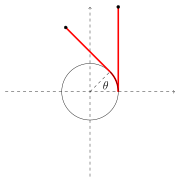
A heavy particle lies on a smooth horizontal table, and is attached to one end of a light inextensible string of length \(L\). The other end of the string is attached to a point \(P\) on the circumference of the base of a vertical post which is fixed into the table. The base of the post is a circle of radius \(a\) with its centre at a point \(O\) on the table. Initially, at time \(t=0\), the string is taut and perpendicular to the line \(OP.\) The particle is then struck in such a way that the string starts winding round the post and remains taut. At a later time \(t\), a length \(a\theta(t)\ (< L)\) of the string is in contact with the post. Using cartesian axes with origin \(O\), find the position and velocity vectors of the particle at time \(t\) in terms of \(a,L,\theta\) and \(\dot{\theta},\) and hence show that the speed of the particle is \((L-a\theta)\dot{\theta}.\) If the initial speed of the particle is \(v\), show that the particle hits the post at a time \(L^{2}/(2av).\)
Solution:
1988 Paper 2 Q12
One end of a thin uniform inextensible, but perfectly flexible, string of length \(l\) and uniform mass per unit length is held at a point on a smooth table a distance \(d(< l)\) away from a small vertical hole in the surface of the table. The string passes through the hole so that a length \(l-d\) of the string hangs vertically. The string is released from rest. Assuming that the height of the table is greater than \(l\), find the time taken for the end of the string to reach the top of the hole.
Solution: Consider some point once the string is moving, there will be \(x\) above the table and \(l - x\) hanging in the air. For the hanging string we must have \((l-x)mg - T = -(l-x)m\ddot{x}\). For the string on the table we must have that \(T = -xm \ddot{x}\). Eliminating T, we have \((l-x)g = -l \ddot{x}\) Solving the differential equation, we must have \(x = A \cosh \sqrt \frac{g}{l}t+B \sinh\sqrt \frac{g}{l}t+l\), Since \(x(0) = d, \dot{x}(0) = 0 \Rightarrow B = 0, A = (-d)\). Therefore \(x = l-(l-d) \cosh \sqrt \frac{g}{l} t \Rightarrow t =\sqrt \frac{l}{g} \cosh^{-1} \l \frac{l-x}{l-d} \r\) and we go over the edge when \(x = 0\), ie \(\sqrt \frac{l}{g} \cosh^{-1} \l \frac{l}{l-d} \r\)
1988 Paper 2 Q13
A librarian wishes to pick up a row of identical books from a shelf, by pressing her hands on the outer covers of the two outermost books and lifting the whole row together. The covers of the books are all in parallel vertical planes, and the weight of each book is \(W\). With each arm, the librarian can exert a maximum force of \(P\) in the vertical direction, and, independently, a maximum force of \(Q\) in the horizontal direction. The coefficient of friction between each pair of books and also between each hand and a book is \(\mu.\) Derive an expression for the maximum number of books that can be picked up without slipping, using this method. {[}You may assume that the books are thin enough for the rotational effect of the couple on each book to be ignored.{]}
Solution:

1988 Paper 2 Q14
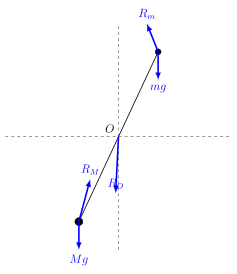
Two particles of mass \(M\) and \(m\) \((M>m)\) are attached to the ends of a light rod of length \(2l.\) The rod is fixed at its midpoint to a point \(O\) on a horizontal axle so that the rod can swing freely about \(O\) in a vertical plane normal to the axle. The axle rotates about a vertical axis through \(O\) at a constant angular speed \(\omega\) such that the rod makes a constant angle \(\alpha\) \((0<\alpha<\frac{1}{2}\pi)\) with the vertical. Show that \[ \omega^{2}=\left(\frac{M-m}{M+m}\right)\frac{g}{l\cos\alpha}. \] Show also that the force of reaction of the rod on the axle is inclined at an angle \[ \tan^{-1}\left[\left(\frac{M-m}{M+m}\right)^{2}\tan\alpha\right] \] with the downward vertical.
Solution:
1988 Paper 2 Q15
An examination consists of several papers, which are marked independently. The mark given for each paper can be an integer from \(0\) to \(m\) inclusive, and the total mark for the examination is the sum of the marks on the individual papers. In order to make the examination completely fair, the examiners decide to allocate the mark for each paper at random, so that the probability that any given candidate will be allocated \(k\) marks \((0\leqslant k\leqslant m)\) for a given paper is \((m+1)^{-1}\). If there are just two papers, show that the probability that a given candidate will receive a total of \(n\) marks is \[ \frac{2m-n+1}{\left(m+1\right)^{2}} \] for \(m< n\leqslant2m\), and find the corresponding result for \(0\leqslant n\leqslant m\). If the examination consists of three papers, show that the probability that a given candidate will receive a total of \(n\) marks is \[ \frac{6mn-4m^{2}-2n^{2}+3m+2}{2\left(m+1\right)^{2}} \] in the case \(m< n\leqslant2m\). Find the corresponding result for \(0\leqslant n\leqslant m\), and deduce the result for \(2m< n\leqslant3m\).
Solution: In order to receive \(n\) marks over the two papers, where \(m < n \leq 2m\) the student must receive \(k\) and \(n-k\) marks in each paper. Since \(n > m\), \(n-k\) is a valid mark when \(n-k \leq m\) ie when \(n-m\leq k\), therefore the probability is: \begin{align*} \sum_{k = n-m}^m \mathbb{P}(\text{scores }k\text{ and }n-k) &= \sum_{k=n-m}^m \frac{1}{(m+1)^2} \\ &= \frac{m-(n-m-1)}{(m+1)^2} \\ &= \frac{2m-n+1}{(m+1)^2} \end{align*} If \(0 \leq n \leq m\) then we need \(n-k\) marks in the second paper to be positive, ie \(n-k \geq 0 \Rightarrow n \geq k\), so \begin{align*} \sum_{k = 0}^n \mathbb{P}(\text{scores }k\text{ and }n-k) &= \sum_{k = 0}^n \frac{1}{(m+1)^2} \\ &= \frac{n+1}{(m+1)^2} \end{align*} On the first paper, they can score any number of marks, since \(n > m\), so we must have: \begin{align*} \sum_{k=0}^m \mathbb{P}(\text{scores }k\text{ and }n-k) &= \frac{1}{m+1} \sum_{k=0}^m \mathbb{P}(\text{scores }n-k\text{ on second papers}) \\ &= \frac{1}{m+1}\l \sum_{k=0}^{n-m} \frac{2m-(n-k)+1}{(m+1)^2} +\sum_{k=n-m+1}^m \frac{n-k+1}{(m+1)^2}\r \end{align*}