Problems
Filters
13 problems found
2016 Paper 1 Q1
- For \(n=1\), \(2\), \(3\) and \(4\), the functions \(\p_n\) and \(\q_n\) are defined by \[ \p_n(x) = (x+1)^{2n} - (2n+1)x (x^2+x+1)^{n-1} \] and \[ \q_n(x) = \frac{x^{2n+1}+1}{x+1} \ \ \ \ \ \ \ \ \ \ \ \ (x\ne -1) \,. \ \ \ \ \ \ \ \ \ \ \] Show that \(\p_n(x)\equiv \q_n(x)\) (for \(x\ne-1\)) in the cases \(n=1\), \(n=2\) and \(n=3\). Show also that this does not hold in the case \(n=4\).
- Using results from part (i):
- \(\bf (a)\) express \( \ \dfrac {300^3 +1}{301}\,\) as the product of two factors (neither of which is 1);
- \(\bf (b)\) express \( \ \dfrac {7^{49}+1}{7^7+1}\,\) as the product of two factors (neither of which is 1), each written in terms of various powers of 7 which you should not attempt to calculate explicitly.
Solution:
- \(n=1\): \begin{align*} && p_1(x) &= (x+1)^2 - 3x(x^2+x+1)^0 \\ &&&= x^2+2x+1-3x \\ &&&= x^2-x+1\\ && q_1(x) &= \frac{x^3+1}{x+1} \\ &&&= x^2-x+1 = p_1(x) \\ \\ && p_2(x) &= (x+1)^4-5x(x^2+x+1)^1 \\ &&&= x^4+4x^3+6x^2+4x+1 - 5x^3-5x^2-5x \\ &&&= x^4-x^3+x^2-x+1 \\ &&q_2(x) &= \frac{x^5+1}{x+1} \\ &&&= x^4-x^3+x^2-x+1 = p_2(x) \\ \\ && p_3(x) &= (x+1)^6-7x(x^2+x+1)^2 \\ &&&= x^6+6x^5+15x^4+20x^3+15x^2+6x+1 - 7x(x^4+2x^3+3x^2+2x+1) \\ &&&= x^6-x^5+x^4-x^3+x^2-x+1 \\ && q_3(x) &= \frac{x^7+1}{x+1} \\ &&&= x^6-x^5+x^4-x^3+x^2-x+1 = p_3(x) \\ \\ && p_4(1) &= 2^8 - 9 \cdot 1 \cdot 3^3 \\ &&&= 256 - 243 = 13 \\ && q_4(1) &= \frac{2}{2} = 1 \neq 13 \end{align*}
- \(\bf (a)\) \(\,\) \begin{align*} && \frac{300^3+1}{300+1} &= (300+1)^2 - 3 \cdot 300 \\ &&&= 301^2 - 30^2 \\ &&&= 271 \cdot 331 \end{align*}
- \(\bf (b)\) \(\,\) \begin{align*} && \dfrac {7^{49}+1}{7^7+1} &= (7^7+1)^6 - 7 \cdot 7^7 \cdot (7^2+7+1)^2 \\ &&&= (7^7+1)^6 - 7^8 \cdot (7^2+7+1)^2 \\ &&&= ((7^7+1)^3 - 7^4(7^2+7+1)) \cdot ((7^7+1)^3 + 7^4(7^2+7+1)) \end{align*}
2016 Paper 1 Q2
Differentiate, with respect to \(x\), \[ (ax^2+bx+c)\,\ln \big( x+\sqrt{1+x^2}\big) +\big(dx+e\big)\sqrt{1+x^2} \,, \] where \(a\), \(b\), \(c\), \(d\) and \(e\) are constants. You should simplify your answer as far as possible. Hence integrate:
- \( \ln \big( x+\sqrt{1+x^2}\,\big) \,;\)
- \(\sqrt{1+x^2} \,; \)
- \( x\ln \big( x+\sqrt{1+x^2}\,\big) \,.\)
Solution: \begin{align*} && y &= (ax^2+bx+c)\,\ln \big( x+\sqrt{1+x^2}\big) +\big(dx+e\big)\sqrt{1+x^2} \\ && y' &= (2ax+b)\,\ln \big( x+\sqrt{1+x^2}\big) + (ax^2+bx+c) \frac{1}{x + \sqrt{1+x^2}} \cdot \left(1 + \frac{x}{\sqrt{1+x^2}} \right) + d\sqrt{1+x^2} + \frac{x(dx+e)}{\sqrt{1+x^2}} \\ &&&= (2ax+b)\,\ln \big( x+\sqrt{1+x^2}\big) + \frac{1}{\sqrt{1+x^2}} \left ( (ax^2+bx+c) + d(1+x^2) + x(dx+e) \right) \\ &&&= (2ax+b)\,\ln \big( x+\sqrt{1+x^2}\big) + \frac{1}{\sqrt{1+x^2}} \left ( (a+2d)x^2+(b+e)x+(d+c) \right) \\ \end{align*}
- We want \(a = 0, b = 1, d = 0, e = -1, c =0\), so \begin{align*} I &= \int \ln \big( x+\sqrt{1+x^2}\,\big) \,\d x \\ &= x\ln(x+\sqrt{1+x^2})-\sqrt{1+x^2}+C \end{align*}
- We want \(a = b =0, e = 0, d = \frac12, c = \frac12\), so \begin{align*} I &= \int \sqrt{1+x^2}\, \d x \\ &= \frac12\ln(x+\sqrt{1+x^2}) + \frac12x\sqrt{1+x^2}+C \end{align*}
- We want \(a = \frac12, b = 0, d = -\frac14, e = 0, c = \frac14\), so \begin{align*} I &= \int x \ln (x+\sqrt{1+x^2}) \, \d x \\ &= \left (\frac12 x^2+\frac14 \right)\ln(x+\sqrt{1+x^2}) -\frac14x\sqrt{1+x^2}+C \end{align*}
2016 Paper 1 Q3
In this question, \(\lfloor x \rfloor\) denotes the greatest integer that is less than or equal to \(x\), so that (for example) \(\lfloor 2.9 \rfloor = 2\), \(\lfloor 2\rfloor = 2\) and \(\lfloor -1.5 \rfloor = -2\). On separate diagrams draw the graphs, for \(-\pi \le x \le \pi\), of:
Solution:


2016 Paper 1 Q4
- Differentiate $\displaystyle \; \frac z {(1+z^2)^{\frac12}} \;$ with respect to \(z\).
- The {\em signed curvature} \(\kappa\) of the curve \(y=\f(x)\) is defined by \[ \kappa = \frac {\f''(x)}{\big({1+ (\f'(x))^2\big)^{\frac32}}} \,.\] Use this definition to determine all curves for which the signed curvature is a non-zero constant. For these curves, what is the geometrical significance of \(\kappa\)?
Solution:
- Let \(\displaystyle y = \frac z {(1+z^2)^{\frac12}}\) then \(\frac{d y}{d x} = \frac{(1+z^2)^{\frac12} - z^2(1+z^2)^{-\frac12}}{1+z^2} = \frac{(1+z^2)-z^2}{(1+z^2)^\frac32} = \frac{1}{(1+z^2)^\frac32}\)
- \(\kappa = \frac {f''(x)}{\big({1+ (f'(x))^2\big)^{\frac32}}}\) then \begin{align*} && \int \kappa \, dx &= \int \frac{f''(x)}{( 1 + (f'(x))^2)^{\frac32}} \, dx \\ && \kappa x &= \frac{f'(x)}{(1 + (f'(x))^2)^\frac12} + C \\ \Rightarrow && (\kappa x-C)^2 &= \frac{f'(x)^2}{1 + (f'(x))^2} \\ \Rightarrow && f'(x)^2((\kappa x - C)^2 - 1) &= -(\kappa x-C)^2 \\ \Rightarrow && f'(x) &= \frac{\kappa x - C}{\sqrt{1-(\kappa x - C)^2 }} \\ \Rightarrow && f(x) &= \frac{1}{\kappa} \sqrt{1 - (\kappa x - C)^2} \\ \Rightarrow && (\kappa y)^2 + (\kappa x - C)^2 &= 1 \\ \Rightarrow && y^2 + (x - C')^2 &= \frac{1}{\kappa^2} \end{align*} Therefore all the curves are circles and \(\kappa\) is the reciprocal of the radius.
2016 Paper 1 Q5
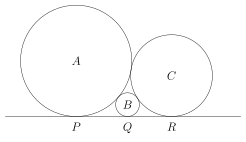
- The diagram shows three touching circles \(A\), \(B\) and \(C\), with a common tangent \(PQR\). The radii of the circles are \(a\), \(b\) and \(c\), respectively. Show that \[ \frac 1 {\sqrt b} = \frac 1 {\sqrt{a}} + \frac1{\sqrt{c}} \tag{\(*\)} \] and deduce that \[ 2\left(\frac1{a^2} + \frac1 {b^2} + \frac1 {c^2} \right) = \left(\frac1 a + \frac1 {b} + \frac1 {c} \right)^{\!2} . \tag{\(**\)} \]
- Instead, let \(a\), \(b\) and \(c\) be positive numbers, with \(b < c < a\), which satisfy \((**)\). Show that they also satisfy \((*)\).
Solution:
- \(\,\)
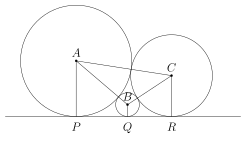
Notice that \begin{align*} && (a+b)^2 &= PQ^2 + (a-b)^2 \\ \Rightarrow && PQ^2 &= 4ab \\ && (b+c)^2 &= QR^2 + (c-b)^2 \\ \Rightarrow && QR^2 &= 4bc \\ && (a+c)^2 &= PR^2 + (a-c)^2 \\ \Rightarrow && PR^2 &= 4ac \\ \Rightarrow && 2\sqrt{ac} &= 2\sqrt{ab}+2\sqrt{bc} \\ \Rightarrow && \frac{1}{\sqrt{b}} &= \frac{1}{\sqrt{c}} + \frac1{\sqrt{a}} \\ \end{align*} Let \(x, y, z = \frac{1}{\sqrt{a}}, \frac1{\sqrt{b}}, \frac{1}{\sqrt{z}}\) so we would like to prove that \(2(x^4+y^4+z^4) = (x^2+y^2+z^2)^2\) or \(x^4+y^4+z^4 = 2x^2y^2+2y^2z^2+2z^2x^2\). We also have \begin{align*} && y &= x+z \\ \Rightarrow &&y^2 &= x^2+z^2+2xz \\ \Rightarrow && (y^2-x^2-z^2)^2 &= 4x^2z^2 \\ \Rightarrow && y^4+x^4+z^4 - 2x^2y^2-2y^2z^2+2x^2z^2 &= 4x^2z^2\\ \Rightarrow && y^4+x^4+z^4 &= 2x^2y^2+2y^2z^2+2z^2x^2 \end{align*}
- Notice that subject to \(y > z > x\) all these steps are reversible, so we must have the equality we desire
2016 Paper 1 Q6
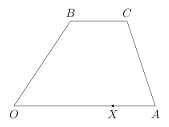
The sides \(OA\) and \(CB\) of the quadrilateral \(OABC\) are parallel. The point \(X\) lies on \(OA\), between \(O\) and \(A\). The position vectors of \(A\), \(B\), \(C\) and \(X\) relative to the origin \(O\) are \(\bf a\), \(\bf b\), \(\bf c\) and \(\bf x\), respectively. Explain why \(\bf c\) and \(\bf x\) can be written in the form \[ {\bf c} = k {\bf a} + {\bf b} \text{ and } {\bf x} = m {\bf a}\,, \] where \(k\) and \(m\) are scalars, and state the range of values that each of \(k\) and \(m\) can take. The lines \(OB\) and \(AC\) intersect at \(D\), the lines \(XD\) and \(BC\) intersect at \(Y\) and the lines \(OY\) and \(AB\) intersect at \(Z\). Show that the position vector of \(Z\) relative to \(O\) can be written as \[ \frac{ {\bf b} + mk {\bf a}}{mk+1}\,. \] The lines \(DZ\) and \(OA\) intersect at \(T\). Show that \[ OT \times OA = OX\times TA \text{ and } \frac 1 {OT} = \frac 1 {OX} + \frac 1 {OA} \,, \] where, for example, \(OT\) denotes the length of the line joining \(O\) and \(T\).
Solution:
2016 Paper 1 Q7
The set \(S\) consists of all the positive integers that leave a remainder of 1 upon division by 4. The set \(T\) consists of all the positive integers that leave a remainder of 3 upon division by 4.
- Describe in words the sets \(S \cup T\) and \(S \cap T\).
- Prove that the product of any two integers in \(S\) is also in \(S\). Determine whether the product of any two integers in \(T\) is also in \(T\).
- Given an integer in \(T\) that is not a prime number, prove that at least one of its prime factors is in \(T\).
- For any set \(X\) of positive integers,
an integer in \(X\) (other than 1) is said to be
\(X\)-prime if it cannot be expressed as the product of
two or more integers all in \(X\) (and all different from 1).
- \(\bf (a)\) Show that every integer in \(T\) is either \(T\)-prime or is the product of an odd number of \(T\)-prime integers.
- \(\bf (b)\) Find an example of an integer in \(S\) that can be expressed as the product of \(S\)-prime integers in two distinct ways. [Note: \(s_1s_2\) and \(s_2s_1\) are not counted as distinct ways of expressing the product of \(s_1\) and \(s_2\).]
Solution:
- \(S \cup T\) is the set of odd positive integers. \(S \cap T\) is the empty set.
- Suppose we have two integers in \(S\), say \(4n+1\) and \(4m+1\), so \((4n+1)(4m+1) = 16nm + 4(n+m) + 1 = 4(4nm + n+m) + 1\) which clearly is in \(S\). The product of any two integers in \(T\) is in \(S\), since \((4n+3)(4m+3) = 16nm + 12(n+m) + 9 = 4(4nm+3(n+m) + 2) + 1\)
- Suppose \(p \in T\) is not prime, then it must have prime factors. They must all be odd, so they are in \(T\) or \(S\). If they are all in \(S\) then \(p\) must also be in \(S\) (as the product of numbers in \(S\)) but this is a contraction. Therefore \(p\) must have a prime factor in \(T\).
- \(3, 7, 11, 19\) are all primes in \(T\). Notice therefore that any product of two of them must be \(S\)-prime. But then \((3 \times 7) \times (11 \times 19)\) and \((3 \times 11) \times (7 \times 19)\) are distinct factorisations into \(S\)-prime factors.
2016 Paper 1 Q8
Given an infinite sequence of numbers \(u_0\), \(u_1\), \(u_2\), \(\ldots\,\), we define the generating function, \(\f\), for the sequence by \[ \f(x) = u_0 + u_1x +u_2 x^2 +u_3 x^3 + \cdots \,. \] Issues of convergence can be ignored in this question.
- Using the binomial series, show that the sequence given by \(u_n=n\,\) has generating function \(x(1-x)^{-2}\), and find the sequence that has generating function \(x(1-x)^{-3}\). Hence, or otherwise, find the generating function for the sequence \(u_n =n^2\). You should simplify your answer.
- \(\bf (a)\) The sequence \(u_0\), \(u_1\), \(u_2\), \(\ldots\,\) is determined by \(u_{n} = ku_{n-1}\) (\(n\ge1\)), where \(k\) is independent of \(n\), and \(u_0=a\). By summing the identity \(u_{n}x^n \equiv ku_{n-1}x^n\), or otherwise, show that the generating function, f, satisfies \[ \f(x) = a + kx \f(x) \] Write down an expression for \(\f(x)\).
- \(\bf (b)\) The sequence \(u_0, u_1, u_2, \ldots\,\) is determined by \(u_{n} = u_{n-1}+ u_{n-2}\) (\(n\ge2\)) and \(u_0=0\), \(u_1=1\). Obtain the generating function.
Solution:
- \(\,\) \begin{align*} && x(1-x)^{-2} &= x \left (1 + (-2)(-x) + \frac{(-2)(-3)}{2!}x^2 + \cdots + \frac{(-2)(-3)\cdots(-2-(k-1))}{k!} (-x)^k + \cdots \right) \\ &&&= x(1 + 2x + 3x^2 + \cdots + \frac{(-2)(-3)\cdots(-(k+1))}{k!}(-1)^k x^k + \cdots ) \\ &&&= x+2x^2 + 3x^3 + \cdots + (k+1)x^{k+1} + \cdots \\ \Rightarrow && u_n &= n \end{align*} \begin{align*} && x(1-x)^{-3} &= x \left (1 + 3x + 6x^2 + \cdots + \frac{(-3)(-4)\cdots(-k-2)}{k!}(-x)^k + \cdots \right) \\ &&&= x \left (1 + 3x + 6x^2 + \cdots + \frac{(k+2)(k+1)}{2}x^k + \cdots \right) \\ &&&= x + 3x^2 + 6x^3 + \cdots + \binom{k+2}{2}x^{k+1} + \cdots \\ && u_n &= \binom{n+1}{2} = \frac{n^2+n}{2} \\ \\ \Rightarrow && 2x(1-x)^{-3} - x(1-x)^{-2} &= (1-x)^{-3}(2x-x(1-x)) \\ &&&= (1-x)^{-3}(x+x^2) \end{align*}
- \(u_n = ku_{n-1} \Rightarrow u_nx^n = ku_{n-1}x^n\) so \begin{align*} && \sum_{n=1}^\infty u_n x^n &= \sum_{n=1}^\infty k u_{n-1}x^n \\ && \sum_{n=0}^\infty u_n x^n - a &= x\sum_{n=0}^\infty k u_{n}x^n \\ \Rightarrow && f(x)-a &= kx f(x) \\ \Rightarrow && f(x) &= a + kxf(x) \\ \Rightarrow && f(x) &= \frac{a}{1-kx} \end{align*}
- Suppose \(\displaystyle f(x) = \sum_{n=0}^\infty u_n x^n\) so \begin{align*} && x^n u_n &= x^n u_{n-1} + x^n u_{n-2} \\ \Rightarrow && \sum_{n=2}^\infty x^n u_n &= \sum_{n=2}^\infty x^n u_{n-1} + \sum_{n=2}^\infty x^n u_{n-2} \\ && \sum_{n=0}^\infty x^n u_n - u_0 - u_1 x &= \left ( \sum_{n=0}^\infty x^{n+1} u_{n} -xu_0 \right) + \sum_{n=0}^\infty x^{n+2} u_{n} \\ && f(x) - x &= xf(x) +x^2f(x) \\ \Rightarrow && f(x) &= \frac{x}{1-x-x^2} \end{align*}
2016 Paper 1 Q9
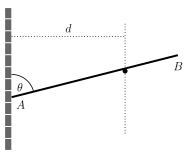
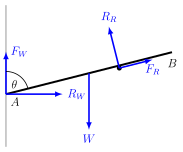
A horizontal rail is fixed parallel to a vertical wall and at a distance \(d\) from the wall. A uniform rod \(AB\) of length \(2a\) rests in equilibrium on the rail with the end \(A\) in contact with the wall. The rod lies in a vertical plane perpendicular to the wall. It is inclined at an angle \(\theta\) to the vertical (where \(0 < \theta < \frac12\pi\)) and \(a\sin\theta < d\), as shown in the diagram.
Solution:
2016 Paper 1 Q10
Four particles \(A\), \(B\), \(C\) and \(D\) are initially at rest on a smooth horizontal table. They lie equally spaced a small distance apart, in the order \(ABCD\), in a straight line. Their masses are \(\lambda m\), \(m\), \(m\) and \(m\), respectively, where \(\lambda>1\). Particles \(A\) and \(D\) are simultaneously projected, both at speed \(u\), so that they collide with \(B\) and \(C\) (respectively). In the following collision between \(B\) and \(C\), particle \(B\) is brought to rest. The coefficient of restitution in each collision is \(e\).
- Show that \(e = \dfrac {\lambda-1}{3\lambda+1}\) and deduce that \(e < \frac 13\,\).
- Given also that \(C\) and \(D\) move towards each other with the same speed, find the value of \(\lambda\) and of \(e\).
Solution:


- \begin{align*} \text{NEL}: && w_C &= e(v_B - v_C) \\ \text{COM}: && mv_B+ mv_C &= m w_C \\ \Rightarrow && w_C &= v_B + v_C\\ \Rightarrow && e(v_B - v_C) &= (v_B + v_C) \\ \Rightarrow && (1-e)v_B &= -(1+e)v_C \\ \Rightarrow && (1-e) \frac{\lambda(1+ e)}{1+\lambda} &= (1+e) \frac{1+e}{2} \\ \Rightarrow && 2\lambda - 2\lambda e &= 1+\lambda + e + \lambda e \\ \Rightarrow && (3\lambda +1)e &= \lambda - 1 \\ \Rightarrow && e &= \frac{\lambda -1}{3\lambda + 1} \\ &&&< \frac{\lambda - 1 + \frac{4}{3}}{3\lambda + 1} \\ &&& = \frac13 \end{align*}

- Since they move towards each other at the same speed \(w_C = - v_D\) \begin{align*} && w_C &= - v_D \\ \Rightarrow && v_B + v_C &= -(v_C+eu) \\ \Rightarrow && -eu &= v_B +2v_C \\ &&&= \frac{\lambda(1+ e)}{1+\lambda} u -(1+e)u \\ \Rightarrow && 1 &= \frac{\lambda(1+e)}{1+\lambda} \\ \Rightarrow && 1+\lambda &= \lambda \left ( 1 + \frac{\lambda -1}{3\lambda+1} \right) \\ &&&= \lambda \frac{4\lambda}{3\lambda +1} \\ \Rightarrow && 1+4\lambda + 3\lambda^2 &= 4\lambda^2 \\ \Rightarrow && 0 &= \lambda^2 - 4\lambda - 1 \\ \Rightarrow && \lambda &= \frac{4 \pm \sqrt{20}}{2} \\ &&&= 2\pm \sqrt{5} \\ \Rightarrow && \lambda &= 2 + \sqrt{5} \\ && e &= \frac{1+\sqrt{5}}{7+3\sqrt{5}} \\ &&&=\sqrt{5}-2 \end{align*}
2016 Paper 1 Q11
The point \(O\) is at the top of a vertical tower of height \(h\) which stands in the middle of a large horizontal plain. A projectile \(P\) is fired from \(O\) at a fixed speed \(u\) and at an angle \(\alpha\) above the horizontal. Show that the distance \(x\) from the base of the tower when \(P\) hits the plain satisfies \[ \frac{gx^2}{u^2} = h(1+\cos 2\alpha) + x \sin 2\alpha \,. \] Show that the greatest value of \(x\) as \(\alpha\) varies occurs when \(x=h\tan2\alpha\) and find the corresponding value of \(\cos 2\alpha\) in terms of \(g\), \(h\) and \(u\). Show further that the greatest achievable distance between \(O\) and the landing point is \(\dfrac {u^2}g +h\,\).
Solution: \begin{align*} \rightarrow: && x &= u \cos \alpha t\\ \Rightarrow && t &= \frac{x}{u \cos \alpha}\\ \uparrow: && -h &= u\sin \alpha t- \frac12gt^2 \\ && - h &= x\tan \alpha - \frac12 g \frac{x^2}{u^2}\sec^2 \alpha \\ \Rightarrow && \frac{gx^2}{u^2} &= h(2\cos^2 \alpha) + x2 \tan \alpha \cos^2 \alpha \\ &&&= h(1 + \cos 2 \alpha) + x \sin 2\alpha \\ \frac{\d}{\d \alpha}: && \frac{g}{u^2} 2 x \frac{\d x}{\d \alpha} &= -2h \sin 2 \alpha + 2x \cos 2 \alpha +\frac{\d x}{\d \alpha} \sin 2 \alpha \\ \Rightarrow && \frac{\d x}{\d \alpha} \left ( \frac{2xg}{u^2} - \sin 2 \alpha \right) &= 2\cos 2 \alpha (x -h \tan 2 \alpha) \end{align*} Since the turning point will be a maximum must be \(x = h \tan 2 \alpha\). Therefore, let \(c = \cos 2 \alpha\) \begin{align*} && \frac{gh^2}{u^2} \tan^2 2 \alpha &= h(1 + \cos 2 \alpha) + h \tan 2 \alpha \sin 2 \alpha \\ \Rightarrow && \frac{gh}{u^2}(c^{-2}-1) &= 1+c+\frac{1-c^2}{c} \\ \Rightarrow && \frac{gh(1-c^2)}{u^2c^2} &= \frac{c+c^2+1-c^2}{c}\\ &&&= \frac{1+c}{c} \\ \Rightarrow && \frac{gh(1-c)}{u^2c} &= 1 \\ \Rightarrow && u^2c &= gh(1-c) \\ \Rightarrow && c(u^2+gh) &= gh \\ \Rightarrow && \cos 2 \alpha &= \frac{gh}{u^2+gh} \\ \\ \Rightarrow && d_{max}^2 &= h^2 + h^2 \tan^2 2 \alpha \\ &&&= h^2\sec^2 2 \alpha \\ &&&= h^2 \frac{(u^2+gh)^2}{g^2h^2} \\ &&&= \frac{(u^2+gh)^2}{g^2} \\ &&&= \left (\frac{u^2}{g}+h \right)^2 \\ \Rightarrow && d_{max} &= \frac{u^2}{g}+h \end{align*}
2016 Paper 1 Q12
- Alice tosses a fair coin twice and Bob tosses a fair coin three times. Calculate the probability that Bob gets more heads than Alice.
- Alice tosses a fair coin three times and Bob tosses a fair coin four times. Calculate the probability that Bob gets more heads than Alice.
- Let \(p_1\) be the probability that Bob gets the same number of heads as Alice, and let~\(p_2\) be the probability that Bob gets more heads than Alice, when Alice and Bob each toss a fair coin \(n\) times. Alice tosses a fair coin \(n\) times and Bob tosses a fair coin \(n+1\) times. Express the probability that Bob gets more heads than Alice in terms of \(p_1\) and \(p_2\), and hence obtain a generalisation of the results of parts (i) and (ii).
Solution:
- There are several possibilities \begin{array}{c|c|c} \text{Alice} & \text{Bob} & P \\ \hline 0 & 1 & \frac1{2^2} \cdot 3 \cdot \frac{1}{2^3} = \frac{3}{2^5} \\ 0 & 2 & \frac1{2^2} \cdot 3 \cdot \frac{1}{2^3} = \frac{3}{2^5} \\ 0 & 3 & \frac1{2^2} \cdot \frac{1}{2^3} = \frac{1}{2^5} \\ 1 & 2 & 2 \cdot \frac1{2^2} \cdot 3 \cdot \frac{1}{2^3} = \frac{6}{2^5} \\ 1 & 3 & 2\cdot \frac1{2^2} \cdot \frac{1}{2^3} = \frac{2}{2^5} \\ 2 & 3 & \frac1{2^2} \cdot \frac{1}{2^3} = \frac{1}{2^5} \\ \hline && \frac{1}{2^5}(3+3+1+6+2+1) = \frac{16}{2^5} = \frac12 \end{array}
- There are several possibilities \begin{array}{c|c|c} A & B & \text{count} \\ \hline 0 & 1 & 4 \\ 0 & 2 & 6 \\ 0 & 3 & 4 \\ 0 & 4 & 1 \\ 1 & 2 & 3\cdot6 \\ 1 & 3 & 3\cdot4 \\ 1 & 4 & 3 \\ 2 & 3 & 3\cdot4 \\ 2 & 4 & 3 \\ 3 & 4 & 1 \\ \hline && 64 \end{array} Therefore the total probability is \(\frac12\)
- \(\mathbb{P}(\text{Bob more than Alice}) = p_1 \cdot \underbrace{\frac12}_{\text{he wins by breaking the tie on his last flip}} + p_2\) If \(p_3\) is the probability that Alice gets more heads than Bob, then by symmetry \(p_3 = p_2\) and \(p_1 + p_2 + p_3 = 1\). Therefore \(p_1 + 2p_2 = 1\). ie \(\frac12 p_1 + p_2 = \frac12\) therefore the answer is always \(\frac12\) for all values of \(n\).
2016 Paper 1 Q13
An internet tester sends \(n\) e-mails simultaneously at time \(t=0\). Their arrival times at their destinations are independent random variables each having probability density function \(\lambda \e^{-\lambda t}\) (\(0\le t<\infty\), \( \lambda >0\)).
- The random variable \(T\) is the time of arrival of the e-mail that arrives first at its destination. Show that the probability density function of \(T\) is \[ n \lambda \e^{-n\lambda t}\,,\] and find the expected value of \(T\).
- Write down the probability that the second e-mail to arrive at its destination arrives later than time \(t\) and hence derive the density function for the time of arrival of the second e-mail. Show that the expected time of arrival of the second e-mail is \[ \frac{1}{\lambda} \left( \frac1{n-1} + \frac 1 n \right) \]
Solution:
- \(\,\) \begin{align*} && \mathbb{P}(T > t) &= \mathbb{P}(\text{all emails slower than }t) \\ &&&= \left ( \int_t^{\infty} \lambda e^{-\lambda x} \d x \right)^n \\ &&&= \left ( [- e^{-\lambda x}]_t^\infty\right)^n\\ &&&= e^{-n\lambda t} \\ \Rightarrow && f_T(t) &= n \lambda e^{-n\lambda t} \\ \end{align*} Therefore \(T \sim \text{Exp}(n \lambda)\) and \(\E[T] = \frac{1}{n \lambda}\)
- Let \(T_2\) be the time until the second email arrives, then. \begin{align*} && \P(T_2 > t) &= \P(\text{all emails} > t) + \P(\text{all but 1 emails} > t) \\ &&&= e^{-n\lambda t} + n \cdot e^{-(n-1)\lambda t}(1-e^{-\lambda t}) \\ &&&= (1-n)e^{-n\lambda t} + n \cdot e^{-(n-1)\lambda t} \\ \Rightarrow && f_{T_2}(t) &= - \left ( (1-n) n \lambda e^{-n \lambda t} -n(n-1)\lambda e^{-(n-1)\lambda t} \right) \\ &&&= n(n-1) \lambda \left (e^{-(n-1)\lambda t} - e^{-n\lambda t} \right) \\ \Rightarrow && \E[T_2] &= \int_0^{\infty} t \cdot n(n-1) \lambda \left (e^{-(n-1)\lambda t} - e^{-n\lambda t} \right) \d t \\ &&&= \int_0^{\infty} \left (n \cdot t (n-1) \lambda e^{-(n-1)\lambda t} -(n-1)\cdot tn \lambda e^{-n\lambda t} \right) \d t \\ &&&= \frac{n}{\lambda(n-1)} - \frac{n-1}{\lambda n} \\ &&&= \frac{1}{\lambda} \left (1+\frac{1}{n-1}- \left (1 - \frac{1}{n} \right) \right) \\ &&&= \frac{1}{\lambda} \left ( \frac{1}{n-1} + \frac{1}{n} \right) \end{align*} (We can also view this second expectation as expected time for first email + expected time (of the remaining \(n-1\) emails) for the first email, and we can see that will have that form by the memorilessness property of exponentials)