Problems
Filters
13 problems found
2013 Paper 1 Q1
- Use the substitution \(\sqrt x = y\) (where \(y\ge0\)) to find the real root of the equation \[ x + 3\, \sqrt x - \tfrac12 =0\,. \]
- Find all real roots of the following equations:
- \(x+10\,\sqrt{x+2\, }\, -22 =0\,\);
- \(x^2 -4x + \sqrt{2x^2 -8x-3 \,}\, -9 =0\,\).
Solution:
- \begin{align*} && 0 &= x + 3\sqrt{x} - \frac12 \\ \sqrt{x} = y: && 0&= y^2 + 3y - \frac12 \\ \Rightarrow && y &= \frac{-3\pm\sqrt{3^2+2}}{2} \\ &&&= \frac{-3 \pm \sqrt{11}}{2} \\ y > 0: && x &= \left ( \frac{\sqrt{11}-3}{2} \right)^2 \end{align*}
- \begin{align*} && 0 &= x + 10\sqrt{x+2} - 22 \\ y = \sqrt{x+2}: && 0 &= y^2 - 2 + 10y - 22 \\ &&&= y^2 + 10y - 24 \\ &&&= (y-2)(y+12) \\ \Rightarrow && y &= 2, -12 \\ y > 0: && x &= 2 \end{align*}
- Let \(y = \sqrt{2x^2-8x-3}\), so \begin{align*} && 0 &= x^2 - 4x +\sqrt{2x^2-8x-3} - 9 \\ && 0 &= \frac{y^2+3}{2} + y - 9 \\ &&&= \frac12 y^2 +y - \frac{15}{2} \\ &&&= \frac12 (y-3)(y+5) \\ \Rightarrow && y &= 3,-5 \\ y > 0: && 9 &= 2x^2-8x-3 \\ \Rightarrow && 0 &= 2x^2-8x-12 \\ &&&= 2(x^2-4x-6) \\ \Rightarrow && x &= 2 \pm \sqrt{10} \end{align*}
2013 Paper 1 Q2
In this question, \(\lfloor x \rfloor\) denotes the greatest integer that is less than or equal to \(x\), so that \(\lfloor 2.9 \rfloor = 2 = \lfloor 2.0 \rfloor\) and \(\lfloor -1.5 \rfloor = -2\). The function \(\f\) is defined, for \(x\ne0\), by \(\f(x) = \dfrac{\lfloor x \rfloor}{x}\,\).
- Sketch the graph of \(y=\f(x)\) for \(-3\le x \le 3\) (with \(x\ne0\)).
- By considering the line \(y= \frac7{12}\) on your graph, or otherwise, solve the equation \(\f(x) = \frac7 {12}\,\). Solve also the equations \(\f(x) =\frac{17}{24}\) and \(\f(x) = \frac{4 }{3 }\,\).
- Find the largest root of the equation \(\f(x) =\frac9{10}\,\).
Solution:

- Notice that there are no solutions when \(x < 0\) since \(f(x) \geq 1\) in that region. Suppose \(x = n + \epsilon, 0 < \epsilon < 1\), then \(f(x) = \frac{n}{n+\epsilon}\), ie \(12n = 7n + 7 \epsilon \Rightarrow 5 n = 7\epsilon \Rightarrow \epsilon = \frac{5}{7}n \Rightarrow n < \frac75\), so \(n = 1 ,\epsilon = \frac57, x = \frac{12}5\). \begin{align*} && \frac{17}{24} &= f(x) \\ \Rightarrow && 17n + 17 \epsilon &= 24 n \\ \Rightarrow && 17 \epsilon &= 7 n \\ \Rightarrow && n &< \frac{17}{7} \\ \Rightarrow && n &= 1, 2 \\ \Rightarrow && x &= \frac{24}{17}, \frac{48}{17} \end{align*}. For \(f(x) = \frac{4}{3}\) we notice that \(x < 0\), so let \(x = -n +\epsilon\), ie \begin{align*} && \frac43 &= f(x) \\ \Rightarrow && \frac43 &= \frac{-n}{-n+\epsilon} \\ \Rightarrow && 4\epsilon &= n \\ \Rightarrow && n &= 1,2,3 \\ \Rightarrow && x &= -\frac{5}{4}, -\frac{3}{2}, -\frac{9}{4} \end{align*}
- \begin{align*} && \frac9{10} &= f(x) \\ \Rightarrow && 9n + 9 \epsilon &= 10 n \\ \Rightarrow && 9 \epsilon &= n \\ \Rightarrow && n < 9 \end{align} So largest will be when \(n = 8, \epsilon = \frac{8}{9}\), ie \(\frac{80}{9}\)
2013 Paper 1 Q3
For any two points \(X\) and \(Y\), with position vectors \(\bf x\) and \(\bf y\) respectively, \(X*Y\) is defined to be the point with position vector \(\lambda {\bf x}+ (1-\lambda){\bf y}\), where \(\lambda\) is a fixed number.
- If \(X\) and \(Y\) are distinct, show that \(X*Y\) and \(Y*X\) are distinct unless \(\lambda\) takes a certain value (which you should state).
- Under what conditions are \((X*Y)*Z\) and \(X*(Y*Z)\,\) distinct?
- Show that, for any points \(X\), \(Y\) and \(Z\), \[ (X*Y)*Z = (X*Z)*(Y*Z)\, \] and obtain the corresponding result for \(X*(Y*Z)\).
- The points \(P_1\), \(P_2\), \(\ldots\) are defined by \( P_1 = X*Y\) and, for \(n \ge2\), \(P_n= P_{n-1}*Y\,.\) Given that \(X\) and \(Y\) are distinct and that \(0<\lambda<1\), find the ratio in which \(P_n\) divides the line segment \(XY\).
Solution:
- Suppose \(X*Y = Y*X\), then \begin{align*} && X * Y &= \lambda \mathbf{x} + (1-\lambda) \mathbf{y} \\ && Y * X &= \lambda \mathbf{y} + (1-\lambda) \mathbf{x}\\ \Rightarrow && 0 &= (2\lambda - 1)(\mathbf{x} -\mathbf{y}) \end{align*} Therefore, either \(\mathbf{x} = \mathbf{y}\) or \(\lambda = \frac12\). Since we assumed \(X,Y\) were distinct, \(\mathbf{x} \neq \mathbf{y}\) and so \(X*Y\) and \(Y*X\) are distinct unless \(\lambda = \frac12\)
- Suppose \((X*Y)*Z = X*(Y*Z)\) \begin{align*} &&(X*Y)*Z &= (\lambda \mathbf{x} + (1-\lambda) \mathbf{y}) * \mathbf{z} \\ &&&= (\lambda^2 \mathbf{x} + \lambda(1-\lambda)\mathbf{y} + (1-\lambda)\mathbf{z}\\ &&X*(Y*Z) &=\mathbf{x}* (\lambda \mathbf{y} + (1-\lambda) \mathbf{z}) \\ &&&= (\lambda \mathbf{x} + \lambda(1-\lambda)\mathbf{y} + (1-\lambda)^2\mathbf{z}\\ \Rightarrow && 0 &= (\lambda^2 - \lambda)\mathbf{x} + ((1-\lambda) - (1-\lambda)^2)\mathbf{z} \\ &&&=(1-\lambda)(-\lambda \mathbf{x} +\lambda \mathbf{z}) \\ &&&= \lambda(1-\lambda)(\mathbf{z}-\mathbf{x}) \end{align*} Therefore they are distinct unless \(\lambda = 1, 0\) or \(\mathbf{x} = \mathbf{z}\).
- Claim: \((X*Y)*Z = (X*Z)*(Y*Z)\) Proof: \begin{align*} && (X*Y)*Z &= (\lambda \mathbf{x} + \lambda(1-\lambda)\mathbf{y} + (1-\lambda)^2\mathbf{z} \\ && (X*Z)*(Y*Z) &= (\lambda \mathbf{x} + (1-\lambda)\mathbf{z}) * (\lambda \mathbf{y} + (1-\lambda)\mathbf{z}) \\ &&&= \lambda(\lambda \mathbf{x} + (1-\lambda)\mathbf{z}) + (1-\lambda)(\lambda \mathbf{y} + (1-\lambda)\mathbf{z}) \\ &&&= \lambda^2 \mathbf{x} + \lambda(1-\lambda)\mathbf{y} + (1-\lambda) \mathbf{z} \end{align*} Claim: \(X*(Y*Z) = (X*Y)*(X*Z)\) Proof: \begin{align*} X*(Y*Z) &= \lambda \mathbf{x} + \lambda(1-\lambda)\mathbf{y} + (1-\lambda)^2\mathbf{z} \\ (X*Y)*(X*Z) &= (\lambda \mathbf{x} + (1-\lambda)\mathbf{y})*(\lambda \mathbf{x} + (1-\lambda)\mathbf{z}) \\ &= \lambda (\lambda \mathbf{x} + (1-\lambda)\mathbf{y}) + (1-\lambda)(\lambda \mathbf{x} + (1-\lambda)\mathbf{z}) \\ &= \lambda \mathbf{x} + \lambda(1-\lambda)\mathbf{y} + (1-\lambda)^2\mathbf{z} \end{align*}
- \(P_1 = X*Y\) divides the line segment into the ratio \(\lambda:(1-\lambda)\). \(P_n\) divides the line segment \(P_{n-1}Y\) into the ratio \(\lambda:(1-\lambda)\), therefore it divides the line segment \(XY\) in the ratio \(\lambda^n : 1- \lambda^n\) Alternatively, \begin{align*} P_1 &= \lambda \mathbf{x} + (1-\lambda)\mathbf{y} \\ P_2 &= (\lambda \mathbf{x} + (1-\lambda)\mathbf{y} )*\mathbf{y} \\ &= \lambda^2 \mathbf{x} + (1-\lambda^2) \mathbf{y} \end{align*} Suppose \(P_k = \lambda^k\mathbf{x} + (1-\lambda^k)\mathbf{y}\) then \begin{align*}P_{k+1} &= (\lambda^k\mathbf{x} + (1-\lambda^k)\mathbf{y}) * \mathbf{y} \\ &= \lambda^{k+1}\mathbf{x} + \lambda(1-\lambda^k)\mathbf{y} + (1-\lambda)\mathbf{y}\\ & = \lambda^{k+1}\mathbf{x} + (1-\lambda^{k+1})\mathbf{y}\end{align*}
2013 Paper 1 Q4
- Show that, for \(n> 0\), \[ \int_0^{\frac14\pi} \tan^n x \,\sec^2 x \, \d x = \frac 1 {n+1} \; \text{ and } \int_0^{\frac14\pi} \!\! \sec ^n\! x \, \tan x \, \d x = \frac{(\sqrt 2)^n - 1}n \,. \]
- Evaluate the following integrals: \[ \displaystyle \int_0^{\frac14\pi} \!\! x\, \sec ^4 \! x\, \tan x \, \d x \, \text{ and } \int_0^{\frac14\pi} \!\! x^2 \sec ^2 \! x\, \tan x \, \d x \,. \]
Solution:
- \begin{align*} u = \tan x, \d u = \sec^2 x \d x: &&\int_0^{\pi/4} \tan^n x \sec^2 x \d x &= \int_0^1 u^n \d u \\ &&&= \frac{1}{n+1} \end{align*} \begin{align*} u = \sec x, \d u = \sec x \tan x \d x: &&\int_0^{\pi/4} \sec^n x \tan x \d x &= \int_{u=1}^{u=\sqrt{2}} u^{n-1} \d u \\ &&&= \left [ \frac{u^n}{n}\right] \\ &&&= \frac{(\sqrt{2})^n - 1}n \end{align*}
- \begin{align*} &&\int_0^{\frac14\pi} x \sec ^4 x \tan x \d x &= \left [x \frac{1}{4} \sec^4 x \right]_0^{\frac14\pi} - \frac14 \int_0^{\frac14\pi} \sec^4 x \d x \\ &&&= \frac{\pi}{4} - \frac14 \int_0^{\frac14\pi} \sec^2 x(1+ \tan^2 x) \d x \\ &&&= \frac{\pi}{4} - \frac14 \left [ \tan x+ \frac13 \tan^3 x \right] _0^{\frac14\pi} \\ &&&= \frac{\pi}{4} - \frac{1}{3} \end{align*} \begin{align*} \int_0^{\frac14\pi} \!\! x^2 \sec ^2 \! x\, \tan x \, \d x &= \left [x^2 \frac12 \tan^2 x \right]_0^{\frac14\pi} - \int_0^{\frac14\pi} x \tan^2 x \d x\\ &= \frac{\pi^2}{32} - \int_0^{\frac14\pi} x (\sec^2 x - 1) \d x\\ &= \frac{\pi^2}{32} - \left [x (-x + \tan x) \right]_0^{\frac14\pi} + \int_0^{\frac14\pi}-x + \tan x \d x \\ &= \frac{\pi^2}{32} - \frac{\pi}{4} (-\frac{\pi}{4} + 1) -\frac{\pi^2}{32} + \left [ -\ln \cos x \right]_0^{\pi/4} \\ &= \frac{\pi^2}{16}- \frac{\pi}{4} + \frac12 \ln 2 \end{align*}
2013 Paper 1 Q5
The point \(P\) has coordinates \((x,y)\) which satisfy \[ x^2+y^2 + kxy +3x +y =0\,. \]
- Sketch the locus of \(P\) in the case \(k=0\), giving the points of intersection with the coordinate axes.
- By factorising \(3x^2 +3y^2 +10xy\), or otherwise, sketch the locus of \(P\) in the case \(k=\frac{10}{3}\,\), giving the points of intersection with the coordinate axes.
- In the case \(k=2\), let \(Q\) be the point obtained by rotating \(P\) clockwise about the origin by an angle~\(\theta\), so that the coordinates \((X,Y)\) of \(Q\) are given by \[ X=x\cos\theta +y\sin\theta\,, \ \ \ \ Y= -x\sin\theta + y\cos\theta\,. \] Show that, for \(\theta =45^\circ\), the locus of \(Q\) is \( \sqrt2 Y= (\sqrt2 X+1 )^2 - 1 .\) Hence, or otherwise, sketch the locus of \(P\) in the case \(k=2\), giving the equation of the line of symmetry.
Solution:
- \(k = 0\), we have \(x^2 + y^2 + 3x + y = 0\), ie \((x+\tfrac32)^2+(y+\tfrac12)^2 = \frac{10}{4}\).

- \(3x^2 + 3y^2 +10xy = (3x+y)(x+3y)\) so \(x^2 + y^2 + \tfrac{10}3xy + 3x+y = (3x+y)(\frac{x+3y}{3}+1) = 0\) so we have the line pair \(3x +y =0\), \(x+3y + 3 = 0\)

- If \(k = 2\) then \((x+y)^2 + (x+y)+2x = 0\). If \(\theta = 45^\circ\) then \( X = \frac1{\sqrt{2}}(x+y), Y = \frac{1}{\sqrt{2}}(y-x)\), ie \(x+y = \sqrt{2}X\) and \(x = \frac{1}{\sqrt2}(X-Y)\), so our equation is:
\begin{align*}
0 &= 2X^2 + \sqrt{2}X + \sqrt{2}(X-Y) \\
&= (\sqrt{2}X + 1)^2 - 1 - \sqrt{2} Y
\end{align*}
which would be a parabola with line of symmetry \(X = -\frac{1}{\sqrt{2}}\).
However, we are actually looking at that parabola rotated by \(45^\circ\) anticlockwise.

2013 Paper 1 Q6
By considering the coefficient of \(x^r\) in the series for \((1+x)(1+x)^n\), or otherwise, obtain the following relation between binomial coefficients: \[ \binom n r + \binom n {r-1} = \binom {n+1} r \qquad (1\le r\le n). \] The sequence of numbers \(B_0\), \(B_1\), \(B_2\), \(\ldots\) is defined by \[ B_{2m} = \sum_{j=0}^m \binom{2m-j}j \text{ and } B_{2m+1} = \sum_{k=0}^m \binom{2m+1-k}k . \] Show that \(B_{n+2} - B_{n+1} = B_{n}\,\) (\(n=0\), \(1\), \(2\), \(\ldots\,\)). What is the relation between the sequence \(B_0\), \(B_1\), \(B_2\), \(\ldots\) and the Fibonacci sequence \(F_0\), \(F_1\), \(F_2\), \(\ldots\) defined by \(F_0=0\), \(F_1=1\) and \(F_n = F_{n-1}+F_{n-2}\) for \(n\ge2\)?
Solution: The coefficient of \(x^{r-1}\) in \((1+x)^n\) is \(\binom{n}{r-1}\) and the coefficient of \(x^r\) in \((1+x)^n\) is \(\binom{n}{r}\). The only ways to get \(x^r\) in the expansion of \((1+x)(1+x)^n\) is to either multiply the \(x^r\) term from the second expansion by \(1\) or the \(x^{r-1}\) term by \(x\). This is \(\binom{n}{r-1} + \binom{n}{r}\). However, the coefficient of \(x^r\) in \((1+x)^{n+1}\) is \(\binom{n+1}r\), so \(\binom{n}{r} + \binom{n}{n-1} = \binom{n+1}r\). Claim: \(B_{n+2} - B_{n+1} = B_{n}\). Proof: Consider \(n\) even, ie \(n = 2m\) \begin{align*} B_{n+2} - B_{n+1} &= \sum_{j=0}^{m+1} \binom{2(m+1)-j}{j} - \sum_{j=0}^m \binom{2m+1-j}{j} \\ &= \binom{2(m+1)-(m+1)}{m+1} +\sum_{j=0}^m \left ( \binom{2(m+1)-j}{j} - \binom{2m+1-j}{j} \right) \\ &= 1 + \sum_{j=1}^m \binom{2m+1-j}{j-1} \\ &= 1 + \sum_{j=0}^{m-1} \binom{2m-j}{j} \\ &= \binom{m}{m} + \sum_{j=0}^{m-1} \binom{2m-j}{j} \\ &= \sum_{j=0}^{m} \binom{2m-j}{j} \\ &= B_n \end{align*} Consider \(n\) even, ie \(n = 2m+1\) \begin{align*} B_{n+2} - B_{n+1} &= \sum_{j=0}^{m+1} \binom{2(m+1)+1-j}{j} - \sum_{j=0}^{m+1} \binom{2(m+1)-j}{j} \\ &= \sum_{j=0}^{m+1} \left (\binom{2(m+1)+1-j}{j} - \binom{2(m+1)-j}{j}\right)\\ &= \sum_{j=1}^{m+1} \binom{2(m+1)-j}{j-1} \\ &= \sum_{j=0}^{m} \binom{2m+1-j}{j} \\ &= B_n \end{align*} as required. \(B_0 = 1, B_1 = 2\), therefore \(B_n = F_{n+2}\)
2013 Paper 1 Q7
- Use the substitution \(y=ux\), where \(u\) is a function of \(x\), to show that the solution of the differential equation \[ \frac{\d y}{\d x} = \frac x y + \frac y x \quad \quad (x > 0, y> 0) \] that satisfies \(y=2\) when \(x=1\) is \[ y= x\, \sqrt{4+2\ln x \, } ( x > \e^{-2}). \]
- Use a substitution to find the solution of the differential equation \[ \frac{\d y}{\d x} = \frac x y + \frac {2y} x \quad \quad (x > 0, y > 0) \] that satisfies \(y=2\) when \(x=1\).
- Find the solution of the differential equation \[ \frac{\d y}{\d x} = \frac {x^2} y + \frac {2y} x \quad \quad (x> 0, \ y> 0) \] that satisfies \(y=2\) when \(x=1\).
Solution:
- Let \(y = ux\), then \(\frac{\d y}{\d x} = x\frac{\d u}{\d x} = u\) and the differential equation becomes, \begin{align*} && xu' + u &= \frac{1}{u} +u \\ \Rightarrow && u' &= \frac{1}{ux} \\ \Rightarrow && u u' &= \frac1{x} \\ \Rightarrow && \frac12 u^2 &= \ln x + C \\ (x,y) = (1,2): && \frac12 4 &= C \\ \Rightarrow && \frac12 \frac{y^2}{x^2} &= \ln x + 2 \\ \Rightarrow && y^2 &= x^2 \l 2\ln x + 4 \r \\ \Rightarrow && y &= x \sqrt{4 + 2 \ln x} \quad (x > e^{-2}) \end{align*}
- Let \(y = ux^2\) then \begin{align*} && \frac{\d y}{\d x} &= \frac{x^2}{y} + \frac{2y}{x} \\ \Rightarrow && u' x^2 + 2x u &= \frac{1}{u} + 2x u \\ \Rightarrow && u' u &= \frac{1}{x^2} \\ \Rightarrow && \frac12 u^2 &= -\frac{1}{x} + C \\ (x,y) = (1,2): && 2 &= C - 1 \\ \Rightarrow && \frac12 \frac{y^2}{x^4} &= 3 - \frac{1}{x} \\ \Rightarrow && y &= x\sqrt{2(3x^2-x)}, \quad (x > \frac13) \end{align*}
2013 Paper 1 Q8
- The functions \(\mathrm{a, b, c}\) and \(\mathrm{d}\) are defined by
- \({\rm a}(x) =x^2 \ \ \ \ (-\infty < x < \infty),\)
- \({\rm b}(x) = \ln x \ \ \ \ (x > 0),\)
- \({\rm c}(x) =2x \ \ \ \ (-\infty < x < \infty),\)
- \({\rm d}(x)= \sqrt x \ \ \ \ (x\ge0) \,.\)
- The functions \(\mathrm{f}\) and \(\mathrm{g}\) are defined by
- \(\f(x)= \sqrt{x^2-1\,} \ \ \ \ (\vert x \vert \ge 1),\)
- \(\g(x) = \sqrt{x^2+1\,} \ \ \ \ (-\infty < x < \infty).\)
- Sketch the graphs of the functions \(\h\) and \({\rm k}\) defined by
- \(\h(x) = x+\sqrt{x^2-1\,}\, \ \ \ \ ( x \ge1)\),
- \({\rm k}(x) = x-\sqrt{x^2-1\,}\, \ \ \ \ (\vert x\vert \ge1),\)
Solution:
- \begin{align*} cb(x) &= c(b(x)) \\ &= 2 \ln x \quad (x > 0) \\ ab(x) &= (b(x))^2 \\ &= (\ln x)^2 \quad (x > 0) \\ da(x) &= \sqrt{a(x)} \\ &= \sqrt{x^2} \\ &= |x| \quad (-\infty < x < \infty) \\ ad(x) &= (d(x))^2 \\ &= (\sqrt{x})^2 \\ &= x \quad (x \geq 0) \end{align*} The domains are specified above. The ranges are \(\mathbb{R}, \mathbb{R}_{\geq 0}, \mathbb{R}_{\geq 0}, \mathbb{R}_{\geq 0}\) respectively.
- \begin{align*} fg(x) &= \sqrt{g(x)^2-1} \quad (|g(x)| \geq 1) \\ &= \sqrt{x^2+1-1} \\ &= |x| \end{align*} So \(fg: \mathbb{R} \to \mathbb{R}_{\geq 0}\). \begin{align*} gf(x) &= \sqrt{f(x)^2 + 1} \\ &= \sqrt{\left ( \sqrt{x^2-1} \right)^2+1} \quad (|x| \geq 1) \\ &= |x| \end{align*} So \(gf: \mathbb{R}_{\geq 0} \to \mathbb{R}_{\geq 0}\)


2013 Paper 1 Q9
Two particles, \(A\) and \(B\), are projected simultaneously towards each other from two points which are a distance \(d\) apart in a horizontal plane. Particle \(A\) has mass \(m\) and is projected at speed \(u\) at angle \(\alpha\) above the horizontal. Particle \(B\) has mass \(M\) and is projected at speed \(v\) at angle \(\beta\) above the horizontal. The trajectories of the two particles lie in the same vertical plane. The particles collide directly when each is at its point of greatest height above the plane. Given that both \(A\) and \(B\) return to their starting points, and that momentum is conserved in the collision, show that \[ m\cot \alpha = M \cot \beta\,. \] Show further that the collision occurs at a point which is a horizontal distance \(b\) from the point of projection of \(A\) where \[ b= \frac{Md}{m+M}\, , \] and find, in terms of \(b\) and \(\alpha\), the height above the horizontal plane at which the collision occurs.
Solution: Since \(A\) and \(B\) return to their starting points, and at their highest points there is no vertical component to their velocities, their horizontal must perfectly reverse, ie \begin{align*} && m u \cos \alpha - M v \cos \beta &= -m u \cos \alpha + M v \cos \beta \\ \Rightarrow && mu \cos \alpha &= Mv \cos \beta \end{align*} Since they reach their highest points at the same time, they must have the same initial vertical speed, ie \(u \sin \alpha = v \sin \beta\), so \begin{align*} && m v \frac{\sin \beta}{\sin \alpha} \cos \alpha &= M v \cos \beta \\ \Rightarrow && m \cot \alpha &= M \cot \beta \end{align*} The horizontal distance travelled by \(A\) & \(B\) will be: \begin{align*} && d_A &= u \cos \alpha t \\ && d_B &= v \cos \beta t \\ \Rightarrow && \frac{d_A}{d_A+d_B} &= \frac{u \cos \alpha}{u \cos \alpha + v \cos \beta} \\ &&&= \frac{\frac{M}{m}v \cos \beta}{\frac{M}{m}v \cos \beta + v \cos \beta} \\ &&&= \frac{M}{M+m} \\ \Rightarrow && d_A = b &= \frac{Md}{m+M} \end{align*} Applying \(v^2 = u^2 + 2as\) we see that \begin{align*} && 0 &= u \sin \alpha - gt \\ \Rightarrow && t &= \frac{u \sin \alpha}{g} \\ && b &=u \cos \alpha \frac{u \sin \alpha}{g} \\ \Rightarrow && u^2 &= \frac{2bg}{\sin 2 \alpha} \\ && 0 &= u^2 \sin^2 \alpha - 2g h \\ \Rightarrow && h &= \frac{u^2 \sin^2 \alpha}{2g} \\ &&&= \frac{2bg}{\sin 2 \alpha} \frac{ \sin^2 \alpha}{2g} \\ &&&= \frac12 b \tan \alpha \end{align*}
2013 Paper 1 Q10
Two parallel vertical barriers are fixed a distance \(d\) apart on horizontal ice. A small ice hockey puck moves on the ice backwards and forwards between the barriers, in the direction perpendicular to the barriers, colliding with each in turn. The coefficient of friction between the puck and the ice is \(\mu\) and the coefficient of restitution between the puck and each of the barriers is \(r\). The puck starts at one of the barriers, moving with speed \(v\) towards the other barrier. Show that \[ v_{i+1}^2 - r^2 v_i^2 = - 2 r^2 \mu gd\, \] where \(v_i\) is the speed of the puck just after its \(i\)th collision. The puck comes to rest against one of the barriers after traversing the gap between them \(n\) times. In the case \(r\ne1\), express \(n\) in terms of \(r\) and \(k\), where \(k= \dfrac{v^2}{2\mu g d}\,\). If \(r=\e^{-1}\) (where \(\e\) is the base of natural logarithms) show that \[ n = \tfrac12 \ln\big(1+k(\e^2-1)\big)\,. \] Give an expression for \(n\) in the case \(r=1\).
Solution: \begin{align*} \text{W.E.P.}: && \text{change in energy} &= \text{work done on particle} \\ \Rightarrow && \underbrace{\frac12mv^2}_{\text{speed before hitting barrier}} - \underbrace{\frac12mu^2}_{\text{speed leaving first barrier}} &= \underbrace{\left( -\mu mg \right)}_{F} \cdot \underbrace{d}_{d} \\ \Rightarrow && v^2 &= v_i^2-2\mu gd \end{align*} Newton's experimental law tells us that the speed leaving the barrier will be \(r\) times the speed approaching, ie \begin{align*} && v_{i+1} &= rv \\ \Rightarrow && v_{i+1}^2 &= r^2 v^2 \\ &&&= r^2v_i^2 - 2r^2\mu gd \\ \Rightarrow && v_{i+1}^2 - r^2v_i^2 &= - 2r^2\mu gd \end{align*} It must be the case that after \(n+1\) collisions the speed is zero, ie \(v_{n+1}^2 = 0\). Not that we can consider \(w_i = \frac{v_i^2}{2\mu gd}\) and we have the recurrence: \begin{align*} && w_{i+1} &=r^2w_i -r^2 \\ \end{align*} Looking at this we have a linear recurrence with a constant term, so let's try \(w_i = C\), then \begin{align*} && C &= r^2 C - r^2 \\ \Rightarrow && C &= \frac{-r^2}{1-r^2} \\ \end{align*} So \(w_i = Ar^{2i} - \frac{r^2}{1-r^2}\). \(w_0 = k \Rightarrow A = k+\frac{r^2}{1-r^2}\) Therefore \(w_n = \left (k+\frac{r^2}{1-r^2} \right)r^{2n} - \frac{r^2}{1-r^2}\) Suppose \(w_n = 0\) then, \begin{align*} && 0 &= \left (k+\frac{r^2}{1-r^2} \right)r^{2n} - \frac{r^2}{1-r^2} \\ \Rightarrow && r^{2n} &= \frac{r^2}{1-r^2} \frac{1}{k+\frac{r^2}{1-r^2}} \\ &&&= \frac{r^2}{k(1-r^2)+r^2} \\ \Rightarrow && 2n \ln r &= 2\ln r - \ln[k(1-r^2)+r^2] \\ \Rightarrow && n &= 1 - \frac1{2\ln r} \ln[k(1-r^2)+r^2)] \end{align*} If \(r = e^{-1}\) then \(\ln r = -1\) \begin{align*} && n &= 1 + \frac12 \ln [k(1-e^{-2}) + e^{-2}] \\ &&&= 1 + \frac12 \ln [e^{-2}(k(e^2-1)+1)] \\ &&&= 1 + \frac12 \ln e^{-2} + \frac12 \ln [1+k(e^2-1)] \\ &&&= \frac12 \ln [1+k(e^2-1)] \end{align*} If \(r = 1\) the recurrence becomes: \(w_{i+1} = w_i - 1\), so \(w_i = k-n\), so we have \(k\) collisions.
2013 Paper 1 Q11
\(\,\)
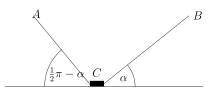
- In the case \(W> T\sin(\alpha+\beta)\), show that the block will remain at rest provided \[ W\sin\lambda \ge T\cos(\alpha+\beta- \lambda)\,, \] where \(\lambda\) is the acute angle such that \(\tan\lambda = \mu\).
- In the case \(W=T\tan\phi\), where \(2\phi =\alpha+\beta\), show that the block will start to move in a direction that makes an angle \(\phi\) with the horizontal.
Solution:
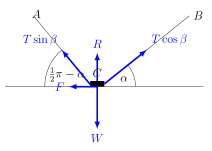
- Assuming the block is at rest we must have: \begin{align*} \text{N2}(\uparrow): && 0 &= T \sin \beta\cos \alpha + T \cos \beta \sin \alpha +R -W \\ \Rightarrow && W &> T \sin \beta\cos \alpha + T \cos \beta \sin \alpha \\ &&&= T\sin(\alpha+\beta) \\ \Rightarrow && R &= W-T\sin(\alpha+\beta)\\ \\ \text{N2}(\rightarrow): && 0 &= T \cos \beta \cos \alpha - T \sin \beta \sin \alpha - F \\ \Rightarrow && T \cos(\alpha+\beta) &= F \\ &&&\leq \mu (W-T\sin(\alpha+\beta)) \\ \Rightarrow && W \sin \lambda &\geq T \cos (\alpha+\beta)\cos \lambda +T \sin (\alpha+\beta) \sin \lambda \\ &&&= T\cos(\alpha+\beta-\lambda) \end{align*}
- If \(W = T\tan \phi\) where \(2\phi = \alpha + \beta\) then \begin{align*} \text{N2}(\uparrow): && ma_y &= T\sin(\alpha+\beta) - W \\ &&&= T \sin(\alpha+\beta) - T \tan \left ( \frac{\alpha+\beta}{2} \right ) \\ &&&= T \tan \left ( \frac{\alpha+\beta}{2} \right ) \left ( 2 \cos^2 \left ( \frac{\alpha+\beta}{2} \right ) -1\right) \\ &&&= T \tan \phi \cos \left ( \alpha+\beta\right ) \tag{notice this is positive so \(R=F=0\)} \\ \text{N2}(\rightarrow): && ma_x &= T \cos(\alpha+\beta) \\ \Rightarrow && \frac{a_y}{a_x} &= \tan \phi \end{align*} Therefore we are accelerating at an angle \(\phi\) to the horizontal
2013 Paper 1 Q12
Each day, I have to take \(k\) different types of medicine, one tablet of each. The tablets are identical in appearance. When I go on holiday for \(n\) days, I put \(n\) tablets of each type in a container and on each day of the holiday I select \(k\) tablets at random from the container.
- In the case \(k=3\), show that the probability that I will select one tablet of each type on the first day of a three-day holiday is \(\frac9{28}\). Write down the probability that I will be left with one tablet of each type on the last day (irrespective of the tablets I select on the first day).
- In the case \(k=3\), find the probability that I will select one tablet of each type on the first day of an \(n\)-day holiday.
- In the case \(k=2\), find the probability that I will select one tablet of each type on each day of an \(n\)-day holiday, and use Stirling's approximation \[ n!\approx \sqrt{2n\pi} \left(\frac n\e\right)^n \] to show that this probability is approximately \(2^{-n} \sqrt{n\pi\;}\).
Solution:
- The probability the first is different to the second is \(\frac68\), the probability the third is different to both of the first two is \(\frac37\) therefore the probability is \(\frac{6}{8} \cdot \frac37 = \frac9{28}\) Whatever pills we are left with on the last day is essentially the same random choice as we make on the first day, therefore \(\frac9{28}\)
- The probability the first is different to the second is \(\frac{2n}{3n-1}\), the probability the third is different to both of the first two is \(\frac{n}{3n-2}\) therefore the probability is \(\frac{2n^2}{(3n-1)(3n-2)}\). [We can also view this as \(\frac{(3n) \cdot (2n) \cdot n}{(3n) \cdot (3n-1) \cdot (3n-2)}\)]
- Suppose describe the pills as \(B\) and \(R\) and also number them, then we must have a sequence of the form: \[ B_1R_1 \, B_2R_2 \, B_3R_3 \, \cdots \, B_{n}R_n \] However, we can also rearrange the order of the \(B\) and \(R\) pills in \(n!\) ways each, and also the order of the pairs in \(2^n\) ways. There are \((2n)!\) orders we could have taken the pills out therefore the probability is \begin{align*} && P &= \frac{2^n (n!)^2}{(2n)!} = \frac{2^n}{\binom{2n}{n}} \\ &&&\approx \frac{2^n \cdot 2n \pi \left ( \frac{n}{e} \right)^{2n}}{\sqrt{2 \cdot 2n \cdot \pi} \left ( \frac{2n}{e} \right)^{2n}} \\ &&&= \frac{2^n \sqrt{n \pi} \cdot n^{2n} \cdot e^{-2n}}{2^{2n} \cdot n^{2n} \cdot e^{-2n}} \\ &&&= 2^{-n} \sqrt{n \pi} \end{align*} There is a nice way to think about this question using conditional probability. Suppose we are drawing out of an infinitely supply of \(R\) and \(B\) pills, then each day there is a \(\frac12\) chance of getting different pills. Therefore over \(n\) days there is a \(2^{-n}\) chance of getting different pills. Conditional on the balanced total we see that \begin{align*} && \mathbb{P}(\text{balanced every day} |\text{balanced total}) &= \frac{\mathbb{P}(\text{balanced every day})}{\mathbb{P}(\text{balanced total})} \end{align*} We have already seen the term that is balanced total is \(\frac{1}{2^{2n}}\binom{2n}{n}\), but we can also approximate the balanced total using a normal approximation. \(B(2n, \tfrac12) \approx N(n, \frac{n}{2})\) and so: \begin{align*} \mathbb{P}(X = n) &\approx \mathbb{P}\left (n-0.5 \leq \sqrt{\tfrac{n}{2}} Z + n \leq n+0.5 \right) \\ &= \mathbb{P}\left (- \frac1{\sqrt{2n}} \leq Z \leq \frac{1}{\sqrt{2n}} \right) \\ &= \int_{- \frac1{\sqrt{2n}}}^{\frac1{\sqrt{2n}}} \frac{1}{\sqrt{2\pi}} e^{-x^2/2} \d x \approx \frac{2}{\sqrt{2n}} \frac{1}{\sqrt{2\pi}} \\ &\approx \frac{1}{\sqrt{n\pi}} \end{align*}
2013 Paper 1 Q13
From the integers \(1, 2, \ldots , 52\), I choose seven (distinct) integers at random, all choices being equally likely. From these seven, I discard any pair that sum to 53. Let \(X\) be the random variable the value of which is the number of discarded pairs. Find the probability distribution of \(X\) and show that \(\E (X) = \frac 7 {17}\). Note: \(7\times 17 \times 47 =5593\).
Solution: There are \(\binom{26}3\binom{23}{1}2\) ways to obtain \(3\) pairs There are \(\binom{26}2 \binom{24}3 \cdot 2^3\) ways to obtain \(2\) pairs There are \(\binom{26}1 \binom{25}5 \cdot 2^5\) ways to obtain \(1\) pairs There are \(\binom{26}7 \cdot 2^7\) ways to obtain \(0\) pairs There are \(\binom{52}{7}\) ways to choose our integers, so \begin{align*} && \mathbb{P}(X = 3) &= \frac{\binom{26}{3} \cdot \binom{23}{1} \cdot 2}{\binom{52}{7}} \\ &&&= \frac{7! \cdot 26 \cdot 25 \cdot 24 \cdot 23 \cdot 2}{3! \cdot 52 \cdot 51 \cdot 50 \cdot 49 \cdot 48 \cdot 47 \cdot 46} \\ &&&= \frac{7 \cdot 6 \cdot 5 \cdot 4 }{51 \cdot 2\cdot 49 \cdot 2\cdot 47 \cdot 2} \\ &&&= \frac{ 5 }{17\cdot 7\cdot 47} = \frac{5}{5593} \\ \\ && \mathbb{P}(X = 2) &= \frac{\binom{26}2 \binom{24}3 \cdot 2^3}{\binom{52}{7}} \\ &&&= \frac{220}{5593} \\ \\ && \mathbb{P}(X = 1) &= \frac{\binom{26}1 \binom{25}5 \cdot 2^5}{\binom{52}{7}} \\ &&&= \frac{1848}{5593} \\ \\ && \mathbb{P}(X = 0) &= \frac{\binom{26}7 \cdot 2^7}{\binom{52}{7}} \\ &&&= \frac{3520}{5593} \\ \\ && \mathbb{E}(X) &= \frac{1848}{5593} + 2 \cdot \frac{220}{5593} + 3 \cdot \frac{5}{5593} \\ &&&= \frac{2303}{5593} = \frac{7}{17} \end{align*} Notice we can find the expected value directly: Let \(X_i\) be the random variable the \(i\)th number is discarded. Notice that \(\mathbb{E}(X) = \mathbb{E}\left (\frac12 \left (X_1 +X_2 +X_3 +X_4 +X_5 +X_6 +X_7\right) \right)\) and also notice that each \(X_i\) has the same distribution (although not independent!). Then \begin{align*} &&\mathbb{E}(X) &= \frac72 \mathbb{E}(X_i) \\ &&&= \frac72 \cdot \left (1 - \frac{50}{51} \cdot \frac{49}{50} \cdots \frac{45}{46} \right) = \frac74 \left ( 1 - \frac{45}{51}\right) \\ &&&= \frac72 \cdot \frac{6}{51} \\ &&&= \frac7{17} \end{align*}