Problems
Filters
1991 Paper 3 Q9
The parametric equations \(E_{1}\) and \(E_{2}\) define the same ellipse, in terms of the parameters \(\theta_{1}\) and \(\theta_{2}\), (though not referred to the same coordinate axes). \begin{alignat*}{2} E_{1}:\qquad & x=a\cos\theta_{1}, & \quad & y=b\sin\theta_{1},\\ E_{2}:\qquad & x=\dfrac{k\cos\theta_{2}}{1+e\cos\theta_{2}}, & \quad & y=\dfrac{k\sin\theta_{2}}{1+e\cos\theta_{2}}, \end{alignat*} where \(0< b< a,\) \(0< e< 1\) and \(0< k\). Find the position of the axes for \(E_{2}\) relative to the axes for \(E_{1}\) and show that \(k=a(1-e^{2})\) and \(b^{2}=a^{2}(1-e^{2}).\) {[}The standard polar equation of an ellipse is \(r=\dfrac{\ell}{1+e\cos\theta}.]\) By considering expressions for the length of the perimeter of the ellipse, or otherwise, prove that \[ \int_{0}^{\pi}\sqrt{1-e^{2}\cos^{2}\theta}\,\mathrm{d}\theta=\int_{0}^{\pi}\frac{1-e^{2}}{(1+e\cos\theta)^{2}}\sqrt{1+e^{2}+2e\cos\theta}\,\mathrm{d}\theta. \] Given that \(e\) is so small that \(e^{6}\) may be neglected, show that the value of either integral is \[ \tfrac{1}{64}\pi(64-16e^{2}-3e^{4}). \]
1991 Paper 3 Q10
The equation \[ x^{n}-qx^{n-1}+r=0, \] where \(n\geqslant5\) and \(q\) and \(r\) are real constants, has roots \(\alpha_{1},\alpha_{2},\ldots,\alpha_{n}.\) The sum of the products of \(m\) distinct roots is denoted by \(\Sigma_{m}\) (so that, for example, \(\Sigma_{3}=\sum\alpha_{i}\alpha_{j}\alpha_{k}\) where the sum runs over the values of \(i,j\) and \(k\) with \(n\geqslant i>j>k\geqslant1\)). The sum of \(m\)th powers of the roots is denoted by \(S_{m}\) (so that, for example, \(S_{3}=\sum\limits_{i=1}^{n}\alpha_{i}^{3}\)). Prove that \(S_{p}=q^{p}\) for \(1\leqslant p\leqslant n-1.\) You may assume that for any \(n\)th degree equation and \(1\leqslant p\leqslant n\) \[ S_{p}-S_{p-1}\Sigma_{1}+S_{p-2}\Sigma_{2}-\cdots+(-1)^{p-1}S_{1}\Sigma_{p-1}+(-1)^{p}p\Sigma_{p}=0.] \] Find expressions for \(S_{n},\) \(S_{n+1}\) and \(S_{n+2}\) in terms of \(q,r\) and \(n\). Suggest an expression for \(S_{n+m},\) where \(m < n\), and prove its validity by induction.
Solution: Claim: \(S_p = q^p\) for \(1 \leq p \leq n-1\) Proof: When \(p = 1\), \(S_p = \Sigma_1 = q\) as expected. Note that \(\Sigma_i = 0\) for \(i = 2, \cdots, n-1\). Using \(S_p = S_{p-1}\Sigma_{1}-S_{p-2}\Sigma_{2}+\cdots+(-1)^{p-1+1}S_{1}\Sigma_{p-1}+(-1)^{p+1}p\Sigma_{p}\), we can see that \(S_p = qS_{p-q}\) when \(1 \leq p \leq n-1\), ie \(S_p = q^p\). Note that \begin{align*} S_n &= \sum \alpha_i^n \\ &= q\sum \alpha_i^{n-1} - \sum r \\ &= qS_{n-1} - nr \\ &= q^n - nr \\ \\ S_{n+1} &= \sum \alpha_i^{n+1} \\ &= q \sum \alpha_i^{n} - r \sum \alpha_i \\ &= q^{n+1} - rq \\ \\ S_{n+2} &= \sum \alpha_i^{n+2} \\ &= q \sum \alpha_i^{n+1} - r \sum \alpha_i^2 \\ &= q^{n+2} - rq^2 \\ \end{align*} Claim: \(S_{n+m} = q^{n+m} - rq^{m}\) Proof: The obvious
1991 Paper 3 Q11
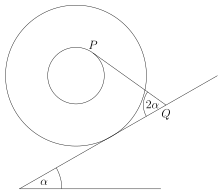
1991 Paper 3 Q12
A smooth tube whose axis is horizontal has an elliptic cross-section in the form of the curve with parametric equations \[ x=a\cos\theta\qquad y=b\sin\theta \] where the \(x\)-axis is horizontal and the \(y\)-axis is vertically upwards. A particle moves freely under gravity on the inside of the tube in the plane of this cross-section. By first finding \(\ddot{x}\) and \(\ddot{y},\) or otherwise, show that the acceleration along the inward normal at the point with parameter \(\theta\) is \[ \frac{ab\dot{\theta}^{2}}{\sqrt{a^{2}\sin^{2}\theta+b^{2}\cos^{2}\theta}}. \] The particle is projected along the surface in the vertical cross-section plane, with speed \(2\sqrt{bg},\) from the lowest point. Given that \(2a=3b,\) show that it will leave the surface at the point with parameter \(\theta\) where \[ 5\sin^{3}\theta+12\sin\theta-8=0. \]
1991 Paper 3 Q13
A smooth particle \(P_{1}\) is projected from a point \(O\) on the horizontal floor of a room with has a horizontal ceiling at a height \(h\) above the floor. The speed of projection is \(\sqrt{8gh}\) and the direction of projection makes an acute angle \(\alpha\) with the horizontal. The particle strikes the ceiling and rebounds, the impact being perfectly elastic. Show that for this to happen \(\alpha\) must be at least \(\frac{1}{6}\pi\) and that the range on the floor is then \[ 8h\cos\alpha\left(2\sin\alpha-\sqrt{4\sin^{2}\alpha-1}\right). \] Another particle \(P_{2}\) is projected from \(O\) with the same velocity as \(P_{1}\) but its impact with the ceiling is perfectly inelastic. Find the difference \(D\) between the ranges of \(P_{1}\) and \(P_{2}\) on the floor and show that, as \(\alpha\) varies, \(D\) has a maximum value when \(\alpha=\frac{1}{4}\pi.\)
1991 Paper 3 Q14
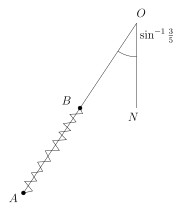
1991 Paper 3 Q15
A pack of \(2n\) (where \(n\geqslant4\)) cards consists of two each of \(n\) different sorts. If four cards are drawn from the pack without replacement show that the probability that no pairs of identical cards have been drawn is \[ \frac{4(n-2)(n-3)}{(2n-1)(2n-3)}. \] Find the probability that exactly one pair of identical cards is included in the four. If \(k\) cards are drawn without replacement and \(2 < k < 2n,\) find an expression for the probability that there are exactly \(r\) pairs of identical cards included when \(r < \frac{1}{2}k.\) For even values of \(k\) show that the probability that the drawn cards consist of \(\frac{1}{2}k\) pairs is \[ \frac{1\times3\times5\times\cdots\times(k-1)}{(2n-1)(2n-3)\cdots(2n-k+1)}. \]
1991 Paper 3 Q16
The random variables \(X\) and \(Y\) take integer values \(x\) and \(y\) respectively which are restricted by \(x\geqslant1,\) \(y\geqslant1\) and \(2x+y\leqslant2a\) where \(a\) is an integer greater than 1. The joint probability is given by \[ \mathrm{P}(X=x,Y=y)=c(2x+y), \] where \(c\) is a positive constant, within this region and zero elsewhere. Obtain, in terms of \(x,c\) and \(a,\) the marginal probability \(\mathrm{P}(X=x)\) and show that \[ c=\frac{6}{a(a-1)(8a+5)}. \] Show that when \(y\) is an even number the marginal probability \(\mathrm{P}(Y=y)\) is \[ \frac{3(2a-y)(2a+2+y)}{2a(a-1)(8a+5)} \] and find the corresponding expression when \(y\) is off. Evaluate \(\mathrm{E}(Y)\) in terms of \(a\).